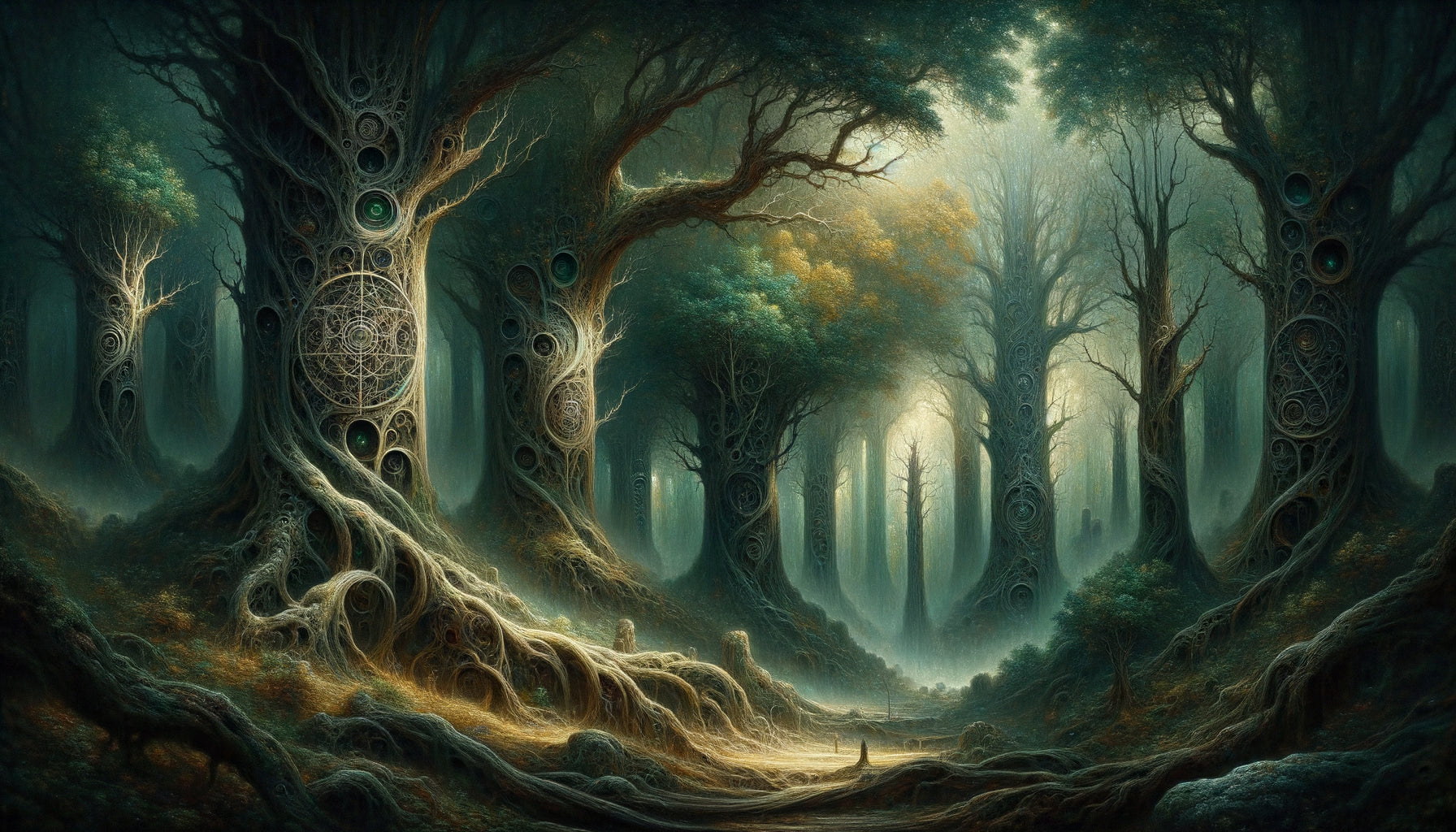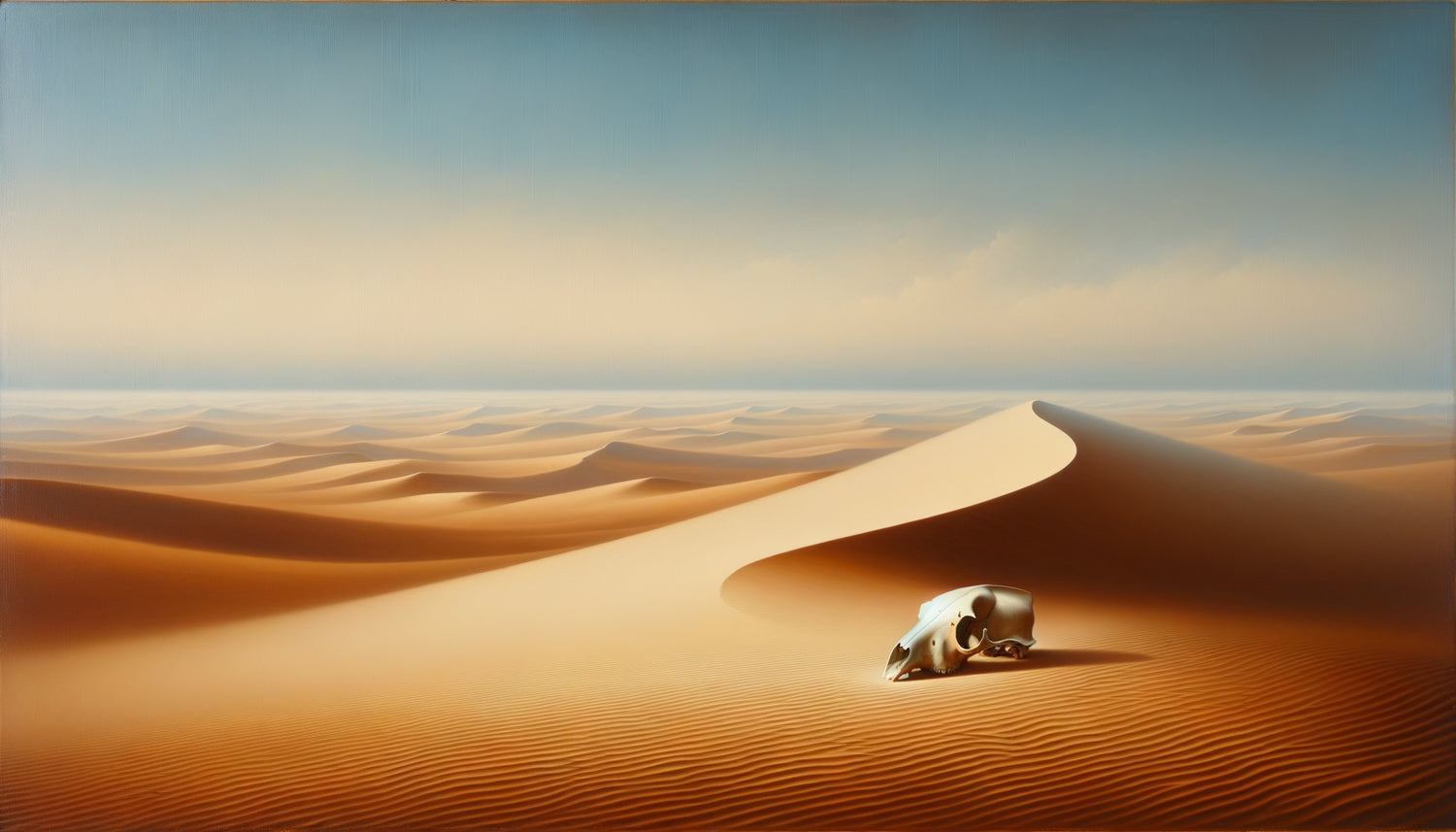
It is four o'clock in the morning in the Sahara. The silence is so profound that you can hear the sand slipping under the wind. It is in this absolute void that I understood why, for millennia, deserts have fascinated spiritual creators. From Georgia O'Keeffe in New Mexico to the Coptic monks of Egypt, from Michael Heizer's Land Art to Tibetan mandalas: the desert is not a place, it is a mirror of the soul.
Here's what deserts bring to spiritual art: a space of stripping away that reveals the essential, a solitude that confronts you with yourself, and an immensity that dissolves the ego to access the sacred. Three dimensions that transform artistic creation into a true inner quest.
You may feel this attraction for vast mineral expanses, these ocher and gold palettes, these infinite horizons. But how to understand this deep connection between desert and spirituality? Why have so many artists sought enlightenment in these arid lands?
Rest assured: this fascination is neither mysterious nor reserved for initiates. It rests on universal psychological and sensory mechanisms that we will explore together. I propose a journey to the heart of this sacred geography, where art becomes meditation and each grain of sand tells a story of transformation.
The emptiness of the desert as a revealer of essence
In my Santa Fe studio, surrounded by paintings inspired by the deserts of the southwestern United States, I observe how stripping away becomes revelation. The desert naturally practices what spiritualities call detachment: it eliminates the superfluous to retain only the essential.
Artists who venture into these spaces quickly understand that the inner quest begins with subtraction. Agnes Martin, settled in the New Mexico desert, created canvases almost empty, crossed by subtle lines. She said: 'The desert taught me that beauty lies in what is removed, not in what is added.'
This aesthetics of emptiness resonates with contemplative traditions. The Desert Fathers Christians, Sufi hermits, Jain ascetics: all sought purification in aridity. Spiritual art born of the desert bears this same minimalist signature - a few strokes, primary colors, pure geometric shapes.
The chromatic palette of the absolute
Ochers, burnt lands, dazzling whites: the color range of the desert becomes spiritual vocabulary. These shades embody the transition between matter and light, between earth and sky. In spiritual art, each nuance tells a stage of the inner quest: the red of the dunes evokes transformed passion, the white of the salt flats symbolizes purification, the gold of the setting sun represents enlightenment.
I spent three weeks in the Atacama Desert studying how light alters perception. At noon, everything becomes raw, absolute. At dusk, the same rocks are adorned with mystical purples. This visual instability teaches impermanence, a central concept in Buddhist spirituality that many contemporary artists explore.
Desert solitude: confronting the deep self
The desert imposes an inevitable encounter with oneself. No distractions, no escapes. This radical solitude becomes the crucible of inner quest for spiritual creators. Anselm Kiefer, fascinated by Australian deserts, saw them as a place to confront the collective shadows of humanity.
In spiritual art, this solitary dimension translates into contemplative works that require the viewer to engage in silent face-to-face interaction. James Turrell's installations in the Arizona desert create spaces where immobility becomes a spiritual experience. His Roden Crater transforms an extinct volcano into a celestial observatory, inviting cosmic meditation.
The artistic traditions of the desert - Arabic calligraphy from Sahara manuscripts, rock paintings from Tassili - all testify to this forced introspection. When the external landscape shrinks, the inner landscape expands. Artists then transcribe visions, revelations, altered states of consciousness born of mineral silence.
The suspended time of vast expanses
The desert abolishes ordinary temporality. Geological formations tell millions of years, while the shadow of a cloud crosses the plain in seconds. This dissolution of linear time facilitates access to meditative states sought by spiritual artists.
I observed how creators integrate this particular temporality: hypnotic repetitions of patterns, slow processes (sand poured grain by grain), ephemeral works erased by the wind. Desert spiritual art embraces impermanence as a fundamental teaching, like mandalas destroyed immediately after completion.

The immensity that dissolves the individual ego
Faced with the limitless horizon of the desert, one's ego is relativized. This experience of dissolution into something greater constitutes the heart of many spiritual traditions. Land artists like Walter De Maria with his 'Lightning Field' in New Mexico create works on a scale of the desert landscape, making humans minuscule against the cosmos.
In my practice, I have found that painting the desert requires renouncing control. Immensity cannot be captured; it is suggested. The best spiritual artists of the desert practice humility: they do not represent the desert, they testify to their own insignificance in the face of it.
This dissolution of the ego paradoxically opens up to a universal connection. The desert then becomes a metaphor for pure consciousness, vast and empty, welcoming everything without retaining anything. Abstract works inspired by the desert - from Rothko to Nasreen Mohamedi - evoke this limitless mental space, a ground for authentic inner quest.
Sacred geographies: deserts as natural temples
Some deserts carry a millennial spiritual charge. The Sinai with its perched monasteries, the Thar in India dotted with Jain temples, the Gobi desert of Buddhist monasteries: these places become subjects and muses for spiritual art. Contemporary artists undertake creative pilgrimages there, bringing back works imbued with this telluric sacredness.
I have had the chance to document several of these sacred geographies. What strikes you is how the spiritual architecture of the desert dialogues with the landscape: adobe walls in the colors of sand, rounded shapes embracing dunes, openings framing the infinite sky. Art born from these places extends this conversation between human and cosmos.
Desert symbols in spiritual iconography
The desert generates its own visual mythology. The oasis symbolizes sudden enlightenment, the dune evokes impermanence, the mirage represents illusion - all recurring motifs in contemporary spiritual art.
Consider Shirin Neshat's works photographed in the Iranian deserts: black veils on white sand, Persian calligraphy on female faces, bodies in dialogue with immensity. She uses the desert as a vocabulary to explore identity and transcendence, a universal questioning of the inner quest.
Symbols stratify according to cultures. In Islamic art, the desert embodies original purity and the place of prophetic revelation. For Australian Aboriginal artists, it is continuous creation, journey of the Ancestors, living memory. Each tradition enriches the desert symbolism of spiritual art, creating a multicultural visual language.
Raw materials and spiritual authenticity
Desert spiritual art often favors raw materials: stone, sand, clay, mineral pigments. This materiality connects the work to the earth from which it comes, anchoring inner quests in the concrete. Sculptures by Andy Goldsworthy using desert stones or Navajo sand paintings embody this philosophy: art as an organic extension of the landscape.
I personally use pigments collected from different deserts - Sahara ochres, Arizona red earths, Icelandic volcanic dust. Each color carries the geological and spiritual memory of its place of origin, transmitting a particular vibration to the viewer. This approach transforms creation into a ritual, an active meditation.

Integrating the spirit of the desert into your living space
How to transpose this spiritual energy from the desert into our interiors? Desert-inspired art creates contemplative sanctuaries in the heart of modern life. A canvas with sand and terracotta tones becomes a window onto vastness, a daily reminder of inner quests.
I recommend choosing minimalist works that breathe. Like the desert, leave empty space around the art. A large format with subtle nuances, hung alone on a clean wall, will recreate this feeling of infinite horizon. Textures are essential: prioritize matte surfaces, slightly grainy, evoking sand or stone.
Lighting plays a crucial role. Changing natural light reveals nuances as it transforms the desert landscape. Position your work where daylight changes it throughout the hours, creating a renewed contemplative experience. Add some natural elements - desert pebbles, driftwood, ceramics - to anchor the space in this spiritual aesthetic.
Transform your interior into a space of contemplation
Discover our exclusive collection of nature paintings that capture the spiritual essence of desert landscapes and invite daily inner quests.
Your own inner desert awaits to be explored
Deserts embody the inner quest in spiritual art because they confront us with the essential: who are we when all superfluity is removed? This question traverses centuries and cultures, uniting medieval monks with contemporary artists, shamans with minimalists.
You don't need to cross the Sahara to embark on this exploration. Each desert-inspired artwork is an invitation to inner travel, a reminder that vastness also exists within us. Start by observing: which desert colors resonate with you? Which horizons call for your contemplation?
Create in your home a corner of silence facing a work that evokes these infinite spaces. Sit in front of it every day for a few minutes. Let the painted immensity slowly dissolve daily concerns. This is how the desert, even represented, accomplishes its spiritual work: it returns us to the essential, to breath, to pure presence.
The desert awaits within you. Spiritual art is its map.
FAQ : The desert and the spiritual quest in art
Why do deserts inspire so much spiritual art?
Deserts create optimal conditions for the inner quest: absence of distractions, deep silence, immensity that relativizes the ego. These characteristics facilitate meditative and contemplative states sought by spiritual artists. Historically, all major mystical traditions have valued the desert as a place of revelation - from Christian Desert Fathers to Sufi hermits, from biblical prophets to Buddhist ascetics. Art extends this tradition by transforming the desert experience into a universal visual language. The reduced palette, purified forms, and empty spaces in desert-inspired works translate this inner stripping plastically. Moreover, desert geology tells of long time, inviting a cosmic perspective that transcends individual concerns - an essential dimension of any authentic spiritual journey.
How to choose a desert-inspired artwork for my interior?
Start by identifying what the desert evokes in you: peace, introspection, freedom, purification? Your intention will guide your choice. Prioritize works with clean compositions that breathe - the void around the elements is as important as the elements themselves, just like in a real desert. The colors should resonate emotionally: ochres and earth tones bring grounding and warmth, whites and beiges create serenity and clarity, desert reds infuse transformative energy. Mentally test the work in your space: can you see yourself stopping in front of it every day for a few conscious breaths? Spiritual art is not just decorative; it becomes support for contemplative practice. Finally, consider the format: large horizons favor the expansion of consciousness, square or vertical formats focus attention. The essential thing is that the work creates a window to inner vastness, even in a restricted urban space.
Do you need to have visited a desert to understand the spiritual art inspired by it?
Absolutely not! The external desert is a metaphor for the internal desert that we all carry. You have certainly experienced moments of contemplative solitude, deep silence, a feeling of immensity facing nature or the starry sky - these experiences touch the same spiritual dimension. Art inspired by the desert reactivates these universal memories. Spiritual artists do not seek to geographically document deserts, but to transmit an inner experience: stripping away, confronting the essentials, humility in the face of something greater than oneself. In front of an authentic desert artwork, you will recognize these states even without having set foot in the Sahara or Atacama. This is the magic of spiritual art: it short-circuits the physical experience to directly touch consciousness. That said, if the work touches you deeply, it can become the beginning of a journey - perhaps one day you will go and verify for yourself what the desert reveals to those who venture into it with an open heart.