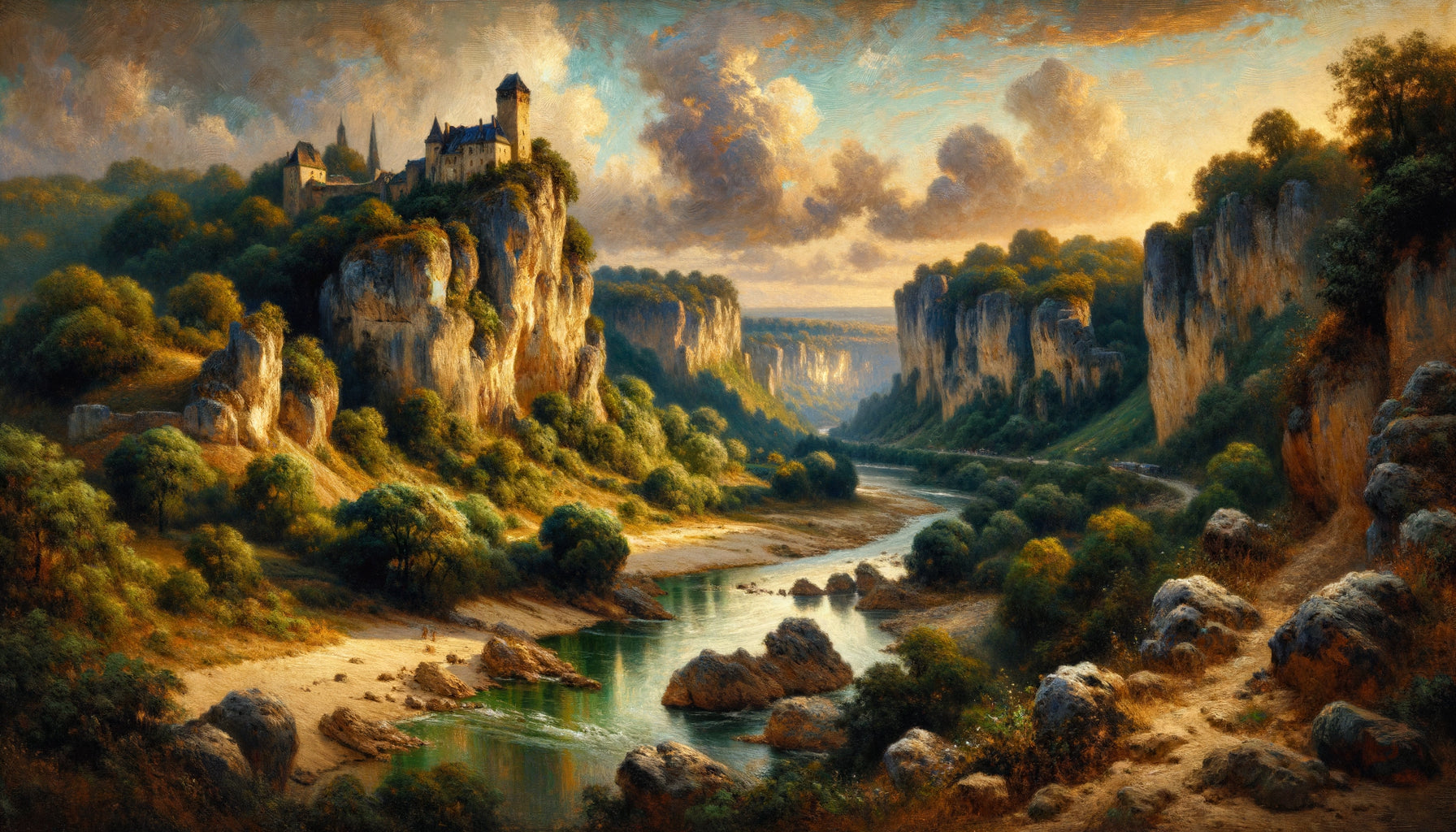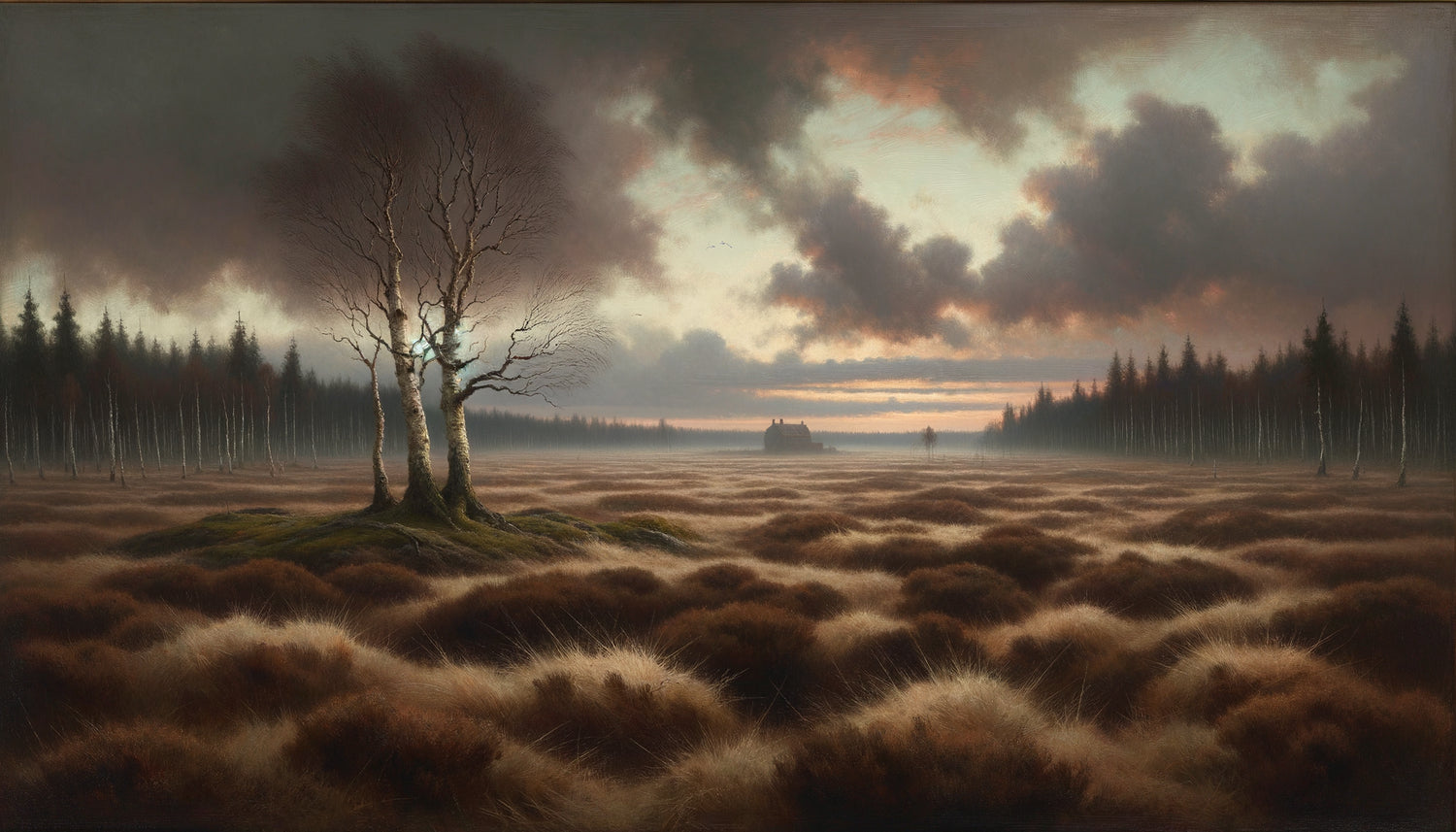
At the turn of the 20th century, in the mists of northern Germany, a small peat bog village became the sanctuary of a silent artistic revolution. Far from the stifling academies of Munich and Berlin, rebel painters chose the Worpswede marshes as a temple for their quest: to capture the mysterious soul of a primitive, wild, almost forgotten nature.
This is what the Worpswede School brings to your decorative universe: an invitation to contemplate melancholic landscapes, a palette of earthy and twilight tones that transform your interiors into poetic refuges, and this visceral connection with an undomesticated nature that is so lacking in our urban spaces.
You may be tired of predictable decor, formatted reproductions of overexposed works. You are looking for this vibrant authenticity, this emotional depth that only true artistic revolutions can offer. The Worpswede School remains little known, eclipsed by its French or Austrian contemporaries.
Rest assured: rediscovering this movement is accessing an intact aesthetic treasure, preserved from trends. I take you to these mystical landscapes of the north, where each canvas tells the intimate sacred relationship between the artist and their environment. Prepare to see nature differently.
When artists flee the city for the peat bogs
In 1889, Fritz Mackensen settled in this isolated village in Lower Saxony, about thirty kilometers from Bremen. What did he discover? Endless stretches of peat bog, low skies laden with clouds, windswept birch trees, and that diffused light, almost liquid, which transforms every moment into a visual meditation.
Otto Modersohn soon joined him, then Hans am Ende. Together, they founded what would become the Worpswede School, a collective of artists fascinated by the idea of painting in nature, not from aseptic workshops. Their manifesto is simple: artistic truth is born from direct contact with the landscape, from patient observation of the seasons, from total immersion in the environment.
This colony of artists soon attracted Fritz Overbeck and Heinrich Vogeler, the latter transforming the Barkenhoff into a true cultural center. In 1898, Paula Modersohn-Becker joined them, bringing a revolutionary feminine sensibility that transcends simple landscape painting to explore the very essence of rural life.
A palette of earth, mist and mystery
The works of Worpswede are immediately recognizable. Forget the bright colors of French Impressionism: here reign the deep browns of the peat bogs, the silvery grays of Nordic skies, the dark greens of aquatic plants. This earthy palette is not sad; it is contemplative.
Paula Modersohn-Becker developed a particularly modern approach, using bold color planes and simplified forms that foreshadow Expressionism. Her portraits of peasant women are not ethnographic studies: they are icons, quasi-sacred representations of femininity rooted in the earth.
Otto Modersohn, for his part, paints crepuscular landscapes where the horizon dissolves into mist. His twilight moors capture this Nordic melancholy, this sensation of horizontal infinity that characterizes the German plains. Each painting becomes a window open onto a world where time seems suspended.
Heinrich Vogeler, on the other hand, evolves towards a Jugendstil (German Art nouveau) style with ornamental and symbolic compositions. His works integrate stylized floral motifs and ethereal female figures, creating dreamlike universes perfect for refined interiors.

Nature as a silent cathedral
What distinguishes the Worpswede School from other landscape movements? This spiritual and mystical dimension of the relationship with nature. The artists do not seek to botanically document their environment: they capture its soul, the genius loci, the spirit of the place.
The moors of Worpswede become under their brushes sacred spaces, almost mythological. The birches stand like columns of a natural temple, the canals reflect infinite skies, the heaths transform into oceans of undulating vegetation. This approach strangely resonates with our contemporary need to reconnect with nature.
Fritz Mackensen paints monumental rural scenes where peasants acquire biblical dignity. His famous Sermon on the heath transforms a simple village assembly into a mystical ceremony, the figures standing out against a dramatic sky charged with symbolic meanings.
This quasi-religious vision of Nordic nature profoundly influences the aesthetics of the time. Worpswede offers an alternative to industrial rationalism: meditative contemplation of primitive landscapes as a path to authenticity.
Paula Modersohn-Becker: the brilliant and tragic star
It is impossible to evoke Worpswede without dwelling on Paula Modersohn-Becker, a tragic and genius figure of the movement. Arriving in 1898, she married Otto Modersohn but refused to be confined to the role of artist's wife. Her four stays in Paris put her in contact with Cézanne, Gauguin and the avant-gardes.
She develops a deeply personal style: portraits of monumental peasant women, self-portraits of disturbing frankness, still lifes of almost violent intensity. Her female nudes, robust and dignified, break with academic canons. She paints real bodies, earthly, powerful.
Her premature death in 1907, at just 31 years old, a few days after giving birth, turned her into a romantic legend. Rainer Maria Rilke, poet residing in Worpswede and close to Paula, would dedicate a magnificent Requiem to her. Today, she is considered a pioneer of German modern art, having anticipated expressionism by several years.
Her works, with their muted colors and simplified forms, blend wonderfully into contemporary interiors seeking this authentic emotional depth. A portrait of Paula instantly brings gravity and intensity to a space.

Integrate the spirit of Worpswede into your interior
How to translate this Nordic mystic aesthetic into your living spaces? The Worpswede School offers extraordinary decorative possibilities for those seeking to escape clichés.
Create a contemplative atmosphere
Worpswede landscapes work beautifully in relaxation spaces: bedrooms, libraries, reading corners. Their soothing palette and meditative dimension invite calm. Favor large formats that create this feeling of immersion in the landscape.
A Modersohn twilight above a natural linen sofa, accompanied by cushions in raw Sienna and dove gray tones: you instantly obtain this refined and serene Nordic atmosphere. Add raw materials – driftwood, artisan ceramics, raw wool – to reinforce the connection with nature.
Play with diffused light
Lighting is crucial to respect the spirit of Worpswede. Forget aggressive spotlights: favor indirect lights, lamps with linen shades, candles. This soft light echoes the veiled skies of the moors and highlights the subtle nuances of the works.
In an entrance or hallway, a Worpswede mist landscape illuminated by a wall lamp creates a poetic transition between exterior and interior, like a visual decompression chamber.
Pair with contemporary styles
The Worpswede School beautifully complements Scandinavian minimalism and Japandi style. The simplicity of forms, the importance given to natural materials, and the restricted palette create an obvious harmony.
In a refined contemporary interior, a portrait by Paula Modersohn-Becker or a landscape from Worpswede brings that emotional depth which avoids coldness. It's the perfect balance between modernity and soul.
Transform your walls into windows onto the mystical landscapes of the north
Discover our exclusive collection of nature paintings that captures this contemplative and soothing magic of Nordic landscapes.
The living legacy of a silent revolution
World War I marks the end of Worpswede's golden age. Heinrich Vogeler evolves towards political commitment and constructivism, breaking with the lyricism of his beginnings. The village nevertheless retains its artistic vocation and becomes a place of pilgrimage for art lovers.
Today, the Barkenhoff Museum and the Worpswede Museum preserve this exceptional heritage. Paula Modersohn-Becker's house can be visited, an emotional sanctuary of a visionary artist. The peat bog landscapes remain intact, offering visitors the same diffused light that inspired so many masterpieces.
The influence of the Worpswede School extends into German Expressionism and continues to inspire contemporary artists fascinated by the mystical representation of nature. At a time when we are collectively seeking to reconnect with the natural environment, these centuries-old works resonate with a troubling topicality.
Integrating Worpswede into your decor means choosing depth over superficiality, contemplation over agitation, authenticity over formatting. It affirms that your walls can tell stories, convey complex emotions, create true spaces of renewal.
Your inner refuge begins now
Imagine yourself in your living room, at the end of the day. The light gently declines. Your gaze rests on a Worpswede landscape hanging in front of you: birch trees stand out against a twilight sky, mist rises from the marshes, time seems suspended. A deep breath. Calm settles.
The Worpswede School offers you this power: to transform your interiors into sanctuaries of tranquility, into windows open onto a preserved nature, into spaces of reconnection with the essential. These artists captured the soul of the Nordic landscapes so that you can, more than a century later, recharge daily.
Start by identifying the wall that deserves this poetic transformation. The one you see when you wake up, the one facing your relaxation space, the one that welcomes your guests. It is there that the mystical spirit of Worpswede will work its silent magic.
Frequently Asked Questions
Why is the Worpswede School less well known than French Impressionism?
The Worpswede School has indeed suffered from a lesser international visibility, in part due to World War I which interrupted its dynamic and culturally isolated Germany. Moreover, its intimate and contemplative aesthetic contrasted with the commercial radiance of Paris. But it is precisely this discretion that makes it a treasure for connoisseurs today: you benefit from a powerful and original aesthetic, without the pitfall of overexposure. The works of Worpswede retain their power of surprise and wonder intact, unlike the saturated reproductions of Monet or Renoir. It is a distinctive aesthetic signature that tells your unique sensibility.
Aren't the dark colors of Worpswede likely to darken my interior?
This is a legitimate but unfounded concern! The Worpswede palette is not dark, it is nuanced and deep. Their grays are bright, their browns are warm, their greens are vibrant. These earthy tones actually create an enveloping and soothing atmosphere, far from the oppressive effect of truly black colors. The trick is to balance: combine these works with light walls (off-white, linen, pearl gray), light natural materials (blonde wood, rattan) and well thought-out lighting. The contrast between the chromatic richness of the painting and the sobriety of the environment creates precisely this sought-after visual depth. Your spaces gain character without losing brightness.
How can you recognize a genuine work inspired by the Worpswede School?
Excellent question to avoid bland imitations! A work authentically inspired by Worpswede has several characteristics: a horizontal composition with importance given to skies and distant horizons, a palette limited to natural tones (ochres, browns, grays, muted greens), diffused light without violent contrasts, and above all this contemplative dimension – the work must invite silence, meditation. Beware of reproductions that are too saturated or contrasted which betray the original spirit. Favor high-quality prints on noble supports (canvas, art paper) that respect the subtlety of nuances. The work should create a soothing presence, not an aggressive visual stimulation. Trust your feeling: if the image soothes you rather than excites you, you are in the authentic spirit of Worpswede.