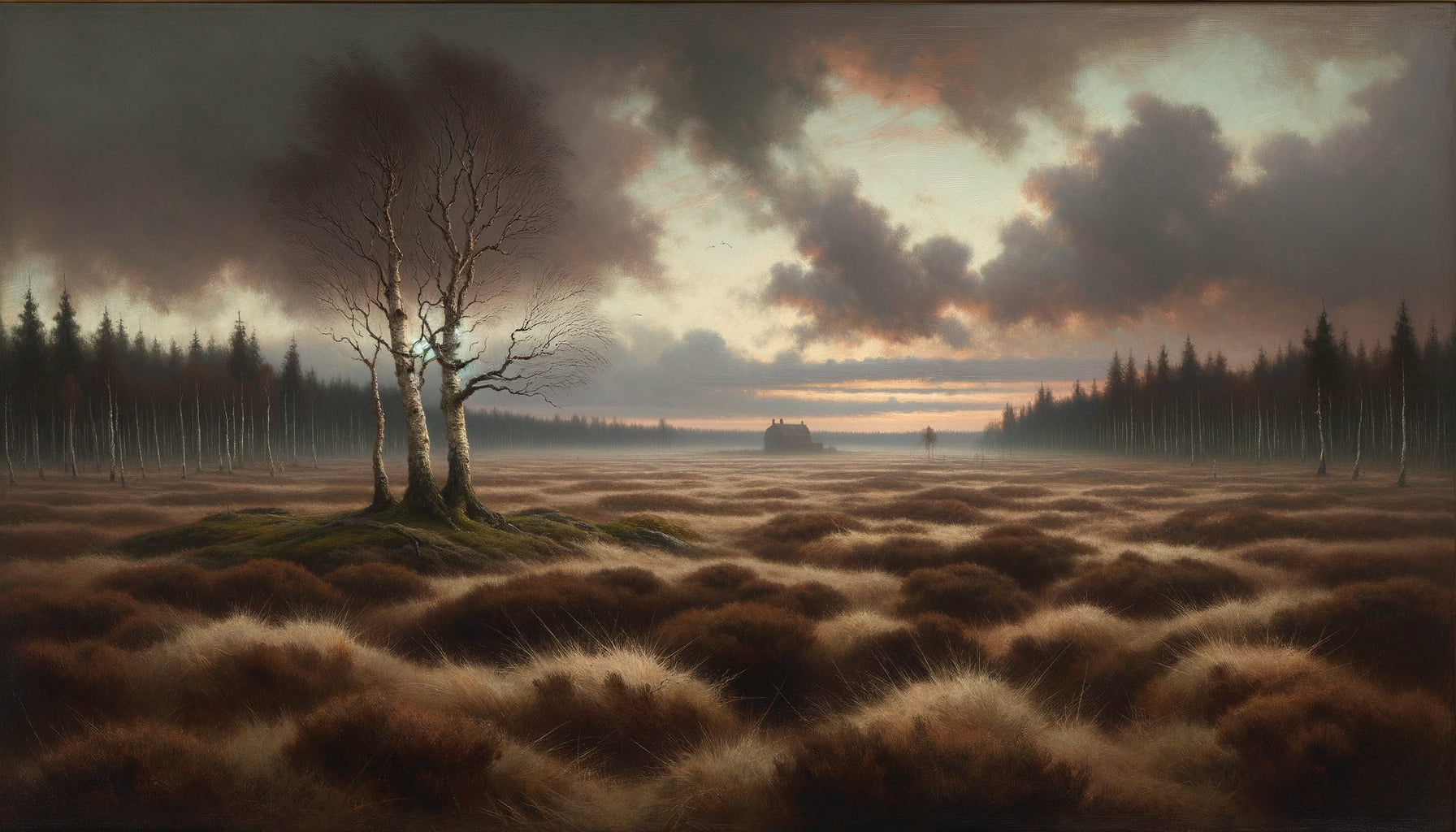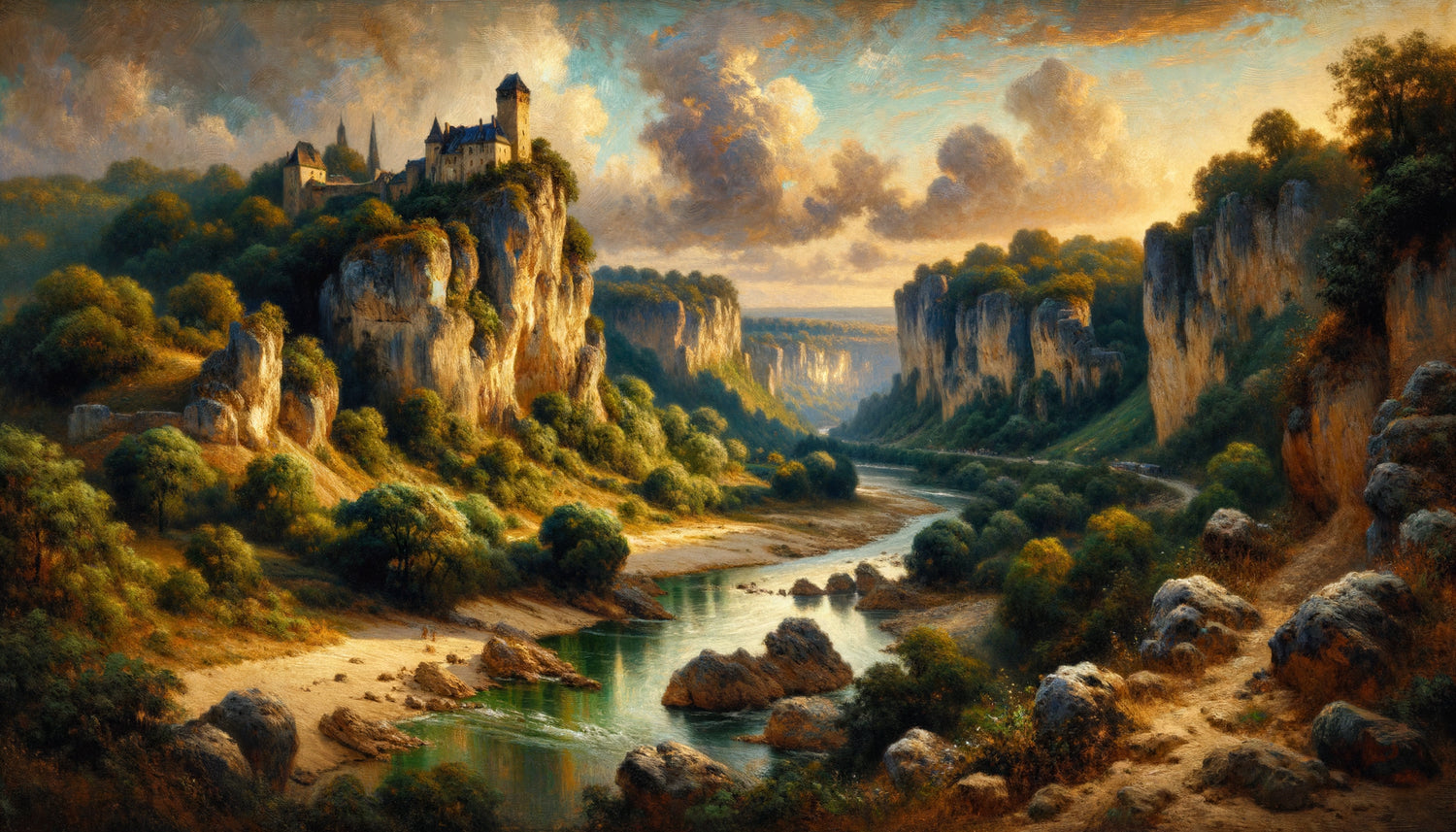
I discovered the Creuse valley on an autumn morning when mist still clung to the meanders of the river. There, before this landscape that seemed suspended outside of time, I understood why dozens of artists had set up their easels here, long before Monet revolutionized painting. This School of Crozant, born in the wild folds of the Creuse, tells a little-known story of French pre-Impressionism – that of an avant-garde who dared to leave workshops to capture the changing light of a raw nature.
Here's what the School of Crozant brings you: a dive into one of France’s most authentic artistic movements, the discovery of a Creuse valley that inspired a pictorial revolution, and keys to understanding how these mysterious landscapes have shaped the visual language we love today in our interiors.
You may be looking to enrich your decor with works that really tell something, that carry a story beyond the simple decorative motif. You wonder how to choose paintings that reflect your sensitivity without falling into clichés. Rest assured: the history of the School of Crozant will offer you a new look at landscape art and reveal why certain natural scenes resonate so deeply within us. I invite you on this pictorial adventure that began more than 150 years ago, in the heart of a wild and preserved France.
When the Creuse becomes an open-air studio
It all begins in the 1850s, when the first painters get off the train at the small station of Crozant, a village perched on cliffs overlooking the gorges of the Creuse. They come to seek what Paris can no longer offer them: a dramatic, almost primitive nature, where granite rocks plunge into turbulent waters, where the ruins of the medieval castle dialogue with changing clouds.
These artists – among whom Armand Guillaumin, Léon Detmold, and Ernest Hareux – do not simply observe from a comfortable window. They set up their easels directly on the steep paths, at the edge of precipices, exposed to the weather whims of this region of the Limousin. This radical approach is the very essence of pre-Impressionism: painting on location, capturing the moment, accepting that light transforms the landscape from hour to hour.
The Creuse valley offers an exceptional playground with its deep gorges, its meandering curves, its wild moors dotted with golden gorse. Unlike the landscapes already domesticated in the Île-de-France region, the Creuse retains a harshness, a ruggedness that forces painters to rethink their palette, to seek darker, more intense, truer tones.
The colors of a silent revolution
If you examine the works of the Crozant School closely, you will notice something fundamental: these artists gradually abandon academic compositions to let the raw material of the landscape speak. Schist cliffs become dark and powerful masses, turbulent skies occupy two-thirds of the canvas, reflections in the water fragment into quick touches that already foreshadow Impressionism.
This pictorial evolution is not by chance. The Creuse valley imposes its rhythm, its changing atmospheres. The same viewpoint can offer ten different paintings depending on the time of day, the season, and the degree of humidity in the air. The painters of Crozant learn to work quickly, to capture the ephemeral, to prioritize sensation over meticulous description.
In your contemporary interior, this approach finds a particularly just echo. A landscape painting from this tradition does not simply tell “a pretty corner of the countryside” – it conveys an energy, an atmospheric presence, a chromatic vibration that dialogues with your space. The tones of slate gray, deep green, and stormy blue characteristic of the Crozant School harmonize wonderfully with minimalist interiors, Nordic atmospheres, or softened industrial decors.

From pre-Impressionism to your wall: understanding the artistic bridge
The term pre-Impressionism deserves attention. It refers to this pivotal period – approximately between 1850 and 1880 – when artists begin to work outdoors with increasing freedom, without yet systematizing the Impressionist techniques that Monet and Renoir will make famous.
The Crozant School perfectly embodies this transition. Its representatives often retain a traditional compositional structure (foreground, middle ground, background), but their touch is freed, their palette brightens in places, and their gaze focuses on the fleeting effects of light. When Armand Guillaumin – who will later frequent the Impressionists – paints the Creuse gorges in the 1890s, he pushes this exploration even further, using vibrant colors and bold contrasts that make his canvases sought-after collector's items.
For those of you seeking to decorate your interior with authenticity, understanding this movement changes everything. You are no longer choosing a simple wall decoration, but a window onto an artistic approach that has shaped our modern perception of landscape. This knowledge transforms your gaze: you begin to appreciate the worked skies, the plays of reflections, the asymmetrical compositions that give character to a space.
The iconic places that bring canvases to life
The geography of the School of Crozant is worth exploring. The village of Crozant itself, perched on its rocky spur, offers dizzying panoramas over the confluence of the Creuse and the Sédelle. Painters immortalize the ruins of the castle, the Devil's Rocks, the Vervy bridge, so many recurring motifs that create a common visual grammar for this movement.
But other sites in the Creuse valley also attract artists: Fresselines, where Monet came to paint in 1889 (thus sealing the link between the School of Crozant and Impressionism), or even Gargilesse, refuge of George Sand, whose medieval alleys and romantic gorges inspire a different atmosphere, more intimate.
These places retain their evocative power today. If you have the opportunity to visit the region, you will immediately understand why these landscapes continue to inspire. The autumn colors of the heathland, the morning mists that blanket the river, the slanting lights of late afternoon on the cliffs – all contribute to creating a natural theater in perpetual renewal.

Integrating the spirit of Crozant into your decoration
How to transpose this artistic richness into your interior? The answer lies less in the style of your furniture than in your decorative intention. A painting inspired by the School of Crozant – whether it is a quality reproduction or a contemporary work taking up these codes – acts as a powerful visual anchor.
In a living room with neutral tones, a scene from the Creuse valley with its deep greens and nuanced greys brings natural depth without breaking harmony. Above a linen sofa or a raw wood console, these landscapes create an organic counterpoint that humanizes the space. The advantage of this pre-Impressionist aesthetic? It avoids the mawkishness of overly polished landscapes while remaining accessible and contemplative.
For a bedroom, prioritize softer scenes: the meanders of the river at dusk, morning mists, luminous undergrowth. These atmospheres promote calm and introspection. In a home office or workspace, more dynamic compositions – steep gorges, stormy skies, monumental rocks – stimulate creative energy without overwhelming the eye.
Formats and frames that enhance these works
Landscapes of the Creuse are best presented in horizontal formats that respect their panoramic nature. A simple frame – natural wood, matte black metal, or even no frame for a contemporary look – allows the work to breathe without parasitizing its intrinsic strength.
Also consider the lighting: an adjustable spotlight or picture lamp reveals the subtle nuances of these compositions where atmospheric gradations play a crucial role. The light should be soft, never frontal, so as not to create reflections that would break the immersion.
The living heritage of a little-known school
If the Crozant School is less famous than the Barbizon School or the Giverny Impressionists, it richly deserves your attention. Its specificity? A raw authenticity, a rejection of easy picturesque scenes, a fidelity to the sometimes harsh character of French nature. These artists did not seek to embellish – they sought to convey an experience, that of standing before a landscape that overwhelms and transforms you.
This philosophy finds a particular echo in our contemporary interiors, often minimalist, sometimes aseptic. Introducing a work from this tradition is inviting a form of natural truth, an organic breath that contrasts with our urban environments. It is also asserting a cultural choice: to value a little-known aspect of French artistic heritage, to support an approach to art that prioritizes sincere emotion over calculated decoration.
Several museums now preserve works from the Crozant School: the Departmental Museum of Creuse in Guéret, the Guillaumin Museum in Crozant, or collections at the Musée d'Orsay. These institutions bear witness to the progressive recognition of this movement, long eclipsed by its illustrious Impressionist successors.
Let the Creuse Valley transform your interior
Discover our exclusive collection of nature paintings that capture the essence of France's most beautiful landscapes and offer you a window onto authentic natural beauty.
Your gaze will never be the same
Now that you know the story of the Crozant School, your way of appreciating painted landscapes has probably changed. You understand that a worked sky is not an accessory detail but the heart of the composition. You perceive how a free and rapid touch can translate the movement of water better than a photographic rendering. You grasp why some works exude this particular presence that transforms a wall into a window open onto an authentic elsewhere.
The next time you choose a work for your interior, ask yourself this simple question: does this painting tell something? Does it carry within it an intention, a search, a lived experience? The artists of the Creuse Valley have bequeathed us this requirement: not to settle for the pretty, but to seek the true, the moving, the transforming.
Start modestly if you wish: virtually visit the collections of the museums mentioned, explore the quality reproductions available, or better yet, plan a trip to the Creuse to feel for yourself the magic of these places. Your interior is waiting for only one thing: that we infuse it with this authenticity that only true art can bring.
Frequently Asked Questions about the Crozant School
Is the Crozant School really different from Impressionism?
Excellent question that reveals all the subtlety of art history! The Crozant School mainly develops before and during the beginnings of Impressionism, but with its own characteristics. Unlike the Impressionists who prioritize bright scenes and vibrant colors, the painters of the Creuse often retain a darker, more dramatic palette, in keeping with the harsh character of the region. They work outdoors like their contemporaries, but their approach remains more structured, less fragmented. Think of the Crozant School as a bridge between landscape realism and Impressionism – it borrows from one its fidelity to the motif, from the other its freedom of touch. For your decoration, this nuance translates into works that are generally easier to integrate into contemporary interiors, because they are less loaded with bright colors.
Can we still find original works from the Crozant School?
Original works by the masters of the Crozant School do indeed exist on the art market, but their availability and price vary considerably depending on the artists. An Armand Guillaumin, for example, achieves high prices in auctions (sometimes several hundred thousand euros), while lesser-known painters of the movement remain more accessible. If you are starting your collection, I recommend three approaches: high-quality museum reproductions that respect the original colors and texture; works by contemporary artists who perpetuate this heritage in the region; or even period engravings and lithographs, often more affordable than oils. Several galleries specializing in 19th century art also offer small formats or studies that can be an excellent entry point into this collection. The essential thing is not so much to possess an original at all costs as to choose a piece that really speaks to you and honors the spirit of the movement.
How to visit the Creuse valley in the footsteps of painters?
What a great idea to literally walk in the footsteps of these artists! The Creuse valley has preserved much of its wild character, and several routes allow you to discover iconic sites. Start with the village of Crozant where a marked trail « In the footsteps of painters » leads you to viewpoints that inspired the most beautiful canvases. The local Guillaumin museum offers themed tours and exhibits works in their geographical context – a truly enlightening experience. Continue towards Fresselines and its spectacular gorges, then Gargilesse with its house of George Sand. Allow at least two days to fully savor the atmosphere, ideally in autumn when colors explode, or in spring when light becomes crystalline. Several charming guesthouses in the region welcome artistic stays with outdoor painting workshops. This immersion will completely transform your understanding of the movement and significantly refine your eye when you choose works for your interior. You will return not only with photos, but a true sensitive knowledge of what makes the specificity of these landscapes.