I discovered the Norwich School by chance, during a rainy stay in Norfolk. On that day, in front of a watercolor depicting windmills under a stormy sky, I understood why these East Anglia landscapes continue to inspire contemporary interiors. This changing light, this raw authenticity, this constant dialogue between man and wild nature.
Here's what the English Norwich School brings to your world: an emotional connection with authentic landscapes that breathe, a timeless naturalist aesthetic that transcends trends, and this unique ability to capture the beauty of British skies in all their dramatic complexity.
Are you looking to create a soothing yet vibrant atmosphere in your spaces? Are you tired of impersonal reproductions that lack soul? The legacy of this first British regional school offers precisely what modern interiors seek: the authenticity of a gaze focused on ordinary nature, sublimated by patient observation.
In this article, I'll take you to discover how these visionary painters from East Anglia revolutionized landscape art, and why their naturalist approach remains so relevant for our contemporary living spaces.
When Norwich becomes the cradle of British naturalism
At the turn of the 19th century, while London celebrated idealized compositions, a group of painters gathered in Norwich chose a radically different path. John Crome, son of a weaver, and John Sell Cotman, a watercolor genius, founded the Norwich Society of Artists – Britain's first provincial art society in 1803.
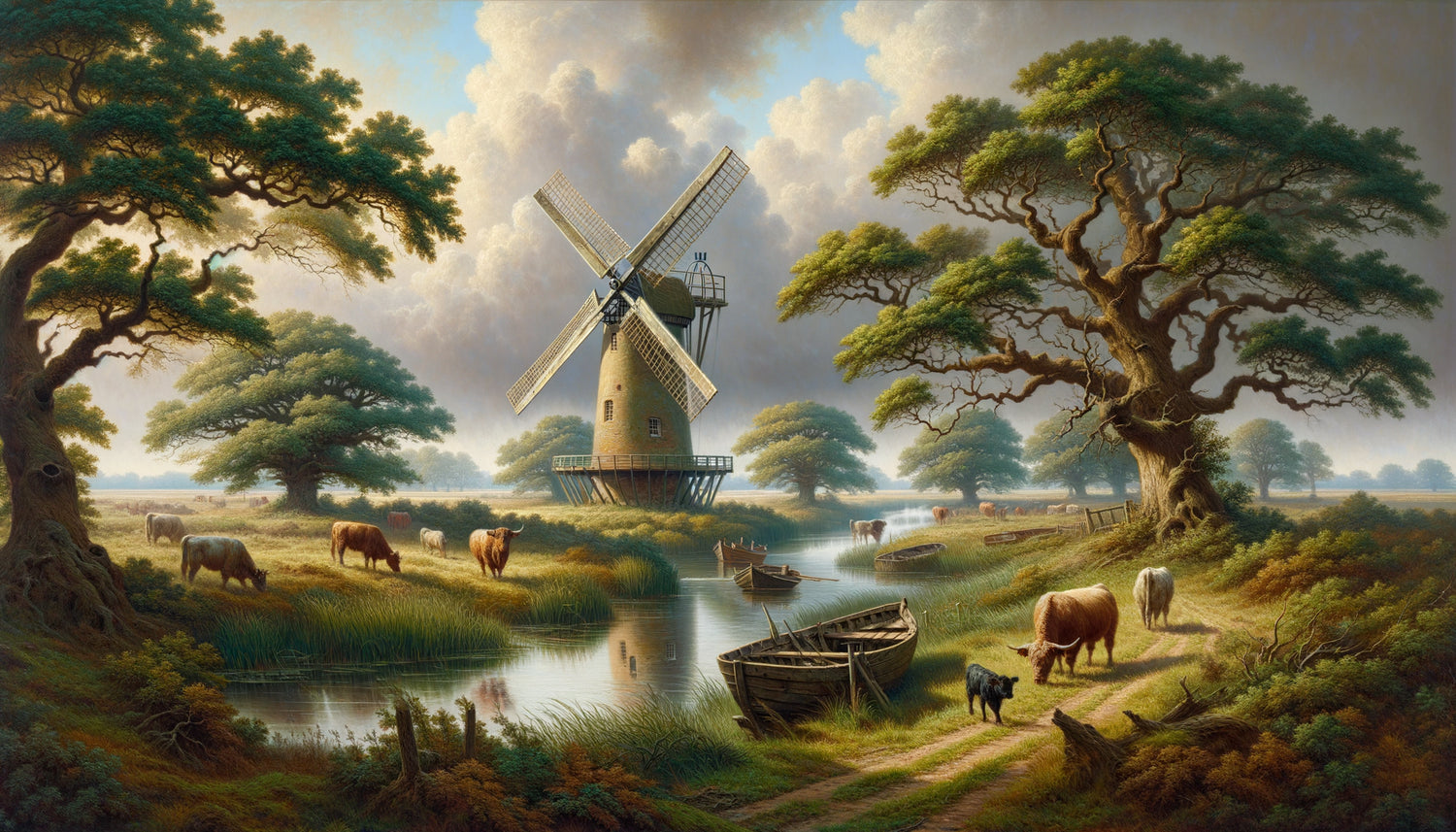
Their manifesto? To paint what they actually saw. The muddy paths of East Anglia, the old oaks twisted by the winds, the Wensum and Yare rivers winding between the reeds, the windmills that dotted the flat horizon of Norfolk. The English Norwich School was born from a deep desire for authenticity.
Unlike Italianizing landscape painters who dominated the era, these artists found their inspiration close at hand. Crome, nicknamed “Old Crome,” tirelessly roamed the surrounding countryside, his easel on his back, capturing the grazing light of early morning on the salt marshes.
The revolution of gaze: painting nature as it is
What fundamentally distinguishes the Norwich School is this direct observation of nature. No mythological references, no picturesque Roman ruins, no idealized shepherds. Just the raw and magnificent reality of East Anglia.
John Sell Cotman pushed this naturalist approach even further. His revolutionary watercolors decomposed landscapes into subtle color planes, almost anticipating abstraction. His views of Norwich Cathedral, Greta Bridge, or the Yorkshire coast bear witness to a stunning modernity.
Members of the Norwich School in England developed a particular sensitivity to atmospheric variations. These changing skies of East Anglia, where clouds from the North Sea transform the light from minute to minute, became the true subject of their compositions. This attention to weather conditions foreshadowed the French Impressionist research of several decades.
Windmills of East Anglia: icons of a territory
Wind and water mills occupy a central place in the iconography of the Norwich School. These utilitarian structures became, under their brushes, poetic symbols of harmony between human activity and the natural environment. The windmills of Coltishall, Thorpe, Mousehold Heath populate their compositions with an almost living presence.

The masters of watercolor and oil: naturalist techniques
John Crome favored oil for his monumental landscapes. His canvases like « The Poringland Oak » or « Mousehold Heath » reveal an earthy palette, deep greens, warm browns that firmly anchor his compositions in the tangible reality of Norfolk.
Conversely, Cotman explored the infinite possibilities of watercolor. His layered wash technique, his bold compositions that simplified forms to the essential, created works of striking modernity. His architectural studies of Norwich Cathedral demonstrate an unparalleled technical mastery.
Other prominent members enriched the stylistic palette of the Norwich School in England: James Stark with his intimate wooded scenes, George Vincent and his dramatic seascapes, John Thirtle and his delicate urban views. Each brought their personal sensitivity while remaining faithful to direct observation of nature.
Why these landscapes resonate in our modern interiors
The contemporary appeal of the Norwich School is explained by several profound psychological factors. In our urban lives saturated with screens and solicitations, these naturalistic landscapes offer a soothing visual refuge. Their authenticity contrasts with the ambient artificiality.
The characteristic hues of East Anglia – these subtle grey-greens, soft ochres, nuanced blues – blend seamlessly with the Nordic and natural palettes that dominate interior design today. A Cotman landscape dialogues beautifully with tones of linen, stone and raw wood.
These works also possess this rare quality: they evolve with the light. A Norwich School watercolor changes atmosphere between morning and evening, creating a living element in your decor. This dynamic dimension considerably enriches your interior's daily experience.
The naturalist heritage in contemporary decoration
The influence of the English Norwich School extends far beyond the historical context of art. Its naturalistic approach today inspires photographers, textile designers, and creators of atmospheres. This philosophy of “really seeing” ordinary nature finds a particular echo in the slow living and biophilia movements.

How to integrate the Norwich spirit into your space
You don't need to own an original Crome work to capture the essence of the English Norwich School. The key lies in understanding their aesthetic principles.
Prioritize quality reproductions that respect the original color subtleties. Cotman watercolors, in particular, lose all their magic in low-quality prints. Invest in professional art prints on textured paper.
For placement, consider these East Anglia landscapes as contemplative windows. They work wonderfully in transitional spaces – hallways, landings, entrances – where they invite slowing down. In an office, a naturalist landscape from the Norwich School promotes concentration without distracting.
Regarding framing, keep it understated. These works speak of authenticity and simplicity. A natural wood frame or a simple cream matting is sufficient. The goal is to let the landscape breathe, not imprison it in excessive ornamentation.
Transform your space with the authenticity of natural landscapes
Discover our exclusive collection of nature paintings that captures the same contemplative poetry of British masters.
The timeless lesson of the Norwich School
Beyond their intrinsic beauty, the landscapes of East Anglia painted by the English Norwich School convey a valuable philosophy to us: grandeur lies in the patient observation of everyday life. No need for exotic destinations or spectacular panoramas to create emotion.
These artists remind us that ordinary nature, the one that surrounds us without our attention, holds an infinite visual richness. A simple muddy path after the rain, light filtering through the leaves of an oak tree, the changing reflections of a river – all deserve our gaze.
This naturalist approach finds a particular resonance today, at a time when we are rediscovering the importance of connecting with our local natural environment. The Norwich School teaches us the art of slow, attentive, appreciative observation.
Imagine yourself tomorrow morning, coffee in hand, letting your eyes wander into a Cotman landscape hanging opposite your window. These East Anglia clouds dialogue with those crossing your own sky. This simple but profound connection with nature, even through art, subtly transforms your daily life. Start by choosing a landscape that resonates with your sensitivity. Let it speak to you.