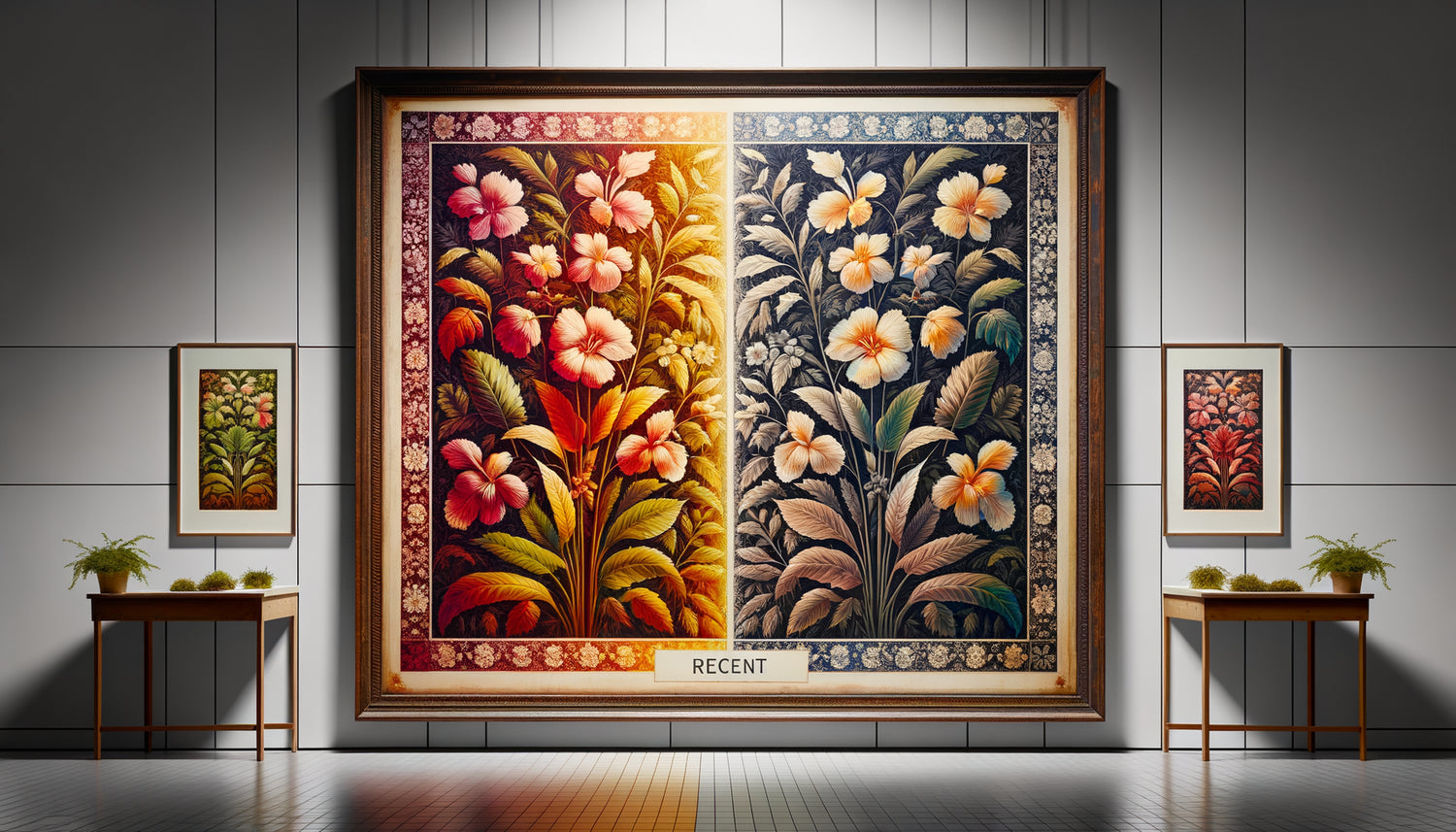
I still remember this client, a seasoned collector, who contacted me three years after purchasing a reproduction of Hermès prints. Their artwork had lost all its depth; the scarlet reds had become pale pinks, and the blacks had transformed into faded grays. A disaster for this centerpiece of their living room. The culprit? Dye ink exposed to natural light. This mishap perfectly illustrates the crucial importance of choosing between pigment and dye inks for your textile print artworks.
Here's what the right choice of ink brings to your textile print artworks: exceptional color preservation over decades, remarkable resistance to UV rays and humidity, and the guarantee that your decorative investment will stand the test of time without alteration. Because a painting featuring Liberty motifs, Scottish tartans, or African wax prints deserves a printing technique that honors the chromatic richness of the original fabrics.
Many of you confide in me with this frustration: falling under the charm of a reproduction of Lyon silks or Persian cashmeres, only to discover a few months later that the shades have faded, and the contrasts have disappeared. This disappointment is all the greater because these works often occupy a central place in your interior decoration.
Good news: understanding the fundamental difference between pigment and dye inks will allow you to choose textile print artworks that will preserve their original vibrancy for generations. Let me guide you through this fascinating universe where chemistry and aesthetics meet.
The molecular structure that changes everything
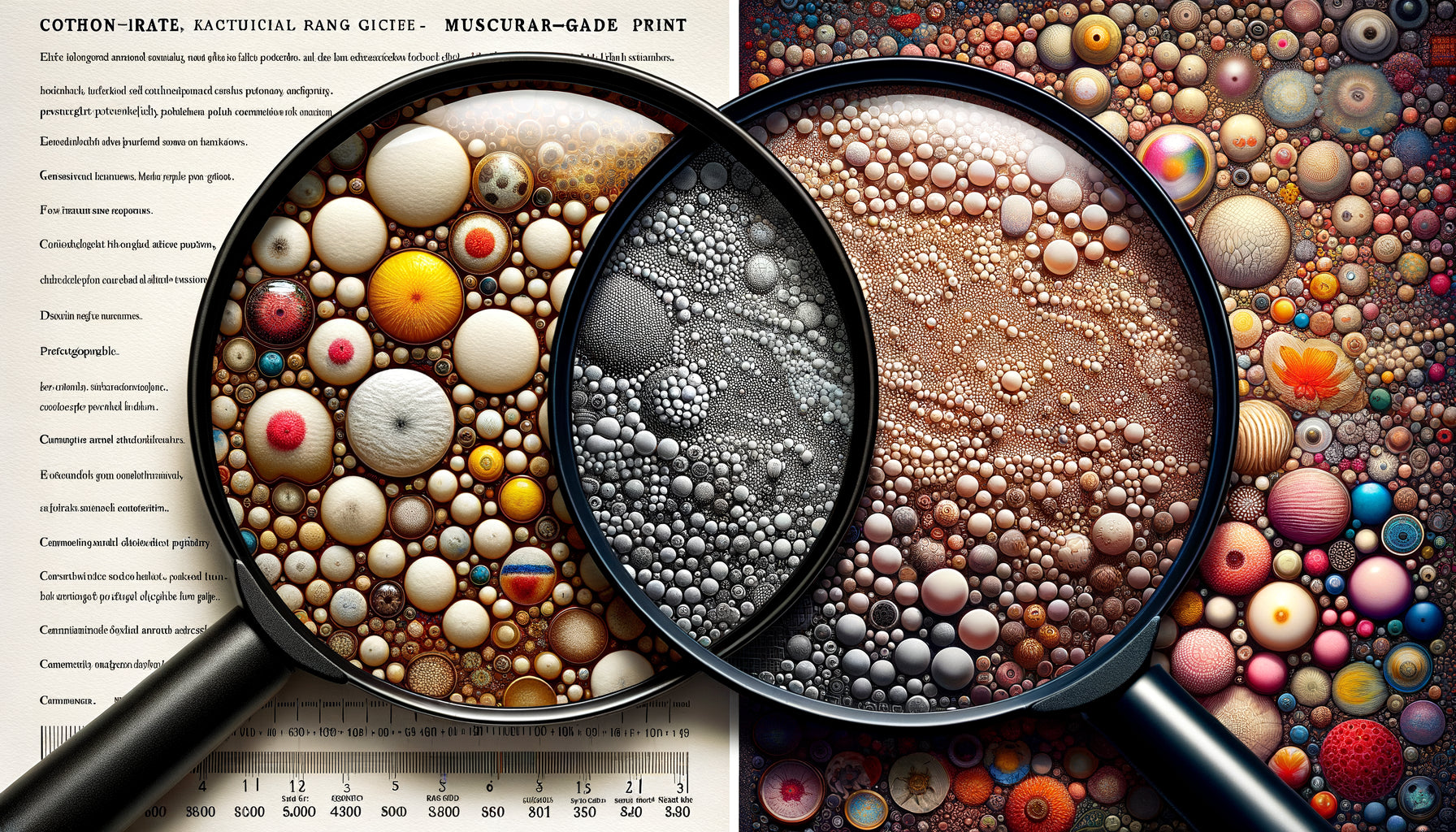
The difference between pigment and dye inks begins at the microscopic level, with two radically different approaches to color. Dyes are soluble molecules that literally penetrate the fibers of the printing medium. Imagine tiny particles that dissolve and infiltrate, creating a complete fusion with the paper. This dissolution generates vibrant, luminous, almost radiant colors.
Pigment inks, on the other hand, work like tiny solid particles suspended in a carrier liquid. These pigments do not dissolve: they remain on the surface of the medium, encapsulated in a protective resin. Think of thousands of micro-capsules of color that adhere to the paper rather than penetrating it. This structure explains why a textile print artwork made with pigments presents unparalleled stability.
The impact on the reproduction of textile patterns
To reproduce the complexity of a William Morris print or an Indian paisley, each technology offers distinct advantages. Dyes excel at reproducing subtle gradients and delicate nuances. On a canvas depicting Japanese silks with their vaporous transitions, the dye captures this fluidity with remarkable precision. The colors seem almost translucent, faithfully reproducing the effect of light passing through a precious fabric.
Pigment inks shine differently: they restore exceptional chromatic density, particularly visible on graphic prints with marked contrasts. An Art Deco geometric pattern, a Scottish tartan with sharp lines, African wax fabrics with saturated colors - all gain presence and depth with pigment technology.
Longevity: the big gap between the two technologies
Let's move on to the heart of the matter: the longevity difference between these two types of inks on your textile print canvases. Standardized tests by Wilhelm Imaging Research, a world leader in photographic preservation, reveal spectacular differences.
A canvas made with standard dye inks will retain its visual quality for 5 to 25 years depending on exposure conditions. Placed in full sun, near a south-facing bay window, this timeframe can be reduced to 2-3 years before degradation becomes visible. Reds and blues are particularly vulnerable: I have seen reproductions of Pucci patterns lose their characteristic violet in less than 18 months.
Conversely, archival quality pigment inks display astonishing longevity: 100 to 200 years under normal exposure conditions, and 300 years or more in the dark. On a textile print canvas displayed in a living room with indirect natural light, you can count on at least 75 to 100 years of perfect color preservation. This durability transforms your purchase into a true family heirloom.
Degradation mechanisms explained
Why such a difference? Dyes undergo photochemical oxidation under the effect of UV rays. Soluble molecules gradually break down, losing their ability to absorb and reflect certain wavelengths of light. This molecular destruction is irreversible. On a canvas depicting Liberty prints with multiple floral nuances, this degradation creates an uneven fading effect, some colors fading faster than others.
Pigments, protected by their resinous envelope and solid structure, remarkably resist this light aggression. The color particles remain intact, maintaining their ability to reflect the original wavelengths. A canvas of Hermès prints or antique silks thus retains all its chromatic fidelity.

Resistance to humidity and environmental conditions
Beyond light, the daily environment constantly tests your textile print artworks. Humidity represents a major challenge, particularly in bathrooms, kitchens or coastal regions. Here again, the difference between pigment and dye ink proves decisive.
Dyes, being soluble by nature, retain some sensitivity to water even after drying. Prolonged exposure to high humidity can reactivate molecules partially, creating color migrations or stains. I have experienced a cashmere pattern artwork installed in a bathroom where the shades had literally run after two years of steam exposure.
Pigment inks offer remarkable impermeability. Once the pigments are encapsulated and fixed, water can no longer dissolve them. Your textile print artworks resist humidity variations, accidental splashes, even gentle cleaning with a damp cloth. This robustness considerably expands placement possibilities in your interior.
The influence of the quality of the support
The longevity of your artwork also depends on the printing substrate. Acid-free archival paper with a neutral pH considerably extends the life of pigment inks. The combination of premium paper and pigments creates an exceptional synergy for reproductions of valuable textile prints. The substrate stabilizes the pigments, the pigments protect the paper from yellowing - a symbiotic relationship.
With dyes, even a superior quality support does not compensate for the intrinsic vulnerability of soluble molecules. The paper may remain intact while the colors gradually fade.
How to identify the technology used?
Faced with a textile print artwork that makes you crack, how do you know which ink was used? Several clues guide you. First, ask the seller about the printing technology. Serious professionals clearly communicate the use of pigment inks and often provide longevity certificates.
Examine the artwork’s surface with a magnifying glass or under raking light. The pigments create a slightly more pronounced texture, a subtle physical presence on the paper's surface. Dyes offer a perfectly smooth, almost translucent surface. On a textile print with detailed patterns, this tactile difference becomes perceptible.
The price is also an indicator: pigment inks cost significantly more to produce. A quality textile print artwork, with a guarantee of longevity, represents an initial higher investment but is largely justified by its exceptional durability.

Preserving your artworks: best practices
Even with pigment inks that are ultra-resistant, a few precautions maximize the longevity of your textile print artworks. Avoid direct exposure to sunlight, particularly between 11 am and 4 pm when UV rays are most intense. A location perpendicular to windows, with indirect natural light, offers the ideal compromise between visibility and preservation.
Use anti-UV glass if your artwork is particularly exposed. This protection filters up to 99% of ultraviolet rays while maintaining optical transparency. For reproductions of precious prints – historical silks, rare textiles – this additional investment proves worthwhile.
Maintain a relative humidity between 40% and 60%, and a stable temperature around 20°C. These museum conditions may seem demanding, but they actually correspond to the usual comfort standards in our interiors. Your textile print artwork will simply appreciate what you yourself appreciate.
Daily maintenance
Regular dusting with a dry microfiber cloth is sufficient for artworks made with pigment inks. Avoid cleaning products, even mild ones, which could alter the protective varnish. If your artwork features textile prints in a glazed frame, clean only the glass with an appropriate product, being careful not to spray directly onto the frame.
Inspect your collection annually, particularly the most exposed works. This vigilance allows for early detection of any potential degradation and adjustment of conservation conditions if necessary.
Transform your walls into a timeless textile gallery
Discover our exclusive collection of fashion wall art that celebrates the richness of textile prints with the guarantee of exceptional preservation thanks to archival quality pigment inks.
The investment in durability
Choosing a textile print artwork made with pigment inks represents a long-term vision for interior decoration. Rather than regularly replacing faded reproductions, you invest in a piece that will last through the decades without losing its luster. This approach fits perfectly into a reasoned and sustainable consumption approach.
For a collector or an art textile enthusiast, the difference in longevity between pigment and dye is not a technical detail: it determines whether your artwork will remain a faithful testimony to the beauty of the original prints or gradually become a pale copy of itself. A Fortuny motif, a Jouy canvas, a Marimekko print – these textile icons deserve a printing technique worthy of their aesthetic value.
Calculate the cost over 20 years: a pigment ink artwork purchased for 200 euros will retain its value and appearance. Three dye artworks at 80 euros each, replaced every 7 years, will cost you 240 euros while generating waste. The economic and ecological equation clearly favors lasting quality.
Imagine your living room in fifteen years. Your textile print artworks made with pigment inks will still display the same deep reds, the same intense blues, the same bright greens. They will still tell the story of the fabrics that inspired them, with the same fidelity as on the first day. This permanence creates a valuable visual anchor in a world of perpetual change. Your investment in pigment technology becomes a lifestyle choice: to prioritize lasting quality over the ephemeral, to build a decorative heritage that will be passed down. Start today by consciously selecting your next textile print artworks, asking the right questions, demanding transparency on printing techniques. Your walls – and future generations – will thank you.
Frequently Asked Questions
Can I have a dye artwork that has already faded restored?
Unfortunately, fading caused by dye inks is irreversible. Once the dye molecules are degraded by UV light or oxidation, no restoration process can recreate the original colors. The only solution is to reprint the artwork, ideally this time using pigment ink to avoid the problem recurring. Some professional restorers may be able to partially mask the most faded areas, but the result remains approximate and temporary. This reality highlights the importance of choosing the right printing technology from the start for your textile prints. Consider this experience as a valuable learning opportunity that will guide your future purchases towards durable artworks.
Do pigment inks really cost that much more?
The price difference between a pigment ink artwork and a dye ink artwork generally varies from 30% to 60%, depending on the formats and quality of the support. This difference is explained by the higher production cost of pigments and the increased technical requirements of the printing process. However, when considered in relation to the exceptional lifespan of a pigment ink artwork (75 to 100 years versus 5 to 25 years for dye), the annual usage cost actually becomes lower. Investing 250 euros in a pigment artwork that will last 100 years amounts to 2.50 euros per year, while a 150 euro dye artwork replaced every 10 years costs 15 euros annually. Economic logic clearly favors the initial investment in durable quality, particularly for textile prints intended to become permanent pieces of your decor.
Are there hybrid inks combining the advantages of both technologies?
Some manufacturers are indeed developing hybrid formulations seeking to combine the brilliance of dyes with the durability of pigments. These inks generally use a pigment base enriched with dyes for certain shades that are difficult to reproduce in pure pigments (particularly some bright oranges and deep purples). Results vary considerably depending on the brands. The longevity of these hybrid inks is generally between that of dyes and pure pigments, with an expected lifespan of 40 to 60 years under good conditions. For your textile prints, if hybrid inks offer a good budgetary compromise, however prioritize 100% pigment inks for the centerpiece pieces of your collection that you want to keep for several decades. Always request a certificate of longevity specifying the exact composition of the inks used.