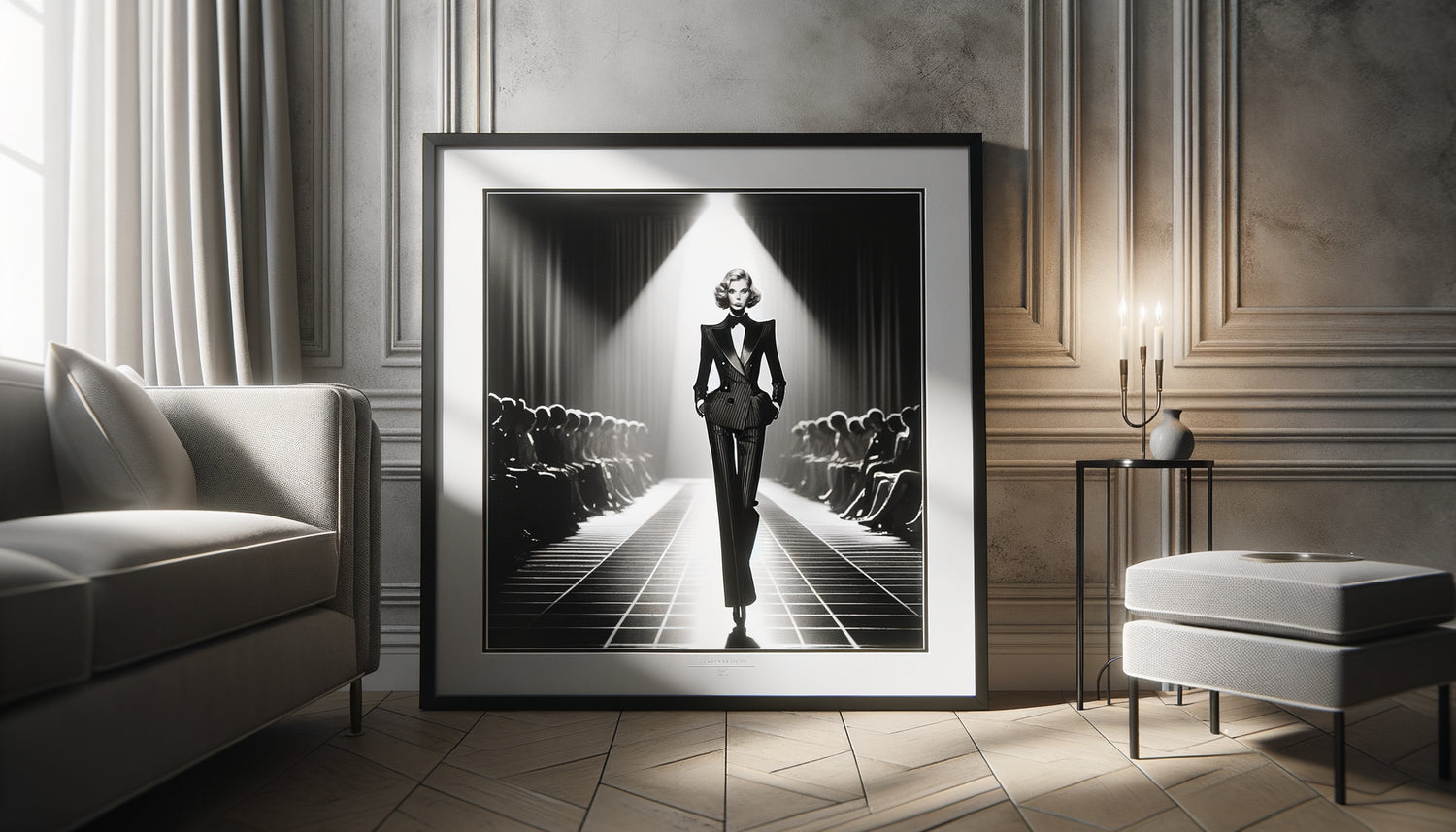
A few years ago, at a Christie's auction in Paris, I saw a collector spend an astronomical sum on an iconic photograph from an Yves Saint Laurent show from the 70s. But what struck me most wasn't so much the photograph itself – though it was sublime – as how it was presented. The minimalist and refined frame literally made the image vibrate. This scene confirmed what I had instinctively known after fifteen years of framing fashion photographs for galleries and private collectors: the frame is never just a container.
Here's what a perfectly chosen frame brings to a photograph from an Yves Saint Laurent show: it magnifies the timeless elegance of the composition, it creates a subtle dialogue between the work and your interior, and it transforms a simple image into a true collector's item. The right framing becomes the link between the couturier's universe and your living space.
Many fashion enthusiasts hesitate when faced with their show photographs. They languish in drawers, or worse, end up in generic frames that stifle their potential. There is fear of making the wrong choice, of opting for a style that is too imposing or, on the contrary, too discreet. This indecision is understandable: a Yves Saint Laurent photograph is not an ordinary image. It carries within it all the history of a mythical house, the audacity of a creative vision, the grace of a captured moment.
Rest assured: enhancing these exceptional clichés does not necessarily require a huge budget or expertise in art history. It just takes understanding a few fundamental principles that respect the DNA of Yves Saint Laurent – this masterful alliance between radical modernity and classic refinement. I will guide you through the framing choices that, from my experience, best reveal these particular photographs.
The Saint Laurent spirit: understanding the visual DNA before choosing
Even before talking about materials or dimensions, it is necessary to grasp what makes a photograph of an Yves Saint Laurent show so recognizable. Unlike commercial fashion shots, these images possess a particular theatricality. YSL's shows were never just presentations of clothing: they were visual manifestos, moments of pure creation where light, movement and the architecture of silhouettes harmonized.
Over the years, I have noticed that these photographs almost always feature clean lines, marked contrasts and a very controlled geometric composition. Even in the movement of a mannequin on the runway, there is this architectural rigor inherited from the Bauhaus that Saint Laurent so admired. This formal characteristic must absolutely guide your choice of frame.
A frame for an Yves Saint Laurent photograph must therefore respect two seemingly contradictory imperatives: to assert a presence while preserving lightness. This is exactly what the couturier did with his creations – structured yet flowing smoking jackets, bold but elegant transparencies.
The matte black frame: contemporary evidence
If I had to recommend a single framing style for an Yves Saint Laurent runway photograph, it would be without hesitation the matte black frame with white mat. This combination may seem classic, almost obvious, but it is remarkably effective.
Matte black has this unique ability to absorb the gaze rather than distract it. It creates a clear, almost conceptual boundary between the world of the photograph and the wall that welcomes it. For a black and white runway image – and many of YSL's iconic photographs are – this frame establishes a chromatic continuity that reinforces the visual impact.
The white mat, for its part, plays a crucial role. It offers visual breathing space, a transition area that allows the eye to fully appreciate the composition. I have found that a mat of 8 to 10 cm works particularly well for medium-sized prints (40x60 cm or 50x70 cm). This generous margin immediately gives the photograph a museum status.
The advantage of the matte black frame also lies in its decorative versatility. It integrates just as well into a minimalist Scandinavian interior as into a Haussmannian apartment with worked moldings, or even an industrial loft. It is a choice that does not go out of style – exactly like Yves Saint Laurent's creations.

The golden alternative: when luxury meets history
For some runway photographs, especially those from the haute couture collections of the 60s and 70s, a golden frame can create a striking effect. But be careful: not just any gold.
I have seen too many beautiful shots spoiled by baroque golden frames, overloaded with ornamentation. What to favor is a discreet gold, slightly brushed or aged, with a thin and refined profile. Think of the gold of the 1920s rather than that of the Rococo. This type of framing works wonderfully with photographs that capture sumptuous evening gowns, embroidered capes, or silhouettes inspired by Mondrian.
The gold frame establishes a fascinating historical dialogue. It recalls that Yves Saint Laurent fashion shows were part of a tradition of French haute couture, while radically reinventing it. This tension between heritage and modernity is materialized in the contrast between the classic gold of the frame and the modernity of the photographic composition.
If you choose this path, I recommend a cream or ivory mat rather than pure white. This warmer shade establishes a harmonious transition to the gold of the frame, avoiding a contrast that could visually fragment the whole.
The brushed metal frame: for the bold
Here's a less conventional but terribly effective option for fashion show photographs with silver or gray tones: the brushed aluminum frame. This resolutely contemporary choice is particularly suitable for images that capture the architectural and graphic aspect of shows.
I recently framed a series of photographs from an 80s YSL show – these angular, almost futuristic silhouettes – in ultra-thin aluminum frames. The result was stunning: the photograph seemed to float against the wall, as if suspended in time. This type of framing creates an art gallery aesthetic instantly.
The metal frame works beautifully in interiors with clean lines, spaces with exposed concrete, design open kitchens. It brings a chic industrial touch that never competes with the image. Its minimal profile – often less than 2 cm – focuses all attention on the photograph itself.
For this type of framing, I generally do not recommend a mat. The photograph goes directly against the glass, creating an impression of continuity and maximum modernity. This is a bold choice for lovers of assumed contemporary decoration.

The question of glass: a detail that changes everything
We often talk about the frame, rarely about the glass. Yet, this component radically transforms the perception of a fashion show photograph. After testing all possible options, I only swear by museum anti-reflective glass for important pieces.
This type of glass eliminates up to 99% of reflections, creating near total transparency. When you stand in front of the photograph, you feel like you are looking directly at the print, with no barrier. For runway images where every detail counts – the texture of a fabric, the fleeting expression of a model, the subtle play of shadows – this absolute clarity makes all the difference.
Anti-reflective glass also has the advantage of filtering UV rays, protecting your photograph from yellowing and degradation over time. If you have invested in an archival print or an authentic vintage photograph, this protection becomes essential.
Granted, this glass costs more than standard glass. But on a quality photograph, the visual difference amply justifies the investment. It's like choosing between ordinary fabric and crepe de soie for a dress: technically, both work, but the experience is worlds apart.
Composing a wall of photographs: the art of staging
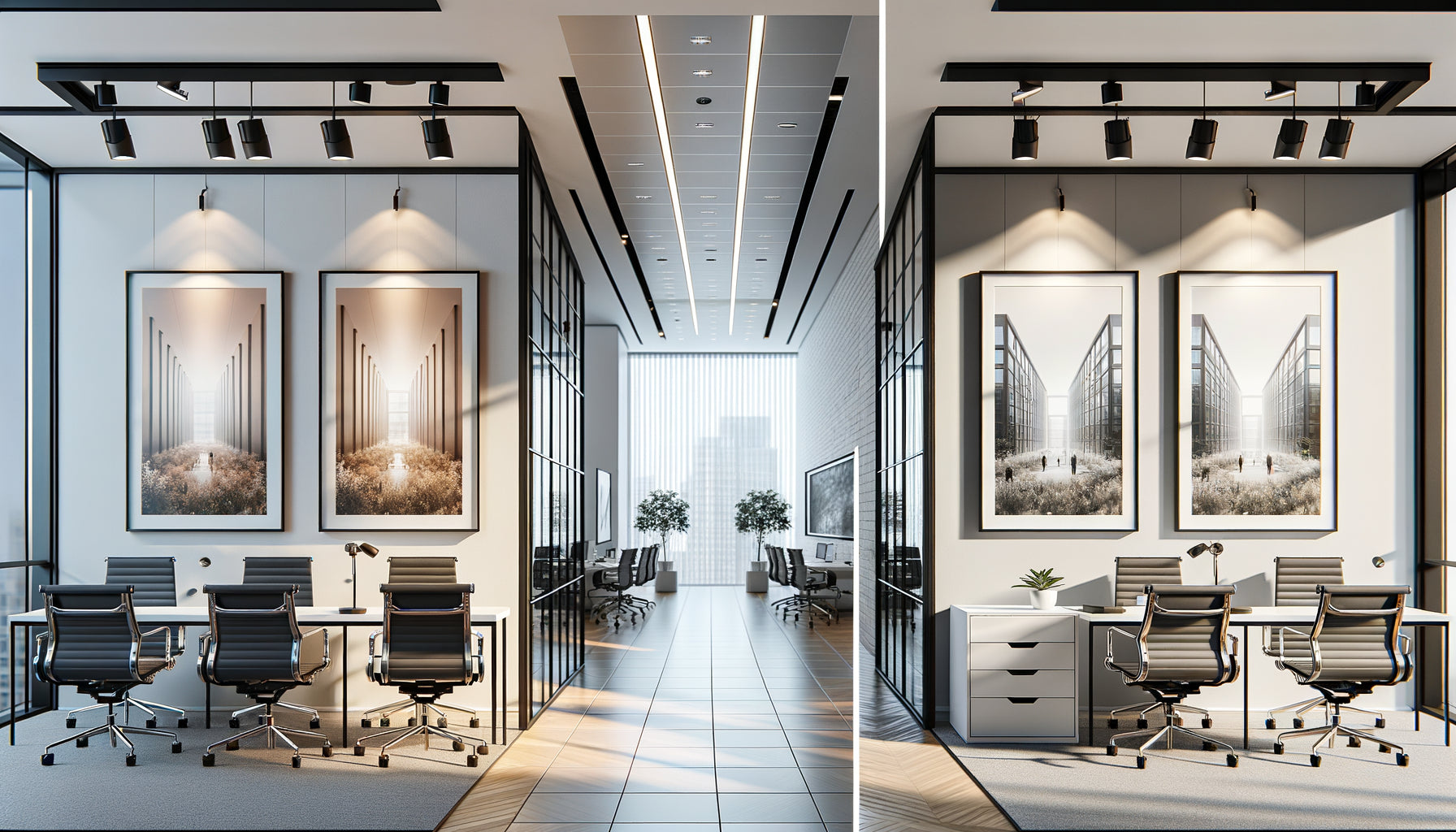
A single Yves Saint Laurent runway photograph makes an impression. But several, arranged intelligently, create a spectacular visual narrative. I have accompanied several collectors in creating true walls of homage, and some rules emerge.
If you own multiple photographs from the same collection or period, maintain absolute frame consistency. Same style of frame, same mat width, same type of glass. This uniformity creates a gallery effect that enhances each image individually while building a harmonious ensemble.
For formats, you can play with dimensions – a large central print surrounded by smaller sizes – but always respect consistent proportions. A 50x70 cm (approximately 20x28 inches) pairs well with 30x40 cm (approximately 12x16 inches), for example. Avoid excessively large size differences that would fragment the composition.
The layout itself deserves reflection. For a contemporary and dynamic effect, opt for an asymmetrical composition with regular spacing of 5 to 8 cm (approximately 2-3 inches) between each frame. For a more classic and solemn rendering, perfectly align the frames in rows and columns, as in a traditional museum.
Ready to transform your passion for Yves Saint Laurent into a wall masterpiece?
Discover our exclusive collection of fashion wall art that celebrates the timeless elegance of the greatest creators.
Your photograph finds its frame
Imagine: you come home after a long day. Your gaze falls on this Yves Saint Laurent fashion show photograph, perfectly framed, which dominates your living room. The matte black frame highlights every shade of gray, every fold of the fabric captured by the photographer. The generous mat gives it a museum presence. You feel that little pride, that aesthetic pleasure that transforms a simple wall into a personal gallery.
The right frame never shouts louder than the image. It reveals, amplifies, protects. It creates this subtle dialogue between the creator's universe and your intimacy. Start with a single piece, perfectly framed. Observe how it transforms your space, how it attracts attention, how it opens conversations.
Framing a fashion show photograph is not an expense, it’s an investment in daily beauty. It's choosing to surround yourself with excellence, remembering every day that elegance is never accidental, but always a conscious and thoughtful choice.