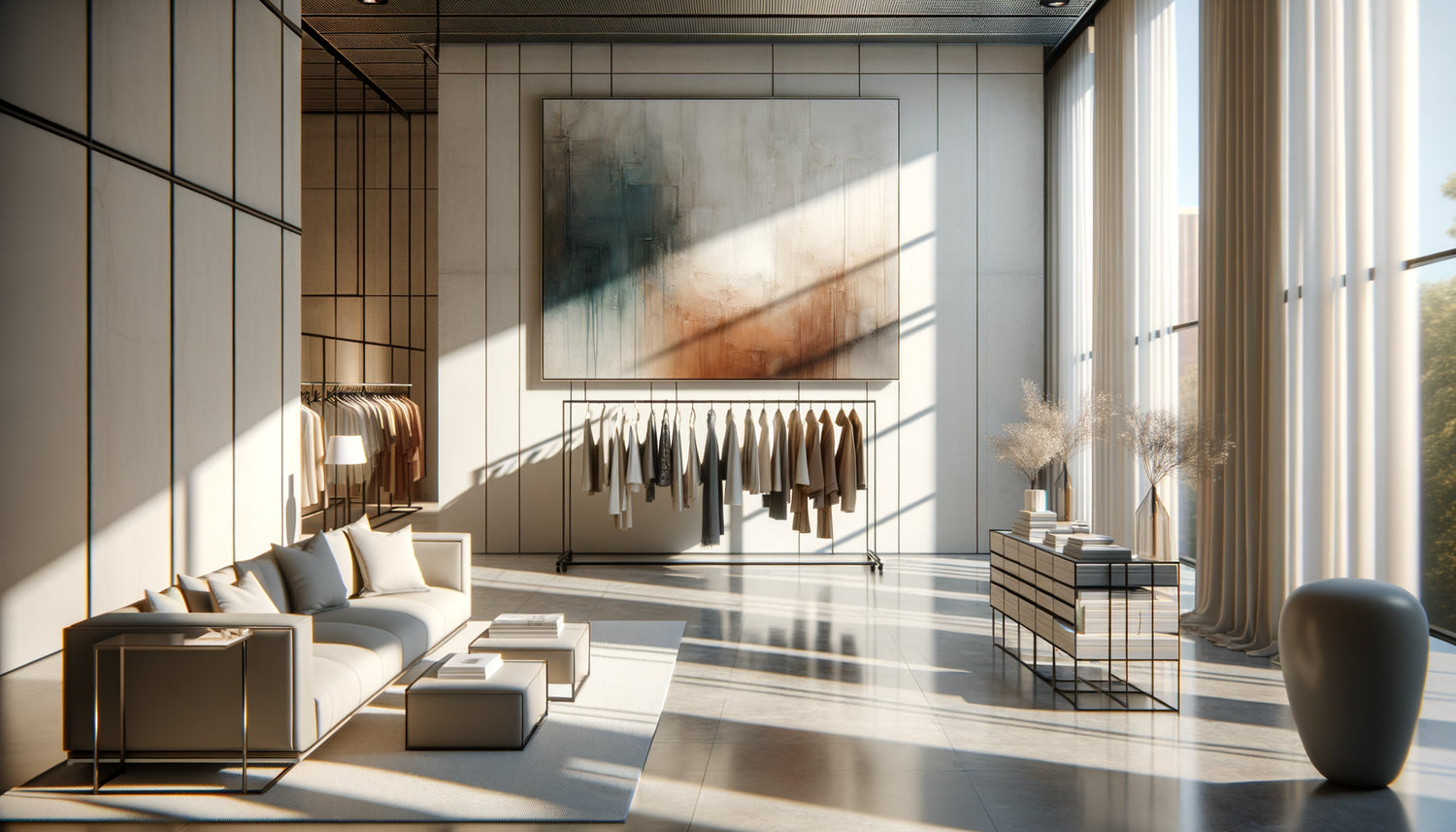
The first time I advised a young creator for the opening of her showroom in Paris, she hung her paintings the day before the vernissage. The next day, not a single Instagram photo did justice to the space. The artworks were lost within the decor, creating a visual confusion that diverted attention from the fashion pieces. We urgently repositioned everything, and the impact was immediate: the space breathed, the collections came to life, customers spontaneously photographed every corner.
Here's what a strategic placement of artwork brings to your showroom: an amplification of brand identity, a fluid circulation that enhances your creations, and a memorable customer experience that turns visitors into ambassadors.
In a fashion showroom, every square centimeter tells a story. You have invested in beautiful artworks, but they remain invisible or even worse, they create a visual cacophony that blurs your message. Customers walk past without seeing them, or stop in the wrong place, disrupting the flow of discovery of your collections. This frustration is universal among creators and showroom owners.
Rest assured: the placement of a wall artwork is not an occult science reserved for set designers. It's a subtle choreography between space, light, and the emotion you want to create. By understanding a few fundamental principles, you will transform your showroom into an immersive experience where each painting plays its role perfectly.
The emotional geography of your showroom
A fashion showroom is not a museum. It's a living space where energy flows, where gazes linger, where emotions are born. Before choosing the location of your wall artwork, mentally draw the natural path of your visitors. Where does their gaze settle when crossing the threshold? What path do they instinctively take?
The entry focal point is crucial. It's the first place where the eye rests, generally facing the door or slightly offset to the right. Place here a painting that embodies the essence of your brand: clean for a minimalist universe, vibrant for an audacious collection, poetic for a romantic style. This painting is your visual handshake, your first promise.
Then observe the natural pause zones. In front of a mirror where customers try on clothes, near the sofa where they sit to think, next to the counter during payment. These spaces deserve paintings that extend the experience, that create a bubble of intimacy and contemplation. A well-placed painting in a pause zone can transform hesitation into a crush.
The art of creating visual dialogues
In a showroom, your wall artwork should never compete with your fashion pieces. It must dialogue with them. Position your artworks to create chromatic or thematic correspondences with your collections, without ever eclipsing them.
Imagine you are presenting a line of clothing in muted tones. An abstract painting with similar nuances, placed three meters behind the display rack, will create a magnificent visual depth. The customer subconsciously captures this harmony, and the entire space gains coherence. Conversely, placing the same painting directly behind the rack would create confusion: the eye wouldn't know where to settle.
The rule of visual breaths is essential. Between your paintings and your fashion presentations, allow a minimum of 1.5 to 2 meters of neutral space. This distance allows the gaze to move back and forth, creating connections without saturation. This is particularly crucial for large-scale paintings that need air to breathe.
Destination Walls
Some walls in your showroom are destinations in themselves. The backdrop of a niche, the wall perpendicular to the windows, the space above an elegant console. These locations call for statement paintings, impactful pieces that justify approaching them. Choose them for your most remarkable works, those worthy of being discovered as treasures.
Conversely, circulation walls – those along which visitors walk – are better suited to series of smaller paintings or narrative artworks. The movement of the body in transit creates a cinematic experience, a visual sequence that unfolds gradually.

Light as a Revealer of Location
A beautiful wall painting in the dimness becomes invisible. In the glare of direct light, it loses all its magic. Light literally dictates where your works can fully live.
Do the following exercise: spend an entire day in your showroom and observe how the light travels. In the morning, which walls are caressed by soft light? Midday, where do reflections appear? Late afternoon, which areas plunge into shadow?
Walls perpendicular to windows often offer the best locations. They receive indirect light that enhances textures and colors without creating reflections. If your showroom relies primarily on artificial lighting, position your paintings where spotlights create a gentle grazing light, generally at a 30-degree angle from the artwork.
Beware of backlit areas near windows. A painting placed facing a window becomes a dark silhouette during the day. If you have no choice, compensate with dedicated artificial lighting or choose artworks with strong contrasts that resist backlighting.
When architecture becomes your ally
Each showroom has an architectural personality: ceiling height, moldings, exposed beams, columns, niches. These elements are not constraints but invitations to creativity in choosing the location of your paintings.
A generous ceiling height – beyond 3 meters – allows you to play with verticals. A large, narrow painting placed between two supports creates an effect of majesty. Conversely, in a low space, prioritize horizontality and place your works at eye level (between 1.45 and 1.60 meter from the floor), not too high, to maintain intimacy.
Architectural elements such as columns or beams naturally delineate zones. Use them as invisible frames. A painting placed in the space defined by two columns benefits from a free architectural staging. It naturally becomes a focal point without effort.
The systematic filling error
Too many showrooms fall into the trap of filling: paintings everywhere, on every available wall panel. This abundance paradoxically creates a feeling of emotional emptiness. Each work loses its singularity in the visual noise.
Dare to strategic bare walls. A large white wall between two paintings is not wasted space; it's a breath that magnifies the two adjacent works. This visual economy is the secret of the most photographed showrooms: they understand that emptiness is part of the composition.

The photographic gaze method
Here is an exercise that revolutionizes the choice of location: photograph your showroom from all possible angles. Not to document, but to understand. Your smartphone's objective captures exactly what the human eye will see in its first impression, before the brain filters and analyzes.
Look at these photos. Where is your eye naturally drawn? Which spaces seem to call for a point of interest? Where do uncomfortable visual voids appear? These are your priority locations for wall paintings.
Virtually test by printing your photos and drawing rectangles in the intended locations. This low-tech method avoids costly drilling errors. Some even use augmented reality applications, but a simple sketch on a printed photo remains surprisingly effective.
Emotional influence zones
Each location in your showroom has a different emotional temperature. Areas near the entrance are dynamic, almost exciting. The nooks at the back of the showroom are contemplative and intimate. Central spaces are convivial and social.
Match your artworks to these temperatures. An energetic, colorful, dynamic abstract work finds its place in entry areas where energy is high. A poetic portrait, a meditative black and white photograph will thrive in a quiet corner where customers come to relax.
This correspondence between place emotion and artwork emotion creates a fluid experience. The visitor feels that everything is in its place, without necessarily being able to explain why. This is a sign of a perfectly chosen location.
Transform your showroom into an unforgettable visual experience
Discover our exclusive collection of fashion artworks that naturally dialogue with your creations and enhance every space.
Validation through real experience
Theorizing the ideal location is one thing. Validating it in real conditions is another. Before permanently fixing your artworks, organize a test day. Simply lean your works against the walls in the intended locations.
Invite some trusted people – not necessarily experts, on the contrary. Observe their behavior without asking them any questions. Where do they spontaneously stop? Which artworks do they photograph? In front of which works do they linger? This behavioral data is worth all theoretical advice.
Also listen to unsolicited comments. When someone spontaneously says “this artwork is perfect here,” it means that the location creates a visual obviousness. Conversely, if no one mentions a beautiful painting, it probably means that its location does not do it justice.
The evolving location
A fashion showroom lives to the rhythm of collections. What worked perfectly with your spring collection may require an adjustment in autumn. Consider the placement of your artworks as a seasonal choreography rather than a fixed installation.
Plan for hanging systems that allow flexibility: wall rails, multiple hooks, modular cleats. This freedom will allow you to breathe life into your space, create novelty for your regular customers, and visually adapt your showroom to the evolution of your brand.
Imagine your showroom in six months, after this transformation. Visitors step through the threshold and spontaneously stop, captivated by the visual harmony. They discover your collections in a natural flow, punctuated by contemplative moments in front of your perfectly placed paintings. They photograph the space, share the experience, return with friends. This transformation begins with a simple decision: give the placement of your wall art the strategic attention it deserves. Start tomorrow with the photographic exercise, observe your space with a fresh eye, and let the architecture and light guide you to the locations that will make all the difference.
Frequently Asked Questions
At what exact height should I hang a painting in my fashion showroom?
The ideal height is between 1.45 and 1.60 meters from the floor to the center of the painting, which corresponds to the eye level of an average person. In a showroom, this rule can be slightly relaxed depending on the context: near a sofa or seating area, descend to 1.35-1.40 meters to create intimacy. In a standing area like a presentation space, maintain 1.50-1.55 meters. The essential thing is that the gaze naturally meets the work without effort upwards or downwards. If you are unsure, temporarily place the painting with repositionable adhesive tape and live with it for a few days. Your body will quickly tell you if the height is comfortable.
How many paintings should I install in a 50m² showroom?
There is no magic formula, as it all depends on your brand identity and the density of your fashion presentations. Nevertheless, an empirical rule works well: one significant painting every 10-15m² of visible wall surface, or 3 to 5 artworks for a 50m² showroom. The common mistake is to want to fill all the walls. Always prioritize quality and impact over quantity. A single large painting beautifully placed will have more effect than five small scattered works. Start by installing your essential pieces – the welcome artwork, the destination artwork at the back, an artwork in the fitting room area – then observe for a week. You will intuitively know if there is a missing point of interest somewhere. The feeling you are looking for: a breathable space where each painting stands out.
Should I change the location of my paintings with each new collection?
Not necessarily with every collection, but a seasonal rotation – two to three times per year – keeps your showroom dynamic and fresh. Certain anchor locations, such as the welcome artwork that embodies your brand identity, can remain fixed. Conversely, works in circulation areas or near fashion presentations would benefit from evolving with your collections. This rotation offers several advantages: it creates novelty for your regular customers, allows you to showcase different pieces of your art collection, and avoids visual fatigue. Take photos before each rearrangement to create a visual memory. You will quickly discover which locations consistently work and which require more experimentation. This flexibility transforms your showroom into a living space rather than a frozen decor.