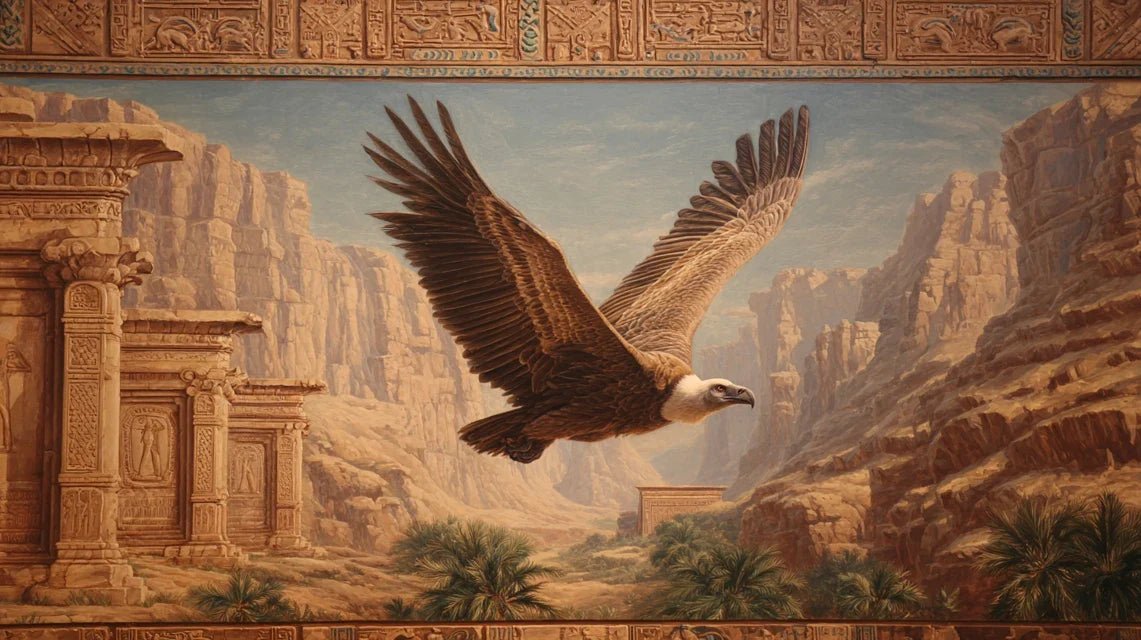
Within the silence of a gallery where I presented a collection of ancient frescoes, a woman stopped abruptly in front of a fragment of stucco depicting a vulture with wings spread. She remained motionless for twenty minutes. When I approached her, she simply said to me: “It’s the first time a bird has made me want to fly without scaring me.” This scene perfectly summarizes what I discover every day when restoring wall artworks: the Egyptian vulture possesses this rare power to transform fear into fascination, death into rebirth, emptiness into fullness.
Here's what the Egyptian vulture brings to wall art: a symbolic power that transcends eras, a graphic aesthetic of astonishing modernity, and a spiritual presence that transforms the atmosphere of a space. You may have already felt this frustration with a decor lacking depth, these walls that remain silent despite all your efforts. This impression that something essential is missing, a soul, a story that vibrates beyond mere aesthetics. I understand this quest. For fifteen years restoring millennial frescoes and advising collectors, I’ve learned that the most powerful motifs are never those we impose, but those that choose us. And the Egyptian vulture, this sacred bird venerated in antiquity, continues to choose those who are ready to welcome its quiet strength into their interior.
The millennial heritage that transcends centuries
When I restore an Egyptian fresco, my hands always tremble at the first contact with the Egyptian vulture - its scientific name. Not from technical nervousness, but out of respect for what has crossed 3000 years without losing a shred of its power. In ancient Egypt, this bird of prey embodied Nekhbet, the protective goddess of Upper Egypt, guardian of the pharaohs and symbol of divine motherhood.
What particularly fascinates me is the duality of this bird in Egyptian wall art. On one hand, a scavenger with an essential ecological role - desert purifier, cleaner of the lands. On the other hand, a divinity with immaculate white wings, crowned with the red pshchent, protector of royal births. This apparent contradiction reveals profound wisdom: beauty often arises from what transforms the end into a beginning.
On the walls of the Luxor temples that I studied, the Egyptian vulture systematically appears above doors and passages. Never an accident in Egyptian art. This strategic position made it a guardian of thresholds, a protector of transitions. Transposing this principle into our contemporary interiors creates a striking symbolic dimension: each passage becomes a sacred moment, each space an invitation to transformation.
The living hieroglyph on your walls
In hieroglyphic writing, the Egyptian vulture represents the letter « A » - the beginning, the first breath. I've seen designers subtly incorporate this detail into modern murals, creating a silent conversation between millennia-old alphabet and our daily lives. This approach transforms a wall into a cultural palimpsest, where each glance discovers a new layer of meaning.
A graphic aesthetic of stunning modernity
The first time an interior architect asked me to reproduce an Egyptian vulture for a minimalist loft in Antwerp, I thought it was a mistake. How can you reconcile ancient art and contemporary design? Then I understood his genius: the silhouette of the Egyptian vulture is inherently modern.
Observe the ancient mural representations: clean lines, majestic curves, perfect symmetry, bold chromatic contrast. The bright white of the plumage against the ochre backgrounds, the deep black of the flight feathers, the blood red of the crown. This palette reduced to the essentials perfectly matches the codes of contemporary design. No superfluity, only the power of the line and the strength of the symbol.
In my wall art inspired by Egypt, I often play with scale. A monumental vulture, spreading its wings over three meters wide, radically transforms the perception of a space. It doesn't decorate: it structures, it anchors, it dialogues with architecture. I installed such a mural in an entrance hall where the ceiling reached five meters. The effect was striking - the vulture didn't dominate the space, it elevated it.
The play of textures in wall representation
What flat reproductions never show is the texture. On the original frescoes, the Egyptian vulture emerges from the wall in layers: a smoothed background, a slightly raised outline, plumage details worked into recesses. This physical depth creates shadow games that animate the bird according to the daylight. I always encourage my clients to prioritize techniques that respect this three-dimensionality - stucco, bas-relief, thick paint - rather than simple prints. Wall art lives by its material.

Discover this inspiring artwork
The protective symbolism that soothes the space
A client confided in me that since installing a depiction of an Egyptian vulture in her bedroom, she has been sleeping better. Coincidence? I don't believe in symbolic coincidences. For millennia, this bird has embodied maternal protection in its most absolute form. Nekhbet watched over royal newborns, her wings spread formed a spiritual shield against malevolent forces.
This protective dimension naturally emanates from Egyptian vulture wall art. It's not superstition, it’s the psychology of shapes and symbols. We instinctively react to millennial archetypes. Open wings evoke embrace, coverage, security. The piercing gaze of the raptor suggests benevolent vigilance. The dominant but non-aggressive posture communicates a reassuring strength.
In living spaces, I have found that the Egyptian vulture works particularly well in three contexts: above a bed (sleep protection), in an office (guardian of concentration), or facing the main entrance (protector of the home). This distribution is not arbitrary - it takes up traditional locations in temples, adapted to our domestic use.
When the vulture dialogues with contemporary African design
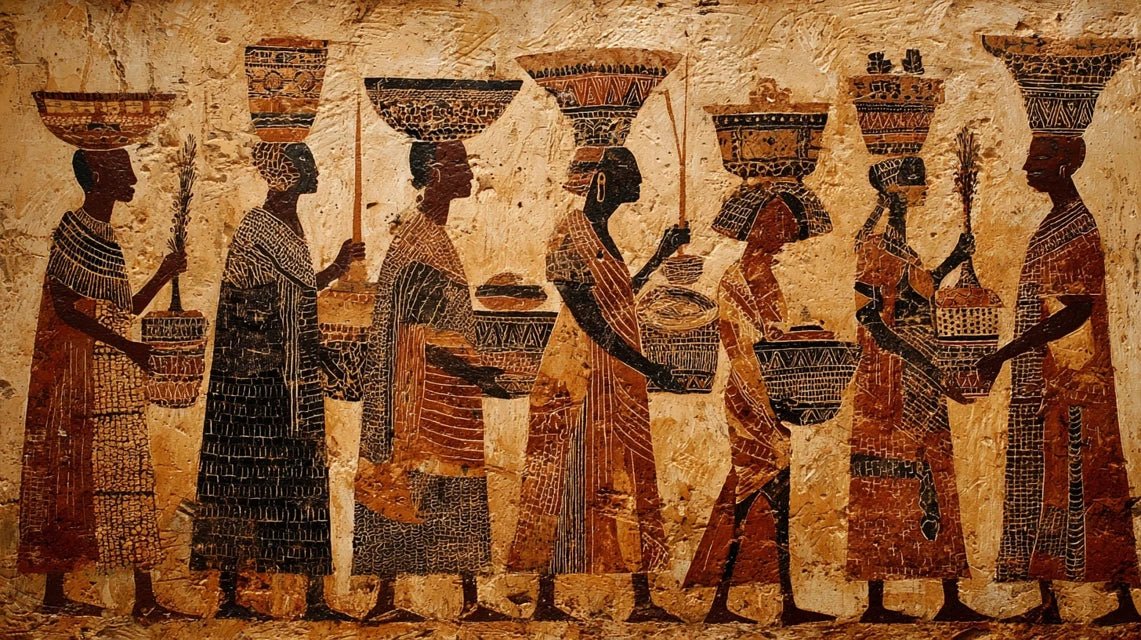
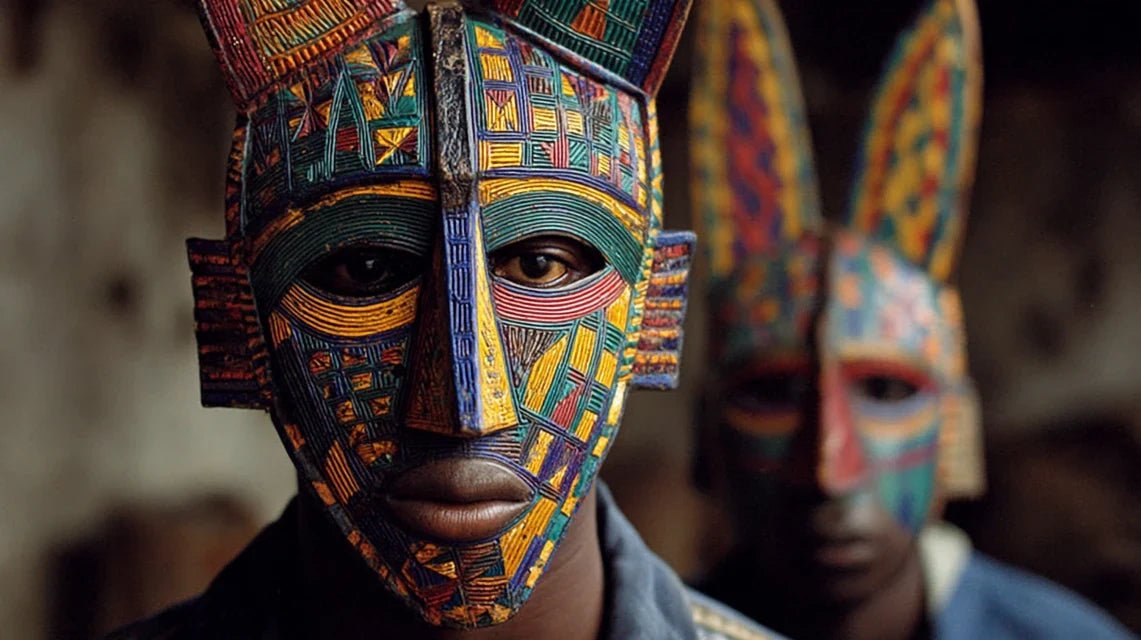
It would be a mistake to confine the Egyptian vulture to a purely antique aesthetic. Egypt belongs to Africa, and this bird resonates deeply with African wall art as a whole. I have worked on several projects where we have merged the classic representation of the vulture with Berber motifs, sub-Saharan geometries, and West African palettes.
The result? A mural artwork that celebrates the continuity of African culture while remaining resolutely contemporary. The Egyptian vulture then becomes a bridge between north and south of the continent, between millennial history and current creation. This approach considerably enriches the visual narrative of an interior.
I particularly remember one fresco where the vulture was surrounded by Ghanaian Adinkra motifs and Moroccan zelliges. The whole created a Pan-African mural conversation of extraordinary richness. Each element retained its integrity while participating in a higher harmony. It is precisely this kind of dialogue that today's lovers of authentic African art are looking for.
The color palette that unites Africa
If you look closely, you will notice that the colors associated with the Egyptian vulture - brilliant white, ochre, deep black, earthy red - are found in artistic expressions throughout the African continent. From the Sahara to the savannah, from deserts to forests, this palette tells a common geological and cultural story. Integrating an Egyptian vulture into an interior that celebrates African art therefore creates a natural chromatic coherence.

Discover this inspiring artwork
How to integrate this power into your interior
After fifteen years of observing reactions to Egyptian vulture frescoes, I have identified three approaches that consistently work. The first: the monumental vulture. An imposing, unique representation that becomes the masterpiece of a room. This option is suitable for generous spaces where you want to create a dramatic focal point.
The second approach favors narrative frieze. Several medium-sized vultures, arranged in sequence, telling a story - flight, hunt, rest. This configuration draws directly from Egyptian temples where narratives unfold horizontally. It works wonderfully along a hallway or above a library.
The third method, more subtle, integrates the Egyptian vulture as part of a larger ensemble. It appears among hieroglyphs, lotuses, sacred scarabs, creating a rich composition that invites the eye to explore. This option is particularly suitable for enthusiasts who want complete cultural immersion.
In all cases, the golden rule remains the same: respect scale and symbolic intensity. A vulture that is too small loses its majesty. Too stylized, it becomes decorative at the expense of the sacred. The balance lies in this tension between strong graphic presence and historical authenticity.
Ready to welcome millennial power into your interior?
Discover our exclusive collection of African paintings that celebrate the heritage of the Egyptian vulture and transform your walls into sacred spaces.
The vulture as an invitation to inner travel
What touches me most about the Egyptian vulture, beyond its graphic beauty and historical significance, is its ability to reconnect us with something essential. In our interiors saturated with stimuli, meaningless objects, interchangeable decorations, this millennial bird acts as a reminder: we need symbolic anchoring.
Each morning, meeting the gaze of an Egyptian vulture on your wall is reconnecting with a spiritual lineage that crosses centuries. It's remembering that our living spaces can be more than functional or aesthetic - they can carry meaning, guardians of wisdom, catalysts for transformation.
I have seen collectors cry in front of certain frescoes. Not misplaced sentimentality, but the raw emotion of recognizing something that resonates deep down. The Egyptian vulture activates this recognition. It tells us: you belong to a story larger than your time, your roots run deeper than you imagine, and these walls can witness this connection.
The fascination exerted by the Egyptian vulture in wall art is therefore not simply a decorative phenomenon or a passing trend. It's the answer to a contemporary thirst for authenticity, depth, accessible sacredness. In a world that values the ephemeral, this bird offers eternity. In interiors that change with trends, it proposes timelessness. And in our often fragmented lives, it brings a symbolic unity that gathers our past, present and future.
You are now standing in front of your bare wall, with a different question. No longer "What am I going to hang?" but "What presence do I want to invite into my daily life?". If the answer resonates with protection, transformation, quiet power and millennial heritage, then the Egyptian vulture awaits you. Start simply: visit galleries specializing in African art, observe quality reproductions, let your instinct guide you towards the representation that speaks to you. Authentic wall art is not chosen rationally - it recognizes us, and we recognize it in return.
Frequently asked questions about the Egyptian vulture in decoration
Does the Egyptian vulture suit all interior styles?
Absolutely, and that’s where its exceptional strength lies. Unlike preconceived notions that confine it to ethnic or eclectic interiors, the Egyptian vulture remarkably integrates into minimalist, industrial, or even Scandinavian spaces. The key is in the graphic treatment and color palette. In a contemporary loft, prioritize a clean black and white representation that emphasizes the geometry of the bird. In a bohemian interior, dare to use traditional ochre and turquoise colors. For an industrial style, opt for a mixed technique combining raw stucco and natural pigments. I’ve even seen sublime Egyptian vultures in minimalist Japanese interiors, where the silhouette of the bird dialogued with the zen philosophy of inhabited emptiness. The essential is to respect two principles: the quality of execution (a poorly executed vulture breaks the harmony) and the consistency of scale (the work must converse with your architecture, not dominate it brutally). If you are hesitant, start with a transitional piece like a hallway or entrance, where boldness is more easily acceptable before conquering the main living spaces.
Does this strong symbolism risk becoming tiresome over time?
This is a legitimate concern that I regularly hear, and my experience provides a reassuring answer: millennial symbols do not become tiresome, they are revealed progressively. Unlike purely decorative motifs which quickly exhaust their visual interest, the Egyptian vulture works in layers of meaning. In the first few months, you appreciate its graphic presence, its immediate aesthetic impact. Then you begin to notice the details: the precise curve of a wing, the intensity of the gaze, the symbolism of protection. Next comes the historical dimension - you research, discover Nekhbet, understand the associated rituals. Finally, the personal relationship unfolds: the work becomes a silent companion, an anchor in your daily life. I have clients who have lived with Egyptian vulture frescoes for ten years and confide to me that they still discover new resonances. The symbolic depth acts as an inexhaustible source - the more you draw from it, the more it is renewed. If you are still afraid of monotony, opt for a technique that evolves with the light: a bas-relief that transforms according to natural lighting, a fresco with pigments that subtly patinate, or a modular composition that you can rearrange.
How to distinguish a respectful representation from a simple exotic decoration?
This question reveals an essential sensitivity to cultural appropriation, and I commend you for it. The boundary between authentic homage and superficial decoration rests on three criteria. Firstly, historical research: a respectful representation relies on precise iconographic sources - frescoes of temples, papyri, funerary stelae. Always ask the creator about their references. A serious artist will be able to quote their inspirations, show you the originals that guided them. Secondly, quality of execution: The Egyptians attached sacred importance to the artistic gesture. A sloppy reproduction, with approximate proportions, betrays this respect. Observe the symmetry of the wings (almost perfect in Egyptian art), the precision of the feathers, the anatomy of the bird. Thirdly, intention: honestly question your motivation. Are you looking for an eye-catching exotic object or an authentic cultural connection? Do you want to understand what the Egyptian vulture represents or simply follow a trend? A respectful approach involves documenting yourself, learning the history of Nekhbet, understanding why this bird was sacred. Favor artists and artisans who work with traditional techniques, who can explain their process, and ideally who maintain a personal link with Egyptian or African culture. Authentic wall art is not consumed, it is received with gratitude and responsibility.