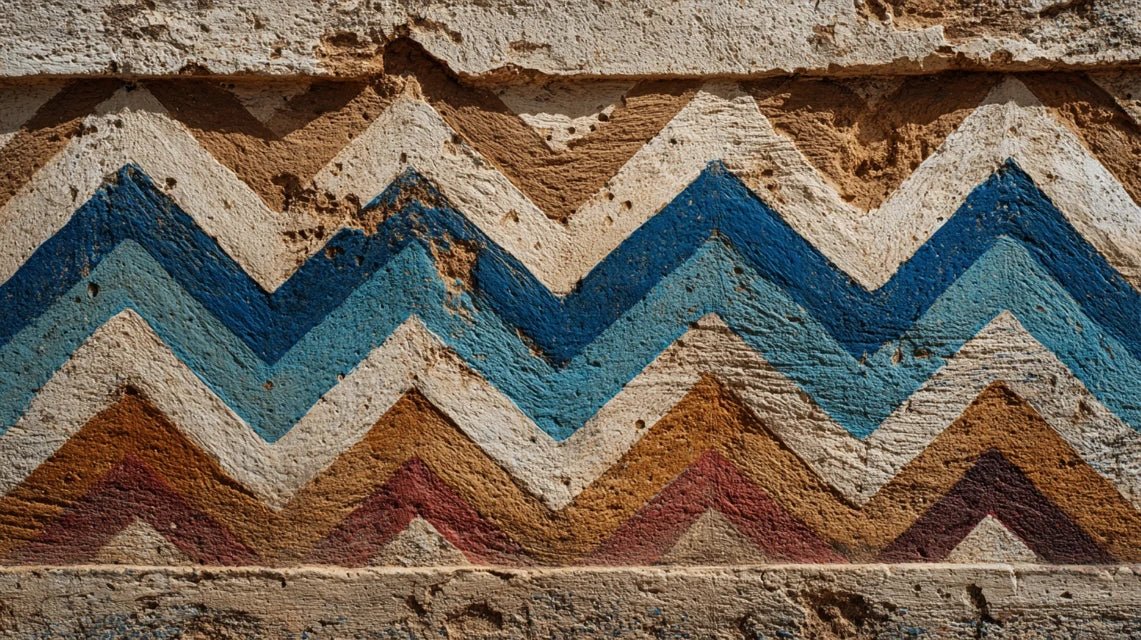
The first time I saw an Ndebele wall with my own eyes, in a small community near Pretoria, I stood frozen for several minutes. These vibrant zigzag patterns seemed to dance under the South African sun, telling a story I didn't yet understand. A grandmother, sitting in front of her freshly painted house, smiled at my wonder: “Each line tells our story”, she told me. That day, I understood that these zigzags were not mere decorations.
Here’s what the zigzag patterns in Ndebele wall art reveal: they convey the history of a resilient people, encode messages between women, and create a unique visual language born from cultural resistance. These bold geometric shapes carry within them centuries of wisdom, rebellion, and identity.
You've probably come across these Ndebele murals on Pinterest or in decorating magazines. You admire their surprising modernity, their vibrant colors, those hypnotic zigzags. But no one has really explained to you why these patterns exist, what they actually mean, or how they became one of Africa's most recognizable artistic legacies.
Rest assured: the history of Ndebele motifs is as fascinating as it is accessible. It blends political resistance, matrilineal transmission, and creative genius. After fifteen years studying traditional African art and collaborating with Ndebele artisans, I'm going to reveal the hidden secrets behind each line.
You will discover how these wall zigzags became an act of defiance, a secret code between women, and today, an inexhaustible source of inspiration for contemporary decoration. Prepare to see these geometric patterns in a whole new light.
The birth of zigzags: a secret language born of oppression
The history of Ndebele zigzag motifs begins in the 1820s, but it was in the 20th century that they took on their revolutionary dimension. When the apartheid regime banned the Ndebele people from speaking their language publicly and confiscated their land, women retaliated with their brushes.
The zigzags became a coded visual language. Each angle, each color, each variation of the pattern conveyed information: the marital status of a family, important events, kinship ties. These murals transformed each house into a page of a living book, readable only by those who held the keys to reading it.
What makes these geometric patterns so powerful is their dual nature. To the outside eye, they are beautiful abstract decorations. For the Ndebele community, each line tells: “This family celebrated a marriage”, “This house experienced a mourning”, “This woman has attained a respected status”.
The zigzag itself symbolizes the path of life: neither linear nor predictable, made up of ups and downs, unexpected turns. This angular shape embodies resilience – the ability to change direction without ever breaking.
An exclusively feminine art: passed down from mother to daughter for generations
Here's an essential fact to understand Ndebele motifs: these are created by women, and only women. This art is passed down from mother to daughter in a strict matrilineal tradition, perpetuated for centuries.
Each young Ndebele girl learns to paint the zigzags around the age of ten. She begins by observing her mother, then practices on secondary surfaces before being entrusted with a section of wall. The technique is rigorous: no rules, no masking tape, just a chicken feather or a rudimentary brush, a firm hand and years of practice.
The Ndebele murals are regularly redone, often after important events or simply to refresh the house. It's not a static art form intended to last for decades like a European fresco. It is a living art, which evolves, breathes, transforms with the life of its inhabitants.
The painting ritual
The traditional process begins with preparing the wall with a mixture of cow dung and clay, creating a smooth surface. Then come the pigments: formerly natural (ochres, charcoal, lime), now often replaced by acrylic paints in vibrant colors – electric blue, fuchsia pink, lemon yellow, emerald green.
The woman first traces the main lines in white, outlining the areas. Then she fills the spaces with her zigzag motifs, chevrons, interlocking triangles. Each artisan develops their own style, recognizable by initiates. It's like a visual signature.

Discover this inspiring artwork
Decoding the zigzags: what the motifs really tell
Contrary to popular belief, there is no “universal dictionary” of Ndebele motifs. Meanings vary from region to region, from family to family. However, some symbols cross communities with shared interpretations.
Zigzags typically represent the journey of life, obstacles overcome, or the sacred mountains of the Ndebele territory. The sharper the angles, the more they evoke difficulties and moments of rupture. Wide, flowing zigzags suggest a period of prosperity and harmony.
Chevron patterns (repeated zigzags forming Vs) often symbolize protection, visually creating a barrier against negative energies. Interlocking triangles can represent generations fitting together, the family heritage that is perpetuated.
The language of colors
In Ndebele wall art, colors amplify the messages of shapes. White symbolizes purity and new beginnings. Red evokes passion, blood, ancestral ties. Blue – particularly prized – represents the protective sky and water source of life. Yellow embodies wealth and solar energy.
Ndebele women combine these vibrant colors with a boldness that defies our Western conventions. A wall can juxtapose five or six saturated hues without any transition, creating a striking visual impact. This chromatic audacity has become the recognizable signature of Ndebele art.
From tradition to modernity: the evolution of zigzag patterns
Ndebele zigzag patterns have undergone a fascinating evolution throughout the 20th century. In the 1940s-1950s, the patterns were relatively subdued, mainly using natural ochres and simple geometric shapes. Then, in the 1960s, a revolution occurred.
Access to brightly colored industrial paints transformed the aesthetics. Artisans enthusiastically adopted these new pigments, creating the vibrant wall paintings we know today. Some purists criticized this “modernization,” but Ndebele women saw it as an opportunity to amplify their visual message.
More recently, Ndebele patterns have incorporated elements of the contemporary world. Some artisans incorporate shapes reminiscent of airplanes, cars, mobile phones – always stylized in the traditional geometric language. These additions prove that Ndebele art is not frozen in the past but continues to evolve.
International influence
Since the 1990s, Ndebele zigzags have conquered the world of design. From fashion designers to interior architects, all are inspired by these bold geometries. Esther Mahlangu’s house – the most famous Ndebele artist – has been photographed in all the decoration magazines around the world.
This international recognition has created economic opportunities for the Ndebele communities, but also raised complex questions about cultural appropriation. When a luxury brand uses Ndebele motifs without crediting or compensating the culture of origin, it is problematic. Ideally, one should be inspired while honoring and supporting the artisans.

Discover this inspiring artwork
Integrate the spirit of Ndebele zigzags into your decor
You don't need to paint entire walls to capture the energy of Ndebele zigzag motifs. The essence of this art lies in its boldness, its frank geometry and its vibrant contrasts – principles adaptable to any interior.
Start with a focal point : a cushion with geometric patterns, a rug with colorful zigzags, or an authentic work of art. The important thing is to let this element breathe, give it space rather than drowning it in a profusion of competing patterns.
For a more impactful look, consider an accent wall inspired by Ndebele aesthetics. You can use painter's tape to create crisp lines and precise zigzags, choosing three or four contrasting colors. The result will be modern, graphic and full of joyful energy.
The golden rules
To honor the spirit of Ndebele murals in your decor : prioritize frank geometry over curves, dare to use bright colors in saturated blocks, create contrast with white or black borders, and mix scales (large and small patterns).
Don't be afraid of color. Ndebele art teaches us that visual joy is an act of resistance against monotony. An interior that celebrates zigzags and bold hues is an interior that refuses blandness and affirms its personality.
Transform your space with the vibrant energy of African art
Discover our exclusive collection of African art that captures the audacious spirit of traditional motifs and brings color and character to your interior.
What Zigzags Teach Us About Beauty and Resilience
Beyond their visual impact, Ndébélé zigzag patterns carry a valuable philosophical lesson. They remind us that beauty can be born from adversity, that creativity finds ways even in oppression, and that culture is sometimes passed down through the most everyday gestures.
These wall paintings also question our relationship with art. In Western culture, art is often confined to galleries, museums, designated spaces. Ndébélé women show us another way: art as an integral part of the habitat, regularly renewed, accessible to all eyes.
There is something profoundly liberating about this approach. Imagine considering your home as an evolving canvas, repainting a wall to mark a new chapter in your life, using decoration as narrative language rather than simple static embellishment.
Ndébéle zigzags invite us to rethink our relationship with color, geometry, and visual audacity. In a world of beiges and timeless grays, they shout that chromatic joy is a legitimate choice, that exuberance has its place in our interiors.
The next time you see a zigzag pattern – on fabric, in a magazine, or better yet, during a trip to South Africa – you will know that you are observing much more than a pretty decorative motif. You are looking at the heritage of a cultural resistance, the secret language of generations of women, and living proof that art can be both beautiful and deeply meaningful.
Start small if you wish: a cushion with geometric patterns, a poster inspired by Ndébélé art, or simply a new look at the zigzags already surrounding you. The essential thing is to welcome into your life some of this vibrant energy, this chromatic audacity, this philosophy that transforms every surface into history. Your walls too can tell your journey, your transformations, your path made of broken lines and bright colors.