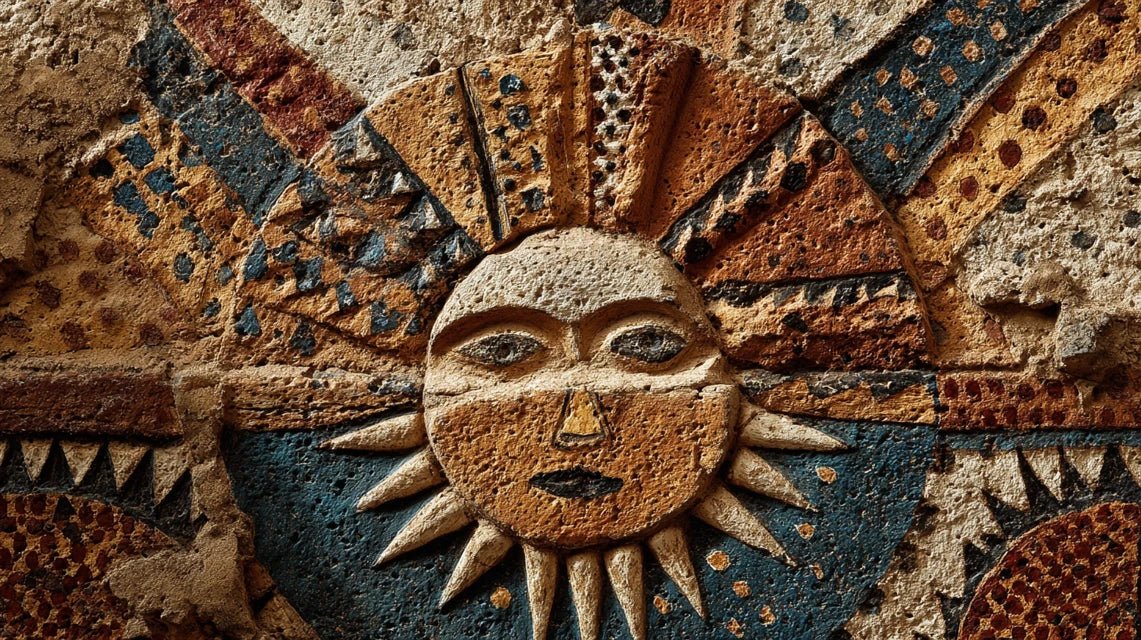
The first time I laid eyes on these radiant circles carved into the rock of Tassili n'Ajjer, I felt this mysterious connection with artists who disappeared millennia ago. These solar motifs are not mere decorations: they tell the story of an entire civilization that survived in one of the most hostile environments on the planet.
Here’s what the solar motifs in Saharan mural art bring: a deep understanding of the spiritual beliefs of ancient desert peoples, a symbolic connection with the cycles of life and death, and a visual testimony to the vital importance of the sun in human survival. Many believe that Saharan rock art is limited to animal representations. Yet, these celestial symbols constitute the true sacred language of these forgotten civilizations. Let me guide you through these circles of light carved into stone, and discover why they still resonate today in our contemporary quest for meaning and harmony.
The sun as a deity: when stone becomes temple
In the vast desert expanse of the Sahara, the sun was not simply a celestial body: it was the supreme divinity, one that gave and took away life at will. The mural solar motifs found in the caves of Hoggar, Tassili or Adrar des Ifoghas testify to this absolute veneration.
These circular representations, often accompanied by stylized rays or concentric spirals, symbolized universal creative power. Saharan artists did not choose these sites at random: the rocky walls were oriented to capture the first or last rays of the day, transforming each sunrise and sunset into a luminous ritual where the engraved symbols literally lit up.
The sacred geometry of the radiant circle
The circular shape of the solar motif is never random. It embodies perfection, eternity, the endless cycle. Around this central circle, the rays generally spread in symbolic numbers: four for the cardinal directions, eight for the desert winds, twelve for the lunar cycles. This precise geometry reveals a sophisticated cosmology where each engraved line carried a deep spiritual meaning.
Between life and survival: the symbols of daily rebirth
Living in the Sahara meant facing an existential struggle every day. The sun represented this fascinating duality: a source of life through its warmth and light, but also a destructive force capable of annihilating all existence. The Saharan solar motifs capture this tension in their very aesthetics.
Carefully observe these engravings: many feature a dark center surrounded by light rays, or vice versa. This alternation symbolizes the day-night cycle, but also death-rebirth, drought-rain, despair-hope. For these nomadic peoples, each sunrise was a renewed promise, a victory over the glacial darkness of the desert night.
The wall representations frequently show human figures in prayer or dance around these solar symbols, suggesting complex rituals intended to honor the star and ensure its benevolence. These scenes reveal a society deeply connected to cosmic rhythms, where spirituality permeated every aspect of existence.

Discover this inspiring artwork
The colors of the star: ochre, red and the gold of the desert
The chromatic palette of Saharan solar motifs is never neutral. Yellow ochre and red dominated these compositions, obtained from iron oxides naturally present in the desert. These shades directly evoked the colors of the sun at different times of the day: the bright yellow of the zenith, the incandescent red of twilight.
A mineral alchemy full of meaning
The choice of pigments was part of a spiritual approach as much as an aesthetic one. Red ochre, sometimes called 'blood of the earth', symbolically linked the sun to human life, the vital flow. Some rock sites feature solar motifs where the pigments have been applied in multiple layers, creating effects of depth and radiance that seem to pulsate even today.
This sophisticated technique suggests that artists were seeking to capture not the static appearance of the sun, but its dynamic energy, its ability to transform everything it touches. In your contemporary interior, finding these warm tones immediately creates an atmosphere of ancestral connection and enveloping warmth.
Spirals and concentric circles: cosmology in motion
Beyond the simple radiating disc, Saharan artists have developed complex variations of the solar motif. Spirals symbolized the apparent movement of the sun in the sky, its daily course from east to west. Concentric circles, on the other hand, evoked the different spheres of the universe: terrestrial, celestial, divine.
These sophisticated representations reveal a precise astronomical observation. Some researchers have identified references in these patterns to solstices, equinoxes, or even solar eclipses that must have terrified and fascinated these populations. Saharan wall art thus served as a sacred calendar, a cosmological map, a collective memory engraved in stone for eternity.
The sun as a bridge between worlds
In many ancient Saharan cultures, the sun was considered a portal between the world of the living and that of the ancestors. Solar motifs placed near tombs or in isolated caves suggest this psychopomp function: the star guided souls on their post-mortem journey, raising them to the firmament.
This funerary dimension explains why so many rock art sites featuring solar symbols have been discovered in remote, difficult-to-access locations, as if these spaces constituted sanctuaries reserved for the most sacred rituals. The austere beauty of these wall representations evokes a stripped-down spirituality, focused on the essential.
Bring the symbolic power of the African sun into your home
Discover our exclusive collection of African paintings that capture the millennial essence of these Saharan motifs and transform your space into a sanctuary of light and positive energy.

Discover this inspiring work
In our modern, hyperconnected but spiritually fragmented world, Saharan solar motifs exert a magnetic attraction. They embody a direct, unmediated relationship with fundamental natural forces. Their refined geometry responds to our contemporary thirst for minimalism and authenticity.
Integrating these ancient symbols into interior decoration is not merely an aesthetic trend: it's reconnecting with a millennial wisdom, acknowledging that our ancestors possessed an intuitive understanding of natural cycles that we have largely lost. A Saharan solar motif on your wall becomes a daily reminder of our place in the universe, our dependence on cosmic rhythms.
Contemporary designers reinterpret these Saharan forms into creations that combine respect for tradition and modern sensibility. Radiant circles find their place in Scandinavian, bohemian or ethnic interiors, proving their cross-cultural ability to evoke warmth, protection and vital energy.
Preserve and honor: the fragile heritage of desert walls
These rock art treasures are now threatened by erosion, climate change and sometimes vandalism. Each fading solar motif represents an irreparable loss of our common human heritage. By choosing to celebrate these Saharan symbols in our daily lives, we participate in their memorial survival.
Photographers, artists and artisans who draw inspiration from these ancestral motifs create a form of living cultural preservation. Rather than letting these images disappear into the desert's oblivion, they offer them a new life, a new relevance, while raising public awareness about the importance of protecting the original sites.
Choosing a work inspired by Saharan solar motifs for your interior becomes an act of active memory, a way of saying that these ancient voices still deserve to be heard, that their symbolic wisdom still resonates with our contemporary lives.
Conclusion: under the same sun, across the millennia
Solar motifs in Saharan wall art remind us of an essential truth: despite the millennia that separate us from these anonymous artists, we contemplate the same star, we feel the same warmth on our skin, we seek the same light in the darkness. These circles carved into rock transcend time to connect us to the universal human experience.
Begin your own symbolic journey: observe tomorrow morning's sunrise with a new attention, imagine the hands that patiently engraved these sacred spirals, and ask yourself what legacy you want to leave for future generations. The sun continues its eternal course, and with it, the permanent invitation to honor the light that sustains us.
FAQ: Your questions about Saharan solar motifs
Why was the sun so important to ancient Saharan peoples?
The sun literally represented the difference between life and death in the desert. Beyond its obvious vital function (heat, light, orientation), it structured entire existence: it dictated moments of movement, periods of rest, cycles of activity. For these populations, the sun was not simply a natural phenomenon but a conscious entity with which a respectful relationship had to be maintained. Saharan solar motifs served as sacred interfaces with this power, places where humans could communicate with the divine. This importance is reflected in the central position these symbols occupy in Sahara rock art, often at the heart of the most elaborate compositions, surrounded by ritual scenes or complex cosmological representations.
How to integrate these ancestral symbols into a modern decoration?
Integrating Saharan solar motifs into a contemporary interior relies on the balance between respecting authenticity and adapting to your personal aesthetic. Start by choosing a centerpiece: a painting, tapestry or wall sculpture that captures the essence of these ancient symbols. Prioritize creations that use authentic tones (ochres, sienna earths, deep reds) to maintain the connection with the original pigments. In a minimalist interior, a streamlined solar motif becomes a powerful focal point. In a bohemian space, multiply references with textiles, ceramics or luminaires inspired by these radiant circular forms. The essential thing is not to transform these sacred symbols into simple exotic decoration, but to give them the central place they deserve, creating a true domestic sanctuary of light and positive energy.
Are there different types of solar motifs in Saharan art?
Absolutely, the diversity of Saharan solar motifs reflects the richness of the cultures that populated the desert over millennia. The simple radiating disc is the most common form, but spirals (evoking movement), concentric circles (representing cosmic spheres), double-haloed suns (perhaps symbolizing day and night), and hybrid forms combining solar and lunar elements can also be found. Some regions like Tassili present stylized, almost abstract motifs, while other areas show more naturalistic representations. Variations depended on historical periods (techniques evolved over 10,000 years), ethnic groups (each culture brought its symbolic codes), and probably the specific functions of each site. This diversity makes Saharan solar art a fascinating field where each archaeological discovery reveals new dimensions of ancient desert spirituality.