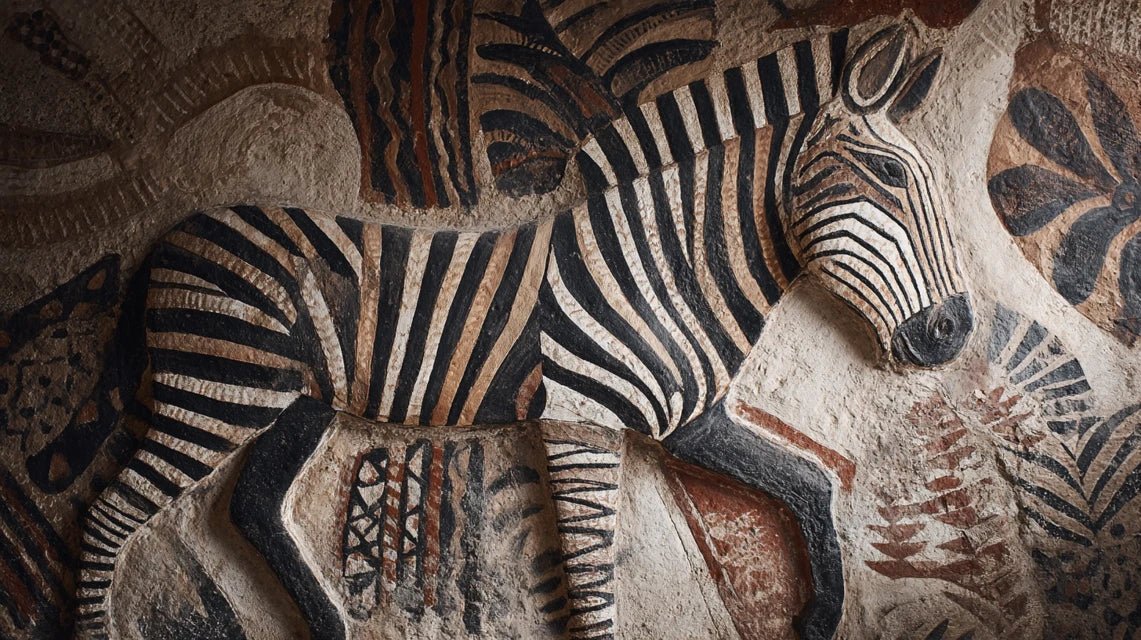
The first time I photographed a mountain zebra in the Cederberg, I realized that these stripes were not simply a random occurrence of nature. Each black and white band seemed to tell a millennial story, a visual code that the San had already deciphered on the rock walls more than 2,000 years ago. These graphic patterns, now ubiquitous in contemporary wall art from Southern Africa, carry a symbolic richness that transcends mere animal representation.
Here's what the symbolism of zebra stripes brings to wall art: a spiritual connection with cosmic balance, a timeless graphic power that structures space, and a cultural heritage that dialogues between tradition and modernity.
Many admire these murals without grasping their depth. We see stripes, we appreciate the bold aesthetics, but we miss the essential point: why do these patterns resonate so strongly within us? Why do muralists in Johannesburg, Cape Town or Maputo keep returning to this symbol?
Rest assured, this symbolic richness is not reserved for initiates. It is offered to anyone who agrees to look beyond appearances, to understand how the stripes of the zebra have become much more than a decorative motif.
In the lines that follow, I invite you on a visual and cultural journey where rock art dialogues with street art, where the sacred animal becomes a graphic manifestation, and where each stripe reveals a fragment of the southern soul.
Zebra stripes in the imagination of the San: much more than an animal
In the Drakensberg caves, San rock paintings reveal a fascinating truth: the zebra was never depicted as mere game. Its stripes appear as energetic portals, lines of force that shamans crossed during their trances. This spiritual conception still deeply permeates contemporary wall art in Southern Africa.
The San perceived within these contrasting bands a principle of universal balance. Black and white did not oppose each other; they coexisted in a dynamic harmony. This visual philosophy explains why so many contemporary murals use zebra stripes to evoke reconciliation, dialogue between opposites, beauty born of creative tension.
The striped pattern as a cosmic map
The ancients interpreted each orientation of the stripes. Vertical ones connected earth to sky. Oblique ones symbolized movement, migration, the eternal cycle. Contemporary mural artists pick up this visual grammar by deliberately orienting their patterns to create works that guide the eye and structure urban space.
In Soweto, I observed a monumental mural where the stripes of a stylized zebra created a disturbing optical effect: depending on the viewing angle, they seemed to ripple, vibrate, almost breathe. The artist confided in me that he had been inspired by the rock paintings of Tsodilo Hills, where the San already exploited these illusions to suggest the passage between visible and invisible worlds.
When street art reinvents heritage: the graphic power of stripes
Southern African wall art has found in the zebra's stripes a universal language. This pattern offers an immediate graphic strength while carrying a cultural depth that anchors the work in its territory. Muralists from Cape Town to Windhoek understood this: these black and white bands capture attention from afar, invite you closer, then reveal their layers of meaning.
The absolute contrast of the stripes works miraculously in an urban context. On dilapidated facades, township walls or industrial surfaces, this pattern instantly creates a focal point. But unlike purely decorative graffiti, the zebra's stripes charge the space with a symbolic presence that transforms the mundane into the sacred.
The visual code of southern identity
In Johannesburg, at the City of Gold festival, I photographed a dozen murals using zebra stripes. Each adopted a different approach: geometric abstraction, hyperrealism, fused with Ndebele patterns, fragmented into pixel art. Yet, all instantly communicated their belonging to Southern Africa.
This is all the magic of this symbol: it has such a strong visual identity that you can deconstruct it, reinvent it, mix it with other influences without losing its ability to evoke its roots. The zebra's stripes have become the connecting thread of a dialogue between generations of artists, between techniques, between visions of the world.

Discover this inspiring artwork
Between duality and unity: the philosophy of stripes in contemporary aesthetics
Southern African wall art uses zebra stripes to explore a universal theme: how do opposites create harmony? This philosophical question, already present in traditional cosmologies, finds a particular resonance in post-apartheid societies where reconciliation remains a daily challenge.
In a monumental mural in Pretoria, the artist depicted two human profiles whose contours merge into zebra stripes. Black and white are not juxtaposed, they intertwine, creating a gray zone that is itself beautiful. This symbolic use of stripes transcends decorative motifs to become a political statement and an invitation to rethink our dualities.
Visual rhythm as a metaphor
The stripes of the zebra create a rhythm, an alternation that guides the eye in a hypnotic movement. Muralists exploit this property to structure their compositions: accelerating the rhythm creates tension and dynamism, slowing it down evokes contemplation and serenity.
I saw in Maputo a fresco where the stripes started from a central zebra to spread over the entire facade, gradually widening into bands of several meters. The effect was striking: one visually perceived the idea of an energy that propagates, an influence that extends, a message that travels.
Contemporary appropriation: from sacred to everyday
A fascinating transformation is taking place in Southern African mural art: the zebra's stripes migrate from sacred spaces (caves, ritual sites) to everyday spaces (markets, schools, train stations). This democratization does not dilute the symbol, it updates it, making it accessible to new audiences.
In Durban, a collective of artists covered the walls of an elementary school with frescoes where children ride stylized zebras. The stripes become a graphic playground, support for imaginary stories. Yet, the symbolic dimension persists: these children grow up surrounded by motifs that visually remind them of their belonging to a territory, a history, a system of values that honors balance and coexistence.
When the motif becomes an identity statement
In the townships, the zebra's stripes assert themselves as a cultural marker. Faced with global visual homogenization, this motif firmly anchors the space in its Southern identity. It resists international trends not by rejection, but by affirming a rooted aesthetic.
I documented an entire alleyway in Khayelitsha where each house displays variations on the theme of zebra stripes. Some hyperrealistic, others cubist, still others fused with traditional textile motifs. The whole creates a stunning visual corridor, an open-air gallery where ancestral symbolism dialogues with contemporary expressive urgency.
 Discover this inspiring artwork
Southern African wall art has developed specific techniques to do justice to the complexity of zebra stripes. The challenge is not only technical, it is conceptual: how to translate in two dimensions the texture, the volume, the movement of these bands that draw a three-dimensional body?
Muralists use light and shadow play to create the illusion of relief. In black stripes, shades of gray suggest the curve of the body. In white ones, touches of ocher or beige evoke the skin under the fur. This chromatic subtlety, far from the apparent binary opposition, reveals the sophistication of the pattern.
Adapting to urban surfaces
In Cape Town, I observed an artist adapting zebra stripes to a wall of irregular bricks. Rather than fighting the texture, he integrated it: each mortar recess became a line of shadow, each protruding brick caught the light differently. The stripes seemed to pulsate with variations in sunlight.
This sensitive approach to the support distinguishes Southern African wall art. Zebra stripes are not placed on the wall, they follow its accidents, its stories, its scars. The symbol is literally embodied in the urban material.
Want to bring this symbolic power into your interior?
Discover our exclusive collection of African paintings that celebrate the visual heritage of Southern Africa with contemporary works inspired by the ancestral symbolism of animal patterns.
Living with stripes: when a symbol transforms space
Imagine yourself every morning facing a work where zebra stripes structure your space, create a visual rhythm that soothes or energizes according to your needs. This presence is not simply decorative: it reconnects you to a philosophy of balance, to an aesthetic that has crossed the millennia without losing its relevance.
Southern African wall art teaches us that great symbols are not consumed, they are lived. Zebra stripes in your interior become silent companions who daily recall the beauty born of the coexistence of opposites, the strength emanating from harmony rather than uniformity.
Start by observing these patterns in contemporary African art. Let them resonate within you. Then choose the work that dialogues with your space, that prolongs these millennial lines of force into your everyday life. This is how ancestral symbolism remains alive: not frozen in museums, but pulsing on our walls, structuring our gazes, nourishing our imaginations.
Frequently asked questions about the symbolism of zebra stripes in art
Why are zebra stripes so prevalent in contemporary African art?
Zebra stripes embody a millennial symbolic heritage while offering graphic strength that works perfectly within the contemporary aesthetic. In Southern African wall art, they represent the balance between opposites, a theme particularly resonant in post-colonial societies seeking to reconcile different heritages. Visually, the absolute black and white contrast immediately captures attention while allowing for endless stylistic variations. Artists also appreciate that this motif is instantly recognizable as African without falling into clichés, thus offering a strong visual identity that can be reinterpreted very personally. Finally, stripes create a rhythm that naturally structures compositions, guiding the eye and creating movement even in a static image.
How to integrate this symbol into a modern interior decoration?
Integrating zebra stripes into a contemporary interior succeeds when one respects the balance between presence and subtlety. Opt for a centerpiece – a large painting inspired by Southern African wall art – rather than multiplying references that would risk creating a thematic atmosphere. Place this work on a clean wall where the motif can breathe and deploy its visual rhythm. Zebra stripes work beautifully in minimalist interiors where their strong graphic contrasts with the surrounding sobriety, but also in more eclectic spaces where they dialogue with other geometric patterns. In terms of colors, black and white stripes harmonize with practically all palettes, but create particularly striking effects with touches of ochre, terracotta or deep green that evoke the landscapes of Southern Africa. The essential is to consider this presence as a structuring element of your space, not as a simple accessory.
What is the difference between a decorative and symbolic use of stripes?
The difference lies in the intention and depth of representation. A purely decorative use reproduces the pattern for its immediate visual impact, without consideration for its orientation, rhythm or dialogue with the space. The symbolic approach, as found in authentic Southern African wall art, considers each aspect of the pattern as carrying meaning: the thickness of the bands, their orientation, variations in texture, interaction with the environment. A symbolic work invites a deep reading – one discovers nuances in the blacks, details in the transitions, an intention in the overall composition. It also creates a dialogue with the cultural heritage of ancestral representations while asserting a contemporary vision. To recognize this difference, observe whether the artwork simply applies a repetitive pattern or uses stripes to create movement, suggest an emotion, structure space thoughtfully. Symbolic art resonates differently depending on your mood and time of day, progressively revealing its layers of meaning.