The first time I crossed the threshold of an Osun shrine in the heart of Oshogbo's sacred forest, my eyes were overwhelmed by a burst of vibrant colors. Monumental frescoes covered every surface, telling millennia-old stories in a visual language that was both foreign and strangely familiar to me. These Yoruba murals were not merely decorative: they pulsed with spiritual energy, transforming the space into a portal between the visible and invisible worlds.
Here's what these murals of the Osun shrines bring to our contemporary understanding of sacred design: a bold color palette that defies our Western aesthetic conventions, a narrative iconography capable of transforming any space into a place of contemplation, and a living artistic tradition that dialogues with modernism without ever denying its roots.
You may have admired African artworks in aseptic galleries, never grasping their original spiritual context. You feel this frustration at creations reduced to their decorative value, emptied of their soul. Yet, Yoruba sacred art offers us much more than mere aesthetic pleasure: it reveals a holistic approach to artistic creation where beauty, spirituality and social function merge into a total experience. I invite you on a journey to the heart of these Nigerian shrines, where every brushstroke is a materialized prayer.
The spiritual heritage of Osun: when the goddess inspires brushes
In Yoruba cosmology, Osun (or Oshun) reigns over fresh waters, fertility and love. This feminine deity also embodies artistic beauty and material abundance. The shrines dedicated to her in Nigeria, particularly in the region of Oshogbo, are epicenters of artistic creation where Yoruba murals reach their most sublime expression.
These temples bear no resemblance to the religious architectures we know in the West. Nestled in a lush forest recognized by UNESCO, the Osun shrines blend into their natural environment. Exterior and interior walls become monumental canvases where founding myths, attributes of the goddess and symbols of fertility are expressed.
Tradition has it that artists commune spiritually with Osun before painting. It's not simply a decorative work: it is an act of devotion. The pigments themselves possess a sacred dimension, often prepared according to ancestral recipes passed down orally from generation to generation. Yoruba sacred art never separates the creative gesture from its spiritual intention.
A chromatic explosion that defies conventions
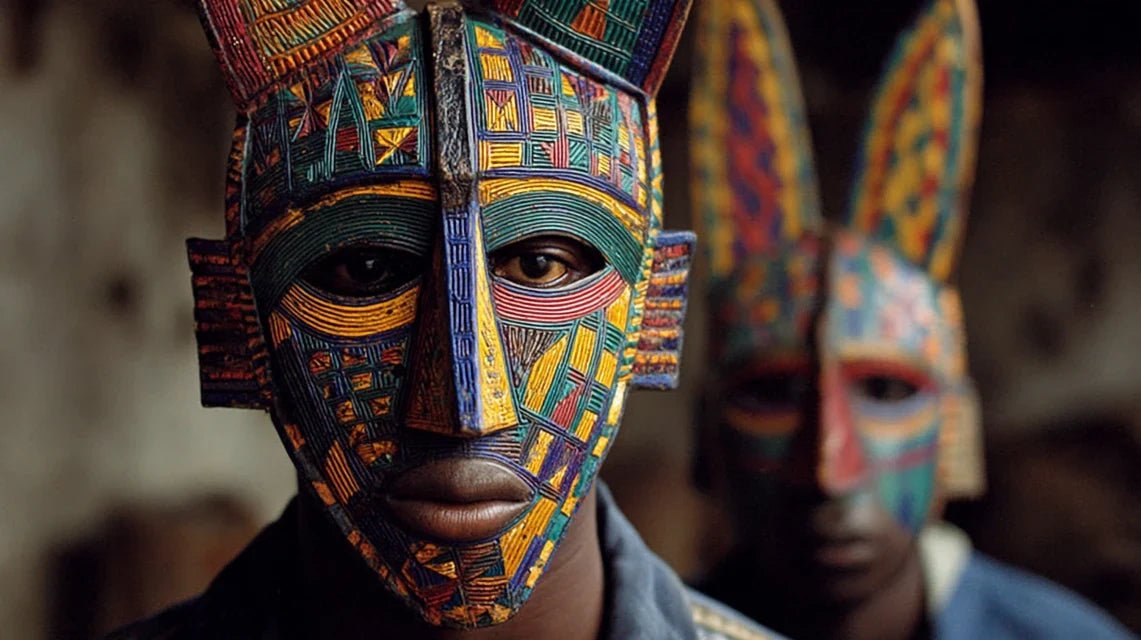
If you’re expecting muted, earthy tones, the Osun sanctuary murals will deliver a masterful surprise. Yoruba artists wield an unexpectedly modern palette: electric blues, bright yellows, deep reds, emerald greens. These vibrant colors are not chosen at random.
The golden yellow evokes gold, honey, and amber, all associated with Osun. It's not the pale, understated yellow of our minimalist interiors, but a vibrant yellow that captures equatorial light. The turquoise recalls the waters of the sacred river, while the white symbolizes spiritual purity and ancestors.
This chromatic boldness profoundly influenced my understanding of contemporary design. We are so afraid of color in the West; we confine it to timid touches, cushions carelessly tossed on a gray sofa. Yoruba murals teach us that a wall can become a visual celebration, that chromatic saturation does not necessarily produce chaos but can generate a higher harmony.
Ancestral pictorial techniques revisited
Artists at the Osun sanctuaries traditionally use natural pigments extracted from local minerals, plants, and even crushed seashells. The binder? Often a preparation based on plant sap or palm oil. This organic approach gives the frescoes a particular texture, slightly matte, which absorbs and reflects light in a unique way.
Since the 1960s, thanks in part to the influence of Austrian artist Susanne Wenger who settled in Oshogbo, techniques have been enriched without betraying the spiritual essence. Acrylic paints have joined the traditional palette, allowing increased durability in Nigeria’s humid climate. This technical hybridization perfectly illustrates how Yoruba sacred art remains alive by integrating modernity.

Discover this inspiring artwork
The symbolic language: decoding narrative frescoes
Faced with a Yoruba mural, the Western gaze sometimes feels lost. Where does the story begin? What is the visual hierarchy? These questions themselves reveal our cultural assumptions. Yoruba iconography does not function according to a linear reading but according to a circular and multidimensional logic.
Fish frequently appear in Osun shrines, symbolizing the fertility and abundance of waters. Gourds evoke femininity and ritual offerings. Serpents are not malevolent figures but messengers between worlds, guardians of ancestral wisdom. Birds, especially peacocks, represent the beauty and divine vanity of Osun.
This visual grammar composes complex narratives. A fresco can simultaneously tell a creation myth, illustrate the attributes of the goddess, map the ritual space of the sanctuary, and serve as a meditative support for the faithful. This semantic density radically distinguishes Yoruba sacred art from profane decoration.
Monumental female figures
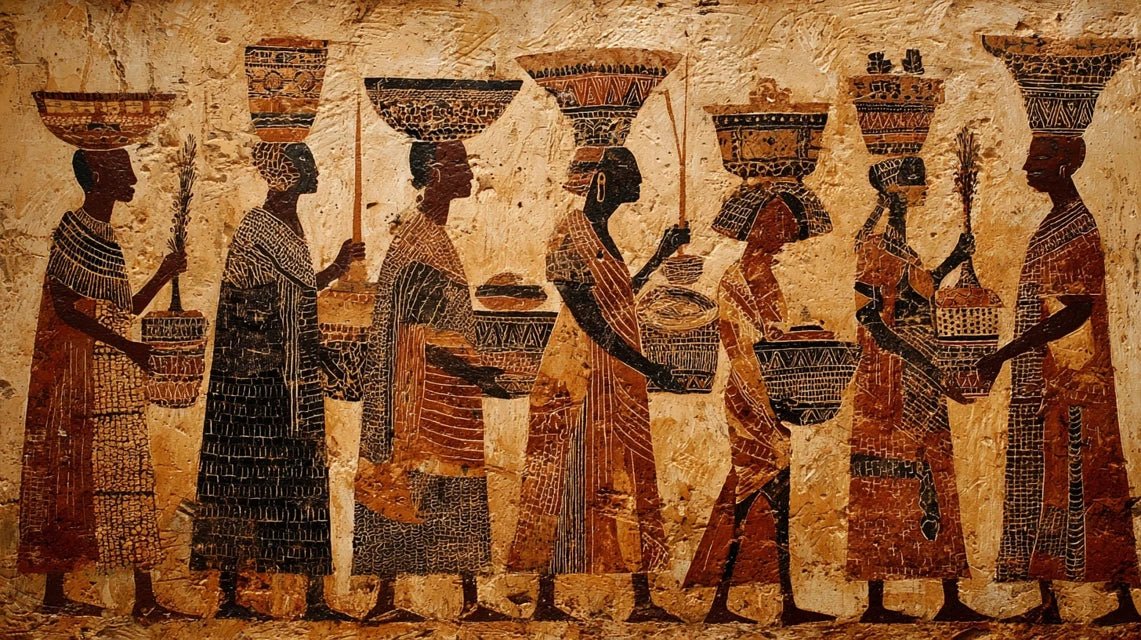
In the wall paintings of Osun shrines, the female figure dominates. Osun herself is represented with an assumed sensuality: generous breasts, wide hips, sumptuous jewelry. This celebration of the female body as a source of life and prosperity contrasts with the prudishness that has long characterized Western religious art.
These representations are not erotic but reverential. They affirm that the sacred passes through the corporeal, that spirituality does not require rejection of the flesh. For a contemporary designer, this approach offers extraordinary freedom: it legitimizes sensuality in space, it authorizes an aesthetic of abundance rather than asceticism.
When shrines meet artistic modernity
The sacred forest of Oshogbo embodies this miraculous fusion between tradition and avant-garde. In the 1960s, Susanne Wenger and Yoruba artists such as Adebisi Akanji created a unique artistic movement, the New Yoruba Sacred Art. Wall paintings were enriched with expressionist influences without ever losing their spiritual function.
This period saw the emergence of more abstract compositions, unprecedented perspective games, while maintaining the traditional symbolic vocabulary. The walls of Osun shrines became laboratories where aesthetic innovation and ritual fidelity coexist harmoniously.
This lesson resonates deeply with anyone interested in contemporary space design. It proves that one can honor a heritage without fossilizing, that one can integrate diverse influences without diluting one's identity. Yoruba wall paintings show us that tradition is not a museum but a living organism.

Discover this inspiring artwork
Inspiration for our interiors: conveying sacred energy
How to integrate the spirit of these Osun sanctuary murals into our living spaces? The idea is not to slavishly copy sacred motifs out of their spiritual context. But we can draw inspiration from their fundamental aesthetic principles.
Dare to create a statement wall. Rather than accumulating small, scattered works, consider an entire wall as a canvas. Yoruba sacred art teaches us that impact comes from scale and boldness. A large expanse of color, a mural commissioned from a local artist, a monumental wall composition can radically transform the atmosphere of a room.
Embrace saturated color. Yoruba paintings free us from the tyranny of beige and gray. A deep blue, a golden yellow, a burnt terracotta: these hues have lasted for centuries because they resonate with something deeply human. They are not fleeting trends but chromatic archetypes.
Integrate visual storytelling. The frescoes in the Osun sanctuaries tell stories. Your space can do the same: a gallery wall documenting your travels, a composition of objects evoking your family history, motifs celebrating what you truly care about.
The overall sensory dimension
The Osun sanctuaries are not limited to the visual. The overall experience integrates the rough textures of earth walls, the scents of incense and flowers, the sounds of the surrounding forest. This multisensory approach should inspire our way of designing interiors.
A textured wall is not just a surface to look at: it's a tactile invitation. Yoruba murals, with their thickness and relief, engage the whole body in the aesthetic experience. Think of lime plasters, chalk paints, sculpted panels that add physical depth to your walls.
Let the vibrant energy of Africa transform your space
Discover our exclusive collection of African paintings that capture the spiritual and chromatic essence of millennial artistic traditions to infuse authenticity and character into your interiors.
Preserving and celebrating a living heritage
The murals of the Osun sanctuaries face considerable contemporary challenges. The Nigerian tropical climate, natural erosion, limited resources for conservation threaten these artistic treasures. Yet, unlike works in museums, these frescoes continue to fulfill their spiritual function.
UNESCO's recognition of the sacred forest of Oshogbo as a World Heritage Site in 2005 has brought crucial international visibility. But true preservation will not come only from institutions: it emerges from the renewed interest of young Yoruba generations for their cultural heritage, and from the attention we, international admirers, give to this Yoruba sacred art.
Each time we integrate the spirit of these works into our own spaces, each time we recognize the sophistication of these traditions, we participate in their cultural survival. Appreciation is not appropriation when it comes with respect and contextual understanding.
The subtle but profound global influence
If you look closely at contemporary wall art in world metropolises, you will discover the imprint of Yoruba paintings. From artists of the African diaspora to creators who have traveled to Nigeria, the influence is manifested: in the chromatic boldness, in the narrative non-linear compositions, in the celebration of the body and spirituality.
Street art, in particular, owes a great deal to these African mural traditions. The very idea that a wall can become a space for cultural proclamation, identity resistance and democratic beauty finds echoes in Yoruba sacred art which, long before our urban frescoes, transformed public surfaces into powerful visual statements.
Imagine yourself in your living room, facing a wall that no longer inspires you. You have considered off-white, perhaps a pearl gray if you feel adventurous. Now visualize the same space transformed by the spirit of the Osun sanctuaries: a golden yellow that captures the changing light of the day, patterns that tell your own story, a presence that transforms a simple room into a personal sanctuary.
The murals of the Osun sanctuaries in Nigeria teach us that our living spaces can be much more than functional or even beautiful: they can be nourishing for the soul. Start modestly. Choose a wall, a bold color that speaks to you, a symbol that resonates with your journey. The Yoruba sacred art does not ask you to copy, but to connect with this universal truth: the environment we create shapes who we are.
Let these millennial traditions remind you that your home is not just a place of passage, but a personal temple deserving the same creative and spiritual intention that Yoruba artists bring to their sacred sanctuaries.