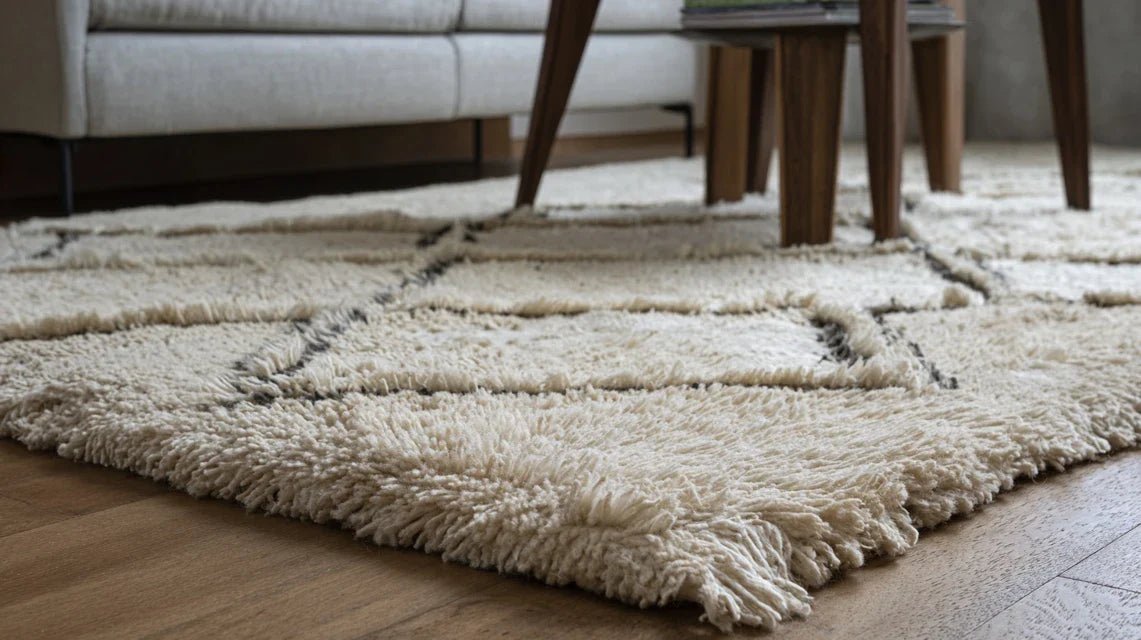
The first time I hung a Beni Ourain Berber rug on the wall of a Parisian gallery, visitors stopped dead in their tracks. It was no longer just a textile: it was a contemporary work of art that dialogued with the abstract canvases around it. The asymmetrical black lines on a milky background captured the light like a minimalist installation, transforming the space into a sanctuary of serenity. Since this foundational experience, I have understood that these Moroccan artisanal pieces transcend their primary function to become true wall sculptures.
Here's what Beni Ourain rugs bring to minimalist wall art: an artisanal authenticity that warms up clean interiors, an organic geometry that animates white walls without overwhelming them, and a tactile presence that introduces the missing sensory dimension in contemporary spaces.
Are you looking to personalize your minimalist interior without betraying its purity? Do you find your walls too cold, too white, too impersonal? Are you hesitating between expensive contemporary artworks and soulless mass production decorations? Beni Ourain rugs as wall art offer this rare third path: accessible authenticity, character without ostentation, warm sophistication.
Rest assured: transforming a Berber rug into a wall installation requires neither particular technical skills nor an excessive budget. This decorative approach adapts equally well to industrial lofts and Haussmannian apartments, cocooning bedrooms and design living rooms. In this article, I share my discoveries on the harmonious integration of these Moroccan pieces into contemporary minimalist aesthetics.
The Berber Soul Serving Western Minimalism
Beni Ourain rugs are born in the mountains of Morocco, woven by Berber women according to millennial traditions. Their natural palette – cream, ecru, off-white enhanced with black or brown motifs – is a direct result of the undyed wool from local sheep. This chromatic sobriety is not a modern aesthetic choice but a consequence of the mountain environment where these pieces served as protective blankets against the cold.
What fascinates about the Beni Ourain minimalist approach is their intuitive geometry. The artisans do not work from plans: they improvise diamonds, broken lines, scattered dots that tell their personal story. Each motif becomes unique, carrying a silent narrative. Unlike repetitive industrial prints, these asymmetrical compositions create a dynamic balance that captivates the eye without tiring it.
Hanging a Berber rug on the wall reverses its primary function while revealing its artistic dimension. Freed from being walked upon, the textile fully reveals its high wool texture, its artisanal irregularities, and its variations in density. Natural light sculpts the reliefs of the weaving, creating subtle shadows that animate the surface throughout the day.
When Texture Replaces Color
In a minimalist interior, the absence of bright colors does not mean visual monotony. Beni Ourain rugs perfectly embody this principle: their richness lies in tactile depth rather than chromatic palette. The thick wool, hand-knotted with varying densities, creates a palpable relief that adds a physical dimension to flat walls.
I have observed how a Berber rug of 150x200 cm transformed a bare white wall into a magnetic focal point. The contrast between the smooth surface of the wall and the generous texture of the textile generates a captivating visual tension. The clean motifs black on natural background work like gestural brushstrokes on a blank canvas, introducing movement without breaking the monochrome harmony.
This decorative strategy brilliantly responds to the problem of Scandinavian or Japanese interiors that sometimes lack warmth. The wall rug instantly brings this essential organic touch: the presence of life, imperfection, authenticity. It humanizes the design space without compromising its sobriety, a difficult balance that few decorative objects achieve.
The dialogue with contemporary architecture
The geometric lines of the Beni Ourain motifs naturally dialog with contemporary architecture. In a loft with exposed metal beams, these tribal compositions create a fascinating contrast between primitivism and modernity. In an apartment with clean lines, they introduce the welcome irregularity that breaks the sometimes cold perfection of industrial design.
The wall dimension of Berber rugs gives them a sculptural presence. Unlike framed paintings, they occupy space with an affirmed materiality. Their thickness projects shadows, their texture absorbs sound, their generous format visually structures the room. They become flexible partitions, tactile screens, three-dimensional canvases.

Discover this inspiring artwork
Composing a Berber wall gallery
To create a coherent wall art with several Beni Ourain rugs, I apply the rule of three: three pieces of different sizes arranged in an asymmetrical constellation. A large central rug (200x300 cm) anchors the composition, flanked by two smaller pieces (100x150 cm) placed vertically offset. This arrangement creates a visual rhythm that guides the eye across the wall.
The spacing between pieces is as important as the rugs themselves. I allow each textile to breathe by maintaining at least 30 cm between the edges. This negative space amplifies the presence of each piece, allowing the eye to appreciate the patterns individually before perceiving the whole as a global installation.
For a bolder approach, the partial overlap of two Berber rugs creates an unexpected depth. A large light rug becomes the background on which a smaller one, with denser patterns, stands out in relief. This technique borrows from collage practices while preserving the clean aesthetic characteristic of minimalism.
The importance of wall support
Fixing a rug to the wall requires a method adapted to its weight. For lightweight pieces (less than 3 kg), a discreet metal rod inserted into the upper weave is sufficient. Heavier rugs require an industrial Velcro system: one adhesive strip attached to the wall, its counterpart sewn onto the back of the textile. This invisible solution preserves the illusion of a floating artwork.
Some collectors opt for minimal framing: four thin strips of natural wood that border the Berber rug without constraining it. This hybrid approach evokes works under glass while respecting the textile nature of the object. The frame visually structures the piece, facilitating its integration into a wall gallery composed of other mediums.
Strategic zones for wall installation
The headboard is the preferred location for a Beni Ourain rug on the wall. Its woolly texture creates a cozy cocoon that visually envelops the sleeper, while its geometric patterns bring graphic interest without excessively stimulating the mind before sleep. The neutral palette of the Berber rugs naturally harmonizes with white or linen bedding, pillars of the minimalist bedroom.
In a clean living room, the wall opposite the sofa offers the ideal field of vision. A large Berber rug becomes the equivalent of a visual fireplace: a warm convergence point that anchors the living space. Its generous dimensions counterbalance the low furniture typical of Scandinavian design, restoring verticality often absent from contemporary interiors.
For circulation areas – hallways, entrances, landings –, a wall rug transforms the passage into a gallery. These neglected zones instantly gain character thanks to the textile presence. The narrow format of hallway Beni Ourain rugs (80x250 cm) is perfectly suited to these linear architectures, creating a perspective effect that visually expands the space.
Playing with architectural lighting
Lighting reveals or conceals the subtleties of clean motifs. Ceiling-mounted grazing light accentuates the texture of the weave, creating spectacular shadow plays that evolve with the time of day. Conversely, frontal lighting softens contrasts, highlighting the woolly softness rather than the graphic geometry.
I particularly appreciate adjustable spotlights which allow to modulate the atmosphere. In the evening, a warm light (2700K) warms the cream tones of the Berber rug, creating a cocooning atmosphere. During the day, letting natural light dialogue with the textile reveals subtle nuances of raw wool – from off-whites to pink beiges – invisible under artificial lighting.
Transform your walls into an authentic art gallery
Discover our exclusive collection of African paintings that capture the essence of artisanal traditions to sublimate your minimalist interior.

Discover this inspiring artwork
Care and preservation of the textile work
A Beni Ourain rug wall hanging escapes wear from foot traffic, but requires particular attention against dust. A vacuum cleaner with a soft brush attachment, passed monthly in the direction of the nap, preserves the freshness of the wool. This simple operation avoids the accumulation of particles that would gradually tarnish the characteristic whiteness of the textile.
The untreated natural wool of Berber rugs fears excessive humidity. In humid rooms (bathrooms, kitchens), wall hanging presents more risks than in dry spaces. If you want this installation, ensure optimal ventilation and regularly check for signs of mold on the back of the textile.
Accidental stains are treated locally with a damp cloth and Marseille soap, dabbing without rubbing. This ancestral method respects natural fibers while effectively removing dirt. For a deep cleaning every three to five years, entrust the rug to a specialist in antique textiles who masters the techniques adapted to Berber wool.
Investing in artisanal authenticity
A true Beni Ourain rug represents between 60 and 150 hours of manual labor. This time is reflected in the price – between 400 and 2000 euros depending on the dimensions – but also in the incomparable quality of the result. Compared to gallery contemporary art, Berber textiles offer a remarkable authenticity-to-price ratio: you acquire a unique piece steeped in cultural history.
Identifying an authentic Beni Ourain requires examining certain revealing details. The back of the rug should present the same pattern as the front, a sign of a traditional through knotting. Irregularities in shape (rarely perfectly rectangular), variations in density and small imperfections testify to manual work. Beware of pieces that are too perfect: they often signal Moroccan industrial production intended for the Western market.
Purchasing directly from specialized importers or Berber cooperatives guarantees authenticity while fairly compensating female artisans. Some platforms certify traceability, sometimes documenting the identity of the weaver and the region of origin. This transparency adds a valuable narrative dimension: your wall art becomes a carrier of a concrete human story.
The ethical dimension of decorative choice
Choosing a Berber rug as a wall artwork is an act of conscious consumption. You support an ancestral craft threatened by industrialization, preserving female know-how passed down from mother to daughter for generations. This ethical dimension enriches the presence of the object in your interior: it becomes a symbol of your values as well as your aesthetic taste.
The minimalist approach naturally aligns with this philosophy: prioritize a few authentic and durable pieces rather than accumulating ephemeral decorative objects. A Beni Ourain rug will last through the decades, adapting to changes in style thanks to its timeless neutrality. It is the antithesis of disposable decoration, an investment that improves over time.
Visualize your decorative transformation
Imagine returning home tomorrow evening. Your gaze no longer glides over anonymous white walls but stops on the generous texture of a Berber rug suspended. Its geometric patterns capture the light of the evening, creating a ballet of shadows that silently animates your space. Your guests immediately notice this unique piece, triggering conversations about Moroccan craftsmanship, authenticity and the beauty of imperfection.
This transformation requires neither construction work nor a large budget. One afternoon is enough to install your first rug wall, instantly transforming the atmosphere of a room. The investment – financial and temporal – remains modest compared to the visual and emotional impact generated. You create an interior that resembles you, balancing modernity and tradition, purity and warmth.
Start with a single Beni Ourain rug in the space that feels most impersonal. Observe how it dialogues with your existing furniture, how light sculpts its reliefs, how your perception of the room evolves. This experimentation will naturally guide you towards other installations, gradually composing a coherent wall gallery that tells your unique decorative story.