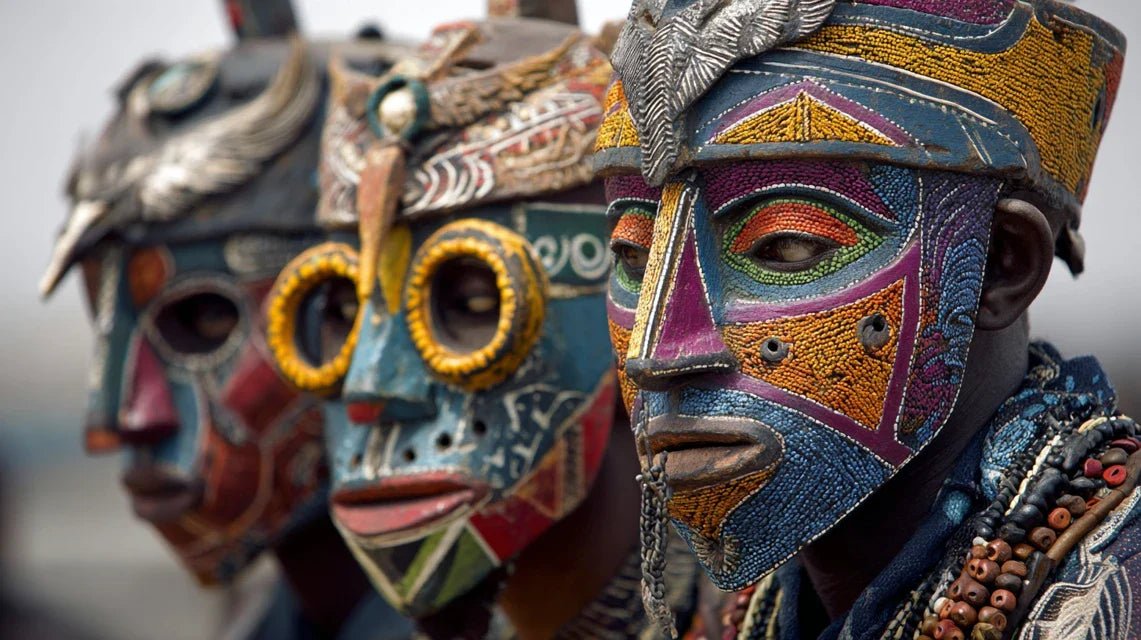
The first time I held a Gelede mask in my hands in a sculptor's workshop in Porto-Novo, I was struck by the vibrancy of its colors. This deep red, this immaculate white, these touches of intense black... These shades are not there simply to decorate. They tell a millennial story, carry coded messages that only initiates truly understand. Each color in Gelede masks has a precise spiritual meaning, passed down from generation to generation by Yoruba artisans from Benin.
Here's what the colors of Gelede masks reveal: a spiritual language that honors ancestral mothers, a direct connection with the forces of nature, and a visual code that protects the community from evil spirits.
You may be looking at these colorful African masks in galleries or in photos, fascinated by their graphic beauty, but you feel like you lack the keys to truly understand them. This frustration is legitimate: the chromatic symbolism of Gelede masks remains mysterious to those who have not grown up within this Yoruba tradition.
Rest assured, I will guide you on this fascinating chromatic journey. After a decade spent documenting West African craftsmanship and exchanging with sculptors and initiates, I have learned to decode this extraordinary visual language. Together, we will unlock the secrets of these sacred colors that transform a simple piece of wood into a bridge between the visible and invisible worlds.
White, color of ancestral mothers
In the Gelede universe, white dominates as the color of purity and feminine wisdom. It is no coincidence that most Gelede masks have a bright white base. This shade directly evokes the Iyami, these ancestral mothers with mystical powers that the Gelede ceremony seeks to honor and appease.
White also symbolizes life, light, and fertility. When a Gelede mask appears in its immaculate whiteness during nighttime ceremonies, it embodies the benevolent presence of these maternal forces that watch over the community. Artisans traditionally use kaolin or powdered chalk to obtain this deep, almost luminescent white in the dark.
I have observed how sculptors apply this color with a quasi-meditative attention. Each layer of white is a prayer, an invocation to female ancestors. This color is never neutral in the Gelede context: it vibrates with a palpable spiritual energy that participants in the ceremonies immediately feel.
The traditional white technique
Benin artisans mix kaolin with natural binders from plant saps. This ancestral process creates a unique texture, different from modern paints. The resulting white has a particular matte finish that absorbs and reflects light spiritually, creating a hypnotic effect during ritual dances.
Red: power and contained danger
The red in Gelede masks is always charged with ambiguity. This intense color evokes both the blood of life and spilled blood, the creative force of women and their potential for destruction if they are offended. Touches of red on a Gelede mask signal the presence of a powerful energy that demands respect and caution.
Traditionally extracted from ferruginous clay soils or vegetable dyes such as red sandalwood, this pigment often marks the lips, cheeks, or certain decorative motifs of the mask. The red represents the Ashe, this invisible vital force that circulates in the Yoruba universe and which women naturally possess in abundance.
In my experience documenting these masks, I have noticed that sculptors use red sparingly but strategically. A red mark in the wrong place can upset all the symbolic charge of the mask. It is a color that does not tolerate approximation: it must be placed exactly where tradition requires, no more or less.

Discover this inspiring work
Deep Black: The Connection with the Invisible
Black occupies a fascinating place in the palette of Gelede masks. Far from being a color of bad omen as in some Western cultures, black symbolizes here mystical depth, spiritual maturity and connection with ancestors. It is the color of the night during which the most sacred Gelede ceremonies take place.
Artisans obtain this deep black from crushed charcoal, soot or fermented vegetable dyes. Applied to certain parts of the mask, it creates a striking contrast with white, generating that visual tension that characterizes the Gelede aesthetic. Black can adorn sculpted hair, eye contours or geometric patterns.
What particularly impresses me is how black absorbs light during nighttime dances. The black parts of the mask seem to disappear into the darkness, creating an impression of a floating face, partially visible, partially dissolved in the world of spirits. This effect is never accidental: it is calculated to provoke this feeling of supernatural presence.
Black in Contemporary Masks
Today, some sculptors use modern paints to achieve deeper blacks, but purists maintain that only traditional charcoal possesses the appropriate spiritual energy. This issue sometimes divides communities between strict tradition and pragmatic adaptation.
Blue and yellow: the colors of cosmic balance
Less frequent than the white-red-black triad, blue and yellow nevertheless appear on some Gelede masks with very specific meanings. Blue, rare and precious in traditional pigments, evokes water, freshness, and calm. It tempers overly intense energies and brings appeasement.
Yellow, often obtained from ochres or turmeric, symbolizes prosperity, the abundance of harvests, and the generosity of the earth. When a Gelede mask incorporates yellow, it generally carries a message of hope and fertility for the community. These secondary colors enrich the visual vocabulary of masks without ever dominating the main shades.
In the workshops I visited, artisans explained to me that each color added must be spiritually justified. One does not choose a shade for its aesthetic effect alone: it must correspond to the specific message that this particular mask is intended to convey during the ceremony. It is a complex chromatic grammar that sculptors learn through years of apprenticeship.

Discover this inspiring artwork
The chromatic composition: a coded language
What truly fascinates about Gelede masks is that colors never function in isolation but always in composition. The juxtaposition of white and black creates a dialogue between the visible and the invisible. The addition of red to this duality introduces the dimension of vital power. Each mask thus becomes a complex visual sentence.
Gelede initiates can read a mask as we read a text. The proportion of white to black, the position of touches of red, the presence or absence of secondary colors... All of this communicates precise information about the type of ceremony, the spirit invoked, and the ritual intentions.
I have witnessed passionate discussions between sculptors debating the exact placement of a red band on a mask's forehead. To an untrained eye, it seems futile. But in the Gelede context, a few centimeters can radically change the spiritual message. This precision is a testament to extraordinary cultural sophistication.
The contemporary evolution of palettes
Today, some Gelede masks intended for tourists or collections incorporate bright, non-traditional colors such as pink or electric green. While these pieces are aesthetically interesting, they no longer carry the spiritual weight of authentic ceremonial masks. This distinction is important for informed collectors.
How to integrate this chromatic wisdom into your home
Understanding Gelede colors can transform your perception of African art and enrich your decorative choices. When you welcome a mask or work inspired by this tradition, you are not simply installing a decorative object: you are inviting a millennial symbolic language into your space.
To honor this cultural richness, always prioritize authentic pieces or respectful reproductions that maintain traditional color codes. Place these works in spaces where their presence can be contemplated, where their colors dialogue with your interior without being drowned in visual chaos.
The white-black-red combinations of Gelede masks harmonize beautifully with clean contemporary interiors. These timeless colors create powerful focal points that anchor the space while telling a deep story. Each glance at these colors becomes a visual meditation, a reminder of the invisible forces around us.
Be inspired by African chromatic wisdom
Discover our exclusive collection of African paintings that celebrate the symbolic richness of Yoruba traditions and transform your interior into an authentic space for cultural connection.
Celebrate the living heritage of Gelede colors
The colors of Gelede masks are not simply aesthetic choices frozen in the past. They continue to live, to transmit their spiritual message to anyone who takes the time to listen. In your living room, office or personal gallery, these ancient hues dialogue with modernity, creating bridges between worlds.
Imagine yourself every morning facing these colors steeped in history. The white that reminds you of the wisdom of ancestors, the red that stimulates your vital energy, the black that connects you to your inner depth. These masks become silent companions who enrich your daily life with a spiritual dimension often absent from our contemporary interiors.
Start by truly observing the colors the next time you contemplate a Gelede mask or an African-inspired artwork. Ask yourself what they communicate, how they interact, what emotion they evoke in you. This conscious attention transforms decoration into a profound cultural experience, and your living space into a celebration of human diversity.
Frequently Asked Questions About Gelede Mask Colors
Can you mix Gelede masks with other decorating styles?
Absolutely! Gelede masks possess such visual strength that they blend remarkably well into contemporary, Scandinavian, bohemian or eclectic interiors. Their timeless color palette (white, black, red) functions as a sophisticated neutral that anchors the space. The key is to offer them respectful highlighting: a clean wall, appropriate lighting, enough space for their spiritual presence to express itself. Simply avoid burying them in an accumulation of decorative objects that would dilute their symbolic and visual impact.
How do you know if the colors of a Gelede mask are authentic?
Authentic ceremonial masks use natural pigments that create particular shades: a slightly creamy white (kaolin), an earthy red (ferruginous ochre), a deep matte black (charcoal). Too bright or fluorescent colors usually betray the use of modern paints intended for tourist pieces. Also look for some natural wear on antique masks, variations in tone that testify to the manual application of pigments. If possible, prefer specialized galleries or sellers who document the provenance of their pieces. Authenticity can also be felt in the symbolic coherence: the colors must follow the traditional logic that we have explored.
Should you restore the colors of an old Gelede mask that has faded?
This question divides collectors and conservators. My recommendation: preserve the patina of time rather than restoring. Natural discoloration is part of the object's history and testifies to its authenticity. Amateur restoration risks destroying the spiritual and market value of the mask by using inappropriate pigments. If the piece has significant value, consult a specialist restorer in African art who will understand the cultural issues. For your interior, a patinated mask often has more character and nobility than a freshly repainted piece. Beauty sometimes lies in the imperfection that time has sculpted.