


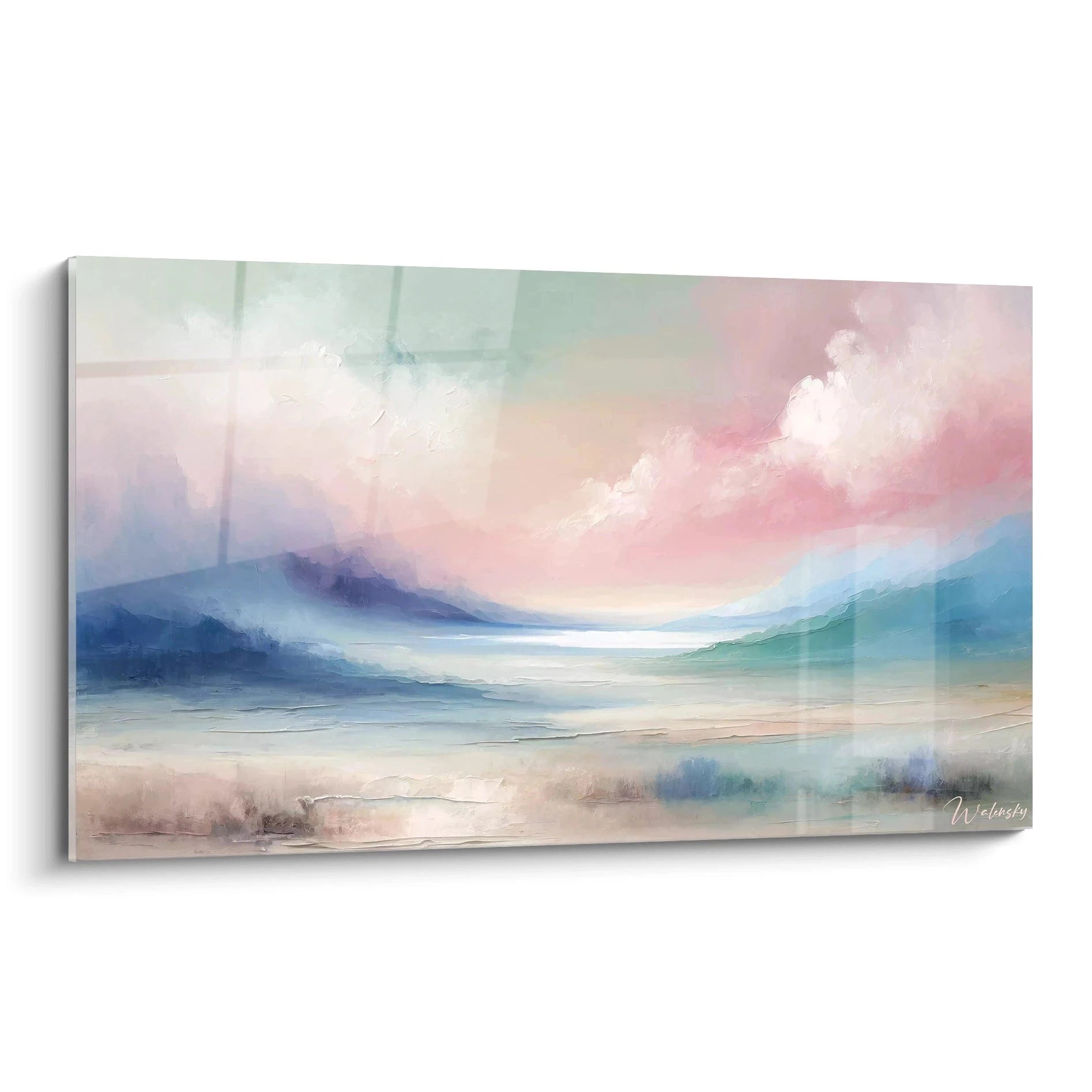

What Quality Criteria Should You Check When Buying a Wall Art?
November 10, 2025 · 7 min read · by Walensky
That day, in the workshop of an artist in Montmartre, I understood why two seemingly identical paintings could have such different prices. One was already cracking after six months on display, the other lasted through decades without faltering. The difference? Quality criteria invisible at first glance, but decisive for the durability and beauty of a work.
Here's what checking the quality of a wall painting brings you: a work that retains its colors and brilliance for years, an investment protected from costly disappointments, and the certainty of acquiring a piece worthy of sublimating your interior. Because a quality painting is not only an aesthetic purchase, it’s a lasting relationship with art.
You are facing a painting that makes you vibrate. Its colors speak to you, its composition resonates within you. But how do you know if this emotion will last? How to distinguish a solid work from a print that will fade at the first ray of sunshine? This uncertainty paralyzes so many enthusiasts who give up their crushes for fear of being wrong.
Rest assured: a few simple criteria, accessible even to novices, are enough to assess the real quality of a wall painting. You don't need to be an expert in restoration or fine arts. I will reveal these distinctive signs that I have learned to recognize through my visits to workshops, galleries and with informed collectors.
The support: this invisible foundation that changes everything
The canvas or support constitutes the framework of your wall painting. In professional workshops, I felt the difference between a quality stretched canvas and a simple print on industrial material. The weave density is immediately felt under your fingertips: a 280 g/m² canvas offers unparalleled resistance to tension and deformation.
For wall paintings on canvas, check that the frame is made of solid wood, ideally pine or fir dried. Lower-end plywood frames warp with humidity. A good frame has tension keys in the corners: these small triangular pieces of wood allow the canvas to be retightened if it loosens over time.
Prints on aluminum dibond or plexiglass offer other advantages: lightness, resistance to moisture, perfect flatness. Check the thickness of the support: a minimum of 3 mm to avoid flexions. The quality of the adhesion between the print and the support is detected by observing the edges: no bubbles, no peeling should be visible.
The quality of printing: when technology reveals or betrays
Approach the wall painting. At a few centimeters, what do you see? A museum-quality print remains sharp even viewed up close, without pixelation, without color bands, without visible halftones. Large format professional printers use between 8 and 12 ink cartridges to reproduce subtle nuances impossible to obtain with basic 4-color systems.
Pigment inks far outperform dye-based inks in terms of longevity. A pigment ink print retains its color intensity for 75 to 200 years according to manufacturers, compared to 5 to 25 years for dyes. This information is rarely on the label, but a serious seller should be able to tell you what type of inks were used.
Print resolution is another key criterion. For a quality wall art print, require at least 300 DPI (dots per inch). Below that, outlines become blurry and gradients have unsightly steps. Pay particular attention to the transition areas between colors: they should be smooth, without stair-stepping effect.
The raking light test
Here's a tip from a gallery owner: stand to the side and let the light graze the surface of the wall art print. Defects in uniformity, ink build-up, irregularities in the support immediately appear. A perfectly flat and homogeneous surface is evidence of a controlled manufacturing process.

The finishes: these details that mark excellence
A quality wall art print is recognized by its impeccable finishes. Examine the edges: on a stretched canvas, the return to the sides of the frame should be clean, without creases or visible staples on the front. High-end galleries consistently offer a museum finish with image wrap around the edges.
The mounting system deserves your attention. Welded or screwed metal fasteners offer superior reliability to simple glued hooks. For large formats (over 80 cm), check for at least two fixing points. A heavy wall art print requires a reinforced suspension system, sometimes with rail.
Surface protection significantly extends the life of your artwork. A UV varnish or protective lamination preserves colors from ultraviolet rays and facilitates maintenance. Gently run your hand over the surface: it should be smooth, without snagging, slightly satin. Cheap glossy finishes crack quickly and create unpleasant reflections.
— Our selection


Origin and traceability: your guarantee of peace of mind
A quality wall art piece comes with precise information: technique used, origin of manufacture, characteristics of the materials. Certifications such as compliance with European standards for pigments or the origin of wood (FSC, PEFC) testify to a commitment to quality.
Beware of vague descriptions. A professional seller should be able to explain the creation process, identify the artist or publisher, and specify the warranty conditions. Limited edition prints offer added value, provided that the numbering is authentic and accompanied by a certificate.
Geographic origin influences quality: some European regions concentrate recognized expertise in art printing. Manufacturing in France or Europe generally guarantees compliance with strict standards for ink toxicity and material durability.
Transparency, the best indicator of trust
Ask direct questions: where is the wall art piece manufactured? What type of ink? What warranty in case of defect? A serious professional responds without evasion. Areas of shadow often hide compromises on quality.

— You may also like


The price: decoding the real value
A quality wall art piece has a cost. Abnormally low prices almost always signal compromises: low-resolution printing, fugitive inks, fragile supports. For a 60x80 cm format with quality printing, expect to invest at least 80 to 150 euros depending on the complexity of the work.
But high price does not automatically rhyme with quality. Some brands inflate their prices without technical justification. Compare objective characteristics: type of support, thickness, resolution, inks, finishes. A balanced value for money is verified by confronting these tangible criteria.
Permanent promotions are a warning sign. A wall art piece displayed at 300 euros then sold at 49 euros reveals a misleading marketing strategy rather than a real value. Favor brands that display fair and stable prices, reflecting their commitment to quality.
You deserve a piece of art that stands the test of time
Discover our exclusive collection of wall art selected for their museum quality and exceptional durability.

In the same vein
Emerald of the Abyss Painting - Animals Octopus Edition
233,90€
Discover this artwork →Your gaze transformed, your decision informed
You are now equipped to decipher the quality of a wall painting in seconds. Robust support, high-definition print with pigment inks, careful finishes, transparent origin: these simple criteria protect you from disappointments and transform your impulsive purchase into a thoughtful investment.
Imagine this painting in your living room, intact and bright in ten years, twenty years. Its colors as vibrant as on the first day, its surface impeccable, its presence unchanged. This longevity is not an inaccessible luxury, it is simply the result of informed choices at the time of acquisition.
The next time you fall for a work, take two minutes to check these essential points. Approach, touch, question. Your crush deserves to last.
Frequently asked questions about the quality of wall paintings
How can I know if a wall painting will resist the humidity of my bathroom?
Humidity is the main enemy of traditional canvas wall paintings. For humid rooms, prioritize rigid supports such as aluminum dibond, plexiglass or acrylic glass. These materials do not swell, warp or develop mold. Check that the print has a protective lamination or waterproof varnish. If you want a canvas, make sure it has received specific waterproofing treatment and install sufficient ventilation. In case of doubt, test the information with the seller: a serious professional will advise against unsuitable supports rather than risk your satisfaction.
Can a cheap wall painting still be of good quality?
Yes, but with important nuances. An accessible price doesn't necessarily mean poor quality, especially for standard sizes and digital reproductions of works not subject to copyright. Economies of scale allow some retailers to offer correct prints at contained prices. However, systematically check objective criteria: minimum resolution 300 DPI, UV-resistant inks, support of at least 2-3 mm thickness. A truly high-quality wall art involves incompressible costs in raw materials and manufacturing. Beware of prices defying all economic logic: they often hide recycled materials, low-definition prints or compromised durability. Good value for money exists, but never below a certain threshold.
How long should a quality wall art last?
A wall art manufactured according to current quality standards should retain its appearance for 20 to 50 years minimum under normal exposure conditions. Prints with museum-quality pigment inks can even reach 75 to 200 years depending on the manufacturers and storage conditions. The main degradation factors are direct sunlight exposure (UV rays bleach pigments), excessive humidity (which deforms supports) and sudden temperature variations. To maximize the longevity of your wall art, avoid sunny locations, maintain a stable humidity rate between 40 and 60%, and gently clean the surface with a dry microfiber cloth. If you notice rapid discoloration or deformations within the first two years, it is a sign of a manufacturing defect: a quality wall art should not show any signs of weakness for at least a decade.
Explore our collections


