Every year, when October unveils its autumnal colors, a question resurfaces in my event decoration workshop: why this obsession with green when it comes to representing Halloween witches? After fifteen years spent creating festive universes for private events and film studios, I delved into American visual archives to understand this association that has become so natural. The answer fascinated me: it blends cinema history, color psychology, and popular culture in a cocktail as delightful as a poisoned candy apple.
Here's what this story of the green witch reveals: a technical cinematic revolution, the evolution of our collective fears, and a decorative palette that is now transforming our interiors into veritable film sets every Halloween.
You may have noticed this inconsistency: in traditional European folktales, witches are never described as green. Yet, ask a child to draw a witch, and spontaneously, they will grab a green crayon. How did a color absent from ancestral folklore become the visual DNA of these fantastic creatures? And above all, how can we use this knowledge to create truly memorable Halloween atmospheres in our living spaces?
Rest assured: you don't need to be a film historian to appreciate this dive into the American visual imagination. This story is one of a magical encounter between technical innovation and creative genius, which has shaped our collective perception of witchcraft for the next hundred years.
1939: The year The Wizard of Oz invented the green witch
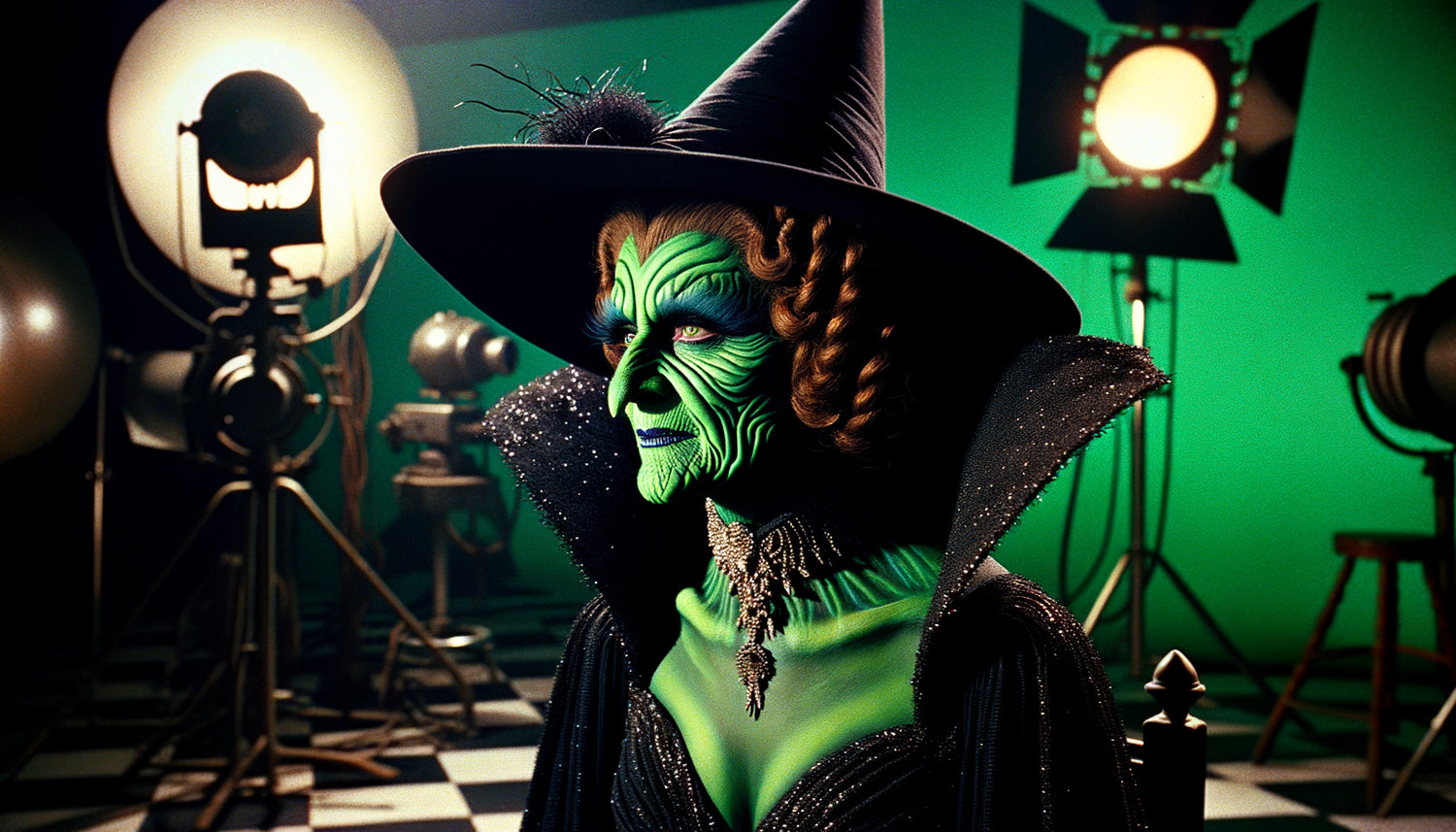
It all begins in the MGM studios in 1939. Margaret Hamilton, an accomplished theater actress, comes to portray the Wicked Witch of the West in The Wizard of Oz. The makeup department then makes a choice that will change the history of visual culture: covering her entire face with coppery green makeup. This was not a random aesthetic choice, but a revolutionary technical decision.
The film used the new Technicolor process, an expensive technology that magnified primary colors in a way never seen before. Green, the complementary color of red (the famous ruby slippers), created a striking visual contrast on screen. But beyond the technique, this choice touched something deeper within our psyche: green instinctively evokes decay, poison, disease, and putrefaction.
Margaret Hamilton spent five hours in makeup every day of filming. The copper present in the green paint was so toxic that she developed severe skin reactions. Ironically, the witch was literally poisoned by her own color. This real suffering shone through in her performance, adding a terrifying authenticity to the character.
The Wizard of Oz became one of the most-watched films in history, broadcast every year on American television for decades. Entire generations of children have thus neurologically associated the concept of a witch with this greenish hue. The image of the green witch has imprinted itself on the collective unconscious with the force of a universal archetype.
The psychology of green: why this color evokes witchcraft
In my set design work, I discovered that green possesses a fascinating duality. It is the color of lush nature, of springtime life, but also of swamp creatures, mold, and toxins. This symbolic ambivalence makes it the perfect choice for representing the witch: a being who masters natural forces while diverting them to malevolent ends.
Studies in color psychology reveal that unsaturated greenish tones trigger an instinctive avoidance reaction in humans. Evolutionarily, we have learned to distrust non-edible green foods and greenish stagnant waters carrying diseases. The wizard's green activates these ancestral survival mechanisms, creating a subtle but powerful discomfort.
In American popular art post-1939, this association became systematized. Illustrators of children's books, costume designers, and party decorators adopted the code of green as a visual marker of witchcraft. It has become a universal language: a black pointed hat + a green face = witch, without need for explanation.
The evolution of green shades in the representation of witches
If you observe carefully, the shades of green have evolved over the decades. The 1940s-1960s favored a yellowish-green, almost bilious, reflecting the technical limitations of printing and television. The 1970s-1980s saw the emergence of a more saturated, almost neon green, carried by the psychedelic aesthetic and advances in the cosmetics industry for Halloween.
Today, in contemporary interior decoration for Halloween, we play with an expanded spectrum of greens: from vintage moss green to sophisticated emerald green, through the neon green of the 1990s. This diversity allows us to create radically different atmospheres, from assumed kitsch to refined gothic elegance.

How other cultures represent witches
What makes the American phenomenon so unique is its contrast with the visual traditions of the rest of the world. In Europe, witches in medieval and Renaissance illustrations display pale, cadaverous, or simply human complexions. European witches are distinguished by their dark clothing and attributes (brooms, black cats, cauldrons), never by a fantastical skin color.
In Asian cultures, female malevolent magical creatures often present spectral white complexions (the Japanese yūrei) or unmodified faces. The idea of green skin as a marker of magical malice is deeply rooted in the American imagination specifically, then exported via Hollywood to the rest of the world.
This Americanization of witch iconography has created a global visual language. Today, even in France or Japan, Halloween decorations take up these codes: the green witch has become a visual esperanto of the celebration, transcending cultural boundaries through the power of Hollywood cinema.
Integrate the wizard's green into your Halloween decor with refinement
Drawing on this historical understanding, how to use green in your Halloween decor without falling into childish clichés? In my projects for demanding clients, I apply three principles that transform this popular code into contemporary elegance.
First principle: sophistication through nuance. Abandon the glaring apple green in favor of complex greens: grey-green, sage green, deep forest green. These shades subtly evoke the magical universe while maintaining consistency with an adult and refined decor. A bouquet of autumnal branches in a bottle green vase, moss green candles arranged on a fireplace mantel create this atmosphere without infantilizing the space.
Second principle: dramatic contrast. Follow the lesson of The Wizard of Oz: green is sublime when it dialogues with its complement. Combine your touches of green with purple, aubergine, or burgundy elements. A painting depicting a witch in green tones framed with plum velvet creates a striking visual depth that immediately captures the eye.
Third principle: lighting as revealer. Green changes radically depending on the light. Programmable LED bulbs allow you to project greenish hues onto white or neutral objects, temporarily transforming your space without permanent decorative investment. This approach is particularly relevant for those who want to celebrate Halloween without compromising their daily aesthetic.
The green witch in contemporary wall art
Wall art offers the opportunity to anchor this iconography in your interior with permanence and sophistication. Contemporary representations of witches reinterpret the green code with a fascinating creative freedom: botanical illustrations where the witch merges with vegetation, stylized portraits playing on shades of green, abstract compositions evoking magic through color alone.
These works function as bridges between popular culture and artistic expression. They acknowledge American visual heritage while transcending it, creating pieces that remain relevant beyond Halloween season. A large format depicting a witch in emerald green and gold tones can become a centerpiece of a living room, dialoguing with botanical elements and creating a mysterious atmosphere all year round.
Transform your interior with the mysterious elegance of witch green
Discover our exclusive collection of Halloween wall art that reinvents the green witch iconography with sophistication and contemporary creativity.

The lasting legacy of Margaret Hamilton and her green witch
It is remarkable that a performance filmed in 1939 continues to shape our visual language more than eighty years later. Margaret Hamilton herself was aware of the cultural impact of her character. In her last interviews, she expressed her pride in creating an archetypal figure instantly recognizable around the world.
This green witch has crossed decades, reinvented in countless works: the musical Wicked humanized and complicated it, television series declined it, contemporary artists deconstructed it. But the color code remains: green equals witch in the Western collective imagination, a visual shortcut as powerful as the association of red-Christmas or orange-autumn.
For us, creators of atmospheres and decoration enthusiasts, understanding this visual genealogy enriches our practice. Each color choice carries a story, activates unconscious associations with our guests. Witch green is not just a convention: it's a cultural heritage that we can celebrate, subvert, or reinterpret according to our creative intentions.
Create Your Own Interpretation of the Witch's Palette
Beyond simply reproducing established codes, true creativity lies in appropriating this story to write your own chapter. In my most successful projects, I encourage my clients to consider green as a starting point rather than a final destination.
Imagine a botanical interpretation: terrariums filled with plants with varied green foliage, evoking witch's herbology without any kitsch elements. Or a mineralistic approach: green crystals (malachite, aventurine, fluorite) arranged like ingredients of modern alchemy. Or even a textile vision: deep green velvets reminiscent of enchanted forests in fairy tales, creating an implicit witchy ambiance through texture and color.
These sophisticated approaches honor the heritage of the American witch's green while elevating it beyond costume and temporary decoration. They create spaces that whisper their theme rather than shout it, inviting contemplation and conversation rather than simple visual recognition.
The story of the green witch teaches us that the most powerful visual conventions often arise from technical constraints (Technicolor) transformed into brilliant artistic choices. In decor, this lesson remains relevant: our limitations (budget, space, existing style) can become catalysts for our most original creativity.
Conclusion: From the MGM Studio to Your Living Room, Magic Continues
When Margaret Hamilton donned her copper-green costume in 1939, she could not have imagined that her image would define the appearance of witches for the next hundred years. This chromatic revolution born from a technical innovation has become a universal visual language, a code that every child instinctively deciphers.
Today, whenever you incorporate a touch of green into your Halloween decor, you participate in this living story. You dialogue with a cinematic heritage, activate collective archetypes, and create immediate emotional connections with your guests. This is the magic of color: its ability to communicate instantly, without words, complex narratives and deep emotions.
So this year, when you choose your decorative elements, think about the power of witch's green. Use it with intention, sophistication, and perhaps a touch of humor. After all, the best witches have always known that true magic lies in transforming the everyday into the extraordinary, one shade of color at a time.
Frequently Asked Questions About Green Halloween Witches
Do all Halloween witches have to be green in my decor?
Absolutely not! Green has become a recognizable visual code, but the richness of your decor lies in your personal interpretation. In my projects, I often encourage a more nuanced approach: witches with natural tints in green environments (forests, magical gardens), or conversely, subtle touches of green (accessories, lighting) on more realistic figures. Green as an accent rather than an obligation often creates more sophisticated and memorable atmospheres. Think of green as an ingredient in a recipe: it can be the dominant element or simply a subtle note that enriches the whole. The important thing is that your decor tells the story you want to share with your guests.
Why does green work so well for creating an unsettling atmosphere?
The power of green in Halloween contexts lies in its psychological ambiguity. Our brains associate green with plant life and health, but some greenish hues (especially those tending towards yellow or gray) instinctively trigger alert signals related to toxins, mold, and decay. It is this tension between familiarity and discomfort that creates the perfect atmosphere for Halloween. In practice, prioritize desaturated greens, moss or lichen tones, rather than bright spring greens. Lighting also plays a crucial role: diffused green light transforms an ordinary space into a mysterious environment, as it changes the perception of skin tones and creates an unreal, almost supernatural atmosphere.
How to incorporate the green witch theme without my decor looking childish?
The key lies in the sophistication of materials and subtlety of references. Rather than caricatured witches, opt for works of art that evoke witchcraft through symbols: medicinal plants, lunar phases, crystals, botanical elements. If you want to integrate figurative representations of witches, choose artistic illustrations with complex palettes where green dialogues with golds, purples or deep blacks. Noble textures (velvet, linen, artisan ceramics) instantly elevate the aesthetics beyond a party costume. Also consider scale: a large wall piece depicting a witch in a refined contemporary or vintage style becomes a work of art that transcends the season, rather than a simple seasonal decoration. Elegance always comes from restraint and attention to detail.