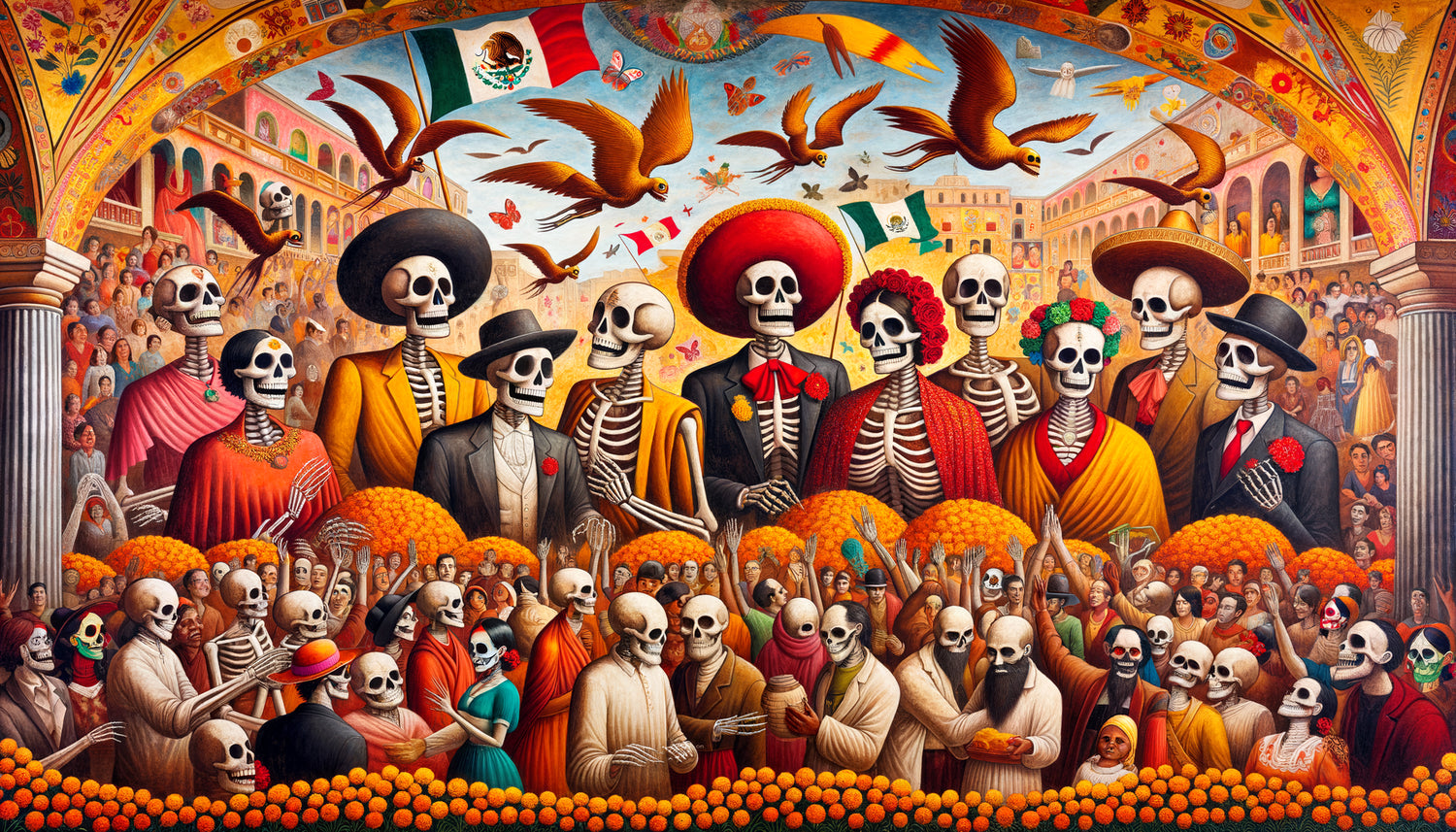
I spent three hours standing still in front of the central panel of *Sueño de una tarde dominical en la Alameda Central* at the Museo Mural Diego Rivera, in Mexico City. My gaze kept returning to this elegant Catrina at the center of the composition, surrounded by dancing skeletons and intertwined historical figures. This moment transformed my understanding of Mexican mural art: Diego Rivera did not paint social frescoes *despite* the festive skeletons; he created political manifestos *thanks* to them. These joyful bones were not mere folkloric ornaments, but formidable visual weapons for abolishing boundaries between life and death, between the elite and the people, between the sacred and the profane.
Here's what integrating skeletons into Rivera’s murals reveals: a narrative strategy to criticize power without censorship, a celebration of pre-Hispanic Mexican identity in the face of European influence, and a visual democratization that made political art accessible to all, even the illiterate. Many think these skeletons simply relate to the folklore of the Día de Muertos. But Rivera orchestrated something far more subversive: he transformed death into a revolutionary ally, capable of saying truths that the living could not pronounce safely. Let's explore how this visionary muralist wove these festive bones into his monumental frescoes to create a revolutionary visual language that still resonates today in our contemporary interiors.
The Catrina: when skeletal elegance becomes social satire
Rivera immortalized José Guadalupe Posada’s La Calavera Catrina by placing it at the heart of his *Sueño de una tarde dominical*. This skeleton lady adorned with an extravagant hat originally embodied a biting satire of Mexicans who rejected their indigenous roots to adopt European manners. In Rivera's fresco, she becomes much more: a bridge between eras, holding the hand of young Diego as a child on one side and that of Posada on the other.
What Rivera masterfully understood is that the skeleton levels everyone. Beneath the skin, the aristocrat and the peasant are identical. By dressing this Catrina in feathers and lace, then placing her alongside revolutionaries like Zapata and oppressive figures from the Porfiriato, Rivera created a social critique that even authorities hesitated to censor. How can you ban a smiling skeleton? How can you accuse of subversion a representation of death, this universal reality?
The visual vocabulary of disguised protest
In his frescoes at the Palacio Nacional, Rivera peppered historical scenes with small festive skeletons that commented on the main action. A Spanish conquistador could be observed by an indigenous skeleton holding a cempasúchil flower, this emblematic orange flower of the Día de Muertos. These subtle details created a double visual discourse: the official narrative on the surface, and underneath, an ironic commentary accessible to those who knew how to look.
During my on-site studies, I noticed that Rivera used skeletons as temporal markers. They signaled that history was not linear but cyclical, that the dead continued to influence the living, and that past injustices haunted the present. This narrative technique transformed his murals into visual palimpsests where multiple time periods coexisted.
The pre-Hispanic heritage: from sacred bones to revolutionary frescoes
To understand why Rivera so naturally integrated skeletons into his social compositions, one must go back to pre-Hispanic traditions. The Aztecs preserved walls of skulls (tzompantli) not as macabre symbols but as celebrations of the eternal cycle. Mictlantecuhtli, the god of death, was not a terrifying figure but a necessary guardian.
Rivera, deeply influenced by these ancient cosmologies, rejected the European Christian conception of death as punishment or absolute end. In his mural La historia de México, skeletons are never victims or threats: they are active participants, sometimes even joyful. This vision radically transformed the official historical narrative. The indigenous dead of the Conquest did not disappear into oblivion: they still danced, still claimed, still existed.
The ritual calendar as a narrative structure
Each year, the Día de Muertos (November 1st and 2nd) temporarily abolishes the border between the living and the dead. Rivera structured some of his murals according to this ritual logic: scenes where generations mingle without temporal hierarchy. In the Alameda panel, Benito Juárez visually dialogues with characters born after his death, while skeletons orchestrate these impossible encounters.
This narrative technique allowed Rivera to avoid the pitfall of one-dimensional propagandistic art. His murals did not impose a single reading but invited dialogue between eras, between classes, and between ideologies. Festive skeletons served as facilitators of these impossible visual conversations.

When bones bear the colors of revolution
In his murals for the Secretaría de Educación Pública, Rivera created an entire cycle where skeletons participate in workers’ and peasants' struggles. We see calaveras wearing sombreros and bandoliers, brandishing agricultural tools, celebrating land redistribution. This juxtaposition of festive and revolutionary elements created a unique visual language: social struggle was not only a serious and solemn battle but also a celebration of life that justified sacrificing one's own physical life for it.
This apparent paradox – joyful skeletons in scenes of social conflict – revealed Rivera’s profound philosophy: death was not the opposite of life but its continuation, and social justice was worth becoming a venerated ancestor. The workers depicted in his murals were not afraid to become skeletons because they would thus join the great community of generations.
The colors of transcendence
Rivera used a specific palette for his skeletons: earthy ochres, bright whites, and always those touches of orange cempasúchil and Mexican pink. These colors were not decorative but symbolic. Orange recalled the petals scattered to guide the dead towards family altars. Pink evoked hope and continuity. Rivera’s skeletons were never gray or gloomy: they vibrated with living pigments.
This visual chromotherapy transformed the viewer's perception. Even when addressing harsh themes – exploitation, colonization, injustice – the murals maintained a chromatic vitality that rejected despair. It was this tension between serious subject matter and festive treatment that made Rivera’s work so politically powerful.
Revolutionary accessibility: an art for the illiterate
Rivera created for the masses, not for galleries. His murals occupied public buildings precisely to be seen by those who never frequented museums. Festive skeletons served this democratic mission: every Mexican immediately recognized these figures from Día de Muertos, regardless of their formal education.
An illiterate peasant could “read” a Rivera mural thanks to this shared visual vocabulary. Seeing an elegant skeleton alongside a wealthy landowner instantly communicated: “You will end up identical underground, so why this arrogance now?” This visual pedagogy transformed public walls into illustrated newspapers accessible to all.
Laughter as a political weapon
Rivera’s skeletons almost always smile. This smile is not innocent: it is the subversive humor that has always been the weapon of the oppressed. Making the powerful laugh by depicting them as future ridiculous skeletons was more effective than a thousand fiery speeches. Laughter desacralizes, demystifies, equalizes.
In the context of the post-revolutionary Mexican period of the 1920s-1950s, when Rivera was working, this strategy was brilliant. New governments encouraged a "national" and "popular" art without always realizing how much Rivera's murals also criticized their own contradictions. The skeletons allowed for this protective ambiguity: after all, they are "just" folklore traditions.

From Mexico to your interior: the living decorative heritage
The influence of Rivera's festive skeletons extends far beyond the walls of the Palacio Nacional. It has infused contemporary art, interior design, and even seasonal decoration. When you hang a reproduction of a Rivera scene or a piece inspired by Día de Muertos, you are not adopting just a decorative element: you are inviting a philosophy of life into your space.
This aesthetic reminds us that our interiors should not only reflect material comfort but also our stance on essential questions. A smiling skeleton on a wall whispers: "Enjoy the present, eternity equalizes everything." It is a valuable reminder in our societies obsessed with accumulation and performance.
Contemporary creators who draw inspiration from Rivera understand that engaged art can be beautiful, that the political can coexist with the poetic, that the festive does not exclude the profound. This lesson resonates particularly today as we seek meaning in our personal environments.
Transform your space with the revolutionary spirit of Rivera
Discover our exclusive collection of Halloween wall art that celebrates this same bold fusion between the festive and the meaningful, between tradition and contestation.
Living with the heritage of revolutionary skeletons
Diego Rivera's murals teach us that beauty and justice are not mutually exclusive. His festive skeletons still dance on Mexican walls, reminding us that each generation must negotiate its own relationship with power, tradition, and mortality. By integrating this aesthetic into our contemporary spaces, we are not just honoring an artist: we are perpetuating a tradition of joyful resistance.
Imagine your living room transformed by this visual philosophy: vibrant colors that affirm life, symbols that question without aggression, a decoration that sparks conversations rather than simply filling an empty wall. This is the living legacy that Rivera leaves us: the idea that our daily aesthetic choices can carry meaning, celebrate community, honor those who came before us.
Start simple: a decorative element inspired by Día de Muertos, a reproduction of a section of a fresco, Mexican orange and pink colors in your textiles. Each choice then becomes a small act of cultural memory, a discreet celebration of this ancestral wisdom that Rivera so masterfully translated into monumental images. Your walls can whisper the same truths as his: we are temporary, so let's live fully, create beauty, fight for justice, and dance with our ancestors.
FAQ: Understanding the skeletons in Rivera’s art
Why did Diego Rivera specifically use skeletons rather than other symbols?
Rivera chose skeletons because they constituted a visual language immediately recognizable by all Mexicans, regardless of their education. Unlike abstract symbols or European allegories that required artistic training to decipher, festive calaveras have been part of living popular culture since pre-Hispanic times. They also allowed for disguised social criticism: by showing that rich and poor end up identical in the form of skeletons, Rivera highlighted the absurdity of social inequalities without uttering a word. It was a brilliant narrative strategy that partially evaded censorship while conveying powerful political messages. Moreover, in the Mexican cosmology he defended, the dead do not disappear: they remain present, advisors and witnesses to the living, creating a historical continuity that Rivera wanted to represent visually.
How can you incorporate the festive skeleton aesthetic of Rivera into a modern interior without falling into kitsch?
The key is to understand the underlying philosophy rather than simply copying the appearance. Prioritize pieces that resonate with you: a framed reproduction of a section of Rivera's mural, authentic artisanal decorative elements rather than mass productions, or colors inspired by his palette (orange cempasúchil, Mexican roses, earthy ochres) in your textiles and accessories. The sophisticated approach is to create visual dialogues: a unique artistic skeleton as a focal point, accompanied by living vegetation and natural materials that balance the symbol of mortality with vitality. Avoid cluttered accumulations and prefer intention: it's better to have one meaningful piece well showcased than ten scattered elements. Remember that Rivera himself meticulously structured his compositions: each skeleton had its reason for being. Apply this same principle of thoughtful composition to your space.
Isn't this festive skeleton aesthetic perhaps too specifically Mexican to work in other cultural contexts?
It is precisely its deep roots in Mexican culture that make this aesthetic paradoxically universally relevant. Rivera addressed fundamental human questions: mortality, justice, the memory of ancestors, criticism of power. All cultures deal with these themes, simply with different visual vocabularies. Adopting elements of Rivera's aesthetics is engaging with another way of understanding these universals. It becomes problematic only if one settles for a superficial appropriation without understanding or respecting the original meanings. But if you are genuinely interested in the philosophy of Día de Muertos – celebrating life by accepting death, honoring those who came before us, maintaining links between generations – then integrating these symbols becomes an act of respectful intercultural dialogue. Rivera himself mixed pre-Hispanic, colonial, and European modernist influences: he was already practicing this conscious cultural syncretism that we can continue today.