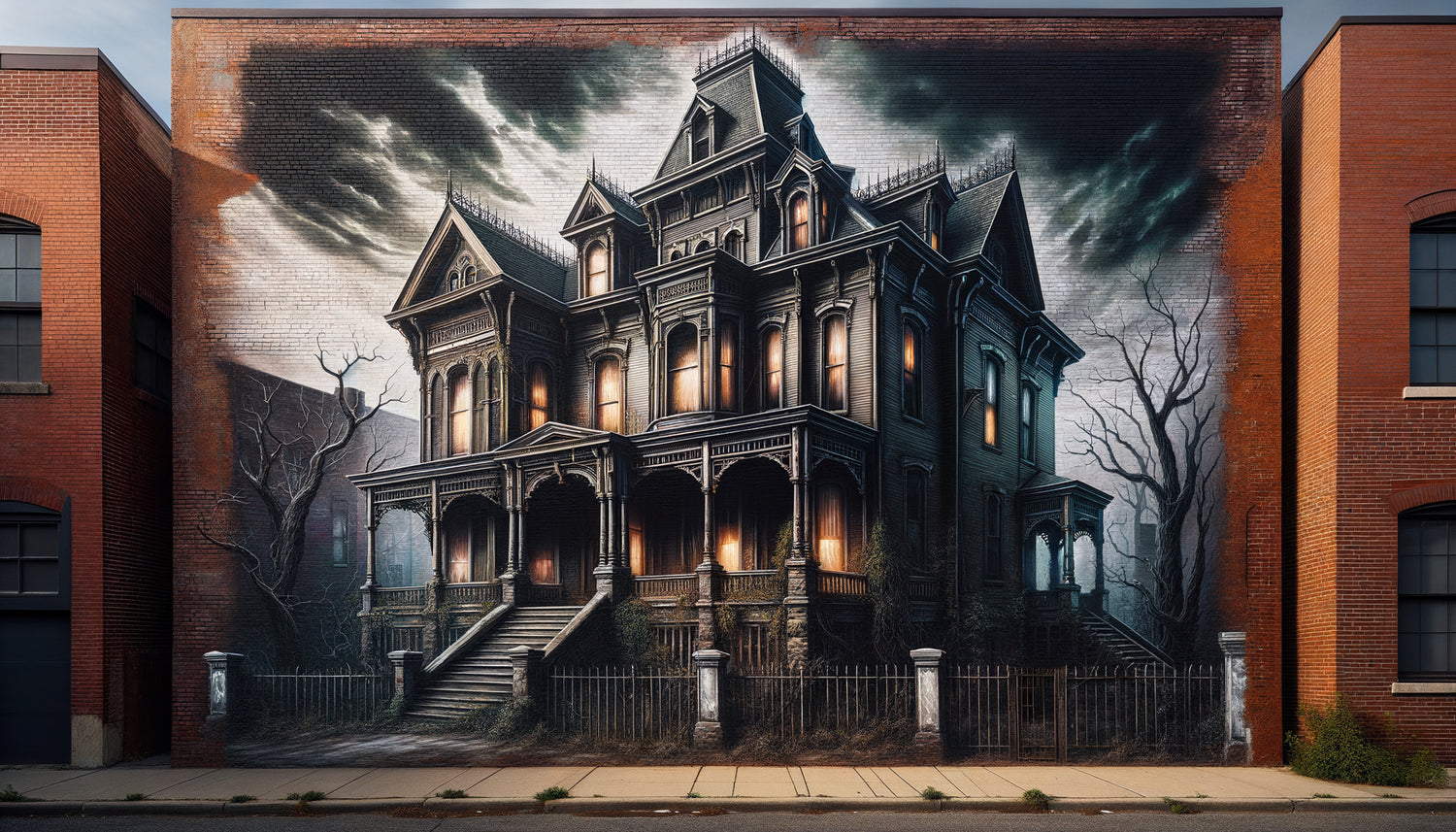
During a Hollywood cinema decor auction in 2019, I observed a fascinating phenomenon: a giant canvas depicting a dilapidated Victorian under a stormy sky sold for three times its estimate. Bidders weren't simply buying a painting – they were acquiring a fragment of American anxiety, beautifully orchestrated.
Here’s what the symbolism of haunted houses in American wall art reveals: a collective fascination with architectural transgression, a visual outlet for contemporary domestic anxieties, and a paradoxical celebration of home as a place of emotional ambivalence. These wall representations don't simply decorate our spaces – they crystallize our complex relationships to intimacy, memory, and security.
Many think these images are just Halloween clichés, seasonal decorations without depth. This superficial perception overlooks the psychological richness of this pervasive motif in the American visual imagination, from Norman Rockwell illustrations to contemporary street art installations.
Rest assured: understanding this symbolism requires no psychoanalysis training. Simply observe how these haunted houses dialogue with our own living spaces, how they transform our walls into distorting mirrors of our intimate concerns.
I invite you to explore the psychological layers that make the haunted house more than just a decorative motif – a true visual language of the American collective unconscious.
The Gothic Victorian: Architecture of Social Anxiety
In the Providence galleries where I spent three years studying American popular imagery, one constant emerges: the dilapidated Victorian house embodies the fear of downward social mobility. These once-grand homes, now in ruins, symbolize what sociologists call status decline.
American wall artists consistently favor this architectural style for their depictions of haunted houses. Why? Because the Victorian evokes a fantasized golden age – one of industrial prosperity, stable family fortunes, and rooted lineages. Its decay visualizes the deeply American anxiety of the bourgeois dream's collapse.
Recurring elements are never arbitrary: sagging shutters suggest loss of control, broken windows translate domestic vulnerability, and leaning turrets embody the instability of social structures. Each crack in the facade becomes a metaphor for a crack in the ideal of the American home.
This wall iconography functions as a collective outlet. By visually exposing these domestic ruins, wall art allows for exorcising fears related to the precariousness of social status, mortgage debt, and the fragility of family legacies.
The Lit Porch: Liminality Between Safety and Danger
A technical detail fascinates in 80% of representations of haunted houses that I have cataloged: the slightly open door with an inner glow. This composition is not accidental – it activates what environmental psychologists call spatial attraction-repulsion.
The ajar threshold creates a powerful visual tension. It invites and repels simultaneously, materializing our ambivalent relationship to intimacy. This architectural liminality reflects deep contemporary anxieties: who can cross the threshold of our private life? What intrusions do we fear?
Wall artists brilliantly exploit this transitional zone. The porch becomes a psychological scene where our fantasies of domestic violation and our contradictory desires for social openness play out. In an American culture obsessed with private property and residential security, this motif touches a universal sensitive chord.
The ambiguous light filtering from the inside adds another dimension: it suggests an indeterminate presence, neither living nor dead. This visual uncertainty perfectly corresponds to our era of blur between public and private life, between physical and digital presence.

Skeletal trees and wild gardens: the return of repressed nature
In Brooklyn's urban murals to Los Angeles installations, invasive vegetation around haunted houses symbolizes nature’s revenge on domestic order. This imagery resonates particularly in a culture that has founded its identity on the domestication of wild territory.
Roots deforming foundations, branches scratching windows, weeds engulfing manicured paths – each vegetal element becomes a visual manifestation of what Freud called the return of the repressed. America, built on the ideology of the conquered frontier, projects into these desolate gardens its fear of nature reclaiming its rights.
This theme finds a particular echo in our era of ecological awareness. Haunted houses surrounded by hostile nature translate our collective environmental guilt. They visualize the anxiety that our air-conditioned and artificial domestic spaces are ultimately unsustainable, doomed to be reabsorbed.
The chromatic palette of anguish: decoding color choices
After analyzing hundreds of haunted house wall reproductions, a chromatic pattern emerges with remarkable consistency. Artists consistently favor muted grays, oxidized browns, and twilight purples – a palette that instinctively activates our emotional responses to decay.
These shades don't just decorate: they communicate specific psychological states. Gray evokes moral uncertainty, the ambiguity between life and death. Rusty browns suggest the passage of time, the inevitability of decline. Nocturnal purples create an atmosphere of transition between the visible and invisible worlds.
In contrast to these muted tones, touches of sickly yellow at windows or putrefied orange add a note of perverted vitality. These corrupted warm colors visually translate the idea that something persists in these abandoned spaces – not life, but not quite death either.
This chromatic sophistication reveals that American mural artists are not naively reproducing clichés, but consciously orchestrating complex emotional environments. Each nuance works on our psyche subliminally.

The transgressive fascination: why we want these images in our homes
Here's the fascinating paradox I regularly observe: people invest considerable sums to create warm and secure interiors, then deliberately hang representations of inhospitable dwellings on their walls. This apparent contradiction reveals a deep psychological need for controlled transgression.
By incorporating haunted houses into our decor, we practice what psychologists call 'symbolic exposure'. We visually invite our domestic anxieties into a controlled framework, thus disarming their disruptive power. It's a form of sophisticated emotional vaccination.
These wall representations also function as safety valves for our repressed ambivalence towards the home. The dominant discourse constantly idealizes the house as a sanctuary. But domestic reality also includes claustrophobia, family tensions, and the weight of responsibilities. Haunted houses on walls offer an acceptable outlet for these unacknowledged feelings.
In an American culture saturated with injunctions to domestic happiness and residential success, these images paradoxically allow us to breathe. They implicitly validate our moments of fatigue in the face of the demands of the perfect home, our occasional desire for abandonment and chaos.
The cultural heritage: from Washington Irving to urban murals
The cultural lineage of haunted houses in American art goes back long before Instagram. Washington Irving established as early as 1820 with his gothic tales a visual vocabulary that illustrators will popularize for two centuries. This continuity reveals that we are touching something fundamental in the national imagination.
Nineteenth-century engravings, pulp magazine covers from the 1950s, horror movie posters, to contemporary street art installations – all draw on the same symbolic reservoir. This thematic permanence suggests that the haunted house functions as a cultural American archetype, as significant as the frontier or the road.
Contemporary mural artists do not simply reproduce these codes: they update them. Victorian houses now coexist with suburban bungalows, translating the evolution of domestic anxieties. Anxiety is no longer only about old patrician homes, but also standardized subdivisions, indebted housing developments.
Transform your space with this powerful symbolism
Discover our exclusive collection of Halloween art that captures the psychological depth of American haunted houses.
Consciously integrate this iconography into your decor
Now that you understand the psychological layers of these representations, you can integrate them with intention. A haunted house mural is not just decorative – it's a visual conversation choice with your own domestic ambivalences.
Consider the location carefully. In an office, these images can stimulate creativity by inviting controlled chaos. In a living room, they create a visual friction point that prevents the space from sinking into safe banality. Even in a bedroom, they can paradoxically reassure by validating our nocturnal anxieties rather than denying them.
Haunted house wall art works best in contrast rather than accumulation. A single powerful painting among a clean contemporary decor creates a productive tension. This unique piece becomes a psychological focal point, an invitation to reflect on our own relationship with domestic space.
Also choose your level of literalism. Hyperrealistic representations trigger immediate visceral responses. More abstract interpretations – where the haunted house becomes chromatic and compositional suggestion – allow for more subtle resonance, leaving your unconscious to complete the meanings.
Conclusion: consciously inhabiting our contradictions
Haunted houses in American wall art ultimately teach us a valuable lesson: our domestic spaces are woven with contradictions, and that's perfectly normal. The home is simultaneously sanctuary and prison, refuge and responsibility, heritage and burden.
By hanging these unsettling representations on our carefully decorated walls, we accomplish an act of psychological sophistication. We acknowledge that authentic domestic life contains shadow as well as light, disorder as well as harmony.
This week, observe differently the depictions of haunted houses you encounter – in galleries, on social media, in shops. Ask yourself what specific anxiety they crystallize for you. This awareness will transform your relationship with your own space, making it richer, more nuanced, more human.
Frequently Asked Questions
Why are haunted houses in art almost always Victorian?
The Victorian style perfectly embodies the golden age of American bourgeois prosperity – that of stable industrial fortunes and rooted family dynasties. By depicting these sumptuous architectures in a state of disrepair, artists visualize a profound cultural anxiety: the fear of social decline and the collapse of traditional structures. The excessive ornamentation of these houses – turrets, bow-windows, decorative friezes – makes their decay all the more spectacular and symbolic. It is precisely this contrast between past splendor and present ruin that activates our emotional responses. Colonial houses or cottages, which are more modest in their initial design, do not allow for the same visual discourse on falling from heights. The dilapidated Victorian thus becomes a perfect metaphor for the fragility of our material achievements.
Is it strange to hang a depiction of a haunted house in a modern and bright interior?
On the contrary, it is precisely within this contrast that lies all the psychological power of this decorative choice. Integrating unsettling imagery into a reassuring space creates a productive tension that prevents your decor from sinking into banality. It's a gesture of emotional sophistication: you acknowledge that authentic domestic life simultaneously contains light and shadow, order and chaos. The most daring interior designers have long used this principle of controlled dissonance to create memorable spaces. A haunted house wall art among sleek Scandinavian elements becomes a fascinating focal point that invites reflection. It humanizes your space by implicitly admitting that the perfect home does not exist – and that this imperfection is precisely what makes our interiors living and authentic.
Do these representations only suit Halloween or can they remain on display all year round?
Relegating them to seasonal decoration is completely missing their symbolic richness. Haunted houses in American wall art function as permanent cultural archetypes, as significant as any other major artistic motif. Their association with Halloween is relatively recent and commercial – their presence in the American imagination dates back two centuries of literature and visual arts. Displayed all year round, they offer a valuable psychological counterpoint to constant cultural injunctions for perfect domestic happiness. They validate our ambivalence towards home, our moments of fatigue in the face of residential responsibilities, our recognition that domestic intimacy also involves claustrophobia and tension. Consider them as you would a Dutch still life or a romantic storm scene: works that question our condition rather than simply decorating our walls. Their relevance transcends seasons.