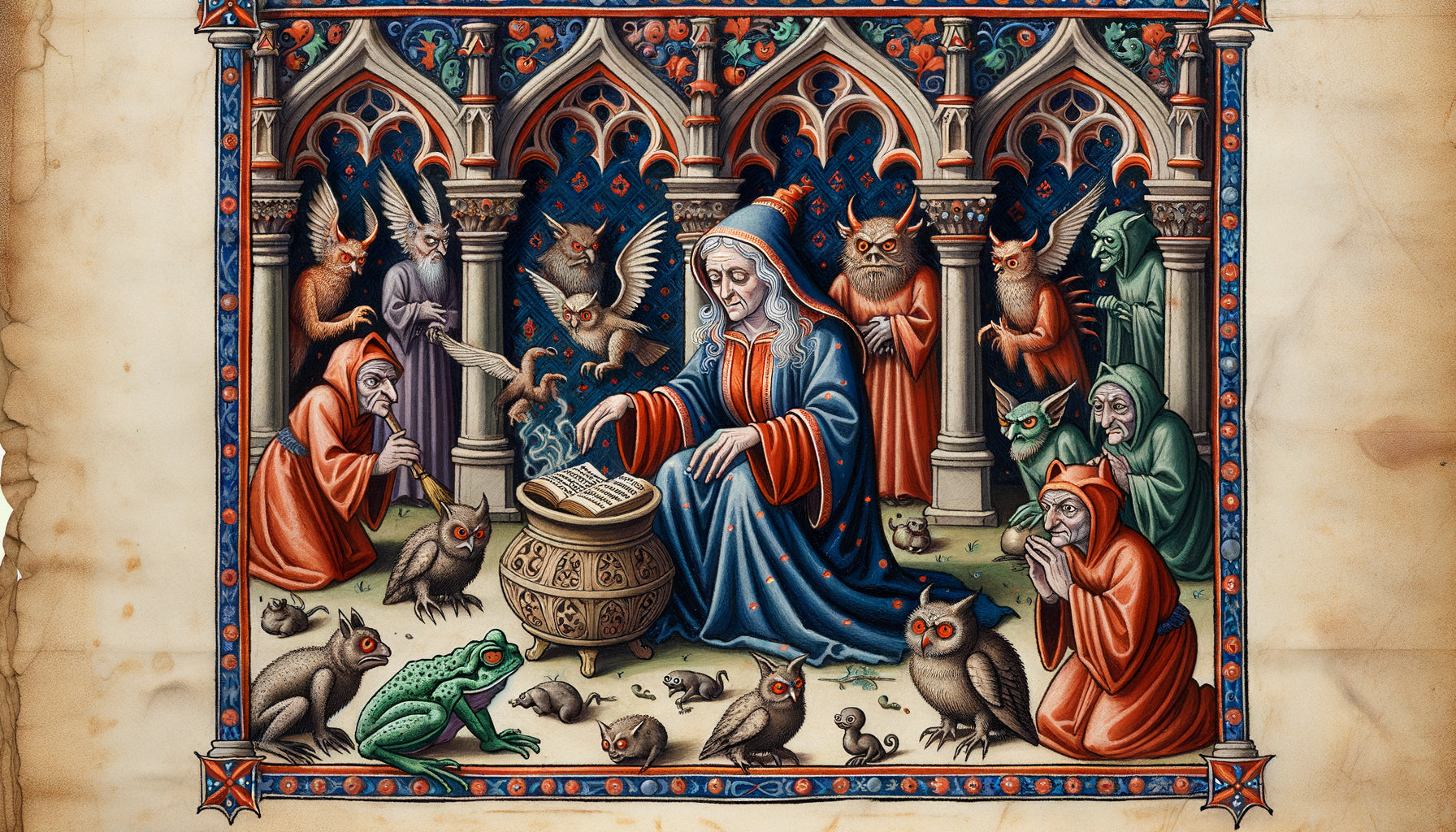
On this October evening, as I prepared a themed exhibition around fantastic creatures for a Parisian gallery, I was struck by a disturbing realization: the monsters that now adorn our Halloween decorations bear the invisible imprint of an 18th-century Spanish genius. Francisco de Goya, this master of shadow and grotesque, continues to influence our visual imagination three centuries later, particularly in our contemporary representations of Halloween creatures.
Here's what Goya's influence brings to your Halloween decorations: a disturbing psychological depth, a refined aesthetic of the monstrous, and an artistic dimension that transcends the simple festive accessory. These elements transform your interiors into spaces charged with meaning, where the terrifying becomes sophisticated.
You may have already felt this frustration: your Halloween decorations seem to lack character, oscillating between childish kitsch and gratuitous horror. It's impossible to find that artistic touch that would elevate your autumnal ambiance beyond the commercial cliché.
Rest assured, understanding Goya’s legacy in contemporary art will allow you to select decorative pieces that truly tell a story. I am going to reveal the visual codes and aesthetic signatures that betray this major artistic lineage.
The sleep of reason: when Goya invents our modern nightmares
In 1799, Goya engraved an image that would revolutionize our perception of the monstrous: The Sleep of Reason Produces Monsters. This work from his series of Caprices lays the foundations for all contemporary monstrosity. Unlike purely symbolic medieval creatures, Goya's monsters emerge from the human psyche, from our inner anxieties.
This conceptual revolution is reflected today in sophisticated Halloween representations. The creatures that adorn contemporary paintings are no longer simple decorative scarecrows: they embody our collective fears, our ambivalent relationship to reason and unreason. Pay close attention to a successful modern monster illustration: it often presents this same disturbing ambiguity, this gray area between dream and nightmare that Goya masterfully explored.
Bats with outstretched wings, owls with piercing eyes, spectral figures populating our autumn decorations directly take up the iconography of Goya's Caprices and Disparates. This lineage is not insignificant: it gives our interiors an unsuspected cultural depth.
Black Paintings: The dark aesthetic that shapes Halloween
Between 1819 and 1823, Goya created his terrifying Black Paintings directly on the walls of his house, the Quinta del Sordo. These hallucinatory works, including the famous Saturn Devouring His Son, establish a color palette and atmosphere that is systematically found in contemporary representations of Halloween monsters.
Do you recognize this dominance of deep blacks, earthy ochres, and chalky whites that create violent contrasts? This is the direct signature of Goya. Contemporary artists working on the Halloween universe consciously or unconsciously draw from this color palette. This palette is not chosen at random: it evokes earth, decomposition, the passage of time, the boundary between life and death.
The influence of the black paintings also manifests in the treatment of monstrous faces. Goya distorts features, exaggerates expressions to grotesque caricatures, creates hybrid beings between human and animal. These techniques are now found in representations of witches, zombies, and fantastic creatures that adorn our walls in October. The disproportionately open mouth, bulging eyes, clawed hands: all elements directly inherited from the visual vocabulary of Goya.
Expressive texture at the service of dread
Goya applied paint with a revolutionary gestural freedom for his time. His visible brushstrokes, impasto, and scratches create a living, almost palpable material. This textural approach is found in quality contemporary illustrations: artists play on material effects, superimpositions, organic textures that bring the represented creatures to life. An Halloween painting that fits into this tradition will never be smooth or too digital: it will retain this expressive roughness that characterizes Goya's work.

How to identify Goya's codes in your decorations
Now that you know the foundations of this influence, here are the precise visual markers that betray the lineage with Goya in contemporary representations of Halloween monsters.
First clue: unbalanced composition. Unlike symmetrical and reassuring representations, works inspired by Goya feature unstable compositions where creatures seem to emerge from the frame or tilt out of the image. This formal instability reinforces the feeling of unease and imminent danger.
Second clue: absence of a reassuring hero. In Goya's universe, there is no Saint George to slay the dragon. Monsters reign without opposition, confronting the viewer directly with their own vulnerability. Contemporary representations that follow this path offer no protective element, no secure distance: the monster looks at you, addresses you, involves you.
Third clue: unsettling hybridization. Grotesque creatures are never entirely animal or entirely human. They occupy this uncomfortable in-between that disrupts our reassuring classification system. Observe the quality contemporary works: their witches retain a residual humanity that makes them more terrifying than pure monsters, their fantastic animals bear expressions too human to be comfortable.
The importance of implicit narrative context
Goya's monsters are never gratuitous: they illustrate a social critique, a philosophical reflection, an existential anguish. This narrative dimension is found in the best contemporary Halloween representations. Rather than a simple decorative vampire, look for works that suggest a story, a context, a dramatic tension. This narrative depth is the mark of a true artistic lineage with the Spanish master.
Integrating Goya's aesthetics into your autumn decor
Understanding this influence allows you to compose an Halloween decoration that transcends simple seasonal kitsch. Favor works that present these formal characteristics: marked light contrasts, chromatic palette restricted to blacks, ochres and whites, dynamic and unbalanced compositions, hybridization of forms.
In your living room or entrance hall, a painting inspired by Goya's aesthetics will create a sophisticated and unsettling atmosphere. Combine it with indirect lighting that accentuates the shadows, with natural materials such as aged wood or oxidized metal. This approach transforms your Halloween decoration into a true artistic installation, where fright becomes refinement.
Contemporary representations of Halloween monsters that fit into this tradition do not go out of style after October 31st. Their artistic dimension allows them to cross the seasons, becoming collector's pieces that enrich your interior all year round. Some collectors keep them permanently, appreciating this touch of gothic mystery in their daily environment.

Contemporary artists heirs to Goya
Several contemporary art movements explicitly claim Goya’s legacy in their depictions of fantastical creatures. Neo-expressionism of the 1980s, with its tormented figures and violent brushstrokes, is directly rooted in this lineage. Artists like Jean-Michel Basquiat or Georg Baselitz drew on Goya's visual vocabulary to create their own modern monsters.
More recently, narrative illustration for adults, dark art, and certain branches of street art reactivate this aesthetic. Creators who specifically work on the Halloween universe appropriate these codes to produce works that go far beyond the framework of simple festive decoration. Their halloweenesque monsters carry this psychological charge, this symbolic depth that characterizes Goya's work.
As a curator, I have observed that the pieces that are most successful with discerning collectors are precisely those that establish this dialogue with art history. They allow enthusiasts to create culturally rich interiors, where each element tells a story and is part of a consistent aesthetic tradition.
Transform your interior with the legacy of masters
Discover our exclusive collection of Halloween wall art that draws on the great tradition of fantastic art, from black romanticism to the most daring contemporary representations.
Create a consistent collection around this aesthetic
If you wish to deepen this approach, gradually build a collection that explores the different facets of Goya's influence in contemporary art. Start with a masterpiece that presents the characteristics we have identified: dark palette, unbalanced composition, hybrid creature with strong psychological content.
Then complement it with satellite works that explore variations on this theme. A series of smaller formats representing details: a clawed hand, a monstrous eye, a ghostly silhouette. This accumulation creates an effect of fragmented narration, as if your wall were telling a disturbing story in successive touches.
Don't hesitate to mix different techniques: engravings in the spirit of the Caprices, paintings with generous impasto reminiscent of the Black Paintings, contemporary digital illustrations that reinterpret these classic codes. This technical diversity enriches your decoration while maintaining a strong aesthetic consistency around Goya's legacy.
Imagine yourself in a few weeks, hosting guests for an autumn evening. Their eyes are immediately drawn to this fascinating creature adorning your wall, both terrifying and magnetic. You then share with them this exciting discovery: the unsuspected influence of Goya on our contemporary imagination. Your Halloween decor is no longer just a seasonal accessory, but a gateway to art history and its current resonances. Start today to build up this collection that will enrich your interior and nourish your conversations for years.
Frequently Asked Questions
Do you need to be an art expert to appreciate these references to Goya?
Absolutely not, and that's precisely the beauty of this influence! The visual codes established by Goya have become so universal that they intuitively speak to our collective unconscious. You don't need to know art history to feel the disturbing power of a hybrid creature or the unsettling atmosphere created by marked light contrasts. These elements work first on an emotional and sensory level. However, understanding this lineage considerably enriches your aesthetic experience and allows you to select decorative pieces with more discernment. It’s like enjoying a delicious dish: you can enjoy it without knowing the recipe, but understanding the ingredients and techniques used deepens your gustatory pleasure.
Are the Goya-inspired representations too dark for a family interior?
This concern is legitimate, but based on a misunderstanding. The Goyesque aesthetic is not synonymous with gloomy or depressive decor. It's more about introducing a dimension of mystery, psychological depth and visual sophistication. Everything depends on dosage and integration into your space. A single striking piece inspired by this tradition, strategically placed in a bright living room with more contemporary and streamlined elements, will create a fascinating focal point without darkening the overall atmosphere. Children, moreover, are often less frightened by these artistic representations than by cheap commercial Halloween imagery, because they intuitively perceive the cultural and creative dimension of the work. As always in decoration, balance is key: it's about adding character, not turning your house into a museum of horrors.
Where can you find contemporary works that truly fit within this tradition?
This is indeed the most delicate question, as the market is saturated with superficial Halloween imagery lacking true artistic depth. Look for creators who explicitly claim influences from art history, who work with genuine reflection on composition, color and symbolism. Galleries specializing in fantasy art, independent artist platforms and some high-end art publishers offer limited series that fit into this tradition. Favor signed, numbered works accompanied by a certificate of authenticity. Carefully examine the quality of printing or execution: true artworks present subtle nuances, rich textures, visual complexity that rewards prolonged observation. Beware of overly smooth, too digital reproductions that have lost this expressive materiality characteristic of the Goyaesque aesthetic. Specialized collections like those offered by demanding curators generally guarantee this level of artistic quality.