While searching through illuminated manuscripts and medieval murals, a curious absence emerges: where did the black cats go that we so naturally associate with Halloween witches? This iconic creature, omnipresent in our contemporary imagination, remains mysteriously invisible in medieval art dedicated to witchcraft. Yet, representations of women accused of occult practices are not lacking in ancient manuscripts.
Here's what this absence reveals: a fascinating transformation of our visual codes, a shocking cultural history that links superstition and aesthetics, and valuable keys to understanding how our modern Halloween decorations have shaped their own mythology. This historical enigma transforms our gaze on the symbols we display each autumn in our interiors.
You may have wondered why this black cat-witch association seemed so obvious, almost ancestral. You probably imagined that this iconography dated back to the origins of European witchcraft. This belief is shared by most lovers of gothic decor and Halloween atmospheres.
Rest assured: this confusion is normal. Medieval art of witches obeyed radically different visual codes than ours, and understanding this evolution greatly enriches our appreciation of contemporary decorative symbols.
In this article, I take you on a journey through the centuries to discover how the black cat became the quintessential emblem of witches, why it was absent from medieval representations, and how this knowledge can transform your approach to Halloween decor.
Medieval art of witches: a bestiary without felines
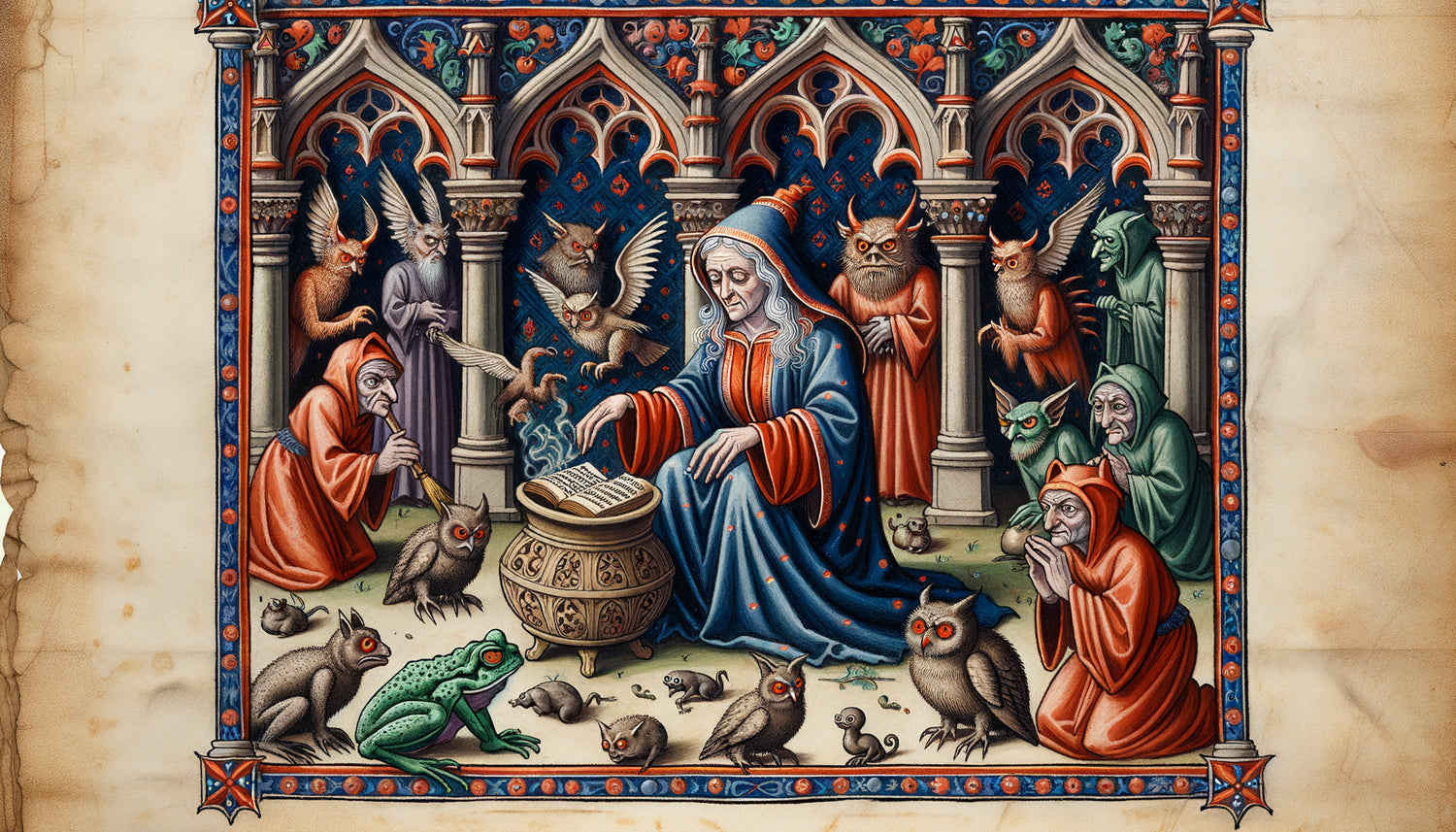
Medieval manuscripts are full of accusations of witchcraft and depictions of women practicing dark rituals. However, when examining these illuminations from the 12th to the 15th centuries, black cats are notably absent. Medieval artists favored other creatures to symbolize evil and transgression.
In the margins of prayer books and on church frescoes, we discover witches accompanied by toads, snakes, goats or ravens. The goat, in particular, embodied lust and the devil himself. Birds of prey evoked darkness and death. But the domestic cat? Practically invisible in this symbolic universe.
This absence is explained by the very status of the cat in the Middle Ages. Unlike our time when it reigns supreme in our homes, the medieval cat occupied an ambiguous position. Useful for hunting rodents in attics and monasteries, it had not yet acquired the sinister aura that later centuries would lend it. Medieval art reflected a reality where the cat remained essentially a functional animal, not yet laden with occult connotations.
The true companions of medieval witches
When medieval artists wanted to depict the familiars of witches – these mischievous spirits believed to serve them –, they chose creatures with much more symbolic significance. The toad, the epitome of repugnance, frequently appeared in scenes of sabbats. Demons often took the form of goats during nocturnal gatherings. These iconographic choices followed a precise theological logic, inscribed in the demonology treatises of the time.
Transformation: When the Cat Becomes Malevolent
The shift primarily occurs in the 16th and 17th centuries, a period of witch-hunting frenzy in Europe. It is in court records and trial narratives that the black cat begins to weave its fatal link with witchcraft. Accusations multiply: women were seen talking to cats, feeding them their blood, transforming themselves into felines to carry out their nocturnal misdeeds.
This diabolization corresponds to a profound change in the cultural perception of the cat. Its independence, luminous eyes in the darkness, silent movements become suspicious in a society obsessed with controlling and monitoring deviant behavior. The black cat, in particular, concentrates all anxieties: its color evokes darkness, the opposite of divine light.
Engravings from the late Renaissance and early modern period then begin to represent this new association. Illustrations in demonology manuals, such as the famous Malleus Maleficarum in its later illustrated editions, finally show witches surrounded by cats. The Halloween iconography we know originates in this period, not in the Middle Ages as one might believe.

Halloween and the Modern Consecration of the Black Cat
The true triumph of the black cat as a symbol of Halloween is an essentially Anglo-Saxon and modern phenomenon, which develops mainly in the 19th century. With the progressive commercialization of Halloween in the United States, image creators drew on a repertoire of frightening but charming symbols, domesticating ancestral terrors.
Victorian Halloween postcards, veritable ancestors of our festive decorations, fixed this iconography: the arched black cat, with shining eyes, perched on a pumpkin or alongside a witch with a pointed hat. These images created a coherent but anachronistic visual mythology, projecting this association retrospectively onto the entire history of witchcraft.
Today, it's impossible to imagine an Halloween decoration without a black cat. This creature has become the central element of autumnal visual compositions, from wall art to decorative cushions. Its absence in medieval art nevertheless recalls that our aesthetic codes are cultural constructs, evolving over the centuries and fashions.
The Victorian aesthetic revolution
It was the Victorian era that truly codified the Halloween aesthetics we know. Illustrator artists created a coherent visual universe, mixing Gothic elements, rural folklore and light humor. The black cat occupies a central place precisely because it offers this perfect blend: enough unsettling to evoke mystery, enough familiar to remain reassuring.
Why this knowledge enriches your Halloween decoration
Understanding the history of the black cat in witchcraft iconography transforms your approach to Halloween decoration. Instead of mechanically reproducing symbols whose origin you ignored, you can now consciously play with visual codes and their evolution.
You could, for example, create a decoration deliberately contrasting authentic medieval imagery – with its toads, goats, ravens – and the modern Halloween aesthetic dominated by the black cat. This juxtaposition would create a fascinating narrative depth in your interior, visually telling the cultural evolution of these symbols.
Wall art depicting black cats for Halloween takes on a new dimension when you realize that they embody a relatively recent visual construct, a modern myth rather than an ancestral tradition. This awareness adds a layer of sophistication to your decorative choice: you are not just following a trend, you are participating in an iconographic tradition that has been built up over several centuries.

How to integrate this story into your interior aesthetics
For decoration enthusiasts looking to go beyond clichés, this historical knowledge opens up exciting creative possibilities. You can imagine a gothic reading corner where reproductions of authentic medieval illuminations coexist with Victorian illustrations of black cats, creating a visual dialogue between eras.
A gallery wall dedicated to the evolution of Halloween iconography could include: Renaissance engravings showing the first links between cats and witchcraft, Victorian postcards establishing modern visual codes, and contemporary creations reinterpreting these themes. This chronological progression tells a story while creating a striking visual impact.
Spaces dedicated to Halloween gain depth when they integrate this historical dimension. Instead of accumulating symbols without narrative connection, you build a coherent universe that intrigues and educates your guests. A simple black cat on a canvas becomes the starting point for a fascinating conversation about the cultural evolution of our fears and symbols.
Authentic Medieval Inspiration as an Alternative
For those seeking a truly distinctive Halloween aesthetic, drawing inspiration from authentic medieval bestiaries – toads, ravens, goats – offers a refreshing alternative to the ubiquitous black cats. This historically informed approach creates an atmosphere that is both darker and more authentic, escaping conventional commercial norms.
Transform your interior with a touch of gothic history
Discover our exclusive collection of Halloween wall art that celebrates the fascinating evolution of the iconography of witches and their mysterious companions.
From Absence to Omnipresence: A Visual Revolution
The history of the black cat in witchcraft art perfectly illustrates how our visual codes are constructed and transformed. What seems obvious and ancestral today is often a relatively recent invention, shaped by cultural shifts, collective fears, and commercial aesthetic choices.
This absence of the black cat in medieval witchcraft art is not an oversight or a gap on the part of artists of the time. It faithfully reflects a reality where this association simply did not exist. Medieval witches, in the imagination of their time, mingled with other creatures, followed different symbolic codes. The black cat conquered its central place much later, gradually becoming the iconic image we know today.
For decoration enthusiasts, this historical understanding offers a valuable creative freedom. You can choose to celebrate the black cat in all its modern glory, knowingly. Or alternatively, you can explore more historically authentic alternatives, creating a distinctive and scholarly Halloween aesthetic. In either case, your choice becomes intentional rather than automatic.
The next time you admire a painting depicting a witch and her black cat, you will know that you are not contemplating a millennial tradition, but the result of a fascinating cultural evolution. This creature, absent from medieval illuminations, has conquered our imaginations and our interiors, becoming the quintessential symbol of a celebration that itself has considerably evolved over the centuries.
Your Halloween decor can now tell this story. Every element you choose – whether inspired by classic Victorian aesthetics or authentic medieval bestiaries – becomes a conscious statement, an informed choice that adds depth to your visual universe. The absence of the black cat in medieval art is not an anecdotal curiosity: it's an invitation to rethink our symbols, question our decorative certainties, and build interiors that tell stories as captivating as the myths they represent.
Frequently Asked Questions About Black Cats and Halloween Iconography
Did Witches in the Middle Ages Really Have Cats?
Historical documents from the Middle Ages rarely mention cats in connection with witchcraft accusations. This association only becomes frequent starting in the 16th century, during the intensification of witch hunts. Women accused sometimes did have cats – as many people did at the time to control rodents – but this trivial detail was transformed into proof of a demonic pact by courts. The idea that every medieval witch had her black cat is therefore largely a retrospective myth, constructed by later iconography and reinforced by modern Halloween representations.
Why the Black Cat Specifically and Not Other Colors?
The color black has concentrated anxieties related to darkness, the unknown, and, in medieval and modern Christian symbolism, sin and the devil for centuries. Black cats were already considered unlucky in some European traditions before their specific association with witches. When cats began to be linked to witchcraft in the 16th-17th centuries, the black cat naturally became the preferred variant in artistic representations and narratives. This focus intensified with Victorian Halloween iconography, which sought visually striking symbols: the contrast between the black of the cat and the orange of pumpkins created a perfect aesthetic impact for postcards and decorations.
How to Create a Historically Authentic Halloween Decoration?
For an authentic approach inspired by the Middle Ages and the Renaissance, prioritize symbols actually present in art from those periods: toads, snakes, ravens, goats, and hybrid demonic creatures. Explore medieval manuscript illuminations and Renaissance engravings for inspiration from authentic compositions. You can incorporate reproductions of these historical works into your decor, creating a sophisticated gothic atmosphere that stands out from commercial clichés. If you wish to include black cats – after all, they are part of the evolution of this iconography – you can create an intentional contrast between authentic medieval sections and modern Victorian sections, transforming your decoration into a true visual journey through the history of Halloween imagination.