

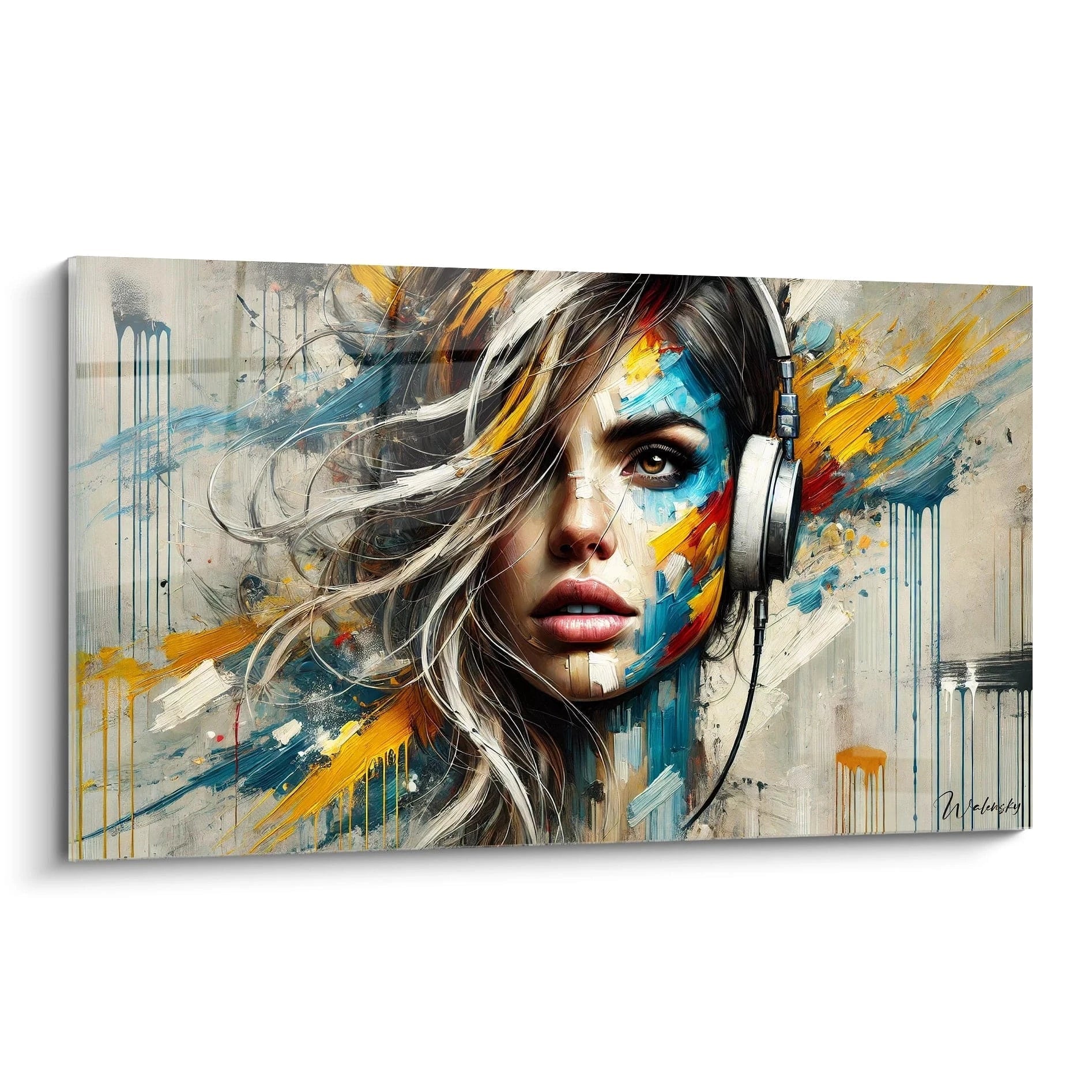






Printed Artwork vs. Hand-Painted Artwork: What You Need to Know
October 11, 2025 · 15 min read · by Walensky
You are standing in front of this magnificent painting , in this gallery, the heart beating a little faster... But this little voice in your head whispers: "Is it really hand-painted or just a beautiful print?"
You touch the surface discreetly, scrutinize the details, searching for these brushstrokes that betray the artist's work. This uncertainty annoys you, you who want to invest in something authentic and durable.
You've already experienced this frustration: buying something thinking you're acquiring an original artwork, only to discover later that it was a printed reproduction. This bitterness of being tricked, this feeling of having paid a premium price for a fake.
Rassurez-vous, this confusion is perfectly normal! Modern printing techniques have become so sophisticated that they sometimes rival traditional painting. The problem isn't your eye, but the lack of clear information about these two worlds.
By the end of this article, you will be able to exactly differentiate a printed artwork from a painted work, know their respective advantages, and confidently choose the one that will truly enhance your interior.
Why This Difference Changes Everything in Your Decor Choices?
Choosing between prints and paintings today, is like choosing between a photo of the Eiffel Tower and actually climbing it: the emotion isn't the same. If you wait any longer, authentic artworks become rarer and their prices skyrocket. You risk being left with limited choices and blown budgets.
🎨 Customer Testimonial: Sarah, interior designer, says: "I bought a printed artwork for €200 thinking I was getting a deal. Six months later, the colors had faded and my clients noticed. I had to replace it with a painting for €800. In the end, I paid €1000 for something that should have cost me €600 from the start."
Conversation with a Decor Expert
The Golden Rule of Informed Choice: A painted artwork ages like a good wine, increasing in value, a print remains frozen in time. In 6 months, you'll already see the difference in your daily feeling.

Our Selection
Marbled Purple and Orange Flow Artwork - Nocturnal Chromatic Fissure - Edition Style Abstract Painting
€233.90
Discover this artworkWhat's Really Behind Your Hesitation
You recognize yourself in one of these situations: you stand in front of a painting for 10 minutes without knowing if it's "real", you obsessively compare prices wondering why some cost 10 times more, or you avoid buying altogether for fear of making a mistake.
What's really happening? Your brain subconsciously detects the differences, but no one has given you the keys to understanding. The problem isn't your artistic instinct, it's the lack of concrete references to decode what you feel.
It's like driving at night without headlights: you feel the road under the wheels, but you don't see where you're going. Once illuminated, everything becomes obvious.
First Revelation: Texture Never Lies
Contrary to what is believed, it's not beauty that differentiates prints and paintings, but the physical presence. Everyone looks with their eyes first, but it's with their fingers that you really understand.
Imagine stroking a baby's cheek versus touching their photo: the same visual softness, a totally different sensation. It's the same principle with your paintings.
This tactile difference influences your daily well-being without you realizing it. Your eye captures these micro-reliefs, these variations in light, and your brain translates that into "living" or "flat".
🔍 Quick test: Take a photo on your phone and look at it under a lamp while slightly moving the device. Now do the same with a textured object (wool sweater, tree bark). See? One reflects uniformly, the other dances with the light.
Second Revelation: Emotional Investment Changes Everything
We think expensive = better, but it's more subtle. The real mechanism? The more you invest emotionally and financially, the more your brain activates its circuits of satisfaction and attachment.
It's like the difference between a microwave reheated dish and a meal you cooked for 2 hours: even if the taste is similar, your pleasure isn't the same.
Result: your painted artwork becomes a daily companion that nourishes your pride, while a print remains a "decor object" that you will eventually stop seeing.
Third Revelation: Durability Hides a Psychological Trap
Here's what no one tells you: a print can physically last 20 years, but psychologically, you get tired of it in 2 years. Sarah's story above is not a coincidence.
Spot this signal in your own home: these objects that you no longer really look at, which have become "transparent" to your eye. It's your brain that has classified the object as "acquired, not precious".
Concrete impact: you change your decor more often, sspend more in the end, and never manage to create that cohesive interior you dream of.
3 signals that don't lie:
- You avoid showing certain paintings to your guests: your instinct detects the "fake" even if you don't know how to explain it
- You regularly change the location of your artworks: it's your brain that's trying to regain lost interest
- You always hesitate about prices: you subconsciously feel that the displayed value and the real value don't match
The Trigger Element: The Relationship with Authenticity
What really makes the difference, is your personal connection to authenticity. Like a domino effect, this choice influences your confidence in your tastes, your daily pleasure, and even the way others perceive your interior. Identify it by asking yourself: "Am I choosing to impress or to truly please myself?"
The rule of the beating heart: If your pulse quickens when you look at a work, it means it is in dialogue with you. No matter its technique, trust this first emotion.
| ❌ What we believe | ✅ The reality | 💡 Why | 🎯 Your benefit |
|---|---|---|---|
| The more expensive, the more beautiful | The more authentic, the more it touches you | Your brain detects artistic intention | Pleasure that grows over time |
| Prints are cheating | Prints have their own qualities | Different techniques, different uses | Informed choice according to your needs |
| You have to be an expert to choose | Your emotion is the best guide | Art speaks to the heart first | Confidence in your personal tastes |
| Prices reflect quality | Prices reflect rarity and work | Different economic mechanisms | Optimized budget according to your priorities |
— Also to discover


Your practical guide to choosing with confidence
Now that you understand the real stakes, let's get practical! This method is like a cooking recipe: first you prepare your ingredients (knowing your criteria), then you assemble (compare concretely), and finally you enjoy (appreciate your choice). In 30 minutes, you will know exactly what type of artwork corresponds to your project.
🎯 Overview of your journey: 3 simple steps that lead you from hesitation to certainty. First identify your real needs (5 min), then decode the techniques (15 min), finally validate your choice (10 min). At each step, you gain clarity and confidence.
Step 1: Reveal your true motivations (the foundation)
Starting with this introspection, is like laying a solid foundation before building. Without this clarity on your deep motivations, you risk choosing with your head and regretting it with your heart. This step avoids 80% of purchase mistakes and gives you that rare satisfaction of having chosen "right".
What you need for this reflection
- A notebook or your phone: to note your spontaneous answers without filtering them. The first draft often reveals your true motivations. Avoid complicated apps that would make you think about the form rather than the substance.
- 15 minutes of peace and quiet: a time when your mind is not distracted by daily emergencies. Your authenticity emerges in silence, not in agitation. An early morning coffee or a break in a park are perfect.
- A photo of your destination space: taken with good natural lighting to see the true colors and proportions. This objective image prevents you from fantasizing about the space and brings you back to the reality of your constraints.
Now, let's move on to concrete action
Revelatory questions to ask yourself
Explore your primary motivation: Note in a maximum of 3 words why you want this painting. Not a constructed sentence, just 3 words that come to you. This spontaneity reveals whether you are looking for pleasure ("beautiful", "emotion", "crush") or status ("prestige", "investment", "impression").
⏱️ Time: 2 minutes | ✅ Successful when: these 3 words really speak to you, even if they surprise you | ⚠️ Attention: do not censor "superficial" words - they sometimes reveal your true needs
Test your budget relationship: Imagine you found exactly what you are looking for, but 50% more expensive than expected. Your first reaction (not the reflection, the reaction): frustration, excitement, or indifference? This instant emotion reveals whether art is a pleasure or a constraint for you.
⏱️ Time: 1 minute | ✅ Successful when: you clearly feel an emotion | ⚠️ Attention: do not rationalize your first reaction
Visualize in 5 years: Close your eyes and imagine yourself looking at this painting in 5 years. Can you still see it? Does it still make you smile? This projection reveals whether you are looking for a lasting crush or an immediate pleasure.
⏱️ Time: 3 minutes | ✅ Successful when: the image is clear (positive or negative) | ⚠️ Attention: if you see nothing, it means your need is not yet ripe
✅ Validation of the step: You now have a clear profile: seeker of authentic emotion (→ painting), lover of accessible aesthetics (→ print), or savvy collector (→ both depending on the context). If it's blurry, start again with less mental and more instinct.
Step 2: Decipher techniques like a pro
Now that you know your motivations, let's move on to the technical decoding! This is where it gets exciting: you'll develop that expert eye that impresses even the sellers. This skill will serve you well throughout your life and transforms each visit to a gallery into a moment of confidential pleasure.
Your artistic detective kit
- Your smartphone with a lamp: sidelight to reveal invisible reliefs. The grazing light transforms your phone into a texture revealer. Avoid the frontal flash which obliterates all relief.
- Your fingers (clean!) : the fingertips contain 2000 nerve endings per cm², which is an ultra-precise texture sensor. This sensitivity gives you information that the eye cannot capture. Use this natural superpower!
- A magnifying glass or zoomed camera: minimum x10 magnification to see the structure of the printing dots or brushstrokes. This microscopic vision reveals the technical DNA of the work and gives you absolute certainty.
Infailible recognition techniques
The dancing light test: Place your light source at a 45° angle to the work and move it slowly. A painting will create moving shadows and changing reflections, an impression will remain uniformly lit. This is the difference between a mountain (multiple reliefs) and a lake (flat surface).
⏱️ Time: 30 seconds | ✅ Successful when: you clearly see if it "moves" or not | ⚠️ Attention: some prints on canvas imitate texture
Examination under a microscope: Zoom in on a colored area with your camera or magnifying glass. An impression reveals regular dots (like in a newspaper), a painting shows irregular tool marks. This technical signature cannot lie.
⏱️ Time: 1 minute | ✅ Successful when: you can distinguish dots or marks | ⚠️ Attention: look at several areas because some artists mix techniques
Step 3: Validate your choice with certainty
Last step, the most rewarding! You will now synthesize your discoveries and make an informed decision. This is the moment when everything aligns: your tastes, your means, your needs. This final clarity gives you that rare confidence of someone who knows exactly what they are doing.
Final validation grid
The perfect match: Confront your motivations from step 1 with your technical discoveries from step 2. If you were looking for "lasting emotion" and you found a real textured painting, that's jackpot! If you wanted "beautiful and cheap" and the print appeals to you, go for it! Alignment is more important than technique.
⏱️ Time: 3 minutes | ✅ Successful when: you feel the coherence | ⚠️ Attention: don't force yourself to like something because it's "better"
The heart and reason rule: Your final choice must make your heart beat AND satisfy your logic. If one of the two is missing, wait to find something better. This patience avoids 90% of regret purchases.
Congratulations! You now master the codes that gallerists use among themselves. Here are some insider tips to perfect your expertise and impress even professionals.
🎨 Gallery secret: Real good deals are often found in mixed techniques: a printed base reworked with paint. You get the authenticity of the artistic gesture with the precision of the print, all at a reasonable price. It's the smart compromise that few people know.
"But how can I be sure I'm not mistaken?"
"I'm afraid of being fooled by a seller who tells me it's painted when it's printed..."
I completely understand this concern! It's even proof that you're taking this choice seriously. Here's the good news: with the tests you've just learned, no seller can mislead you. Texture and light never lie. If you still have doubts, simply ask to touch (gently) the surface. An honest professional will always accept.
🛡️ Your anti-scam insurance: Discreetly test your new expertise on artworks whose technique you already know (at home or at friends'). This practice will give you unwavering confidence for your future purchases.
— In the same spirit


Absolutely essential traps to avoid (even with good intentions)
Now that you know how to recognize and choose, protect your investment! These mistakes are so common even experienced enthusiasts fall for them. But once warned, you will naturally avoid them.
- 🚫 Believing that prints = less quality: It's tempting to prioritize, but some art prints are masterpieces of technical precision. Result: you miss out on magnificent pieces. Instead, ask yourself if the technique serves the emotion you're looking for.
- ⚠️ Buying "for resale" without being a collector: Art is not the stock market! If you don't know the art market, you risk losing money and never enjoying your artworks. First, buy for your pleasure, the value will follow naturally.
- 💸 Ruining yourself to "keep up with the Joneses": Seeing perfect Instagram interiors leads to spending beyond your means. Consequence: financial stress that spoils the pleasure. It's better to have a beautiful, affordable print than a painting that puts you in debt.
- 🎯 Neglecting the lighting of the destination: Even the most beautiful painting can look dull under poor lighting. This mistake kills 50% of your artistic investments. Always test the effect in your actual lighting before buying.
- ⏰ Making a decision under pressure: "It's the last piece" or "the offer ends tomorrow"... These sales techniques make you buy with stress rather than with your heart. Result: guaranteed regrets. A true love deserves time for reflection.
🔍 Your 4 control points before every purchase: Does your heart still beat for this artwork after 10 minutes? Does the budget correspond to your actual means? Does the artwork integrate into your space? Are you rushed or calm? If one answer is negative, postpone your decision by 24 hours.
— Other selected pieces


Your most frequently asked questions about prints vs paintings
For a 50x70cm piece, expect 150-400€ for a quality art print and 300-1200€ for an original painting. Optimize by buying directly from the artist or in emerging galleries. A well-chosen print will give you 5 years of pleasure, a painting will accompany you for life.
A print on art paper with pigment inks lasts easily 25-50 years without visible discoloration, even when exposed to normal room light. The secret: avoid direct sunlight and choose inks certified "museum quality". It's more durable than many poorly preserved paintings!
Three infallible criteria: the visible technique (reliefs, textures, complex color mixtures), the artist's signature (searchable online), and your immediate emotion. If these three elements align, the price becomes secondary. A strong emotion is worth all investments.
Absolutely! It's even very trendy among savvy decorators. The key: thematic or color coherence rather than technique. Three black and white prints + a colored painting create a striking effect. Vary the techniques, keep the visual harmony.
Living room and bedrooms: paintings for emotional intimacy. Kitchen and bathroom: prints for moisture resistance. Office: both depending on your need for inspiration or concentration. Hallways: prints to easily renew the atmosphere.
Your new life as an enlightened art lover
In 3 months, You will look at your new painting with that rare satisfaction of someone who has chosen with full knowledge of the facts. Your guests will notice this new coherence in your decor, this quiet confidence in your aesthetic choices.
More than decoration, You have developed an artistic eye that enriches all your visual pleasures. This skill accompanies you on all your travels, in all your museum visits, in all your cultural discoveries. You have become someone who "knows how to see".
The best part? This expertise was already within you, just waiting to be revealed. Your first gesture: look differently at the works that already surround you. You will be surprised by all you will discover!
🚀 Your next step: Within 48 hours, visit a gallery or art store with your new reading grid. You will feel that exhilarating confidence of someone who understands what they are looking at. This is the beginning of your artistic adventure!
Also read: 📖 Read more articles about wall art
Explore Our Collections


