I’ve moved seven times in fifteen years. Seven different apartments, seven wall configurations, seven times the same puzzle: my beloved paintings never seemed to naturally integrate into the new space. That perfect frame above the sofa becomes too small in the next living room. This three-piece composition loses its balance in a new arrangement. Until the day I understood the secret of discerning collectors.
Here’s what standard sizes bring: total flexibility to renew your decor, unlimited access to frames and supports available everywhere, and a natural harmony between your current and future works. These universal dimensions transform your wall into an evolving gallery.
How many times have you given up buying a painting because it didn’t match any existing frame? How many times have you kept a work that no longer inspires you simply because the custom framing had cost a fortune? This decorative rigidity deprives us of the pleasure of evolving our interior at the pace of our desires.
Rest assured: adopting standard sizes does not mean sacrificing your creativity. On the contrary, it’s offering you total freedom. Like a modular system, these dimensions allow you to replace, add, reorganize without constraint or excessive investment.
I'm going to reveal which formats to prioritize to build an evolving collection, how to combine them intelligently, and why certain dimensions become your best decorative allies.
Versatile rectangular formats: your decor foundations
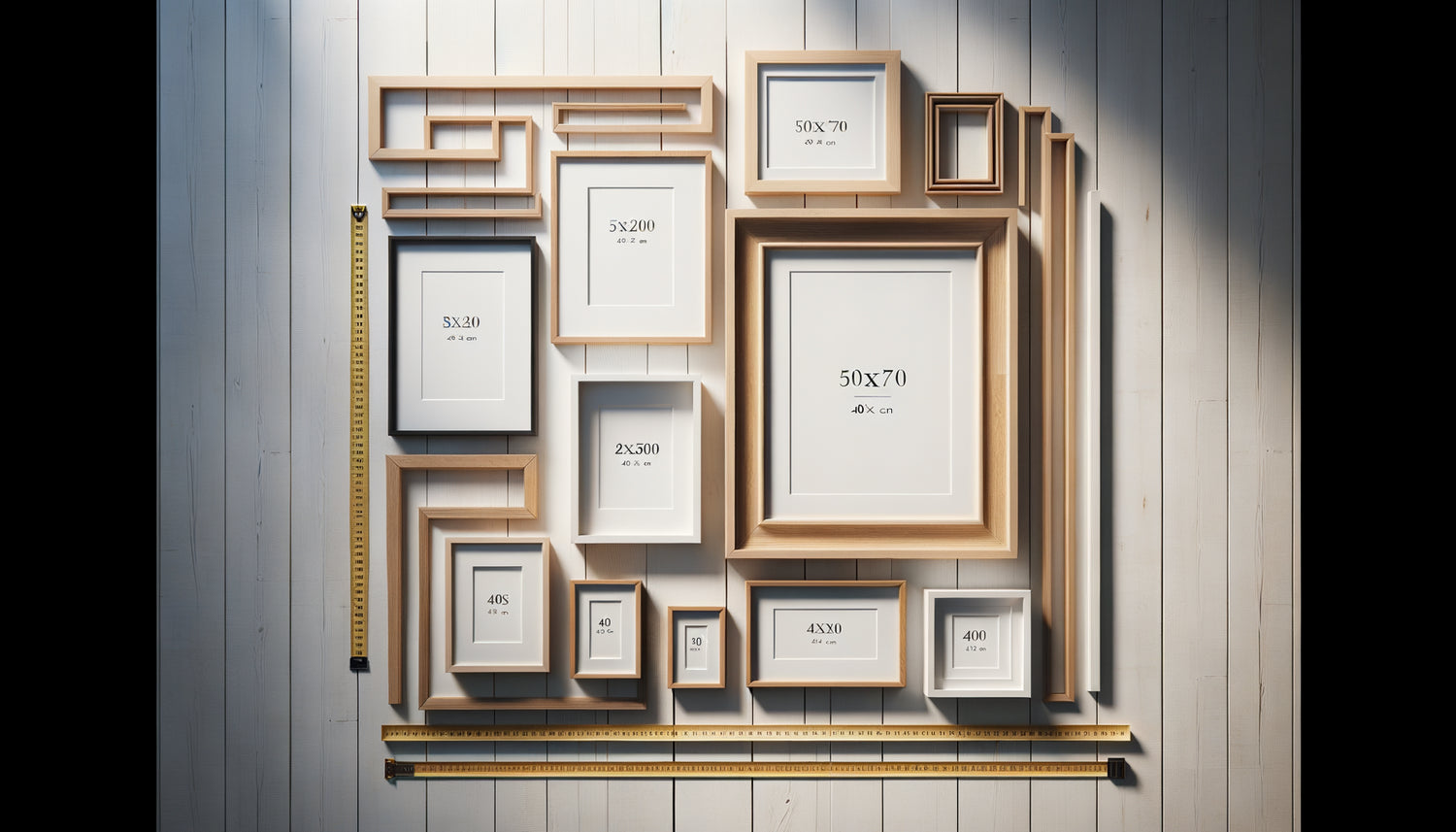
The 50x70 cm format reigns supreme in the world of contemporary decoration. This dimension miraculously adapts to almost all spaces: above a console in the entrance, on the main wall of the living room, in a bedroom above the headboard. Its balanced proportion captures the eye without dominating the room.
I have long favored this format in my projects because it offers a generous expressive surface for the artist while remaining financially accessible. You will find thousands of ready-made frames in this dimension, from a simple black mat to an elegant gilded frame. Your painting can change atmosphere in an afternoon, without going through the framer.
The 40x60 cm format is its ideal little brother. Slightly more compact, it integrates perfectly into wall compositions or constrained spaces. A narrow hallway? A panel of wall between two windows? This format slips everywhere. Even better: you can create a coherent gallery by combining several 40x60 paintings with one or two 50x70.
The A Series: German ingenuity at the service of your decor
A3 (29.7x42 cm) and A2 (42x59.4 cm) formats represent a remarkable strategic choice. Originating from the ISO 216 system, this European standardization guarantees that you will always find framing, glazing, and fixing solutions. Paper shops, craft stores, even some department stores offer frames in A sizes.
The hidden advantage? Professional photographic prints often use these dimensions. Your collection can therefore evolve between original paintings, art photographs, and quality reproductions, all within perfect visual coherence. You start with an A3 watercolor, then later add an A2 photograph, and the whole naturally dialogues.
Squares: Modular modernity
The 50x50 cm square format has conquered contemporary interiors for a simple reason: it offers soothing symmetry and exceptional modularity. A single square artwork creates a powerful focal point. Two side by side generate an elegant diptych. Four in a grid compose an impressive wall installation.
This square dimension also facilitates seasonal rotations. Imagine a composition of four 50x50 artworks that evolves throughout the year: you simply replace one or two elements to refresh the atmosphere without upsetting everything. The Nordic minimalist light wood frame you bought two years ago will perfectly welcome your new abstract acquisition.
The 40x40 cm format follows the same principles with a more intimate scale. Perfect for small spaces, tight compositions or accent walls, it allows you to create decorative clusters without massive investment. Three 40x40 artworks generally cost less than a single custom-made large canvas, while offering infinitely more evolutionary possibilities.

When horizontal meets vertical: orientation flexibility
A little-known secret: some formats work just as well in portrait as in landscape. The 30x40 cm embodies this versatility. Vertically, it visually lengthens a space. Horizontally, it widens it. This double possibility transforms a single format into two distinct decorative tools.
This dimension is particularly relevant for evolving wall compositions. You start with three vertical 30x40 inch canvases aligned. Six months later, you reorganize with two horizontal ones stacked and one on the side. Same format, same framing, a totally renewed atmosphere. That's smart decoration.
The 60x80 cm format for generous walls
In a large living room or spacious dining room, the 60x80 cm format offers a striking presence without becoming monumental. This dimension remains accessible enough to gradually build a coherent collection. Unlike XXL formats that fix your decoration for years, 60x80 allows you to change artwork without feeling wasteful.
Framers consistently offer solutions for this dimension. Online sales sites display dozens of frame models. Even suspension systems adapt naturally. This eliminates the technical obstacles that often discourage decorative renewal.
The art of combination: creating an evolving gallery
The true magic of standard formats emerges when you combine them intelligently. A classic composition combines a 50x70 cm canvas surrounded by four 30x40 cm canvases. Elegant, balanced, and entirely modifiable. Next year, you replace the 50x70 with a new centerpiece. The whole remains harmonious because the proportions naturally dialogue.
I've observed that the most sophisticated collectors voluntarily limit their palette of formats to a maximum of three or four dimensions. This discipline creates a powerful visual coherence while preserving total flexibility. Your eye perceives an intention, a curation, even if the works change regularly.
Standard formats also facilitate thematic rotations. Summer collection of marine landscapes in 40x60, then autumn series of misty forests in the same dimensions. Your frames become permanent receptacles for changing inspirations. It's the capsule wardrobe applied to wall decoration.
The revisited triptych with modular formats
The traditional triptych required three canvases specifically painted to form an ensemble. With standard formats, you create your own evolving triptych: three 40x50 cm canvases aligned horizontally, or three 30x40 cm stacked vertically. Each element remains independent and replaceable, but the whole composes a visual narrative.
This modular approach is perfectly suited to rental apartments. You don't invest in a monumental work that is impossible to reinstall elsewhere. You build a nomadic collection that adapts to each new space. A move becomes an opportunity to reinvent your staging, not a constraint.

Traps to avoid when selecting formats
Not all commercial dimensions deserve the label 'standard practical'. Some exotic formats like 35x57 cm or 48x63 cm trap you in a dead end. Admittedly, they may seem original, but you will pay three times as much for each frame, and options will be counted on your fingers.
Also beware of formats too specific to an artistic style. The panoramic 20x60 cm works beautifully for horizontal landscapes, but becomes problematic if you want to evolve towards portraits or square abstract compositions. Excessive specialization limits your future possibilities.
Another frequent mistake: mixing too many different dimensions without proportional logic. A 30x40 coexists harmoniously with a 60x80 because the large one measures exactly twice the small one. But associating 32x45, 55x73 and 41x59 creates a visual cacophony, even if the works are beautiful individually.
Ready to build your evolving gallery?
Discover our exclusive collection of wall art for Apartment that perfectly adapts to standard formats and transforms your walls into living spaces.
How to measure the future of your collection
Before buying your next painting, ask yourself this simple question: 'Can I easily replace this work in two years?' If the answer involves custom framing at €200, a laborious search for special fixings or an inability to reuse the frame, reconsider your choice.
Standard formats do not limit your creativity, they free it. You dare to take artistic risks because nothing is definitive. This bold contemporary watercolor in 50x70 no longer convinces you after six months? You replace it without drama or excessive expense. Your decoration breathes, evolves, resembles you today, not yesterday.
Build your collection methodically: start by defining your two or three favorite formats according to your spaces. Invest in quality frames in these dimensions – this is a durable purchase that will welcome multiple works. Then let your collection grow organically, guided by your favorites rather than technical constraints.
Your wall as a renewable blank page
Imagine yourself in six months, standing before the wall you're looking at today. The artworks have changed. The seasons have turned. Your gaze has become more refined. But this transformation didn't require major renovations or a huge budget. Simply the pleasure of replacing one work with another, within the same perfectly adapted frame.
Standard formats are not a practical compromise; they are a statement of intent: you refuse to let your decor freeze. You choose the freedom to evolve, experiment, and surprise yourself. Your interior becomes an authentic reflection of who you are now, not who you were during the last redecoration.
Start small if you wish. A single 40x60 cm artwork that you deeply love. A quality frame. The assurance that in a year, this space can welcome a new inspiration without starting from scratch. This is how the most beautiful collections are born: not through exhaustive planning, but through the permanent possibility of evolution.
FAQ: Your questions about standard formats
Do standard formats limit the choice of available artworks?
Absolutely not, on the contrary. Artists, galleries and online stores massively produce in standard formats precisely because they know that buyers can easily frame them and integrate them. You thus have access to a much wider selection than for atypical dimensions. Formats such as 50x70 cm or 40x60 cm concentrate thousands of references in all styles: abstract, figurative, photographic, illustrative. This standardization paradoxically expands your possibilities rather than restricting them. You also find works in all price ranges, from affordable reproductions to original works by emerging artists.
Can I mix different standard formats on the same wall?
Yes, it is even recommended to create a dynamic and personal gallery wall. The key lies in respecting certain harmonious proportions. Favor formats that maintain simple mathematical relationships: 30x40 cm pairs perfectly with 60x80 cm (ratio of 1 to 2), 40x40 cm naturally dialogues with 40x60 cm. Organize your composition by first establishing an invisible guideline – horizontal or vertical – which structures the whole. Varied formats create visual rhythm while maintaining coherence if you respect regular spacing between frames (generally 5 to 8 cm). This approach transforms your wall into a truly evolving gallery where each addition naturally finds its place.
How many different formats should I use in my interior?
To maintain visual harmony while preserving your decorative flexibility, limit yourself to a maximum of three or four formats throughout your interior. This discipline creates a consistent visual signature that subtly connects your different rooms. For example: 50x70 cm for your master pieces, 40x60 cm for secondary spaces, and 30x40 cm for grouped compositions. You can add a square format such as 40x40 cm if you particularly appreciate this geometry. This restricted palette also facilitates the management of your frames: you store a few versatile formats rather than a heterogeneous collection. Each new painting purchase integrates naturally without requiring new framing solutions. It's the intelligent minimalist approach applied to art collecting.