When I first discovered reproductions of the Ennedi rock paintings in a dusty monograph, I felt that shiver only millennia-old art can provoke. These ghostly silhouettes with perfectly round heads, floating on the ochre walls of the Chadian Sahara, were unlike anything I had ever seen. No academic naturalism, no classical proportions. Just this hypnotic geometry that crosses eight thousand years to come and disturb our aesthetic certainties.
Here's what these rock paintings with round heads reveal: a cosmic vision of humanity that transcends realistic portraiture, a universal visual language that still dialogues with our contemporary interiors, and a masterful lesson on the power of stylization. These enigmatic figures from the Ennedi massif embody the very essence of what tribal art collectors are looking for today: the perfect balance between ancestral mystery and graphic modernity.
Yet, faced with these works, one question systematically returns: why this obsession with the circular form? Why did these Neolithic artists choose to represent humans with this spherical head so far from anatomical reality? The frustration is legitimate. Contradictory interpretations abound, oscillating between ritual hypotheses, ceremonial masks or shamanic visions.
Rest assured: this mystery is not an obstacle, but an invitation. Understanding the reasons behind these round heads means penetrating the mental universe of a vanished civilization and profoundly enriching our view of African art. It's also discovering why these millennial motifs now find their place in the most demanding interiors.
I invite you on a journey through the gorges of the Ennedi massif, where prehistoric art dialogues with our contemporary sensibility.
The enigma of round heads: when the Sahara was green
The Ennedi massif, located in northeastern Chad, is home to one of the most extraordinary concentrations of rock paintings in Africa. Classified as a UNESCO World Heritage site, this sandstone plateau hides thousands of human representations dating back to the Neolithic period, a time when the Sahara was a lush savanna traversed by rivers and populated with elephants, giraffes and rhinoceroses.
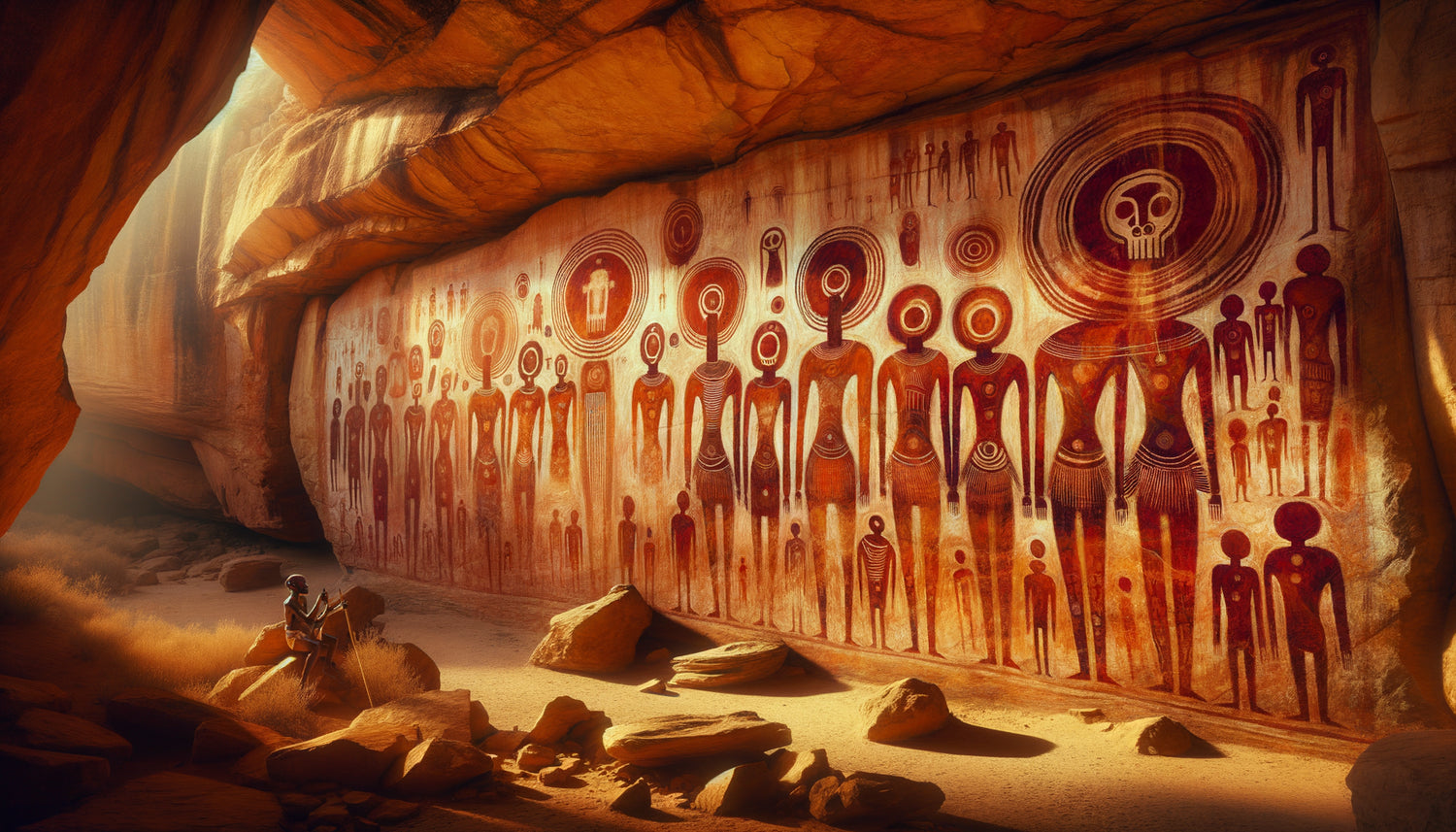
The characters with round heads constitute the oldest and most fascinating phase of this parietal art. Dated between 8000 and 6000 BC, these figures are distinguished by their radical stylization: slender bodies topped with perfect circles, often adorned with internal geometric motifs. Some measure several meters in height, dominating the rock shelters like silent deities.
Archaeologist Henri Lhote, who extensively studied Saharan art in the 1950s, named this period the round heads style, distinguishing it from later more naturalistic phases. This denomination has remained, crystallizing the fundamental question: why this recurring circular form?
The shamanic theory: petrified ritual masks
The first hypothesis, and perhaps the most appealing, sees these round heads as representations of ceremonial masks. The Neolithic societies of Ennedi likely practiced complex rituals, and wearing masks was a central element in many prehistoric African cultures.
These circular heads could thus reproduce hollowed-out gourds, spherical wickerwork or fiber structures worn during initiation ceremonies or shamanic trances. This interpretation finds a disturbing echo in living traditions among some peoples of Central Africa, where round masks symbolize cosmic perfection, the primordial egg or the full moon.
In several rock paintings in the massif, we can also distinguish details that reinforce this theory: horizontal lines evoking openings for eyes, radiant motifs suggesting feather or fiber ornaments. These masked figures would therefore not represent ordinary humans, but shamans in a trance state, initiates or ancestral spirits.
An aesthetic of transcendence
This spiritual dimension also explains why the round heads in the rock paintings give off this impression of otherness. Unlike later, more realistic representations, these silhouettes seem to belong to another world. Their perfect geometry removes them from ordinary humanity and elevates them to the rank of cosmic entities.
In my journey as a collector, I have noticed that this transcendent quality particularly fascinates contemporary art lovers. The characters with round heads in the Ennedi massif evoke both Basquiat and Kandinsky, bridging the gap between figuration and abstraction in a way that Western art has only recently explored.

The symbolic hypothesis: the geometry of the universe
A second, more metaphysical interpretation suggests that these round heads were not trying to represent visible reality at all. They would rather constitute a symbolic language, where the circular form conveys a concept rather than an appearance.
In many African cosmogonies, the circle embodies totality, eternity, the perpetual cycle of life and death. By giving their characters spherical heads, Neolithic artists thus expressed a holistic vision of human beings, integrated into natural and cosmic cycles.
This conceptual approach surprisingly echoes certain practices of modern art. Picasso himself, fascinated by African masks, explored how geometrization frees art from mere imitation to reach a deeper truth. The rock paintings of the Ennedi massif had already practiced this aesthetic revolution ten millennia ago.
The archaeological trail: material remains are elusive
Unfortunately, the current aridity of the Sahara considerably complicates archaeological study. Organic materials – wood, plant fibers, leather – that might have constituted the famous masks have long since disintegrated. Excavations in the Ennedi massif have yielded no preserved headdress or mask.
This lack of material evidence fuels the mystery. We are reduced to interpreting these rock paintings by ethnographic comparison, observing the practices of contemporary African traditional societies. A risky method, as it assumes cultural continuity over eight millennia – a seductive but difficult-to-prove hypothesis.
Some archaeologists propose a more pragmatic explanation: the round head would simply be an artistic convention, facilitating the rapid execution of figures. The circle is indeed one of the easiest shapes to trace, even on an irregular wall. This utilitarian hypothesis, less poetic, does not necessarily contradict symbolic interpretations: technical efficiency and spiritual charge can coexist.

When rock art inspires contemporary decoration
What fascinates me about the characters with round heads is their astonishing visual contemporaneity. Detached from their archaeological context, these silhouettes could illustrate a Scandinavian design manifesto or adorn a New York conceptual art gallery.
This timelessness explains why motifs inspired by the Ennedi massif rock paintings appeal to interior designers today. Their geometric simplicity integrates perfectly into minimalist aesthetics, while their mysterious charge brings the narrative depth sought by enlightened collectors.
I recently discovered a magnificent rendering of these figures in a Parisian loft: a large-format reproduction where ocher round heads stood out against an immaculate white wall, creating a striking dialogue between Saharan Neolithic and urban modernity. The effect was both soothing and intriguing, anchoring the space in a temporality that transcended ephemeral trends.
Tribal art as an emotional anchor
Integrating references to the rock paintings of Ennedi into your interior is reconnecting with that primordial function of art: telling stories that exceed us, connecting us to something larger than our daily lives. The characters with round heads embody this essential narrative dimension.
Unlike generic decorative works, these motifs carry eight millennia of humanity. Each silhouette is a question without a definitive answer, an invitation to contemplation. In our interiors saturated with information and visual solicitations, this meditative quality becomes a rare luxury.
Let the mysteries of the Neolithic Sahara inhabit your daily life
Discover our exclusive collection of African paintings that capture the timeless essence of rock art and transform your walls into portals to the continent's millennial history.
What round heads teach us about art and humanity
Beyond their formal beauty, the rock paintings of the Ennedi massif remind us of a fundamental truth: art has never had the sole vocation of reproducing the visible. Since the Neolithic era, artists have sought to express the invisible, the spiritual, the conceptual.
The round heads illustrate this quest masterfully. Whether they represent ritual masks, cosmic symbols or simply a brilliant stylistic convention, they demonstrate that our Saharan ancestors already possessed a dizzying aesthetic sophistication.
This lesson resonates powerfully today, as African art finally emerges from the shadow where Western ethnocentrism had confined it. The characters with round heads from Ennedi are not exotic curiosities or artistic babblings: they are accomplished works, carrying a vision of the world as valid and complex as any European production.
When contemplating these millennial silhouettes, I cannot help but think about all that we have lost by privileging photographic realism. These Neolithic artists knew that the power of an image does not lie in its fidelity to reality, but in its ability to evoke, suggest, question. A lesson that Cézanne, Modigliani or Giacometti will painfully rediscover millennia later.
Imagine yourself in your living room, a coffee in hand, gazing at a reproduction of these rock paintings. The round heads watch you with their mineral serenity. You will never know for sure what they represent – masks, symbols, spirits –, but this very uncertainty becomes an asset. Your living space now welcomes a millennial mystery, a fragment of humanity that crosses time to question our relationship to the image and the sacred.
The characters with round heads from the Ennedi massif invite us to broaden our definition of beauty, to accept that art can be enigma as much as revelation. In a world obsessed with immediate answers, these prehistoric silhouettes cultivate fertile doubt, which nourishes reflection rather than closing it.
Start simply: explore contemporary reproductions inspired by Saharan rock art, visit an exhibition dedicated to African prehistoric art, or integrate a graphic element evoking these hypnotic circular forms. You will quickly see how naturally these ancient motifs dialogue with contemporary aesthetics.
Frequently Asked Questions about Rock Paintings with Round Heads
Where is the Ennedi massif actually located?
The Ennedi massif is a sandstone plateau located in northeastern Chad, in the Sahara region. Classified as a UNESCO World Heritage Site in 2016, it extends over approximately 40,000 square kilometers and houses thousands of rock paintings in its canyons and shelters. It is one of the most important prehistoric art sites in Africa, although difficult to access due to its isolation. The representations of characters with round heads constitute the oldest and most enigmatic artistic phase there, dating back to the Neolithic when the Sahara was still a fertile and inhabited region.
Do the round heads really represent aliens?
This theory popularized in the 1970s is more of a science fiction than serious archaeology. The strange appearance of the characters with round heads is better explained by terrestrial hypotheses: representation of ritual masks, symbolic stylization, or artistic conventions specific to these Neolithic cultures. The extraterrestrial interpretation ignores the richness of African spiritual and aesthetic traditions, which have always excelled in geometric stylization. These figures are a testament to remarkable artistic sophistication, not an intergalactic visit! They fit logically into the continuity of African tribal art, where geometrization and simplification serve symbolic and ritual purposes.
How can I integrate the aesthetics of rock paintings into my decor?
The rock art of the Ennedi massif offers a surprisingly compatible visual richness with contemporary interiors. Prioritize high-quality reproductions on noble supports (canvas, wood, brushed metal) that respect the characteristic ochre-red-white palette of these works. The characters with round heads work beautifully in minimalist spaces where their graphic strength can express itself without visual competition. You can also opt for modern interpretations of these motifs: cushions, lighting fixtures, or even subtle wallpapers evoking rocky walls. The key is to preserve the meditative and timeless dimension of these millennial figures, avoiding overly elaborate decorative associations that would dilute their contemplative impact.