This morning again, I received a call from a client in the midst of an existential crisis in front of her sofa. 'I bought five beautiful paintings online, but once hung... it's total chaos'. Three holes in the wall, two nervous breakdowns, and that unpleasant feeling of having wasted 800 euros. The problem? She had forgotten that a gallery wall is not composed randomly. It's a visual choreography that transforms a banal wall into a personal artistic manifesto.
Here's what a successful gallery wall brings: it instantly magnetizes the gaze by creating an architectural focal point, it tells your story through a personal curation of artworks, and it transforms an ordinary room into an intimate museum space. Yet, between Pinterest inspiration and the reality of your living room, there's this intimidating gap: where to start? How to choose the right dimensions? What layout should you adopt to avoid a cluttered effect?
After orchestrating more than 400 artistic installations in private and public interiors, I can assure you: composing a harmonious wall of paintings follows precise but accessible rules. You don't need a fine arts degree or a collector's budget. Just a proven method and a bit of creative daring. This guide gives you the keys to design and buy your gallery wall with the confidence of a curator.
The anatomy of a working gallery wall: decoding the fundamentals
A successful wall of paintings rests on three invisible but essential pillars. First, visual balance: your composition must breathe, with a distribution of masses that guides the eye without tiring it. Imagine your wall as a scale where each painting represents a specific weight – dominant color, format, subject – which influences the whole.
Next, thematic coherence. This common thread can be chromatic (neutral tones with a touch of copper), stylistic (black and white photographs of architectures), or narrative (your trip to Iceland told in seven works). Without this backbone, your gallery wall will look like a heterogeneous catalog rather than an intentional installation.
Finally, spatial breathing. The most common mistake? Cramming the frames together like sardines or, conversely, scattering them in an unsettling void. The golden rule: maintain a constant spacing of 5 to 8 cm between each work. This uniformity creates an invisible grid that naturally unifies disparate formats.
The five gallery wall configurations decoded
The symmetrical grid: the reassuring classicism
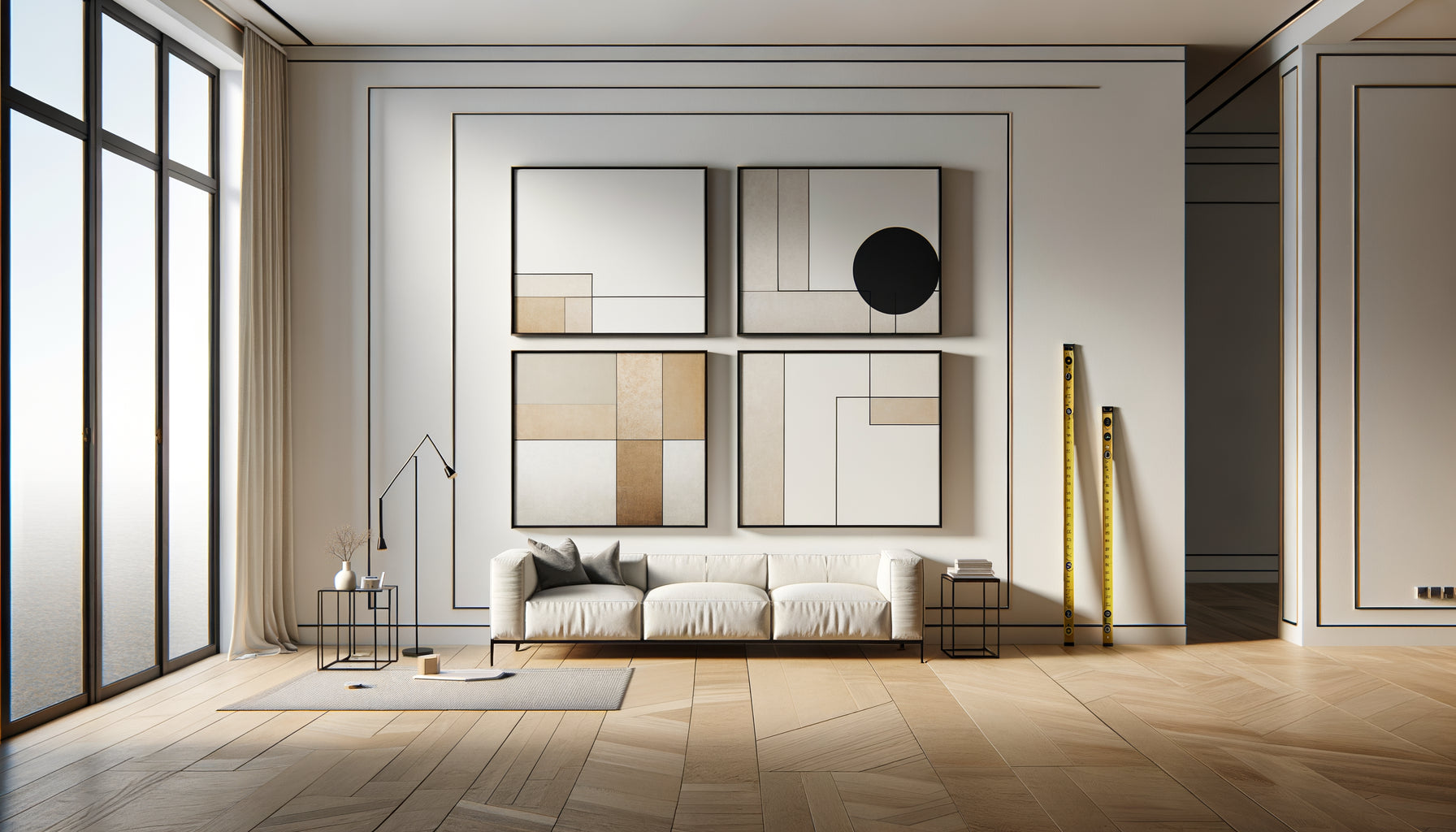
Perfect for beginners and minimalist spaces. You align tableaux of identical formats according to a regular grid: 2x2, 3x3, or 2x4. This arrangement brings architectural serenity ideal above a bed or sofa. Choose uniform frames and play with subjects to create variation.
The living room style: mastered asymmetry
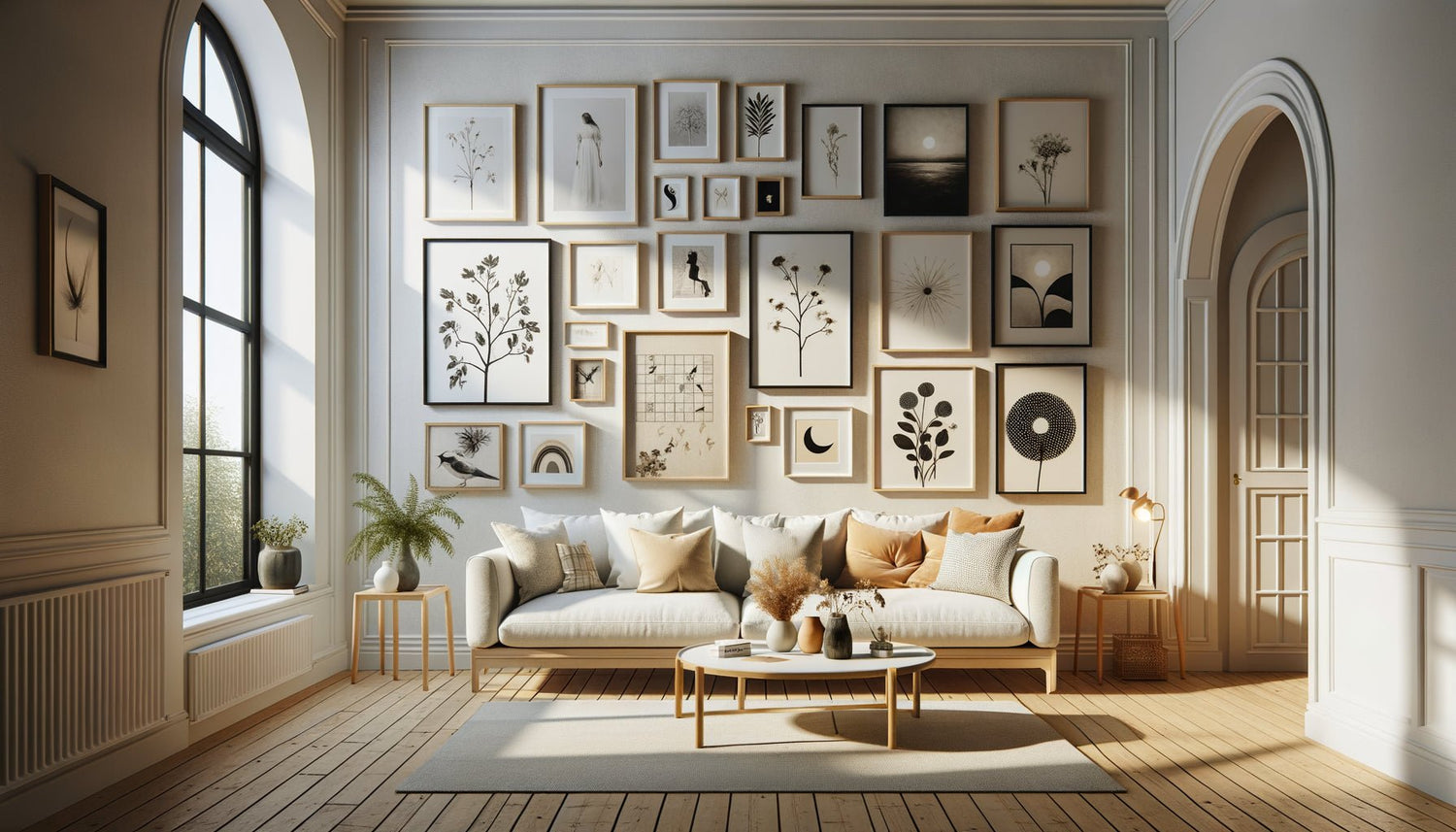
The preferred configuration of Parisian galleries. You mix vertical, horizontal and square formats around an imaginary central line located 145-150 cm from the floor (eye level). The trick: start by hanging your largest artwork in the center, then build around it while respecting the balance of masses.
The horizontal alignment: linear elegance
Three to five tableaux aligned on their top or bottom edge. This arrangement visually lengthens the space – valuable in a hallway or above a sideboard. Vary the heights slightly to avoid the rigidity of a shelf.
The organic accumulation: from wall to ceiling
For the daring. You cover the entire wall with works of all dimensions, leaving little visible wall. This maximalist approach requires a strong color consistency – prioritize a palette of 3-4 colors maximum to avoid visual cacophony.
The asymmetrical constellation: modern minimalism
Four to six pieces arranged with irregular but intentional spacing. This configuration breathes and is suitable for colored walls where the wall itself becomes part of the composition. Ideal for highlighting statement artworks that deserve their own space for contemplation.

Discover this inspiring artwork
The floor plan method: test before drilling
Here's the secret that avoids 90% of disasters: never hang directly. First, reproduce your gallery wall on the floor. Cut paper kraft templates to the exact dimensions of your frames, temporarily tape them to the wall with washi tape, then step back three meters.
Let this mockup live in your space for 48 hours. Observe it at different times of the day, under different lighting conditions. Your eye will naturally detect imbalances: that oversized format too off-center which destabilizes the whole, that uneven spacing which creates visual tension. Adjust, permute, breathe. Only when you are satisfied do you take out the meter and level.
Photograph your validated composition from several angles. These photos will be your references during installation, when perspective distorts and doubt creeps in.
Buying your artworks: non-negotiable criteria
The perfect composition does not save mediocre works. Before buying, check these essential parameters. First, the quality of the printing and support. For a durability of 10+ years, prioritize giclée prints on canvas 360g minimum or on museum paper 230g with pigment inks. Offset posters at €15 will yellow in two years near a window.
Next, dimensional consistency. If you are composing an art wall with mixed formats, make sure they share at least one common dimension (several 50 cm wide, or all 70 cm high). This subtle repetition creates an invisible but effective structural harmony.
Regarding frames: either you completely standardize them (same color, same style), or you embrace diversity with a rule – for example, only natural wood in different essences, or a mix of matte black/brushed brass. The haphazard middle ground between these two approaches invariably produces an impression of incoherence.
Finally, validate the overall color palette. Place all your selections side by side and squint: do the colors blend into a harmonious whole or create discordant clashes? A maximum of three dominant colors guarantee cohesion.
Ready to transform your white wall into a personal gallery?
Discover our exclusive collection of landscape paintings that bring depth and serenity to your wall composition.

Discover this inspiring artwork
The technical hanging: tools and foolproof sequence
Gather your arsenal: spirit level, measuring tape, grey pencil, hammer, wall plugs suitable for your wall (Molly for drywall, Fischer for stone), and an X-shaped hook for heavy loads. For a 8+ piece gallery wall, invest in a laser level – you'll save two hours and avoid frustrating approximations.
The hanging sequence follows a precise hierarchy. Always start with the central or dominant artwork – the one that visually anchors the composition. Hang it positioning its center at 145 cm from the floor. Then work in concentric circles, first hanging the adjacent pieces, then those on the periphery.
Between each hanging, step back and check the overall alignment with your reference photo. This progressive validation avoids the nightmare of the final step where you realize that a 3 cm misalignment on the third artwork has propagated an imbalance to the tenth.
For purists: discreetly mark validated positions with a grey pencil. These markers then erase with a rubber, but they secure your accuracy during hanging.
Lighting your gallery wall: the final touch that changes everything
A beautiful wall of paintings in the gloom remains invisible. Lighting transforms a simple accumulation into a museum installation. Three approaches work. Adjustable spotlights on rail: flexible and adjustable, they allow you to direct light precisely onto each artwork. Install them 50-70 cm from the wall to avoid shadows from frames.
Wall sconces: they create dramatic flat lighting, ideal for textures (thick canvases, wood prints). Position them at the upper third of your composition.
Finally, indirect LED lighting: LED strips hidden behind a top trim project soft and uniform light. This streamlined solution is suitable for symmetrical compositions where each artwork must receive exactly the same intensity of light.
Always prefer a temperature of 3000K (warm white) which faithfully restores colors without the coolness of neutral white. And install a dimmer: the ability to modulate the intensity according to the time of day multiplies the atmospheres of your gallery wall.
Evolving your composition: the art of renewal
A gallery wall isn't a frozen mausoleum. The most successful compositions evolve with the seasons, artistic discoveries, and changes in mood. Plan for this flexibility from the start by installing an adjustable hanging system with cables and hooks – you can modify the height and position without making multiple holes.
Alternatively, reserve 20% of your composition for rotation spaces. These locations welcome your latest acquisitions, creations by artist friends, or seasonal works. This creative breathing keeps your wall alive and personal.
A wall of paintings that tells your story can only be organic, evolving, imperfect. It is precisely this narrative authenticity that distinguishes it from a simple decorative exercise.
You are now equipped to compose this gallery wall that will transform your anonymous wall into a visual manifesto. Start modestly – four or five pieces are enough to create impact – then let your collection grow naturally. In six months, when your guests stop dead in front of your wall asking 'Who designed this composition?', you will savor this rare satisfaction: having created something both visually mastered and deeply personal. Your wall, your rules, your gallery.
Frequently Asked Questions about Creating a Gallery Wall
What is the minimum wall size needed to create a gallery wall?
Good news: you don't need a cathedral. A space of 120 cm x 100 cm is more than enough to compose an impactful wall of paintings with 4 to 6 works. The common mistake is to think that you need an immense wall panel. In reality, it is the density and coherence of your composition that create the gallery effect, not the surface area. Even a narrow corridor 80 cm wide can accommodate an elegant vertical arrangement of three aligned paintings. Simply adapt the number and format of your works to the available space: prioritize medium formats (40x50 cm to 50x70 cm) for small walls, and reserve larger pieces (70x100 cm+) as visual anchors on generous surfaces. The essential thing is to let your composition breathe with at least 15 cm of margin on the sides and 20 cm above furniture if your gallery wall surmounts a sofa or console.
Is it absolutely necessary to buy framed paintings or can we mix with unframed canvases?
Both approaches work, but they create radically different atmospheres. A gallery wall with uniform frames brings structure and sophistication – it's the safe choice for classic or Haussmannian interiors. Conversely, mixing framed canvases and unframed works generates a more contemporary and relaxed energy, perfect for lofts or industrial spaces. If you opt for this mix, respect this proportion: maximum 30% of bare canvases for 70% of framed artworks. Beyond that, the composition loses its structural coherence. A curator's tip: unframed canvases work best in medium formats (50x70 cm) placed between framed pieces that provide visual guidelines. Absolutely avoid mini 20x20 cm canvases without frames in a formal wall of paintings – they will appear lost and unfinished.
How much should I budget for a successful gallery wall?
Your budget depends less on the number of artworks than on the quality of printing and framing. For a gallery wall of 6 to 8 paintings with a lifespan of 10+ years, expect between 400 and 1200 euros. This budget breaks down as follows: 40 to 80 euros per artwork for quality giclée art prints on canvas or museum paper, and 30 to 60 euros per frame for decent frames (solid wood or aluminum, anti-reflective glass). Marketplaces offer posters from 15 euros, but their lifespan does not exceed 2-3 years before visible discoloration. An intelligent approach: first invest in 4-5 quality pieces that will form the permanent skeleton of your composition, then gradually supplement with secondary works. You can also dilute the investment by buying one or two pieces per quarter, which allows you to refine your style over time. Framing often represents 40% of the total budget – if you are handy, buying unframed paintings and framing them yourself can halve the bill.