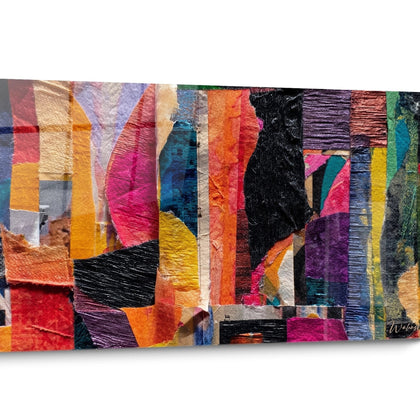
The street art collage wall art brings the raw energy of urban streets directly onto your interior walls. This form of mural expression captures the spontaneity of graffiti, stencils, and torn posters that characterize contemporary urban art. Unlike traditional photographic reproductions, these large-scale creations layer different visual strata to recreate the striking effect of urban palimpsests where tags, wild collages, and successive artist interventions blend together. Each composition juxtaposes graphic fragments, rebellious typography, and iconographic elements from counter-culture to form a vibrant whole that engages with modern interior architecture.
Visual Stratification of Urban Walls Transposed Indoors
The street art collage wall art faithfully reproduces the superposition technique characteristic of urban spaces invested by artists. This multilayered approach integrates heterogeneous graphic elements: fragments of graffitied typography, geometric patterns from stencil work, iconic silhouettes, and saturated chromatic codes specific to clandestine interventions. The final composition evokes these walls that have become supports for collective expression where each new intervention partially covers the previous one.
How do underground visual references enrich contemporary aesthetics?
The integration of symbols from underground culture radically transforms the atmosphere of a residential or commercial space. Representations of stylized aerosol bombs, emblematic masked characters, and protest slogans create captivating visual tension. These direct references to the universe of writers and urban interventionists confer a subversive dimension that contrasts powerfully with the refined architecture of industrial lofts or trendy coworking spaces. Visual authenticity stems from this deliberate juxtaposition of raw elements and a controlled domestic setting.
The Chromatic Palette of Nocturnal Interventions
The dominant chromatic characteristics of street art collage wall art reflect the creative urgency of actions conducted illegally: violent contrasts between deep black and flashy colors, aerosol gradients with imperfect transitions, accidental splatters that become stylistic signatures. This chromatic brutality generates unparalleled visual power in spaces with generous volumes. Monumental formats amplify this intensity by massively occupying vertical wall surfaces, creating focal points impossible to ignore in open architectural configurations.
Iconographic Vocabulary of Artistic Rebellion
The visual repertoire draws from protest imagery: silhouettes of protesters, stylized megaphones, graphically reinterpreted raised fists. These politicized symbols coexist with more playful elements like subverted cartoon characters or anarchic mascots that populate urban wastelands. This cohabitation between graphic activism and clever humor characterizes street art production and is concentrated in these XXL wall compositions. For those seeking a more abstract approach while maintaining this visual energy, a multicolor abstract collage wall art offers an alternative exploring chromatic fragmentation without explicit figurative references.
The Monumental Occupation of Vertical Surfaces
The imposing dimensions of a street art collage wall art respond to a precise architectural logic: visually dominating the space as exterior murals extending over several stories would. This monumental scale creates an immersion effect comparable to that experienced facing walls entirely covered in neighborhoods dedicated to free expression. The XXL format preserves the readability of all graphic details—stylized writing, repetitive patterns, complex gradients—that would lose their impact in a reduced version.
What spatial configuration optimizes the impact of urban compositions?
Installation privileges blind walls in double-height spaces, separation partitions in open layouts, or background surfaces in showrooms and concept stores. The verticality of the support amplifies the upward dynamic characteristic of graffiti climbing along facades. In industrial lofts preserving their raw elements—exposed brick, metal beams, visible pipes—the wall art directly engages with architectural authenticity. Forward-thinking commercial spaces exploit this aesthetic to signal their bold cultural positioning and connection with emerging artistic movements.
Integration Strategies in Hybrid Spaces
Contemporary multifunctional environments—flexible offices, modular event spaces, ephemeral galleries—find in street art collage wall art a strong identity element. Its presence instantly transforms space perception by injecting urban cultural dimension. Preferred configurations place the composition facing main circulation zones to maximize visual exposure. The desired effect reproduces the experience of suddenly discovering a monumental fresco around a street corner: surprise, movement cessation, prolonged contemplation of compositional details.
Wall Proportions and Progressive Visual Reading
The inherent stratification of collage encourages visual exploration through successive layers. From a distance, the composition reveals its global architecture and primary chromatic masses. At middle distance, recurring patterns and typographic play become decipherable. Up close, technical details—superpositions, simulated tears, textural effects—unfold. This multi-level reading requires a sufficiently vast surface so each informative layer maintains its autonomy while contributing to the whole. Reduced formats compress this information at the risk of producing visual confusion rather than the organized complexity characterizing the best urban interventions.
Domestic Appropriation of Clandestine Aesthetics
Acquiring a street art collage wall art responds to a specific cultural appropriation approach: bringing into private space the transgressive energy of peripheral urban zones. This controlled domestication of creative illegality seduces profiles valuing counter-cultural authenticity without renouncing residential comfort. The assumed paradox between the subversive origin of the visual language and its integration into a legal setting precisely constitutes the appeal of these wall compositions for urban art collectors and trendy space decorators.
Why do street visual codes seduce contemporary interiors?
Street art aesthetics embody several values sought in current decoration: perceived authenticity, connection with emerging cultural movements, rejection of bourgeois decorative conventions. Buyer typologies include creative entrepreneurs wishing to signal proximity with disruptive innovation, cultural space managers affirming their avant-garde programming, and individuals building residential identity in rupture with classicism. The wall art becomes a social marker of belonging to a community valuing free expression and non-institutional creativity.
Selection Criteria for Balanced Composition
Evaluation of effective composition examines several technical parameters. The density of graphic elements must achieve balance between visual saturation—reproducing the abundance of urban walls—and preserved legibility of principal motifs. Chromatic contrasts generate the desired energy without slipping into cacophony. Visual hierarchy guides the gaze through composition via strategic anchor points: stylized face, monumental lettering, iconic symbol. The best examples maintain dynamic tension between apparent chaos and underlying organization, reflecting experienced writers' technical sophistication despite the spontaneous appearance of their interventions.
Contextual Evolution and Cultural Resistance
Unlike ephemeral decorative trends, street art aesthetics inscribe themselves in historical continuity tracing back to 1970s New York graffiti and European political stencils. This temporal depth guarantees lasting cultural relevance rather than superficial trendy effect. Visual references traverse decades while reinventing themselves: from classical writing to contemporary conceptual interventions. This historical richness allows current compositions to dialogue with multiple generations of urban artistic practices, ensuring their cultural legitimacy with purists and novices alike discovering this aesthetic.
Is street art collage wall art suitable for conservative professional spaces?
Integration depends on the institutional message sought. Law firms specializing in creative intellectual property, digital communication agencies, contemporary architecture studios use this aesthetic to signal their understanding of current cultural codes and proximity with innovation. Traditional sectors generally favor less connoted artistic expressions.
How to evaluate the visual balance of street art collage wall art before purchase?
Examine the distribution of chromatic masses, variation in scales between graphic elements, and presence of breathing zones despite apparent density. A successful composition allows the gaze to circulate through different reading levels without causing visual fatigue, even during prolonged exposure in everyday living spaces.
Do monumental dimensions of street art collage wall art require specific architectural constraints?
XXL formats demand load-bearing walls or reinforced partitions capable of supporting structural weight, particularly for versions incorporating reliefs or material superpositions. Spaces with standard ceiling height (2.50m minimum) more harmoniously accommodate these vertical compositions that reproduce the scale of exterior wall interventions.


 Multicolor Abstract Wall Art - Neural Fragments - Collage Edition233,90 €
 Abstract Torn Urban Wall Art - Memory Fragments - Collage Edition233,90 €
 Multicolor Abstract Canvas - Urban Fragments - Collage Edition233,90 €
 Multicolor Abstract Collage Canvas - Urban Fragments - Collage Edition213,90 €