


Spiritual Black and White Zen Wall Art
Our Zen Black and White Painting Spiritual collection embodies the essence of Eastern serenity through minimalist compositions. These works celebrate the perfect balance between light and darkness, inviting contemplation and inner peace. Each creation evokes Buddhist philosophy and the art of minimalist zen decor, offering a meditative presence to your interior. Ideal for transforming your space into a sanctuary of peace, these pieces embody contemporary Eastern spirituality with elegance.
 Sakura Soul of Time Painting - zen edition228,90 €
 The Buddha's Dream Wall Art - Zen Buddha Edition273,90 €
 The Legacy of Souls Wall Art - Zen Tree of Life Edition273,90 €
Explore further
In Spiritual Black and White Zen Wall Art
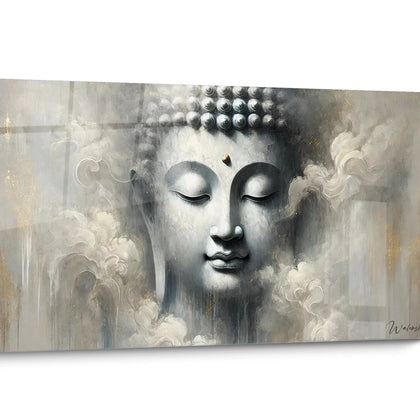
All about Spiritual Black and White Zen Wall Art
- Presentation Zen Black and White Spiritual Wall Art
- Symbolism and Energy
- Impact on Meditation
- Advice and Questions
A zen black and white spiritual wall art represents far more than simple wall decoration: it embodies an ancient philosophy where the absence of color becomes the language of the absolute. These large-format creations capture the essence of meditative emptiness and spiritual fullness through refined compositions that dialogue with inner silence. Designed to transform contemplative practice spaces, these monumental works create visual portals toward transcendence, particularly sought after by meditation practitioners, holistic therapists, and interior architects specializing in wellness spaces. Their generous dimensions allow complete immersion in sacred iconography, offering a powerful focal point to anchor contemplation sessions and foster conscious elevation in yoga studios, energy healing rooms, or personal sanctuaries dedicated to spiritual awakening.
The Monochrome Language of Inner Awakening
The zen black and white spiritual wall art draws its strength from the cosmic duality represented by monochromatic tones. This binary palette naturally evokes the yin and yang, fundamental principle of universal harmony where darkness and light embrace in an eternal dance. The shades of gray that intersperse between these absolute poles symbolize the multiple states of consciousness traversed during the meditative journey, creating a visual map of the inner voyage.
Which spiritual symbols should you prioritize in a monochrome zen wall art?
The most powerful representations include sacred geometric mandalas, circles of contemplation whose mathematical structure reflects cosmic order. Buddhas in deep meditation positions, rendered in contrasting silhouettes, exude a soothing presence that instantly permeates the space. Japanese calligraphies reproducing Buddhist sutras or zen koans offer a textual dimension to the spiritual quest, transforming each character into a portal of reflection. Our collection of zen black and white wall art gathers these different expressions of oriental wisdom in imposing mural formats.
The energetic architecture of monochrome compositions
An authentic zen black and white spiritual wall art respects the principles of ma, that Japanese negative space which gives life to the positive. White areas do not constitute a void but a potential fullness, a visual respiration allowing the eye and mind to rest. Black elements create anchors, focal points for tratak practice, this meditation through gaze fixation used in yogic traditions. This rhythmic alternation generates an ascending energetic flow, naturally guiding the gaze toward the upper planes of the composition.
How do these works influence the chi of a space?
In spiritual feng shui, deep black captures and transforms stagnant energies while pure white disperses and purifies them. A well-positioned monochrome wall art becomes a permanent energy regulator, particularly effective in transition zones between active and contemplative spaces. Panoramic formats create meditative horizons that expand spatial perception and dissolve mental boundaries, facilitating the consciousness expansion sought during advanced spiritual practices.
Catalyst for Presence and Deep Meditative States
Using a zen black and white spiritual wall art as meditation support (visual yantra) radically transforms the quality of contemplative practice. Contemplative neuroscience demonstrates that the absence of chromatic stimulation reduces primary visual cortex activation, allowing attentional resources to redirect toward brain centers associated with introspection and metacognition. This perceptual simplicity facilitates entry into alpha and theta states, brain waves characteristic of deep meditation.
What size should you choose to optimize meditative impact?
Monumental dimensions create a sensory envelopment effect that naturally isolates the practitioner from peripheral distractions. A format exceeding 120 centimeters activates peripheral vision, engaging the parasympathetic nervous system responsible for deep relaxation. This imposing presence generates what zen masters call "benevolent visual pressure," a constant invitation to return to oneself that persists even when the gaze turns away. Spiritual retreat spaces and meditation centers consistently prioritize these immersive formats for their ability to energetically mark sacred space.
The mirror effect of pure consciousness
Spiritual monochrome functions as a projection surface for unconscious psychic content. During silent contemplation, the ambiguous forms and soft contrasts of zen black and white spiritual wall art allow the emergence of inner visions, much like a meditative Rorschach test. This projective quality makes it a valuable tool for visualization practices, shamanic journey, or exploration of altered states of consciousness. Transpersonal therapists frequently integrate these works into their consultation spaces.
How should you position the wall art to maximize its meditative potential?
The optimal orientation places the work facing magnetic north, a direction associated with mental stability in tantric traditions. The installation height should allow the visual center of the work to align with the ajna point (third eye) of the practitioner seated in meditative posture, thus creating a direct vertical energy axis. Indirect lighting, never frontal, preserves subtle contrasts and avoids reflections that would fragment the unitary presence of the composition, essential for maintaining unified concentration (samadhi).
Integration in Personal Sanctuaries and Sacred Spaces
The creation of a meditative altar or spiritual practice corner finds its visual completion in a zen black and white spiritual wall art that becomes its silent guardian. This wall presence immediately establishes the energetic tone of the space, signaling a territory dedicated to interiority and transcendence. Practitioners of different contemplative paths – zen Buddhism, advaita vedanta, Christian mysticism, Sufism – recognize in these refined compositions a universal language transcending particular religious forms.
Associations with ritual objects and sacred elements
The monochrome wall art dialogues harmoniously with traditional practice supports: meditation cushions (zafu), Tibetan singing bowls, prayer malas, rock crystals, or amethyst. Its chromatic neutrality highlights the texture of natural materials – raw wood, stone, handcrafted ceramics – without creating visual competition. Spiritual teachers recommend placing white or black candles nearby, whose living flame creates dynamic contrast with the image's immobile permanence, symbolizing the union of the transitory and the eternal.
Evolution of contemplative relationship with the work
An authentic zen black and white spiritual wall art progressively reveals its layers of meaning. In the first weeks, the eye discovers the overall composition and mass balances. After several months of regular contemplation, subtle details – texture variations, micro-contrasts, internal rhythms – emerge to consciousness, reflecting the deepening of the practitioner's attentional capacity. This perceptual transformation objectively witnesses meditative progress, the work becoming a faithful mirror of inner evolution, particularly valuable for solitary paths without external guidance.
Can you combine multiple monochrome spiritual wall artworks?
Diptychs or triptychs create visual narratives of the spiritual journey – descent into darkness, crossing the void, emergence into light. This spatial sequentiality accompanies progressive practices like nine-stage meditations or Tibetan bardo visualizations. However, the radical simplicity of a single monumental work better preserves the zen principle of "not-two," that fundamental non-duality which dissolves all conceptual fragmentation into the unity of the present instant.
Frequently asked questions about monochrome zen spiritual wall art
Is a zen black and white spiritual wall art suitable for all meditation styles?
Absolutely. Its symbolic neutrality adapts to mindfulness meditations (vipassana), contemplative (zazen), transcendental (with mantra), or guided practices. Only practices requiring specific colored visualizations (such as certain Tibetan tantras) might require particular chromatic supports. For all approaches centered on mental silence and pure presence, monochrome offers the ideal support.
How do you maintain the energy of a zen black and white spiritual wall art?
Beyond delicate physical cleaning, energy traditions recommend regular purification through fumigation with white sage, palo santo, or natural incense. Some practitioners ritually consecrate their work during full moons, charging it with meditative intentions. This conscious relationship progressively transforms the wall art into a personal power object, impregnated with hours of practice and elevated states of consciousness experienced in its presence.
What's the difference between decorative zen wall art and a true spiritual support?
Initial creative intent subtly imprints the work. A zen black and white spiritual wall art created by a practicing artist or inspired by contemplative teachings conveys a distinct vibrational quality, perceptible to sensitive persons. Compositions respecting sacred proportions (golden ratio, Fibonacci sequence) or integrating traditional geometric symbols (sri yantra, flower of life) possess deeper archetypal resonance than purely aesthetic creations, even if visually similar.
Further reading


