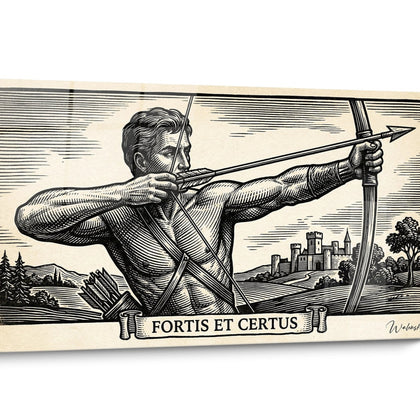
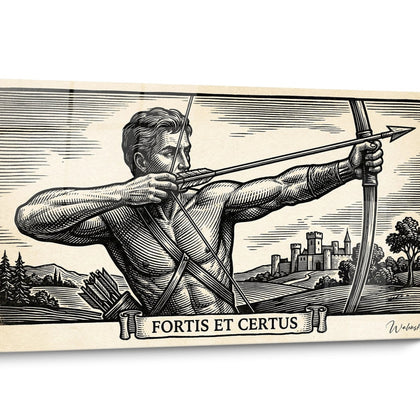
Japanese archery wall art draws from the millennia-old tradition of kyudo, this ancestral martial art where each gesture carries a spiritual and meditative dimension. These large-scale mural representations capture the very essence of this Japanese discipline, depicting archers in traditional hakama attire, armed with their long asymmetrical yumi bows. Unlike Western representations centered on athletic performance, these works convey a profound Zen philosophy, a balance between mental concentration and bodily harmony. Every detail matters: the ritualistic posture hassetsu with its eight distinct phases, the controlled tension of the tsuru bowstring, the suspended instant of hanare where the ya arrow leaves the bow in a fluid and refined movement. These decorative creations transform your interior into a contemplative sanctuary, reminding us that Japanese archery transcends mere technique to become a path of personal development.
Kyudo as Artistic and Spiritual Expression
Why does Japanese archery wall art captivate enthusiasts of Japanese culture?
Japanese archery wall art embodies a philosophy where each movement becomes meditation. Unlike Western disciplines focused on competitive precision, kyudo values the archer's inner path. These mural representations immortalize moments of complete communion between spirit and gesture, capturing this pursuit of formal perfection where the target becomes secondary. Compositions highlight the beauty of natural circular movement, the elegance of the kamae posture, the dignity of tenouchi positioning.
The symbolism of traditional elements depicted
Each visual element of Japanese archery wall art tells a precise symbolic dimension. The yumi, this asymmetrical bow measuring up to 2.21 meters, symbolizes the union of heaven and earth, its longer upper portion evoking spiritual elevation. Bamboo ya arrows represent moral rectitude and pure intention. The makiwara, this traditional target, figures the ego the archer must transcend. Ceremonial white clothing symbolizes the purity of intention necessary for practice.
The minimalist aesthetic of kyudo scenes
These mural creations favor a refined aesthetic characteristic of Japanese art. Backgrounds often stripped down, in neutral tones or subtle sakura cherry blossom motifs, direct all attention to the archer's ritualistic gestures. This visual sobriety facilitates contemplation and mental calm. For those seeking contemporary variations, abstract archery wall art offers modern interpretations that preserve this Zen essence while adopting a geometric and colorful visual language.
How do these paintings transmit the values of bushido?
Japanese archery wall art conveys the fundamental principles of bushido, this samurai code of honor. The absolute concentration visible on the archer's face embodies shin, sincerity and authenticity. The stable and rooted posture reflects courage and determination. The harmonious fluidity of movement expresses respect for forms and tradition. These works remind us that kyudo was practiced by warriors to simultaneously develop technical mastery and spiritual elevation, bodily discipline and refinement of the soul.
Integrating Japanese Archery Wall Art into a Japanese-Inspired Space
Alliance with Zen-inspired décor
Japanese archery wall art naturally becomes the centerpiece of an interior inspired by Japanese aesthetics. Its monumental presence dialogues harmoniously with complementary decorative elements: a tatami floor with refined lines, translucent shoji screens diffusing soft light, a minimalist ikebana with asymmetrical floral compositions. This synergy creates an atmosphere conducive to meditation and rejuvenation, transforming your living room or relaxation space into a genuine domestic sanctuary.
What color palette should you prioritize around a kyudo scene?
Japanese archery wall art typically presents sober color ranges: deep blacks, immaculate whites, nuanced grays, with occasional touches of traditional red or discreet gold. To optimize their visual impact, accompany them with natural tones in your design: sandy beiges evoking raw wood, muted greens recalling Zen garden mosses, earthy ochres. These color harmonies reinforce the sensation of authenticity and connection with nature, a fundamental principle of Japanese wabi-sabi aesthetics.
Strategic positioning in your living space
Large-scale Japanese archery wall art requires thoughtful placement maximizing its contemplative potential. Prioritize a clear wall facing your relaxation or meditation zone, allowing prolonged observation without distraction. The work gains presence when benefiting from sufficient distance, minimum three meters, to appreciate both the overall composition and technical details simultaneously. Avoid high-traffic areas that would fragment the contemplative experience.
Association with other Japanese cultural elements
These mural representations integrate perfectly into coherent cultural staging. Display nearby a tokonoma shelf welcoming a traditional Japanese craft object: raku pottery, collector's katana sword, framed shodo calligraphy. A byobu folding screen with pine or crane motifs can structure the adjacent space. A chabudai low table surrounded by zabuton cushions completes the design, creating a zone where tea ceremony rituals and meditative moments naturally extend the Zen philosophy embodied by the depicted archer.
Scenes and Traditional Techniques of Japanese Archery
The eight ritualistic phases depicted
Japanese archery wall art frequently captures the hassetsu, these eight codified steps transforming each shot into a meditative ceremony. Some compositions immortalize ashibumi, the initial foot positioning forming a precise sixty-degree angle. Others freeze the instant of dozukuri where the body anchors vertically, spine perfectly aligned. Representations of kai, this maximum tension where archer and bow become one, emanate palpable intensity. The hanare, spontaneous arrow release, is often depicted in all its transcendent fluidity.
What types of traditional settings serve as backdrop?
Backgrounds in Japanese archery wall art evoke the sacred spaces where this discipline is practiced. Some works depict the traditional dojo with precise ritual dimensions, its noble wooden floor seasoned by decades of practice. Others situate the archer in an outdoor kyudojo, with the majestic silhouette of Mount Fuji or a bamboo forest swaying in the breeze as backdrop. Scenes of yabusame, equestrian archery during Shinto ceremonies, transport to the universe of thousand-year-old sanctuaries with vermillion torii gates.
Representation of different regional styles
Kyudo comprises several traditional schools with distinct technical particularities, sometimes illustrated in these mural creations. The Heki-ryu style, the oldest, privileges a martial approach inherited from samurai. Honda-ryu emphasizes formal elegance and gestural precision. Ogasawara-ryu, developed for the aristocracy, stresses ceremonial and aesthetic dimension. These nuances translate visually into slightly different postures, specific ceremonial garments, characteristic shooting angles that connoisseurs immediately identify.
How to identify authentic Japanese archery wall art?
To distinguish a representation faithful to kyudo tradition, verify several iconographic elements. The yumi bow must present its characteristic asymmetry, the grip nigiri positioned at the lower third. The archer's gestures must respect the natural biomechanics of circular movement, without artificial stiffness. Traditional clothing includes pleated hakama, white or black keikogi, three-fingered yugake glove with rigid construction. Facial expressions must reflect serene concentration rather than grimacing effort. This visual authenticity guarantees a work respectful of centuries-old tradition.
Where should you place Japanese archery wall art to create a meditative atmosphere?
Favor a space of tranquility such as a bedroom oriented toward calm, an office requiring concentration, or a dedicated meditation corner. The visual presence of the archer in full communion with his gesture naturally promotes mental recentering and introspection.
Is Japanese archery wall art suitable for a martial arts dojo?
Absolutely, these representations find their ideal place in dojos practicing traditional Japanese martial arts: aikido, judo, karate, kendo. They constantly remind of shared values of discipline, respect, and continuous improvement that found all these disciplines inherited from bushido.
How to maintain large-scale Japanese archery wall art?
Avoid direct sun exposure which would progressively fade pigments. Gentle monthly dusting with a dry microfiber cloth suffices. Maintain stable humidity between 40-60% to preserve materials. These precautions guarantee optimal conservation of your decorative investment over several decades.


 Samurai Archer on Horseback Wall Art - Cherry Blossom Warrior - Archery Edition233,90 €
 Samurai Archer on Horseback Painting - The Art of Kyudo at Sunset - Archery Edition233,90 €
 Samurai Archer Painting - Traditional Martial Art - Archery Edition213,90 €