


Bloodhound Dog Painting Portrait
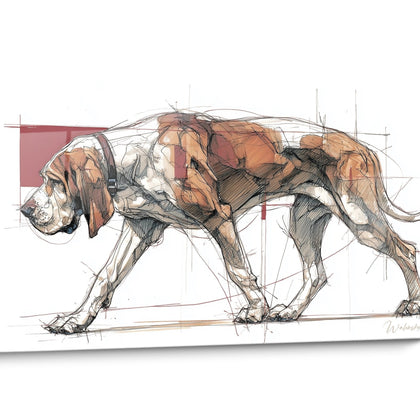
The Painting Bloodhound Portrait captures the nobility and intensity of the gaze of this iconic breed. This collection highlights the distinctive features of the Bloodhound: its deep eyes, its characteristic drooping ears, and its wise expression. Perfect for lovers of dog wall decoration Bloodhound, each work reveals the endearing personality of this scent hound. Ideal for enhancing your interior with an artistic portrait of a dog breed of exception.
 Bloodhound Dog Wall Art Warm Tones - Melancholic Gaze - Bloodhound Edition242,90 €
 Dog Side Profile Canvas in Warm and Black Tones - Noble Gaze - Bloodhound Edition273,90 €
 Looking Up Dog Painting in Black and White - Contemplative Portrait - Bloodhound Edition273,90 €
 Seated Dog Painting in Blue and Gold Tones - Contemplative Portrait - Bloodhound Edition273,90 €
 Warm-Toned Dog Portrait with Melancholic Expression - Deep Gaze - Bloodhound Edition273,90 €
 Sitting Bloodhound Portrait Noble Profile - Canine Elegance - Bloodhound Edition273,90 €
 Hunting Dog with Long Drooping Ears Painting - Animal Portrait - Bloodhound Edition273,90 €
 Saint-Hubert Hound Portrait Expressive Canvas Orange and Black - Noble Gaze - Bloodhound Edition273,90 €
 Brown Canine Portrait Painting with Amber Eyes - Contemplative Gaze - Bloodhound Edition273,90 €
 Long-Eared Dog Print Striking Portrait - Melancholic Gaze - Bloodhound Edition228,90 €
 Bloodhound Dog Wall Art with Melancholic Gaze on Purple Background - Contemplative Canine Portrait - Bloodhound Edition228,90 €
Explore further
In Bloodhound Dog Painting Portrait


All about Bloodhound Dog Painting Portrait
- Bloodhound Portrait Presentation
- The Expression of Bloodhound in Portrait
- Large Format Portrait
- Decorative Integration of Portrait
The Bloodhound dog painting portrait elevates the unique physiognomy of this emblematic breed through a composition centered on facial expression. Unlike representations in action or hunting scenes, animal portraiture focuses exclusively on the gaze, characteristic features and deep personality of the Bloodhound. The distinctive facial wrinkles, majestic drooping ears and intensity of the melancholic gaze constitute the central elements of this intimate artistic approach.
The Singular Expression of Bloodhound Captured in Portrait
The Bloodhound dog painting portrait reveals the full emotional depth of this breed with noble and thoughtful temperament. The artist focuses on the penetrating gaze, slightly veiled by drooping eyelids, which imparts a contemplative dimension to each representation rarely matched in animal art. The characteristic skin folds of the forehead and cheeks, far from being mere anatomical details, become narrative elements that tell the story of a breed forged by centuries of selection for tracking.
How does the portrait showcase the Bloodhound's facial morphology?
The close-up composition allows exploration of texture variations between the short coat of the upper skull areas and the supple skin of the jowls. The disproportionately long ears naturally frame the composition, creating visual symmetry that guides the eye toward the nerve center of the work: the elongated muzzle and expressive eyes. For those who appreciate varied artistic interpretations, the Bloodhound dog watercolor painting offers a delicate alternative to classical portraits, with fluid chromatic transitions that soften the marked features of the breed.
Canine psychology translated through facial portrait
Each portrayal of the Bloodhound captures its patient and stubborn temperament, visible in the fixity of the gaze and subtle tension of facial muscles. Artists specialized in animal portraiture study at length the behavioral morphology: the characteristic head inclination during tracking, the absolute concentration visible in the eyes, the way slightly drooping lips contribute to the expression of quiet determination. This psychological approach radically differentiates the Bloodhound portrait from dynamic representations of other hunting breeds.
The chromatic nuances of the coat in close-up
Close observation reveals the unsuspected complexity of the bicolor or tricolor coat. Variations between deep black, warm fawn and fire markings create natural gradients that only the portrait format allows one to fully appreciate. Light reflections on the short coat highlight the underlying musculature of the powerful neck and jaws, while shadowed areas accentuate the depth of skin folds, transforming anatomy into emotional geography.
The Monumental Portrait of Bloodhound in Contemporary Space
The Bloodhound dog painting portrait in large format transforms the intimacy of portraiture into architectural presence. When dimensions exceed one meter in width, the elongated muzzle reaches near-life scale that establishes unprecedented spatial dialogue between the work and observer. This monumentality amplifies every morphological detail: a skin wrinkle becomes a canyon, an eye transforms into a window to the canine soul, creating an immersive experience impossible to reproduce in smaller format.
Why choose a large-scale Bloodhound portrait?
Contemporary spaces with generous volumes—industrial lofts, cathedral-like living rooms, executive offices—require works at proportional scale. A monumental Bloodhound portrait does more than fill a wall; it creates a magnetic focal point that visually structures the entire space. Visitors are immediately captivated by the gaze that seems to follow them, an optical phenomenon amplified by large dimensions that multiply angles of perception. For lovers of anatomical precision, the Bloodhound dog realistic painting in large format offers striking photographic fidelity where every hair appears individually rendered.
The psychological impact of monumental-scale portraiture
Visual perception science demonstrates that animal representations at life-size or larger activate different neural circuits than those engaged by reduced formats. Facing a 150-centimeter-wide Bloodhound portrait, the brain processes information as tangible presence rather than simple decorative image. This primitive reaction generates amplified emotional connection, particularly sought by breed owners wishing to honor the memory of a departed companion or celebrate their passion for dogs.
Vertical composition adapted to architectural constraints
The Bloodhound portrait, a breed characterized by its slender silhouette and drooping ears, naturally lends itself to vertical compositions that exploit available height. In hallways, stairwells or narrow wall sections between openings, a vertical portrait capturing the inclined head down to the chest creates linear elegance that elevates spatial constraints. Generous dimensions—often 120x180 centimeters—transform these overlooked circulation zones into private art galleries.
Integrating a Bloodhound Portrait into Thoughtful Interior Design
The Bloodhound dog painting portrait fits into a decorative strategy that transcends simple affinity for the breed. Its natural palette—dominant fawn, black and white tones—harmonizes eloquently with contemporary interiors privileging raw materials: aged wood, patined leather, oxidized metals. The noble and ancient character of the breed, whose origins trace to medieval monasteries, brings historical depth to minimalist spaces that might otherwise risk impersonal coldness.
What chromatic environments enhance the Bloodhound portrait?
Walls in neutral tones—slate gray, linen beige, off-white—constitute the ideal backdrop allowing the portrait to assert itself without visual competition. Terracotta or deep forest green atmospheres create sophisticated chromatic harmonies with fire-hued coat nuances, evoking traditional hunting landscapes without falling into rustic pastiche. To discover all possible interpretations of this exceptional breed, the complete Bloodhound dog painting collection presents varied artistic approaches suited to every aesthetic universe.
The portrait as narrative element of a canine collection
Passionate hunting breed enthusiasts often assemble thematic ensembles where the Bloodhound portrait occupies the central position, flanked by representations of tracking scenes or multi-breed compositions. This museum-like staging transforms a wall into visual narration of hunting history, where the portrait plays the role of principal hero whose qualities—legendary scent, unwavering perseverance—are illustrated by complementary works of reduced dimensions. Format hierarchy reinforces this dramaturgy, the monumental portrait naturally dominating smaller companion pieces.
Directional lighting to sculpt facial reliefs
The characteristic folds of the Bloodhound demand studied lighting that creates revealing cast shadows of suggested three-dimensionality. Adjustable spots at warm temperature (2700-3000K) positioned in grazing illumination from above accentuate the depth of forehead wrinkles and lips, transforming the two-dimensional portrait into luminous sculpture. This museum-inspired technique, borrowed from professional galleries, metamorphoses the dog's gaze into a light-capturing point commanding attention under all observation conditions.
Frequently asked questions about Bloodhound dog portrait painting
Is a Bloodhound dog portrait painting suitable for sleek modern interiors?
Absolutely, the timeless character of animal portraiture transcends decorative trends. In minimalist interiors, it brings the organic and emotional touch that humanizes space without compromising overall simplicity, provided a sober palette and centered composition are respected.
What optimal viewing distance for a large-format Bloodhound portrait?
To appreciate both the entire composition and expressive details simultaneously, position yourself at a distance equivalent to 1.5 times the painting's diagonal. At this distance, the eye naturally embraces the complete portrait while perceiving the texture and expression nuances that constitute the richness of representation.
Is the Bloodhound dog portrait painting addressed only to breed owners?
While owners and breeders naturally constitute the primary audience, the universality of canine expression also attracts animal art enthusiasts, classical portrait collectors and decorators seeking pieces with strong emotional presence capable of visually anchoring a reception space or prestigious office.


