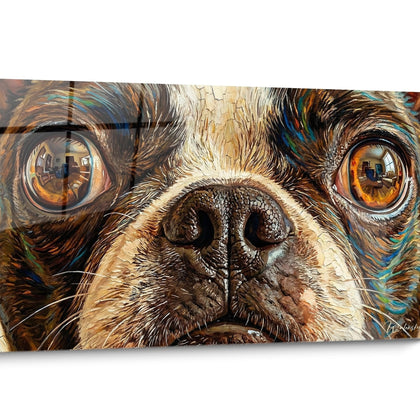
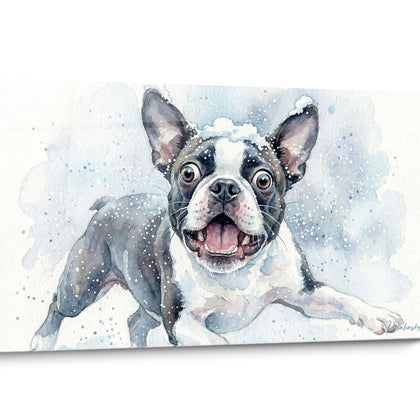
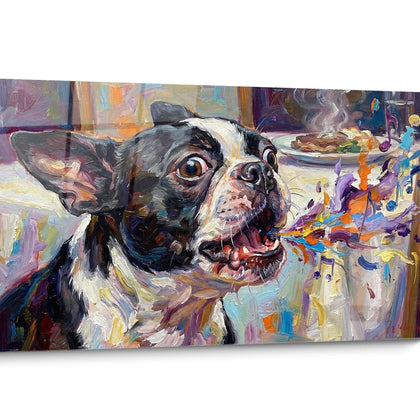
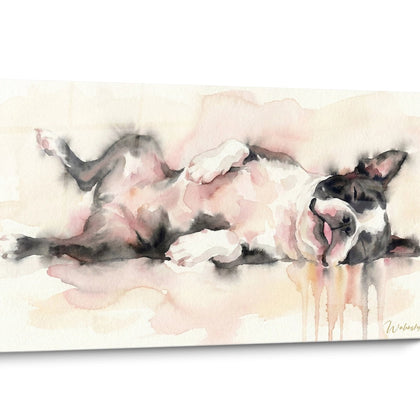
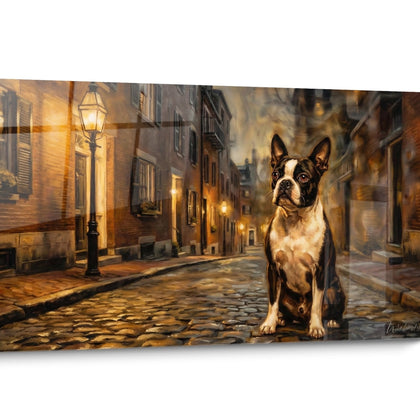
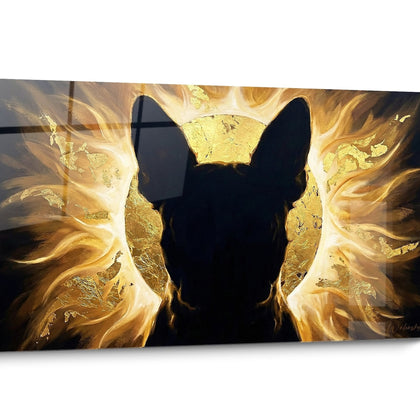
A black and white Boston Terrier dog painting celebrates the very essence of this iconic American breed, whose distinctive two-tone coat constitutes the unmistakable visual signature. This artistic representation captures the intensity of the natural contrast that defines the Boston gentleman, transforming each wall composition into a photographic tribute to the breed's historical chromatic standards. Enthusiasts of this monochrome aesthetic seek absolute fidelity to the Boston Terrier's traditional markings, where deep black dialogues with pure white according to precise anatomical proportions. These large-scale wall creations magnify the typical breed details: the symmetrical facial mask, the impeccable white chest, and the contrasting marks that confer upon each specimen its timeless natural elegance.
The Natural Chromatic Contrast of the Boston Terrier in Wall Décor
The black and white Boston Terrier dog painting exploits a reduced palette that perfectly reflects the authentic genetics of this breed recognized for its emblematic two-tone coat. Unlike whimsical multicolor representations, this monochrome approach scrupulously respects the cynological standards established since 1893 by the American Kennel Club. Discerning collectors favor these faithful compositions where lustrous black zones dominate contrasting with the immaculate white zones characteristic of tuxedo marking.
Why does black and white intensify the Boston Terrier's expression?
Chromatic restriction dramatically strengthens the expressiveness of the dark, penetrating gaze typical of the breed, creating an emotional depth impossible to achieve with color palettes. Large formats accentuate the Boston Terrier's perfect facial symmetry, where each shade of satiny black around the globular eyes immediately captures visitors' attention. This chromatic sobriety suits contemporary minimalist interiors perfectly, where Scandinavian or industrial minimalist furnishings demand powerful but unsaturated visual accents.
The Decorative Impact of Standard White Markings
The regulatory white zones - facial blaze, extended chest, and paw extremities - structure the wall composition visually according to natural vertical and horizontal lines. A large-format painting of 120 to 180 centimeters valorizes these sharp demarcations between dominant black and accessory white, creating spontaneous graphic balance. Interior architects specializing in luxury spaces recommend these monochrome representations for high-end professional environments where discreet elegance takes precedence over color exuberance.
Compatibility with Other Artistic Interpretations of the Boston Terrier
For enthusiasts wishing to vary aesthetic approaches, the watercolor Boston Terrier dog painting offers an alternative fluid sensibility, while black and white rendering privileges the photographic sharpness of racial contours. This chromatic duality harmonizes ideally with metallic chrome or brushed elements, ecru linen or charcoal textiles, creating sophisticated tonal continuities. Major collectors often combine multiple dimensional Boston Terrier representations by varying techniques while maintaining fidelity to natural colors.
Genetic Authenticity versus Whimsical Interpretations
The market unfortunately offers numerous artificial chromatic variations that betray the biological reality of the Boston Terrier. A painting respecting racial standards exclusively privileges intense ebony black associated with pure white, excluding the sepia, grayish, or brown tones frequently proposed through cynological ignorance. This chromatic rigor particularly satisfies professional breeders and breed club members who decorate their exhibition spaces with representations conforming to official judging criteria.
Architectural Enhancement Through Boston Terrier Two-Tone
The integration of a black and white Boston Terrier dog painting into a residential or commercial environment responds to specific decorative logics linked to the structuring power of maximum contrast. Premium space designers exploit this chromatic duality to create immediate visual focal points in spacious entryways, open living rooms, or executive offices. The monumental dimension of 150 to 200 centimeter formats transforms the canine portrait into a standalone architectural element, capable of vertically rhythming an immaculate white wall or visually softening a raw concrete surface.
How does black-white contrast structure the space?
The play of opposition between dark and light zones of the Bostonian coat naturally creates visual guideline vectors that unconsciously guide the gaze along precise trajectories. Strategic placement at eye level (160-170 centimeters from the floor) exploits this biological geometry to establish visual dialogue between observer and artwork. Contemporary interior architects frequently use these monochrome compositions as visual transitions between distinct functional spaces, particularly in partitioned lofts where unifying chromatic coherence proves essential.
Synergy with Contrasting Contemporary Materials
The restricted black-white palette of the Boston Terrier resonates perfectly with trendy material associations: Calacatta veined marble, Galaxy black granite, anthracite polished concrete punctuated with white inserts. This natural chromatic harmony allows avoiding frequent color dissonances when introducing decorative elements into architecturally assertive interiors. Owners of renovated industrial lofts particularly appreciate how the frank gaze of the black and white Boston Terrier complements exposed metallic structures and dark steel joinery.
Comparison with Alternative Chromatic Approaches
While a pop art Boston Terrier dog painting energizes space through color saturation, the monochrome version visually soothes while maintaining an assertive presence. This fundamental difference guides selection according to room function: professional concentration spaces versus playful socialization zones. Black and white rendering also suits high-end commercial galleries where sober elegance conveys values of seriousness and racial authenticity.
Adaptation to Various Architectural Styles
The chromatic neutrality of the black and white Boston Terrier painting facilitates its integration into varied stylistic contexts: Japanese wabi-sabi minimalism, modernized Parisian neoclassicism, softened Scandinavian brutalism. This decorative versatility explains growing popularity of these representations among decorators facing strict chromatic constraints imposed by heritage architectural charters or condominium regulations limiting color interventions on shared spaces.
Authentic Racial Characterization Through Two-Tone Rendering
Acquiring a black and white Boston Terrier dog painting constitutes for many enthusiasts a gesture of identity celebration of this American breed whose "American Gentleman" nickname derives directly from its natural tuxedo appearance. Fidelity to official standard markings - notably the precise white distribution on the head, neck, and limbs - differentiates respectful artistic reproductions from generic illustrations. Enlightened collectors seek works where the artist has manifestly studied the Boston Terrier's specific morphology, capturing the subtle asymmetrical distribution of white zones that renders each specimen unique.
What anatomical details does black and white reveal?
Chromatic restriction concentrates attention on the breed's characteristic proportions: domed forehead, short brachycephalic muzzle, erect triangular ears, compact muscular body. A large wall format of 140 to 190 centimeters allows appreciation of the smooth texture of short coat, the expressive skin folds of the wrinkled forehead during attention, the moist shine of nose and globular protruding eyes. This anatomical precision particularly interests canine veterinarians, professional breeders, and show judges who decorate their clinics and kennels with pedagogically exact representations.
The Genetic Heritage of Tuxedo Pattern
The Boston Terrier's two-tone pattern results from deliberate genetic selection initiated in 1870s Massachusetts, aimed at fixing this distinctive marking that became a racial standard criterion. A Boston Terrier dog portrait painting faithful to standards visually documents this cynological history, transforming wall decoration into a living archive of American canine heritage. Breeding historians appreciate these representations as visual testimonies to the phenotypic stability obtained after 150 years of rigorous selection.
Differentiation from Similar Two-Tone Breeds
Unlike the French Bulldog or Bull Terrier which also present black and white piebald coats, the Boston Terrier possesses specific white marking distribution: mandatory symmetrical facial blaze, complete white collar, whites forelegs to elbows. A quality painting respects these diagnostic particularities, avoiding frequent racial confusions in approximate reproductions. This accuracy interests breed clubs that regularly commission large-format wall artworks for their headquarters and official cynological events.
Complementarity with Other Artistic Expressions of the Boston Terrier
Sophisticated enthusiasts frequently combine the photographic black and white rendering with other stylistic approaches: the golden Boston Terrier dog painting for a luxurious variation, or the modern Boston Terrier dog painting for contemporary geometric interpretations. This multi-style collecting strategy allows declin the same canine subject according to different room ambiances while maintaining thematic coherence around the breed. For a comprehensive view of decorative possibilities, the complete Boston Terrier dog painting range offers numerous stylistic variations while preserving racial authenticity.
FAQ - Frequently Asked Questions about Black and White Boston Terrier Paintings
Does a black and white Boston Terrier dog painting suit existing colorful decoration?
Absolutely, the chromatic neutrality of black and white functions as a soothing visual element in saturated bright-color interiors, creating welcome visual breathing space. The Boston's two-tone coat contrast dialogues harmoniously with all decorative palettes without creating chromatic cacophony, particularly appreciated in eclectic bohemian or maximalist spaces.
What dimension to favor for a black and white Boston Terrier dog painting in a spacious living room?
For living spaces exceeding 30 square meters, monumental formats of 160 to 200 centimeters fully exploit the visual impact of two-tone contrast, creating an almost-real canine presence. This generous scale valorizes the Boston Terrier's anatomical details while establishing an architectural focal point proportioned to spacious volumes, avoiding the timid effect of small formats lost on large walls.
Does black and white rendering better respect the Boston Terrier's racial standards than other approaches?
Effectively, the monochrome representation faithful to natural colors guarantees total conformity with official criteria established by international cynological federations, unlike whimsical multicolor interpretations. This chromatic authenticity particularly satisfies breed purists and canine professionals who privilege biological truth to unbridled artistic creativity.


 Boston Terrier Canvas on Autumn Paved Street - Urban Walk - Boston Terrier Edition232,90 €
 Boston Terrier Hidden Under Blankets - Complicit Gaze - Boston Terrier Edition232,90 €
 Trio of Boston Terriers Canvas with Natural Colors - Expressive Canine Portraits - Boston Terrier Edition233,90 €
 Sitting Boston Terrier on Pavement under Street Lamps - Nocturnal Urban Charm - Boston Terrier Edition233,90 €
 Black and White Boston Terrier on Old Books Painting - The Distinguished Scholar - Boston Terrier Edition233,90 €
 Black and White Boston Terrier Puppies Group Painting in a Basket - Canine Tenderness - Boston Terrier Edition233,90 €
 Expressive Boston Terrier Duo with Red Leash Tableau - Canine Complicity - Boston Terrier Edition233,90 €
 Black and White Dog Canvas Expressive Portrait - Dynamic Gaze - Boston Terrier Edition233,90 €
 Dog Mosaic and Fluid Coat Painting - Artistic Contrast - Boston Terrier Edition233,90 €
 Sleeping Boston Terrier Painting on Golden Blanket - Warm Tenderness - Boston Terrier Edition233,90 €
 Boston Terrier Wall Art with Expressive Large Eyes - Modern Portrait on Orange Background - Boston Terrier Edition233,90 €
 Canine Portrait Painting with Expressive Golden Eyes - Intense Gaze - Boston Terrier Edition233,90 €
 Boston Terrier Resting on Oriental Red Carpet - Peaceful Rest - Boston Terrier Edition233,90 €
 Boston Terrier Lying in Blue-Toned Bed - Artistic Rest - Boston Terrier Edition233,90 €
 Black and White Boston Terrier Painting on Autumn Terrace - Canine Charm - Boston Terrier Edition213,90 €
 Distinguished Boston Terrier Canvas with Golden Bow Tie - Elegant Canine Portrait - Boston Terrier Edition213,90 €
 Boston Terrier Gentleman Wall Art in Tuxedo with Bow Tie - Sophisticated Portrait - Boston Terrier Edition213,90 €
 Duo of Boston Terriers Canvas in Mirror Black and White - Geometric Harmony - Boston Terrier Edition213,90 €