


Bernese Mountain Dog Geometric Wall Art
The Painting dog Bernese Mountain Dog Geometric reinvents this noble companion through a contemporary artistic prism. This collection sublimates the majesty of the Bernese Mountain Dog with angular shapes and modern compositions. Perfect for lovers of geometric dog decoration, each creation captures the essence of this iconic breed with elegance.Geometric animal art meets canine passion here to transform your space into a modern and refined gallery.
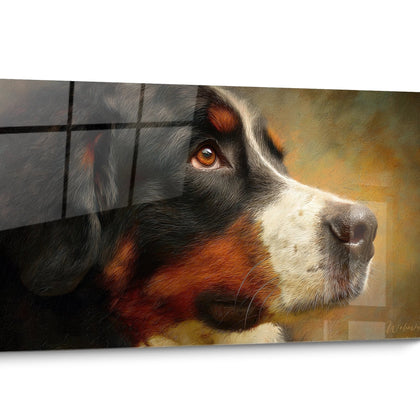
 Tri-Color Dog with Expressive Eyes - Geometric Portrait - Bernese Mountain Dog Edition273,90 €
 Seated Bernese Mountain Dog Wall Art with Geometric Shapes - Colour Harmony - Bernese Mountain Dog Edition273,90 €
 Bernese Mountain Dog Geometric Portrait Blue and Red Wall Art - Noble Gaze - Bernese Mountain Dog Edition228,90 €
Explore further
In Bernese Mountain Dog Geometric Wall Art


All about Bernese Mountain Dog Geometric Wall Art
- Bernese Mountain Dog Geometric Wall Art Presentation
- Geometric Design & Aesthetics
- Visual Architecture & Modernity
- Decorative Impact & Style Compatibility
The geometric Bernese Mountain Dog wall art represents a bold fusion between contemporary aesthetics and canine iconography. This artistic approach transforms the characteristic tricolor coat of the Bernese Mountain Dog into a structured composition of angular shapes and polygons. Modern décor enthusiasts specifically seek this style for its distinctive character that transcends conventional representations, offering an avant-garde interpretation that integrates perfectly with streamlined architectural interiors and demanding professional spaces.
Geometric Art Applied to the Bernese Mountain Dog
The geometric Bernese Mountain Dog wall art exploits visual fragmentation to create a sophisticated mural artwork. This deconstruction technique transforms the natural organic curves of the Bernese into a mosaic of triangles, diamonds, and parallelograms. Artists meticulously decompose the colored masses of black, white, and rust into angular facets, creating a crystallization effect that captures light differently depending on the viewing angle.
Why choose a geometric representation over watercolor?
Unlike the watercolor Bernese Mountain Dog wall art which favors softness and fluid transitions, geometric rendering offers a striking visual structure perfectly suited to contemporary environments. This angular approach harmonizes naturally with modern architectural lines, Scandinavian furniture, and streamlined spaces. Collectors particularly appreciate this aesthetic for its dialogue with raw materials such as concrete, brushed steel, and glass.
Chromatic composition and architectural contrast
The tricolor palette of the Bernese Mountain Dog lends itself remarkably well to geometric interpretation. Deep black blocks create powerful visual anchor points, while white areas provide essential breathing space. Rust-colored touches segmented into geometric shapes produce a chromatic vibration that energizes the whole composition. This chromatic segmentation amplifies the natural contrasts of the breed by creating sharp boundaries between each colored zone, reinforcing visual impact from a distance.
Monumental formats allow full appreciation of the complexity of this artistic fragmentation. Each polygon becomes a composition element in its own right, contributing to overall harmony while maintaining its own identity. This multiplicity of facets generates a visual richness that reveals new details with each observation, transforming the work into an evolving focal point depending on ambient light conditions.
Visual Architecture and Space Structuring
How does geometric style transform spatial perception?
A large-scale geometric Bernese Mountain Dog wall art functions as an architectural element in its own right. The directional lines created by polygon edges establish visual axes that structure the surrounding space. This property proves particularly valuable in open volumes where delimiting functional zones requires subtle yet effective visual interventions. The artwork thus becomes a spatial organizer that guides the eye and creates visual hierarchy.
Angular intersections produce a directional dynamic that contrasts with the usual static quality of a classic Bernese Mountain Dog portrait wall art. This visual energy stimulates attention without creating eye fatigue, thanks to the carefully calculated balance between areas of complexity and visual rest spaces. Interior designers exploit this characteristic to revitalize blank walls or energize circulation areas.
Dialogue with contemporary materials
Polygonal aesthetics resonate particularly well with reflective surfaces and industrial textures. In an urban loft, the geometric facets of the Bernese echo exposed metal structures, glass partitions, and cladding. This material consonance creates sophisticated decorative coherence that unifies the space without resorting to stylistic repetition. The changing reflections on surrounding glass surfaces dialogue with the multiple planes of the artwork, generating subtle animation throughout the day.
Integration in demanding professional spaces
Architecture offices, design studios, and creative agencies massively adopt the geometric Bernese Mountain Dog wall art for its visual communication power. The artwork instantly projects an avant-garde identity while retaining emotional accessibility through the universally appreciated canine subject. This duality between formal sophistication and thematic warmth makes it a strategic choice for reception spaces where first impression determines the perception of professional expertise.
Decorative Impact and Style Compatibility
Which environments optimally showcase this artistic approach?
The geometric Bernese Mountain Dog wall art finds its maximum expression in minimalist Scandinavian interiors, repurposed industrial spaces, and architect residences. Its structured visual language advantageously opposes overloaded decorative trends, offering conceptual breathing space. Contemporary design collectors frequently associate it with signed furniture, sculptural lighting, and limited edition collectible pieces, thus creating coherent ensembles that testify to an affirmed aesthetic sensibility.
Unlike the realistic Bernese Mountain Dog wall art which prioritizes photographic fidelity, geometric interpretation fully assumes its status as figurative abstraction. This artistic freedom authorizes chromatic audacities and proportional distortions impossible in a naturalistic approach, thus offering a considerably expanded expressive palette.
Synergy with layered mural collections
Multiple wall arrangements particularly benefit from the inclusion of a geometric piece. In a triptych composition, the geometric Bernese brings the formal structure necessary to balance more gestural or organic works. Gallerists frequently recommend associating it with other representations of Bernese Mountain Dog wall art in contrasting styles, thus creating an enriching visual dialogue that demonstrates the iconographic versatility of this emblematic breed.
Perceptual evolution and sustained visual engagement
The inherent complexity of geometric fragmentation guarantees progressive discovery. Unlike simplistic compositions that instantly reveal their totality, this layered approach maintains interest over the long term. Owners regularly report perceiving new visual configurations after months of daily cohabitation, testifying to compositional richness. This perceptual depth justifies investment in generous formats that allow simultaneous appreciation of overall structure and individual details of each polygonal facet.
Seasonal light variations substantially modify the artwork's appearance. Low morning light accentuates the visual relief created by chromatic contrasts between adjacent polygons, while midday zenith lighting flattens the composition by revealing its two-dimensional structure. This perceptual plasticity transforms the work into a light barometer that enriches daily experience of the inhabited space.
Does a geometric Bernese Mountain Dog wall art suit classical interiors?
Although designed for contemporary environments, this style brings stimulating contrast to traditional interiors by creating a creative tension between eras. This unexpected juxtaposition generates sophisticated decorative dynamics appreciated by eclectic collectors.
How to maintain a large-scale geometric Bernese Mountain Dog wall art?
Monumental formats require regular dusting with a dry microfiber cloth to preserve chromatic vibrancy. Avoid direct sun exposure which could alter pigments over time; favor locations with stable indirect lighting.
Can you order a geometric Bernese Mountain Dog wall art with a personalized color palette?
Some artists offer chromatic variations exploring monochrome ranges or contrasting palettes while preserving the characteristic geometric structure. These adaptations allow optimal integration into environments with specific chromatic constraints without compromising the artwork's stylistic identity.


