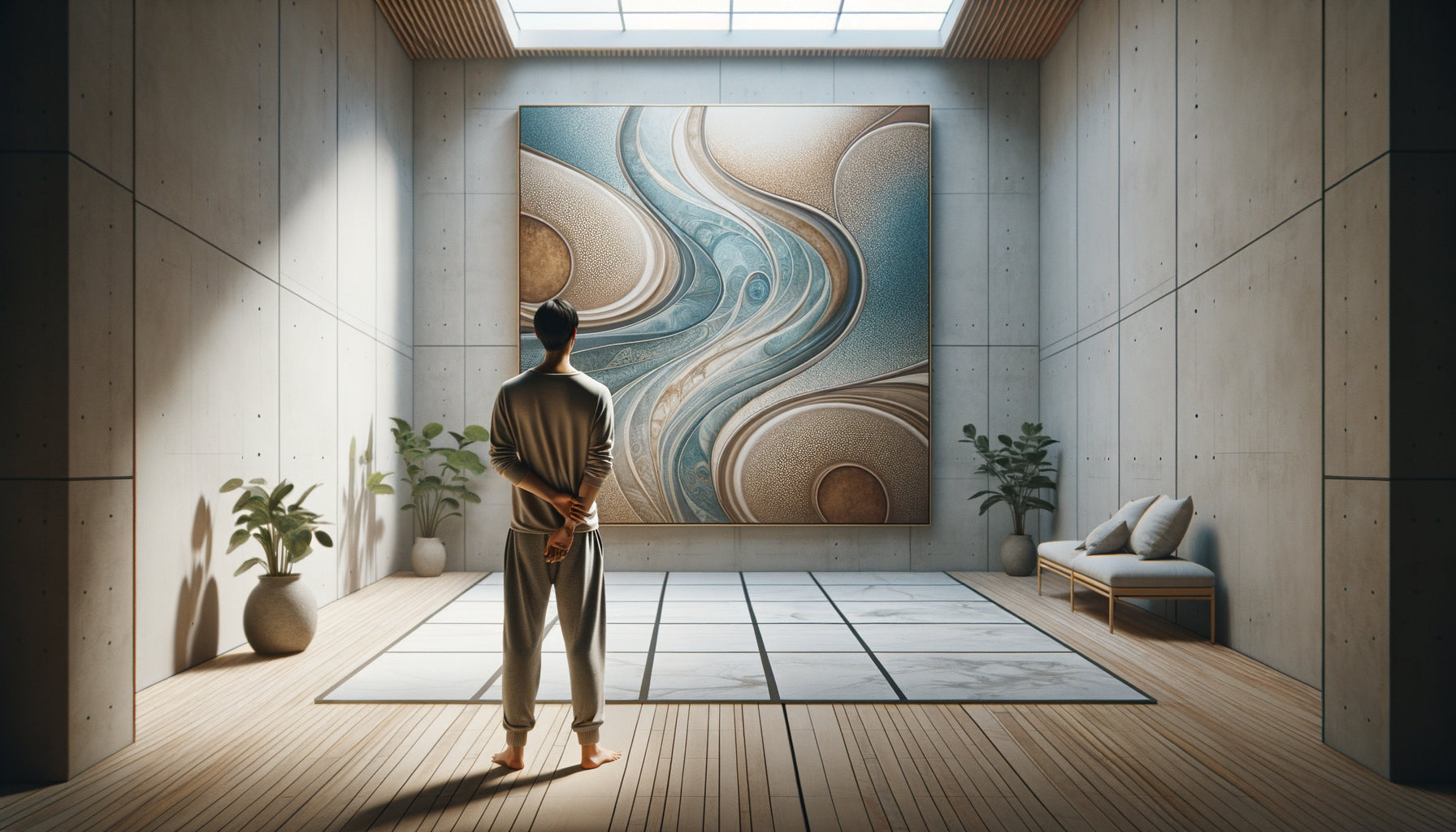
Faced with the blank wall of your living room, you hesitate. On one side, the appeal of Japanese minimalism, that almost monastic serenity. On the other, the vibrancy of Western contemporary art, its affirmed colors, its energy. It's not just a matter of taste; it’s a decision that will define the soul of your space for years to come. I have accompanied dozens of collectors in this quest, and I can assure you: the right painting radically transforms the energy of a room. Here is what an informed choice brings you: a visual harmony that truly resembles you, a consistency with your daily lifestyle, and that deep satisfaction of coming home saying “that’s exactly it.” Many think they have to choose between these two opposing universes, as if adopting a refined Japanese style meant giving up all personal expression, or opting for Western contemporary art condemned their interior to visual chaos. The truth? These two approaches respond to different needs, and understanding which one resonates with your daily life is the key. I will guide you through the nuances of each style so that you make the choice that transforms your wall into a personal sanctuary.
Japanese minimalism: when emptiness becomes presence
A refined Japanese painting never seeks to shout. It whispers. This philosophy of ma – the space between things – makes each empty zone a visual breath. When you install a work inspired by the Japanese style, you are not simply adding decoration; you create a point of silence in the modern visual turmoil. Ink washes on rice paper, asymmetrical compositions inspired by ikebana, shades of gray and beige: everything is designed to soothe the gaze rather than stimulate it.
What strikes in Japanese aesthetics is its ability to express the essential. A cherry branch, three strokes of bamboo, the suggestion of a mountain in the mist. This economy of means is not austerity; it is ultimate sophistication. Every element counts, every empty space has a function. In a contemporary interior saturated with objects and visual information, a refined Japanese style painting acts as a mental reset.
The Japanese approach fits into a different temporality. It does not follow trends; it crosses decades without aging. A hanging scroll or a minimalist print has that timeless quality that makes it a lasting emotional investment. You won't get tired of it because it never seeks to impress, just to be.
Western contemporary art: energy as signature
At the opposite end of the spectrum, Western contemporary art explodes. Saturated colors, expressive gestures, monumental scales sometimes. A Western contemporary painting doesn't just exist on your wall; it affirms a presence, imposes a conversation. It’s the art that says “I am here,” that demands attention, that becomes the focal point around which everything else is organized.
This approach corresponds to a different relationship with time and space. Where the Japanese create contemplation, Western contemporary art generates stimulation. Geometric abstractions, bold compositions, mixed textures: everything is designed to dynamize the space and reflect an affirmed personality. It's the art of those who want their interior to tell who they are today, now, unfiltered.
Western contemporary art also fits into a more narrative approach. A painting can evoke raw emotion, tell a personal story, or refer to an experience. This autobiographical dimension is often lacking in Japanese minimalism, which prefers the universal to the particular. If you're looking for a painting that serves as a conversation starter, one that provokes reactions, Western contemporary art excels in this register.

Your space dictates the style, not the other way around
Before choosing between these two universes, objectively look at your interior. A Haussmannian apartment with moldings, herringbone parquet flooring and a marble fireplace? A Japanese minimalist painting will create a fascinating contrast, a contemporary pause in a classic setting. Conversely, an industrial loft with exposed brick walls and open volumes may call for the energy of a large Western contemporary canvas.
Architecture profoundly influences the perception of a work. In a visually busy space – numerous pieces of furniture, textile patterns, collection of objects – Japanese minimalism brings a welcome breath of fresh air. It doesn't compete with the rest; it balances it. In a minimalist interior with clean lines, a Western contemporary painting injects that touch of life and warmth that avoids a cold showroom effect.
Natural light also plays a crucial role. The subtle nuances of a Japanese wash are fully revealed in soft, diffused light, such as from a north-facing exposure or dimmed by curtains. A contemporary painting with vibrant colors literally explodes under direct light, such as from a south-facing bay window or well-calibrated LED lighting.
When your lifestyle becomes your compass
Beyond pure aesthetics, your daily life should guide your choice. If you lead an intense urban life, if your work is mentally demanding, if you return home seeking decompression, Japanese minimalism acts as a visual balm. These paintings create zones of calm, havens where the eye rests without being solicited.
Conversely, if you work in a creative environment, if you enjoy entertaining, if your interior is a dynamic social living space, Western contemporary art fuels that energy. A vibrant painting becomes a catalyst for conversations, a starting point for exchanges, a reflection of your openness to the world.
Also consider evolution. A minimalist Japanese-style painting traverses changes in decor with remarkable flexibility. You can completely transform your interior, and it will remain relevant. Western contemporary art, especially if it is very assertive, engages you more. Everything else must follow suit, and consistency must be maintained. It's neither better nor worse; it’s a matter of decorative temperament.

What if the answer was in hybridization?
Here's a truth that few dare to express: you don’t have to choose a side. The most interesting interiors I’ve seen actually play on this creative tension between Japanese minimalism and Western expression. A large Western contemporary painting as a centerpiece, balanced by touches of Japanese minimalism in adjacent spaces. Or the opposite: a zen dominant punctuated by a splash of contemporary color.
This hybrid approach, however, requires finesse. It's not about anarchically juxtaposing opposing styles, but about creating an intentional visual dialogue. The secret? Maintain consistency in materials or palette. Natural wood frames can unify a disparate ensemble. Restricting yourself to three colors maximum creates continuity even between divergent styles.
Some Western contemporary artists also incorporate Japanese minimalist principles into their work. Colorful minimalism, off-center compositions inspired by wabi-sabi, the use of emptiness as a compositional element. These hybrid works offer the best of both worlds: Japanese structural serenity enriched with Western expressiveness.
Your wall awaits its transformation
Discover our exclusive collection of wall art for yoga studios that harmonizes Japanese minimalism and contemporary softness to create spaces of authentic serenity.
Take the mental projection test
Before making any purchase, try this simple yet revealing exercise. Close your eyes and visualize yourself in your space, facing the wall that will house the artwork. First, imagine a minimalist Japanese work: neutral tones, minimal composition, visual breathing room. How do you feel? Soothed? Or slightly frustrated by the lack of dynamism?
Now, visualize a contemporary Western painting: affirmed colors, strong presence, manifest energy. What is your visceral reaction? Excitement? Or a feeling of visual aggression? Your first emotional reaction, the one that precedes any rationalization, is often the most reliable. It reveals your authentic need, not the one you think you should have.
Also test the emotional durability. Can you see yourself contemplating this work in five years? Ten years? Japanese minimalism tends to gain depth over time, revealing nuances you hadn't initially perceived. Contemporary Western art offers more immediate intensity that can, depending on the works, either remain powerful or diminish through familiarity.
The emotional investment always surpasses trend
Neither minimalist Japanese style nor contemporary Western art are inherently superior. They respond to different needs, distinct sensibilities, and varied lifestyles. True luxury is not blindly following a decorative trend or rule, but creating an environment that nourishes you daily.
A painting is not just a decorative element. It's a presence with which you live, that you cross several times a day, which subtly influences your mood and energy. This intimate relationship deserves time, attention, and honesty with yourself. The best choice will always be the one that resonates with who you truly are, not who you think you should be.
Whether you ultimately opt for the meditative minimalism of Japanese art or the vibrant expression of contemporary Western art, make sure of one thing: each time your gaze rests on this painting, you feel that little spark of satisfaction, that « yes, that's exactly it ». That’s the only criterion that really matters.
FAQ
Can a minimalist Japanese painting be mixed with classic Western furniture?
Absolutely, and it's often beautiful! The contrast between a minimalist Japanese painting and Western furniture creates a fascinating visual tension. The key is to maintain consistency in tones. If your furniture is light wood, prioritize Japanese works with natural frames. With dark furniture, dare to use black ink washes on white paper for a sophisticated contrast. This mix brings cultural depth to your interior and avoids the « catalog » effect of a style that is too uniform. The secret lies in intentionality: each piece should seem to have been chosen to dialogue with the others, not just juxtaposed randomly.
Will a Western contemporary painting quickly become dated?
It all depends on what you choose. Contemporary Western artworks that are too rooted in a micro-trend (Pantone color of the year, ultra-typed patterns of a decade) risk dating quickly. On the other hand, a Western contemporary painting that explores timeless forms, textures or compositions gracefully transcends the years. Prioritize balanced geometric abstractions, sophisticated color studies, and material textures rather than overly specific cultural references. Also look at the quality of execution: a well-executed work, with real pigments and genuine formal research, retains its aesthetic power far beyond fleeting trends. Quality contemporary art becomes future heritage.
I'm afraid a minimalist Japanese painting will make my interior too cold, is that true?
This concern is understandable but often unfounded if you balance it correctly. A minimalist Japanese painting is never cold when accompanied by warm textiles, natural woods and soft lighting. Authentic Japanese minimalism always incorporates warmth through natural materials and organic textures. If your interior is already very minimalist with a lot of smooth and cold surfaces (metal, glass, polished concrete), add tactile elements: a rug made of natural fibers, linen cushions, handcrafted ceramic objects. Minimalism does not mean austerity, it means clarity. With the right associations, a Japanese painting creates an enveloping and serene atmosphere, not an intimidating museum space. Test by first introducing small touches of minimalism before committing to a large piece.