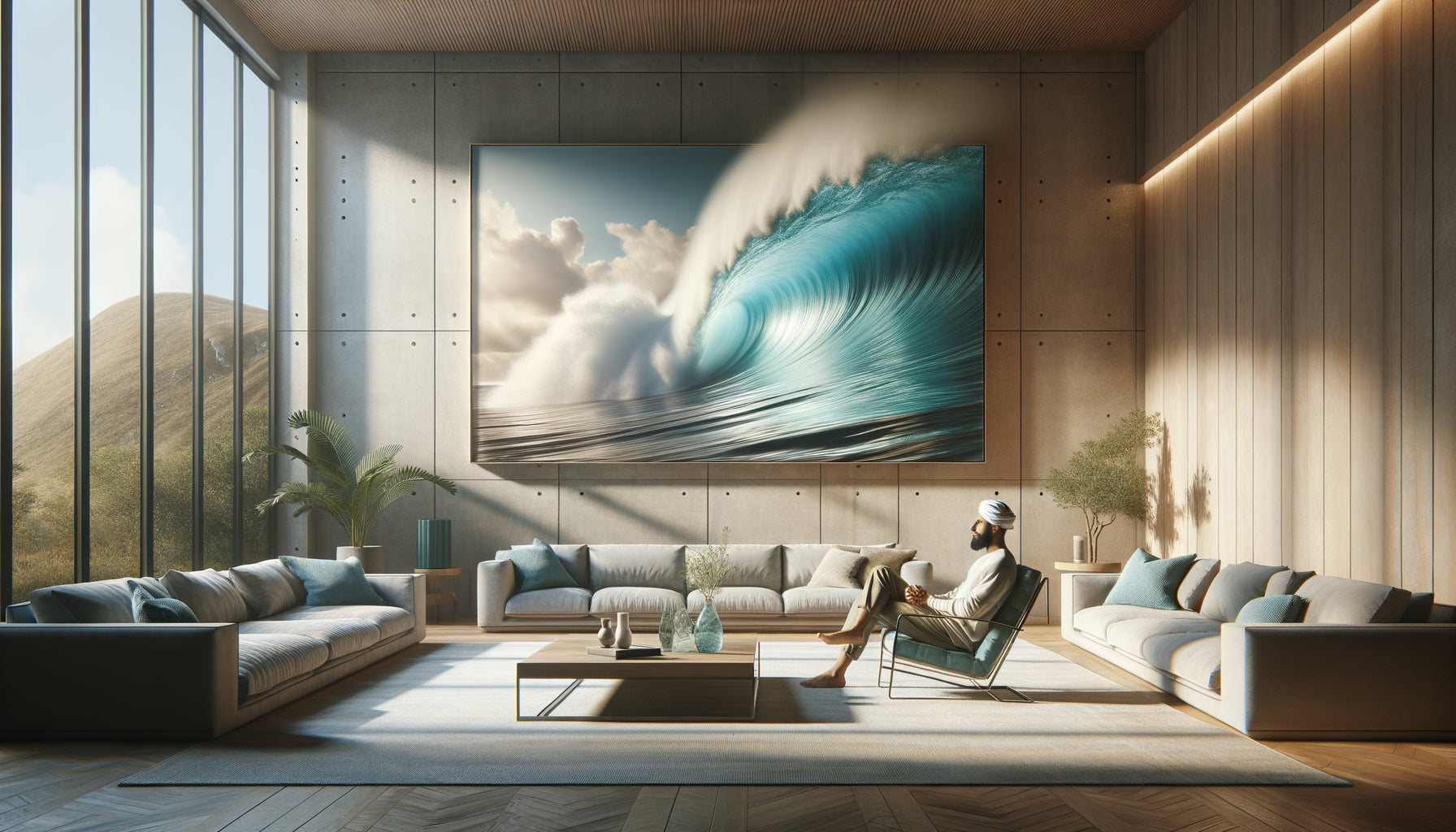
That morning, in my studio bathed in natural light, a student swayed, lost her balance in her tree pose, then caught herself against the wall with a sigh of frustration. "I never seem to hold it," she confided to me. I simply asked her to focus on the abstract painting hanging facing her – three turquoise lines that appear to float in the white space. Thirty seconds later, she held the posture with a stability she had never known. The magic of drishti had just taken effect.
Here's what a painting as a focal point brings to your practice: immediate physical stability in balancing poses, a mental anchor that calms the flow of thoughts, and a meditative depth that transforms each session into an inner journey. Drishti – this ancient yoga technique of fixing one’s gaze – finds its most elegant ally in wall art.
You've probably already experienced this frustration: you are focused in your posture, then a movement in the room attracts your gaze, and you lose your balance. Or worse, you stare at a white wall, your mind wanders to your shopping list, and your body follows the same chaotic path. Balancing poses become an ordeal rather than a celebration.
Rest assured, it's not a question of talent or flexibility. It’s simply that your gaze – and therefore your mind – has not found its refuge. A well-chosen painting becomes this visual sanctuary, this anchor point that reconciles body and mind.
I promise you that by the end of this article, you will understand exactly how to transform a simple painting into a tool for stability, and above all, how to choose one that will make your balancing poses a moment of grace rather than struggle.
Drishti: when gaze sculpts balance
Drishti designates much more than just a point of fixation in the philosophy of yoga. It is a technique of visual concentration that creates a bridge between the outside and the inside, between what you look at and what you feel. Literally translated as "vision" or "gaze," drishti transforms your eyes into an anchor.
Modern science confirms this millennial wisdom: our vestibular system – responsible for balance – works in synergy with our vision. When your eyes fixate on a stable point, your brain receives coherent information that allows your postural muscles to adjust precisely. It’s exactly the same principle that ballet dancers use during their pirouettes.
But here's where the painting comes into play masterfully: unlike a simple spot on the wall or a switch, a work of art offers your gaze a destination worthy of attention. It doesn’t bore you, it doesn’t distract you – it captivates you just enough to maintain your focus without monopolizing your consciousness.
I have observed this transformation in hundreds of students: when they fix their gaze on a painting during their Warrior III pose or Half Moon, their body finds a verticality they didn’t suspect. Their breathing deepens. Muscle tremor decreases. Drishti works its silent magic.
Why a Painting Works Better Than a White Wall
A white wall offers a void that your mind will quickly fill with wandering thoughts. A window invites external distractions. A mirror judges you. But a well-chosen painting becomes your silent practice partner.
The artwork creates what I call “gentle attraction” – enough visual interest to hold your attention, but enough serenity not to stimulate your analytical mind. When you gaze at a painting during your tree pose, your eyes find a refuge that soothes without putting you to sleep.
A painting's composition also offers multiple focal points. In an abstract work, you can choose the intersection of two lines, the center of a circular shape, or the contrast between two colors. This flexibility allows you to adapt your drishti according to your mood and energy of the day.
I've noticed that my students who practice facing a painting develop remarkable consistency. Each session, they find their familiar anchor point. The painting becomes a visual ritual, a signal that tells their body: “It’s time to find your center.”
The Psychological Effect of Beauty
There's also this subtle but powerful dimension: practicing in front of something beautiful elevates your experience. Your yoga practice is no longer just a workout on a mat, it becomes an aesthetic meditation. The painting infuses your session with a contemplative quality that enriches each balancing pose.

The Characteristics of an Ideal Painting for Drishti
Not all paintings are created equal as focal points. After years of observing what actually works, I've identified the essential qualities of a work suited to practicing balancing poses.
Compositional simplicity: Look for paintings with a clean composition. Works that are too busy scatter attention rather than anchor it. A zen circle, soft geometric lines, a soothing gradient – these simple elements offer your gaze a natural resting point.
The soothing color palette: Colors directly influence your nervous system. Shades of blue and turquoise evoke the stability of calm water. Greens evoke the grounding of nature. Beiges and off-whites create a meditative neutrality. Avoid aggressive reds or violent contrasts that stimulate rather than soothe.
The format and height: Your artwork should be positioned at eye level when you are standing in your postures. A medium size (40x60 cm to 70x100 cm) works wonderfully – present enough without being overwhelming. In my practice spaces, I always position paintings between 1m40 and 1m60 from the floor.
An identifiable focal point: The artwork should contain an element towards which your gaze can naturally converge. In abstract art, this could be the intersection of lines, the center of a circle, or a contrast between two shades. This visual anchor becomes your personal drishti.
How to use your artwork during balancing postures
Having the right artwork is only the first step. Here's how to consciously integrate it into your practice to maximize its stabilizing power.
Before the posture: Take a few breaths facing your artwork. Let your gaze gently explore its surface, then identify the precise point that attracts you naturally today. This will be your drishti for this session. Some days, you will be drawn to a bright area; other days, to a darker area. Trust this intuition.
During the posture: As you enter your balancing posture – whether it's the tree, warrior III, or half-moon – immediately fix your chosen point. Do not take your eyes off it. Your gaze should be soft but constant, as if looking through the artwork rather than fixing it with tension. Let your peripheral vision remain slightly active; this paradoxically helps stability.
If you oscillate: Resist the temptation to move your eyes. It is often the movement of the gaze that precipitates a loss of balance. Consciously anchor your vision even more on your drishti point. Imagine an invisible thread connecting your eyes to the artwork – this thread keeps you aligned.
Progressive deepening: With practice, you will notice something fascinating: your awareness deepens as your gaze remains fixed. You begin to feel your breath, the rooting of your supporting foot, the alignment of your spine – all while maintaining that visual connection with the artwork. This is the very essence of drishti: a fixed point outside that releases inner mobility.
The technique of softened gaze
A subtlety I share with my advanced students: after fixing your gaze on the artwork, soften it slightly. Rather than an intense focus that would create eye strain, cultivate what contemplative traditions call the "lion's gaze" – present but relaxed. This quality of vision amplifies the stabilizing effect of drishti while preserving your meditative state.

When practice becomes visual meditation
Something remarkable happens when you regularly practice facing the same artwork: a relationship is woven. Your wall art becomes a silent companion who witnesses your evolution.
I have a student who has been practicing for three years in front of an artwork depicting concentric turquoise circles. She tells me that these circles have become for her a symbol of her own centering. Some days, she fixes the outer circle and feels expansion; other days, the central point becomes her refuge of interiority. The same artwork, but a constantly renewed experience.
This visual consistency also creates a soothing ritual. In our world saturated with changing stimuli, finding the same focal point day after day offers your nervous system a precious predictability. Your body recognizes the signal and enters more quickly into the state of presence necessary for balancing postures.
The artwork thus becomes a portal – a door between the agitated outer world and your inner sanctuary. Each time your gaze rests on it during a posture, you cross this door. Drishti is not simply a physical balancing technique, it is an invitation to existential balance.
Integrating the artwork into your practice space
The placement of your artwork deserves special attention. In my studio, I experimented with different configurations before finding the perfect balance between functionality and aesthetics.
Facing your mat: Ideally, position the artwork on the wall you naturally look at from the top of your mat. So, whether you practice standing or in certain floor postures, your drishti point remains accessible.
Natural light: Avoid placing your artwork directly facing a window that would create distracting reflections. Sidelight is ideal – it illuminates the work without creating visual distraction.
Minimalist context: Your artwork will work better as a focal point if it is not surrounded by other competing visual elements. A relatively clean wall allows the work to fully play its role as a visual anchor.
Physiological height: Remember that your drishti should be accessible without creating cervical tension. A height between 1m40 and 1m70 from the ground is suitable for most practitioners for standing balance postures.
Transform your practice with the power of drishti
Discover our exclusive collection of wall art for yoga studios that have been selected for their soothing qualities and their ability to serve as perfect focal points during your balance postures.
The silent transformation
Close your eyes for a moment and visualize your next session. You unroll your mat facing your new artwork. You enter your tree posture, your gaze immediately finds that familiar point on the canvas. Your foot roots with newfound confidence. Your body stretches towards the sky while your gaze remains anchored. Stability is no longer a struggle – it's a state of being.
The painting you choose will not just be decoration. It will become the silent witness of your progress, the guardian of your sacred space, the anchor point that transforms each oscillation into an opportunity for centering. Drishti is a gift you give yourself – that of embodied presence.
Start simply. Choose a work that resonates with your sensitivity. Position it facing your mat. And during your next practice, offer it your gaze. Observe what happens. The magic of drishti only needs to operate – it is waiting for you to give it this meeting point between art and balance.