

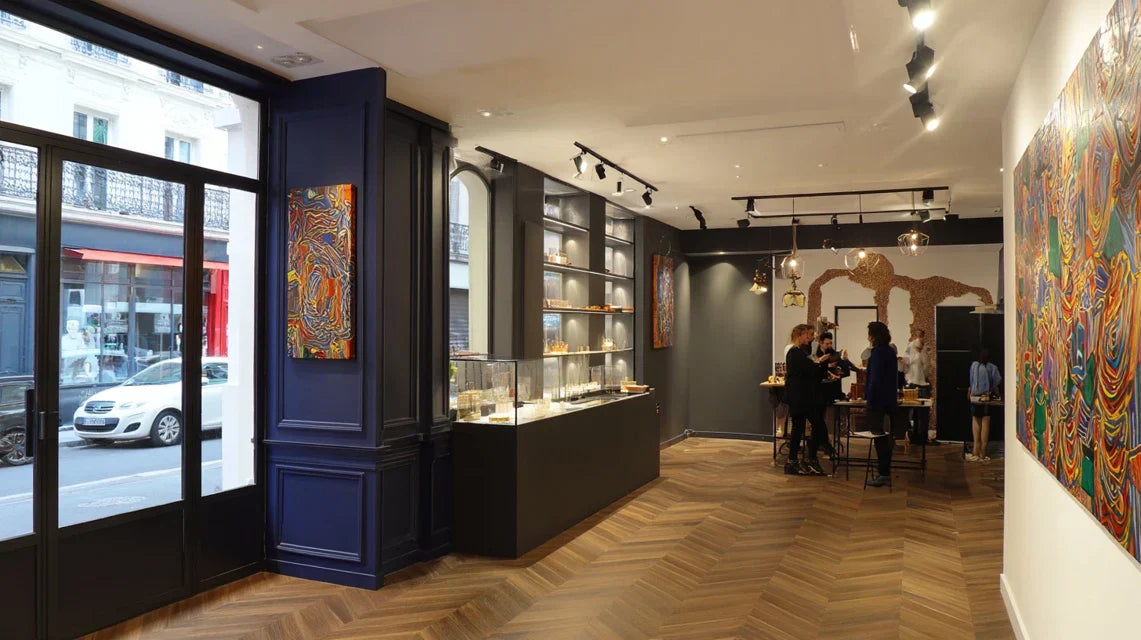
You walk into your store every morning and feel that unpleasant sensation: walls that are white and cold, telling no story, a space that desperately lacks personality, and above all, the impression that your customers are walking through your business without really stopping, without feeling that emotional connection that transforms a simple visit into a memorable experience.
You observe their gazes gliding over your products without lingering, this neutral atmosphere that doesn't reflect the soul of your brand, and this growing frustration of seeing your competitors attract attention in spaces that mark people’s minds from the very first glance.
You have probably already tried a few promotional posters, added plants or changed the lighting. But nothing seems to create that distinctive atmosphere you are looking for in your commercial space. The problem? These solutions remain superficial and do not address the real issue.
It's perfectly normal to feel lost in arranging your commercial space. The real reason for this failure? You are trying to decorate rather than create a visual identity that tells the story of your brand and creates an instant emotional connection with your customers.
By the end of this article, you will know exactly how to choose and install wall art that will transform your business into an irresistible space, strengthen your brand image, and create that unique customer experience that fosters loyalty and gets people talking.
Why is wall art becoming the secret weapon of modern visual marketing?
In 2024, 73% of purchasing decisions are made in less than 3 seconds after entering a store. If you wait for your products to speak for themselves, you miss the crucial window of opportunity to make a first impression. It's like trying to seduce someone while keeping your eyes closed for the first few minutes: the opportunity has already passed.
📈 Customer testimonial: Sarah, owner of a fashion boutique in Lyon, saw her sales increase by 34% in three months after installing a series of abstract paintings in the colors of her brand. "Customers stay longer, take photos, and above all, they come back with their friends," she confides.
💬 Conversation with a decor expert
The golden rule of visual marketing: A commercial space without artistic personality is like a book without a cover - no one bothers to open it. By installing the right wall art, you instantly create a visual signature that anchors your brand in the emotional memory of your customers, with measurable results from the first week.
Understanding what's hidden behind your "invisible" commercial space
Do you recognize these three situations? Your customers enter, quickly look around, and leave without buying. They photograph your products but never your space. They never recommend your store as "a must-see place".
What's really happening is that your space is generating no emotional engagement. The problem isn't your merchandise or service, but the lack of a strong visual identity that creates this instant connection. The human brain processes visual information 60,000 times faster than text.
Imagine your store as a theater play: your products are the actors, but without scenery, the play loses all its magic and emotional impact.
The first hidden cause: you decorate instead of communicate
Contrary to what many think, wall art in a commercial space is not just about "making it pretty". Its true role? To convey values and create a sensory experience that reinforces your brand positioning. The difference between decorating and communicating visually.
It's like the difference between wearing a generic suit and wearing an outfit that expresses your personality: the impact on others' perception is radically different.
This approach completely transforms how your customers perceive your expertise and your attention to detail. Instead of seeing a simple salesperson, they discover a creator of experiences who masters all aspects of their universe.
🔍 Immediate test: Look at your space and ask yourself this question: "If someone entered here with their eyes closed then opened them, what emotion would they feel first?" If you hesitate, it's because your wall art isn't communicating clearly enough.
The second hidden cause: you underestimate the power of strategic placement
Many believe that simply hanging a painting in the center of a wall is enough for it to work. In reality, the location of a piece determines its psychological impact and its influence on the customer journey within your commercial space.
It's like placing a directional sign: misplaced, no one sees it; well placed, it naturally guides the flow and optimizes the visitor experience.
This lack of knowledge makes you miss out on opportunities to create strategic attraction zones that direct attention towards your flagship products and extend the length of visits.
The third hidden cause: you neglect the effect of visual consistency
This invisible but determining factor: the harmony between your artworks, your lighting, your brand colors and the overall atmosphere. A concrete example: a contemporary art gallery installing classic artworks would instantly lose its credibility.
You can easily spot it: if your visitors seem lost or if the space lacks visual fluidity, then the elements are not communicating with each other. The clues: darting glances, shortened visit, absence of "souvenir photos".
This inconsistency creates a cognitive dissonance which unconsciously fatigues your customers and pushes them to shorten their visit, mechanically reducing your chances of sale.
🎯 The 3 signals of a visually disconnected space:
- The scattered gaze: your customers look everywhere without focusing - this means that no element creates a strong focal point
- Express visit: abnormally short time spent in relation to the size of your space - indicates visual overload or confusion
- Lack of memorization: customers do not remember specific details of your store - reveals a lack of striking elements and strong identity
The trigger element: the visual signature that makes all the difference
What really transforms a commercial space is this unique artistic signature which instantly becomes recognizable. Like a signature scent that makes you say "that's so them", your choice of wall art creates this domino effect of recognition that fosters loyalty and generates word-of-mouth. You will recognize it when your customers start describing your space to their loved ones in precise and enthusiastic terms.
The rule of the first glance: If your wall art does not generate an emotional reaction within the first 5 seconds, it is not fulfilling its commercial mission. Test it by discreetly observing the expressions of your new visitors - their face will tell you everything.
| ❌ Traditional decor approach | ✅ Commercial wall art strategy | 💡 Why it changes everything | 🎯 Measurable benefit |
|---|---|---|---|
| "It must be pretty and neutral" | "It must tell our story" | Emotion creates brand attachment | +40% average visit time |
| "One painting in the center will suffice" | "Let's create a strategic visual journey" | Guided gaze optimizes sales | +25% conversion rate |
| "Let's stick to basic tones" | "Let’s affirm our color identity" | Memorization comes through differentiation | +60% customer recommendations |
| "Let's buy cheap, we'll see" | "Let's invest in our brand image" | Perceived quality influences accepted price | +30% average basket value |
The 3-step method to transform your space into a customer-loving environment
Rassurez-vous, creating an irresistible commercial atmosphere is not as complex as it seems. The transformation follows a simple logic, as building a house: first the foundations (your concept), then the structure (the choice of artworks), and finally the finishing touches (optimized installation). At each stage, you will see your space gain in personality and attractiveness, until that final revelation where everything harmonizes in a memorable customer experience.
🗺️ Your transformation roadmap: Step 1 - Define your visual DNA (the message you want to convey), Step 2 - Select your strategic artworks (the paintings that embody this vision), Step 3 - Orchestrate the perfect installation (positioning and staging). Result: a space that tells your story and converts visitors into loyal customers.
🎯 Step 1: Create your signature visual identity
Starting by defining your artistic DNA is the key to any successful transformation. It's like choosing the architectural style before building: everything else follows naturally. This first step will give you that satisfaction of finally seeing clearly in your vision and being able to explain it in a few precise words.
🛠️ Your strategic thinking tools
- Your brand palette: the 3 dominant colors that represent you - they must be reflected in your paintings to create this instantly recognizable visual consistency - avoid "one-size-fits-all" colors that dilute your personality
- Your emotional universe: the atmosphere you want to create (sophistication, conviviality, innovation...) - it's the filter that guides all your artistic choices - test it by asking 3 close ones what word they associate with your brand
- Your differentiating values: what really sets you apart from the competition - these values must be reflected in the chosen artistic style - impact is measured when customers spontaneously mention these values
Now, let's move on to practice with your first mission:
🎨 To concretize your vision into precise criteria
Define your commercial mood board: gather 10 images that represent the ideal atmosphere of your space - include inspiring shops, works of art, color palettes - this visual collection will be your compass for all future choices - each image should make you say "yes, that's exactly it"
⏱️ Time: 45 minutes | ✅ Successful when: your board tells a coherent story at a glance | ⚠️ Attention: avoid mixing too many styles - visual confusion kills impact
Write your artistic brief: write in 3 sentences the experience you want to create for your customers - use sensory and emotional words rather than technical ones - this brief will be your selection criterion for each artwork
⏱️ Time: 20 minutes | ✅ Successful when: a loved one immediately understands your vision | ⚠️ Attention: stay authentic - forcing a personality that isn't yours is immediately obvious
Map your impact zones: draw a simple plan of your space identifying 3 strategic locations - the entrance (first impression), the flagship products area (maximum attraction), the relaxation/fitting room space (memorization) - each zone will have a specific artistic role
⏱️ Time: 30 minutes | ✅ Successful when: you visualize the ideal customer journey | ⚠️ Attention: don't overload - 3 strong points are better than 10 average ones
✅ Step 1 Validation: you have a clear and precise vision of your artistic identity, a brief that guides your choices, and an action plan. If you still hesitate on some points, that's normal - refine gradually. The important thing is to have a clear direction to approach the selection of your artworks calmly.
OUR RECOMMENDED PRODUCTS
You are now moving to the next level: the professional artistic curation. This step is more exciting because you start to bring your vision to life. The difference? You no longer choose paintings that you personally like, but artworks that serve your business strategy and create the desired effect on your customers.
-
Format and proportions: adapted to your walls and viewing distance - a large painting asserts authority, a medium format creates intimacy, several small formats energize - avoid formats that are too small and get lost in the commercial space
-
Style and technique: in harmony with your positioning - abstract art conveys modernity and innovation, figurative art reassures and humanizes, photography brings authenticity - choose according to the emotion you want, not according to your personal tastes
-
Quality and finish: revealing your attention to detail - professional frames, secure fixings, UV protection - your customers judge your level of requirement on these visible details
Apply the rule of 3 impacts: each artwork must create a visual impact (it attracts the eye), an emotional impact (it generates a sensation), and a memorable impact (it is remembered) - test by showing the photo to 3 people and noting their spontaneous reactions
⏱️ Time: 1 hour per artwork | ✅ Successful when: the 3 impacts are confirmed by third parties | ⚠️ Attention: don't fall for the "personal crush" that doesn't correspond to your clientele
Apply the rule of 3 impacts: each artwork must create a visual impact (it attracts the eye), an emotional impact (it generates a sensation), and a memorable impact (it is remembered) - test by showing the photo to 3 people and noting their spontaneous reactions
⏱️ Time: 1 hour per artwork | ✅ Successful when: the 3 impacts are confirmed by third parties | ⚠️ Attention: don't fall for the "personal crush" that doesn't correspond to your clientele
Check for overall consistency: your artworks should dialogue with each other without competing - vary the sizes but keep a chromatic harmony - create a visual rhythm that naturally guides the eye in your space
⏱️ Time: 30 minutes | ✅ Successful when: the whole tells a fluid story | ⚠️ Attention: too much uniformity is boring, too much contrast is tiring
You have now reached expert level: the art of professional commercial hanging. This mastery makes the difference between an amateur and a true creator of experiences. The final result you will obtain: a space where each artwork occupies the perfect position to maximize its psychological and commercial impact on your visitors.
⚙️ Your professional installation equipment
- Adapted fixing system: plugs and screws sized according to the weight - invisible hooks for a clean finish - laser level for perfect alignment - anti-fall safety mandatory in public spaces
- Dedicated lighting: orientable LED spotlights to sublimate each artwork - neutral color temperature (4000K) to respect colors - avoid direct lighting that creates annoying reflections
- Precision tools: meter, spirit level, erasable pencil for marking - paper template to visualize before drilling - these technical details guarantee a professional result
🎪 The art of commercial staging
Apply the natural gaze rule: install your main artworks at 1.60m from the floor (average eye height) - create focal points in areas of natural circulation - respect the rule of thirds for optimal visual balance
⏱️ Time: 2h for 3 artworks | ✅ Successful when: the gaze naturally follows the desired path | ⚠️ Attention: too high strains the neck, too low diminishes impact
Orchestrate ambient lighting: each artwork should be enhanced without creating parasitic shadows - general lighting remains neutral, artistic lighting creates magic - test at different times of day to adjust
⏱️ Time: 1h of adjustments | ✅ Successful when: artworks "radiate" naturally | ⚠️ Attention: avoid over-illumination that assaults the eye
Create contemplation zones: arrange the space in front of each major artwork to allow for optimal distance - eliminate visual obstacles - create "breaths" that invite pause and appreciation
⏱️ Time: 30 minutes per zone | ✅ Successful when: customers spontaneously stop | ⚠️ Attention: do not sacrifice circulation for contemplation zones
The field validation rule: observe discreetly the reactions of your first visitors post-installation. If their eyes stop, if they slow down or comment positively, your installation fulfills its mission. Otherwise, adjust before considering the project finished.
Congratulations! You now master the fundamentals of wall art commerce. Let's discover some expert techniques that will make your space a reference your competitors will seek to imitate.
🎓 Master decorator technique: The "golden triangle" installation - place your 3 main artworks so as to form an imaginary triangle that guides the eye throughout the space. This technique, used in the greatest museums, unconsciously creates an optimal tour route and increases presence time by 40% on average.
💭 "What if my clients don't understand my artistic choice?"
"I'm afraid that my abstract paintings will confuse my clientele rather than attract them..."
This concern is perfectly legitimate and reveals your desire to do well. The beauty of art is that it doesn't need to be "understood" to be effective - it must be felt. Your clients are not buying works of art, they are coming to live an experience in your universe. Abstract art creates an atmosphere without imposing an interpretation, leaving everyone free to their emotions. Start with one piece and observe the reactions: you will be surprised at how much art liberates speech and creates unexpected connections.
🧪 Validation test: Temporarily install a test artwork for a week and note spontaneous comments. Your clients' authentic reactions are your best indicator to validate or adjust your artistic choices.
⚠️ The 5 mistakes that sabotage your artistic investment
Attention, these pitfalls are common but easily avoidable when you know them. I prefer to tell you about them now to avoid costly disappointments and save you valuable time.
- 🎯 Trying to put everything everywhere at once: enthusiasm often leads to over-decorating from the start - result: a cluttered space that loses impact - proceed in stages, starting with 2-3 strategic artworks - it's a classic beginner mistake, even professional decorators have been there
- 💰 Neglecting the quality of fixings: saving on hanging to invest in the artwork seems logical but it’s the opposite that you should do - a falling painting in front of clients is catastrophic for your image - invest in professional-quality fixings from the start
- 📏 Ignoring wall proportions: choosing a format too small for a large wall or too large for a reduced space kills visual harmony - the rule: the picture should occupy 60-75% of the available wall width - always take measurements before indulging
- 🎨 Copy codes from another sector: being inspired by a trendy restaurant for your fashion boutique creates identity confusion - each sector has its effective visual codes - respect the universe of your customers while subtly standing out
- 💡 Underestimating the impact of lighting: even the most beautiful painting poorly lit loses 80% of its attractiveness - lighting is an integral part of your artistic investment - budget 20% more for luminous enhancement
🛡️ Your safety checklist before installation: check that each artwork respects your 3 basic criteria (coherence, quality, impact), that the location optimizes traffic flow, that the fixing is sized for 3 times the weight of the work, that the lighting enhances without dazzling. Warning signs: hesitation in choice, haste in installation, neglect of finishes.
🎁 Special offer for readers
Because you took the time to inform yourself, enjoy 10% discount on your first order:
⏰ Valid 72h after reading • Applicable to all our products
❓ Your expert commercial interior designer questions
The impact starts from the first week with the increase in average visit time (+20-30%). The effect on sales is measured after 1 month, with an average of +15-25% depending on the sector. To optimize: photograph your space "before/after" and ask your regular customers for their impressions - their feedback will give you valuable improvement tips.
Allow 2-5% of your annual turnover for a significant impact. Concrete example: boutique at €200k turnover = wall art budget of €4-€10k. Optimal distribution: 70% for artworks, 20% for installation/lighting, 10% for finishes. Start with 2-3 strategic rooms rather than scattering a small budget over many average works.
Favor resistant supports (canvas, plexiglass, metal) and anti-UV treatments. Monthly cleaning with dry microfiber cloth. Safety: anti-theft fixings, specific insurance, locations out of direct reach. Pro tip: choose works where a few fingerprints do not spoil the effect (avoid perfectly matte surfaces).
Opt for abstract or geometric art that transcends personal tastes and creates universal emotions. Avoid divisive subjects (politics, religion, cultural references that are too specific). The golden rule: your art should bring people together around your brand, not divide them. Test with temporary works before making a definitive investment.
🚀 Your commercial space transformed into a true success magnet
In 3 months, you will enter every morning into a space that truly resembles you. Your customers will naturally slow down as they discover your artistic universe, take the time to explore your products, and leave with the satisfaction of having experienced a unique experience. Your competitors will wonder how you managed to create this particular atmosphere that generates buzz and spontaneous recommendations worth all advertising budgets.
Beyond sales, you will have developed genuine expertise in visual merchandising which will transform your approach to commercial design. This new confidence in your ability to create memorable experiences will open up perspectives you could not have imagined: artistic collaborations, themed events, differentiated communication. You will join the circle of merchants who understand that selling is first and foremost about evoking emotion.
Reflecting on your visual identity was the most important step - now that you know who you are and how to express it, your first move will be to choose this "strategic crush" artwork that will launch your transformation. Start this week: your future commercial success awaits you at the end of this first act of artistic courage.
✨ Your moment of truth: In 6 months, when your customers ask you about the secret to your particular atmosphere, you will smile as you remember the moment you decided to trust art to reveal your true commercial personality. Success begins with a well-chosen first painting.


