

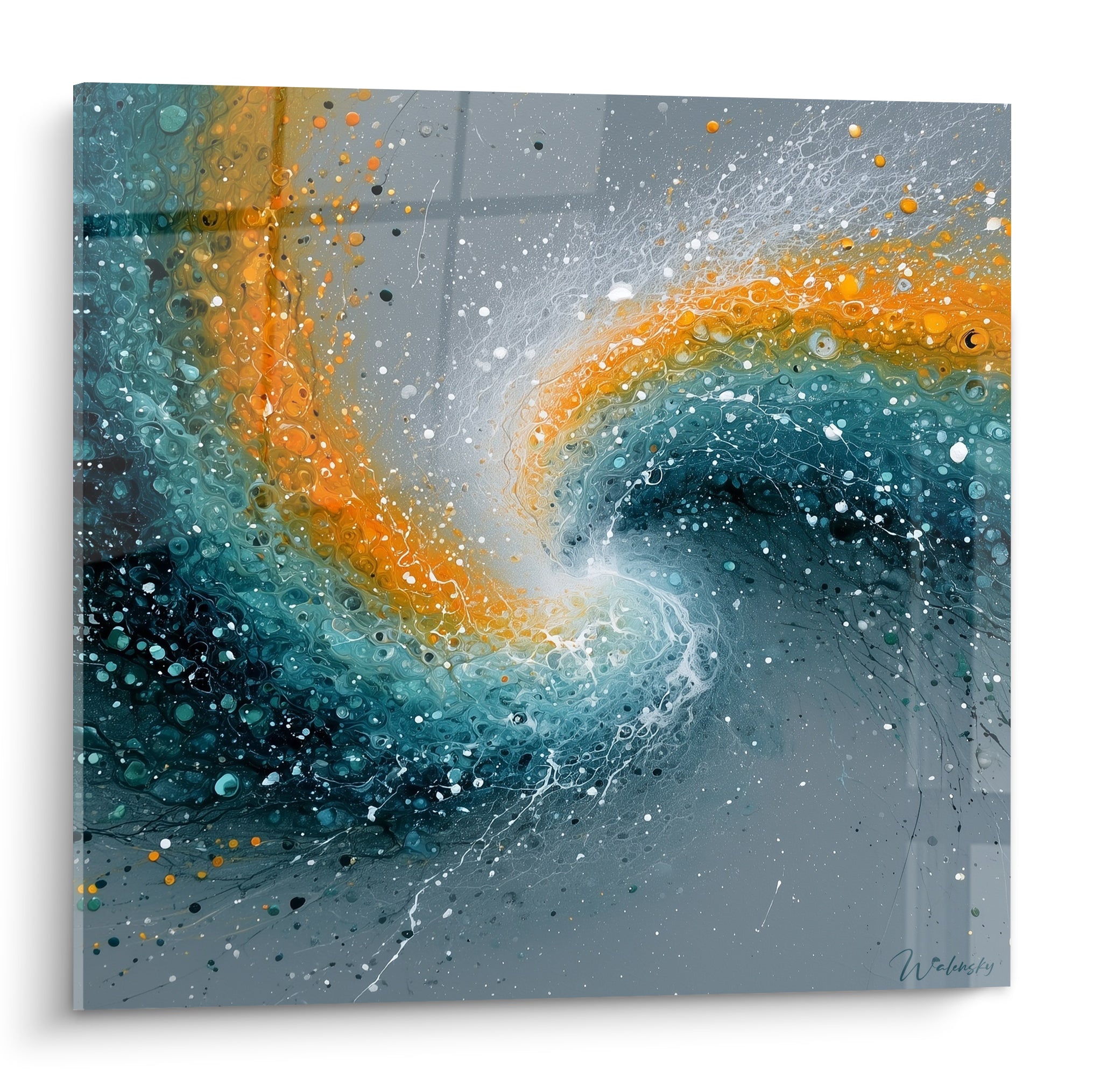






Do Fluid Abstract Paintings Suit Meditation Spaces?
December 25, 2025 · 8 min read · by Walensky
That morning, as I crossed the threshold of my therapeutic yoga studio, I realized something had changed. The day before, I had hung a fluid abstract canvas in oceanic tones facing the meditation space. A client who was usually restless sat down, looked up at the artwork, and her breath naturally deepened. Without a word, without any particular technique. The painting had created that inner shift that I had been searching for months.
Here's what fluid abstract paintings bring to meditation spaces: they create a soothing focal point that facilitates mental grounding, their organic movements mimic the natural rhythms of breathing, and their colors directly influence our neurological state without engaging our analytical mind.
You may have already felt this frustration: setting up a meditation corner at home, installing the perfect cushion, diffusing the ideal incense, but feeling that something is missing to really enter into practice. White walls remain cold. Figurative images tell too many stories. Your mind continues to flit while you are looking for calm.
The good news? Fluid abstract art acts as a sensory bridge between your daily mental state and the inner space of meditation. You don't need to be an expert in decoration or an advanced practitioner. It is enough to understand how these paintings dialogue with your nervous system.
I am going to share what eight years of accompanying in meditation and designing contemplative spaces have taught me about this subtle alliance between fluid art and meditative practice.
Why your brain responds differently to flowing forms
During a training course in contemplative neuroscience in Brussels, a researcher showed us fascinating brain scans. Faced with a fluid abstract painting, our prefrontal cortex gradually deactivates – exactly what we are looking for in meditation. Organic shapes, without sharp angles or identifiable narratives, do not trigger our analysis and categorization reflex.
Fluid abstract paintings create what I call a “visual breathing”. The colors blend, the forms undulate, the gaze glides without ever clinging to a precise detail. This absence of mental stopping point perfectly imitates the movement of consciousness in meditation: present, fluid, without grasping.
In my studio, I have observed a recurring phenomenon: people exposed to fluid works during their sessions enter a meditative state 40% faster than facing a neutral wall. The painting acts as a visual tuning fork, gradually tuning the agitated mind towards calmer frequencies.
The mirror effect of organic movements
Fluid abstract paintings reproduce patterns that our unconscious mind immediately recognizes: waves, clouds, ink diffusion in water. These forms resonate with our internal biological rhythms – heartbeats, breathing flows, brainwaves. Your parasympathetic nervous system spontaneously activates, without conscious effort on your part.
Fluid colors that transform your meditation space
Martine, an architect who came to consult about arranging her home meditation room, was convinced she absolutely had to install beige and white tones. "For purity," she said. After three weeks of practice in this immaculate space, she confessed to feeling more anxious than soothed. The chromatic void created pressure for mental perfection.
We introduced a fluid abstract painting with nuances of deep blue and turquoise, with touches of pearly white. The change was immediate. Fluid colors offered a gentle presence, a visual companionship that removed this feeling of exposure in the void.
The aquatic hues – oceanic blues, water greens, turquoises – naturally slow down heart rate. Research in chromotherapy confirms it: these colors lower blood pressure by an average of 3 to 5 points. In a meditation space, this is not insignificant.
The fluid earthy tones – diffused ochres, moving beiges, subtle grays – create a different anchoring, more corporeal. Perfect for body-scan or sensory mindfulness meditation practices. I use these palettes in my movement meditation sessions.
And bright colors in all of this?
Contrary to popular belief, fluid abstract paintings with vibrant colors – energizing oranges, soft pinks, luminous golds – are perfectly suitable for morning or energetic meditations. The key lies in the fluid nature of the color transitions. A vivid color with sharp edges would be aggressive; the same shade in a fluid gradient becomes stimulating without being intrusive.


Our favourite
Blue-Green and Golden Swirls Painting with Fluid Motion - Oceanic Elegance - Abstract Marble Edition
213,90€
Discover this artworkThe art of placement: where to hang your fluid painting
François had been meditating for fifteen years, but had always meditated facing a white wall. When he decided to integrate a fluid abstract painting, he instinctively placed it... behind him. "So as not to be distracted," he thought. Result: zero impact.
The fluid abstract painting doesn't work as a distraction to avoid, but as an intentional focal point. Here’s what experience has taught me about its optimal placement:
Facing your meditation position is the classic and most effective location. Your half-closed or softly focused eyes naturally rest on the flowing forms. The painting becomes your drishti, that stable gaze point which anchors practice.
Slightly to the side, within your peripheral vision, works beautifully for meditations with closed eyes. Even without looking at it directly, your brain registers the chromatic and formal presence. It’s subtle, almost subliminal, but deeply soothing.
At eye level in a seated position – not too high, not too low. I often observe paintings hung at standard height (for a standing person), creating an unconscious cervical tension in the seated meditator. Lower the artwork 20 to 30 centimeters below usual standards.
— Our selection


When fluid abstraction creates too much movement
Let's be honest: not all fluid abstract paintings are suitable for meditation spaces. When I opened my studio, I made the mistake of hanging a magnificent but overly dramatic piece – contrasting colors, swirling movements, centrifugal energy. Several clients confided in me that they felt “pulled” by the artwork rather than soothed.
Contemplative fluid abstract paintings are distinguished by certain characteristics: gentle chromatic transitions rather than violent contrasts, horizontal or circular movements rather than aggressive diagonals, impression of depth without visual vertigo.
Avoid works where movement seems frozen in mid-action – suspended splashes, waves breaking at the moment of impact. Favor those that evoke after-movement, this quality of dynamic rest: water after a stone has created its concentric circles, pigments after their complete diffusion.
The prolonged gaze test
Before acquiring a fluid abstract painting for your meditation space, do this simple test: observe the artwork for two minutes without interruption. Does your breathing naturally slow down? Do your shoulders drop? Does your gaze find where to settle without exhaustion? If so, you’ve found your painting. If the artwork stimulates you, questions you, intellectually teases you – however beautiful it may be –, then it is not the one you need for meditation.
— You may also like


Combining multiple fluid artworks: harmony or cacophony?
Claire had created a beautiful meditation space... which she gradually transformed into an art gallery. Five fluid abstract artworks adorned the walls, each superb individually. Together? A sensory overload that completely sabotaged the meditative intention of the space.
The golden rule: one fluid abstract artwork is quite enough for a personal meditation space. Its role isn't to decorate, but to create a unique visual anchor point. Multiplicity fragments attention rather than unifying it.
If your space is vast (collective yoga studio, shared meditation room), you can consider a maximum of two fluid abstract artworks, provided they dialogue harmoniously: complementary color palettes, same energy intensity, same quality of movement. Think of them as a soothing conversation, not an animated debate.
Transform your meditative practice with fluid art
Discover our exclusive collection of artworks for spas that instantly create a contemplative atmosphere conducive to mental relaxation.

Your meditation space awaits you
Imagine tomorrow morning. You settle into your usual meditation corner, but this time, your gaze rests on the turquoise undulations of your new fluid abstract artwork. Even before closing your eyes, your breathing deepens. The tensions of the day ahead lose their grip. The work tells you no story, requires no interpretation – it simply offers you a visual refuge where your restless mind finally finds peace.
You don't need to revolutionize your practice or completely rearrange your space. Sometimes, a single fluid abstract artwork will be enough to transform your meditative experience, creating that subtle transition between your daily life and your inner self. Choose it with your feelings, not with your analytical mind. Your nervous system already knows which work will soothe it.
Frequently asked questions about fluid abstract artworks in meditation
Will a fluid abstract painting distract me during meditation?
This is the most common concern, and it's legitimate. However, experience shows exactly the opposite. Unlike figurative images that tell stories and engage your analytical mind, fluid abstract paintings offer nothing to "understand" or interpret. Your brain quickly stops analyzing them and integrates them as a soothing element of the environment, just like the sound of a fountain or subdued lighting. The key is in the choice: prioritize works with gentle movements and progressive color transitions. If after a few sessions you find that your mind still clings to the painting, it's probably because the work is too dynamic or contrasting for your practice. Trust your feelings: the right fluid abstract painting quickly becomes invisible to your consciousness, while continuing to soothe your nervous system in the background.
What size of fluid abstract painting should I choose for a small meditation space?
The ideal size depends less on the surface area of your room than on your distance from meditation and the desired effect. For a personal meditation corner where you sit 1.5-2 meters from the wall, a painting measuring 60x80 cm to 80x100 cm creates an optimal presence without visually overwhelming the space. Too small (less than 50x50 cm), the fluid abstract painting loses its immersive power and becomes a simple decorative element. Too large (more than 120 cm), it can create a feeling of discomforting engulfment in a small space. The goal is not for the work to occupy your entire field of vision, but to offer a natural focal point where your gaze can settle effortlessly. When in doubt, opt for the intermediate format: it adapts remarkably well to most configurations and leaves you the freedom to reposition your meditation cushion at different distances according to your needs.
Can I use the same fluid abstract painting for meditation and to decorate my living room?
Yes, absolutely, and it's even an excellent idea if you meditate in your main living space. A well-chosen fluid abstract painting possesses this rare quality of being versatile : soothing enough to support your meditative practice, aesthetically pleasing enough to enrich your daily decor. This dual function even presents an unexpected advantage: each time you walk through your living room and catch the artwork with your gaze, you subconsciously reactivate the state of calm that you cultivate in meditation. The painting becomes a visual anchor for your practice, a gentle reminder to return to yourself amidst the everyday. Simply ensure its location allows you to create, during meditation, a clear space in front of the work. Ideally, you should be able to quickly put away everyday objects (remotes, magazines, cups) to restore the contemplative purity of your meditation space, even in a multi-functional living room.
Explore our collections


