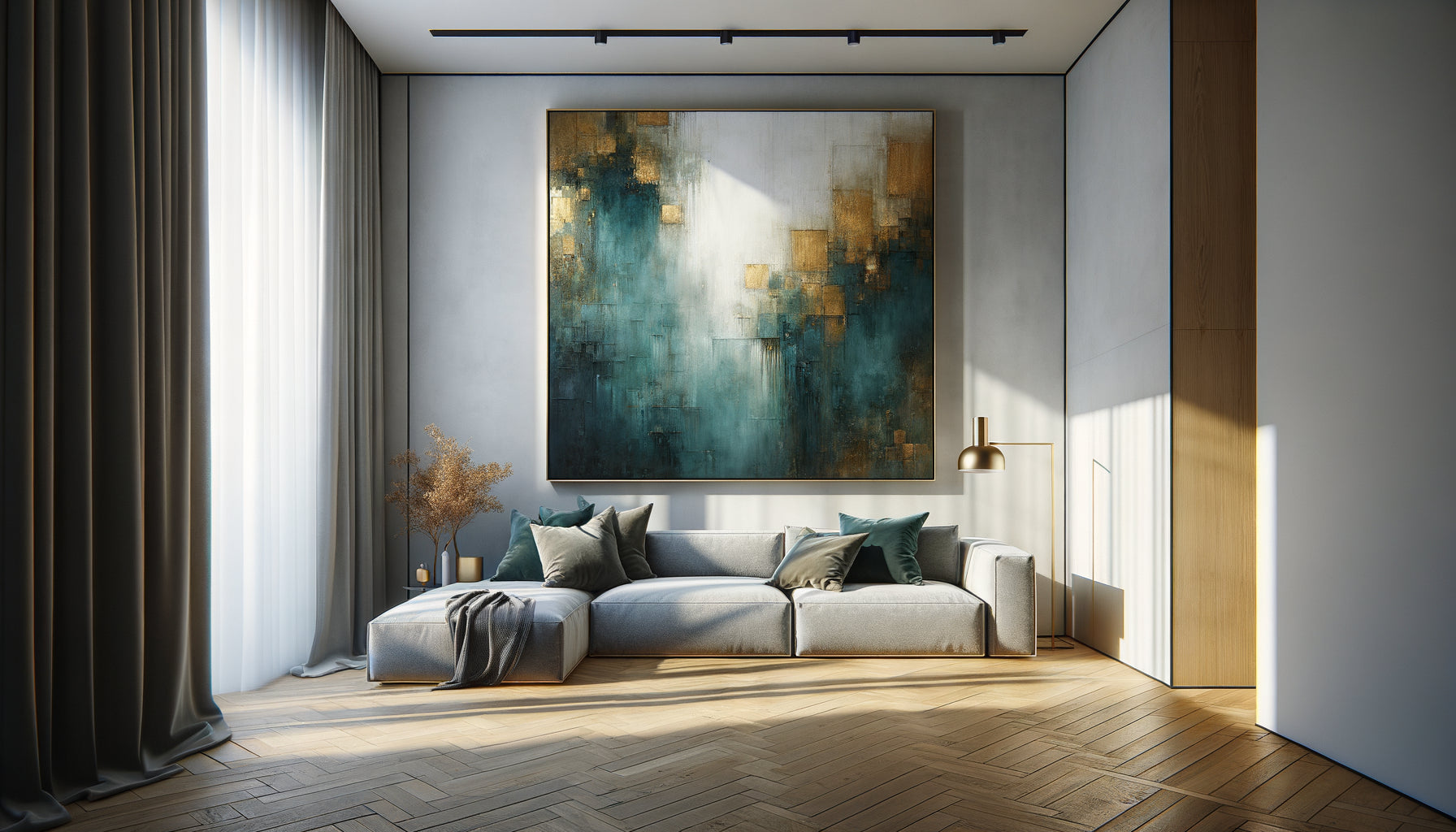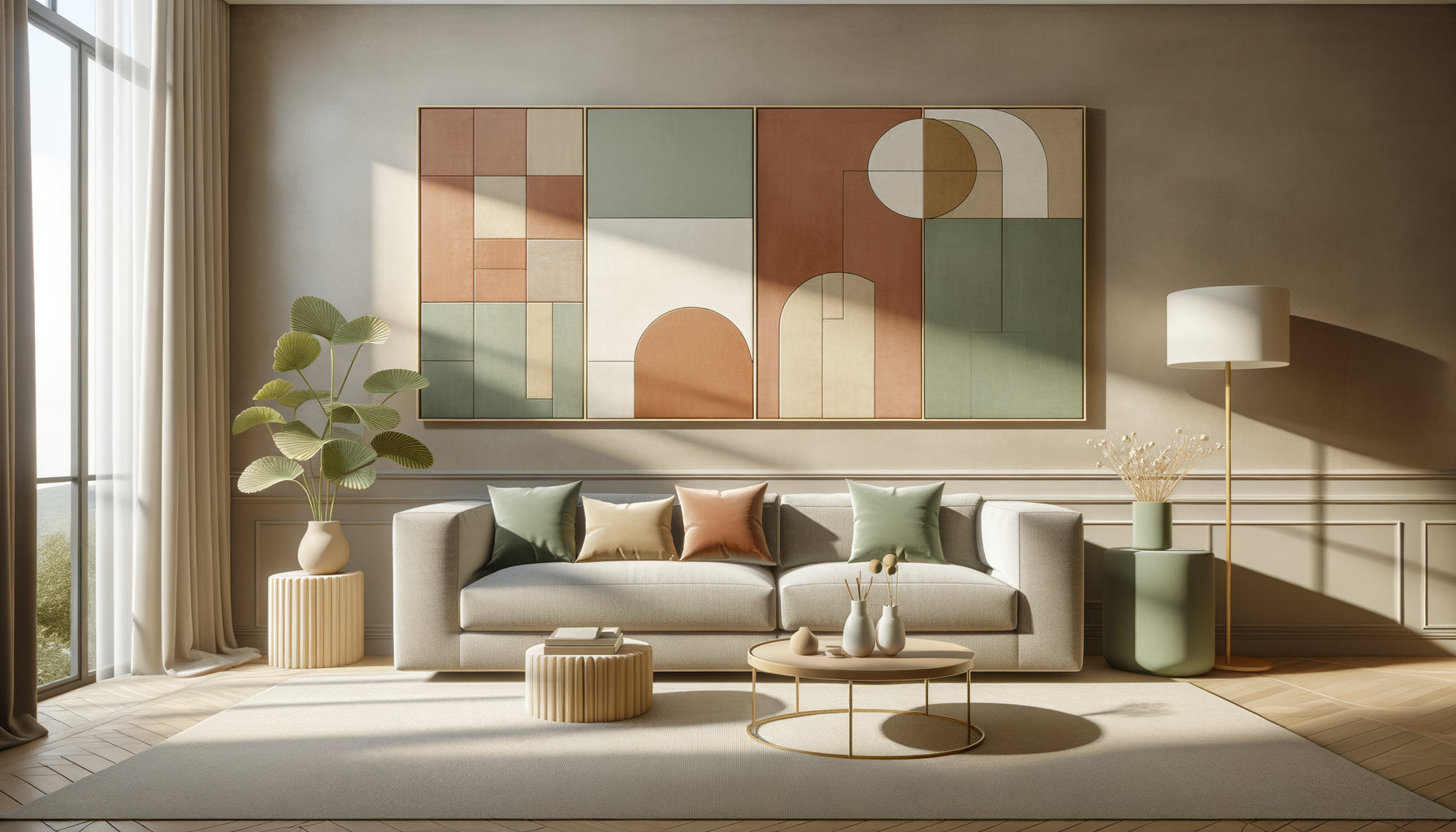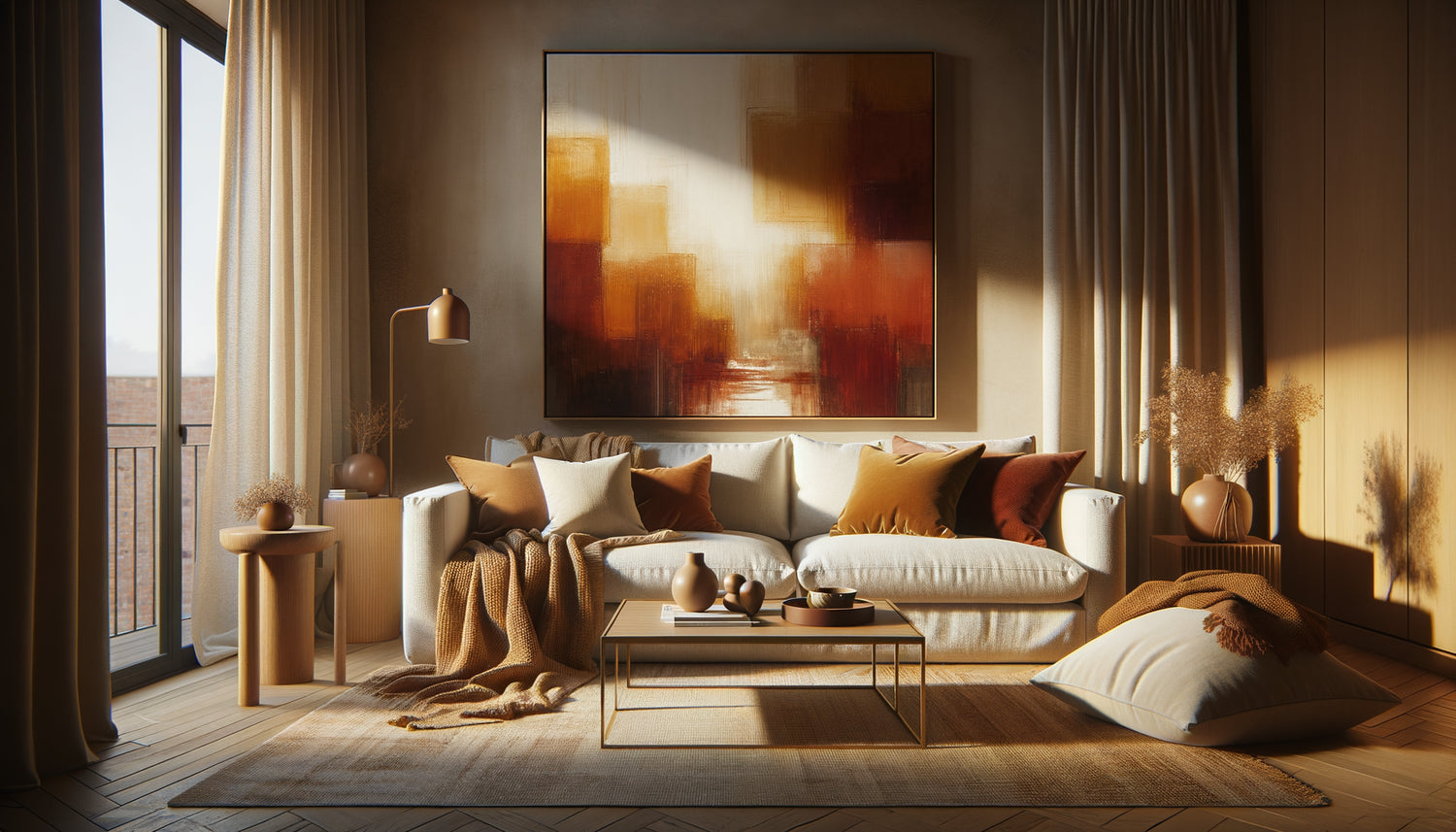
That evening, while visiting a client's apartment in the Marais, I understood why her perfectly arranged living room felt cold. The velvet furniture was there, as were the fluffy throws, but the white walls sucked all the warmth out of the room. A painting, just one, changed everything. In fifteen minutes, her living room went from an impersonal showroom to a welcoming cocoon.
Here's what a well-chosen painting brings to a cozy living room: it creates a warm focal point that dialogues with your textiles, it infuses your space with soul by revealing your personality, and it transforms natural light into an enveloping atmosphere. Yet, faced with the thousands of works available, many give up or impulsively buy a canvas that no longer speaks to them after three months. I regularly see these mistakes during my interventions: unsuitable formats, colors that break harmony, subjects that contradict the desired atmosphere. The good news? Choosing a painting for a cozy living room follows a simple logic that has guided my projects for eight years.
The alchemy of warm colors: the secret to a welcoming living room
In a cozy living room, colors work like an invisible fireplace. Terracotta, ochre, rust, burgundy or mustard shades generate that feeling of warmth you are looking for. When I select a painting for a living room, I first observe the temperature of the room: beige, gray or white dominant? It calls for works with warm tones to create the saving contrast.
An abstract painting with orange hues dialogues beautifully with natural linen cushions. An autumnal scene with its golds and browns extends the effect of a cognac sofa. Even if you like minimalist interiors, a painting with warm colors becomes that emotional anchor that prevents minimalism from tipping into coldness.
However, be careful about balance. A completely bright red painting in a living room already saturated with color will create a visual agitation contrary to the cozy atmosphere. I prefer works where warm colors blend with neutrals: a sunset with its gray-blues, an abstract composition where ochre melts into rose beige. This nuance brings sophistication and serenity.
The power of earthy and natural tones
Paintings in the ranges of burnt Sienna, raw umber or warm sand possess this rare ability to instantly soothe. They evoke organic materials: clay, patinated wood, stone heated by the sun. In my projects, I often combine these paintings with natural tones with furniture made from raw materials – rattan, solid oak, washed linen – to create a sensory coherence that literally envelops the occupants.
The subjects that tell an intimate story
A warm living room breathes with lived-in life. Works that are too conceptual or cold create an intellectual distance that kills the cozy feel. Favor subjects evocative of intimacy: a steaming cup, stacked books, an armchair abandoned near a window, a sleeping cat, dried flowers in a vase.
Familiar landscapes work wonderfully: a misty forest reminiscent of autumn walks, a cobbled street in the rain, lavender fields at dusk. These scenes activate emotional memory and generate that reassuring feeling of déjà vu. In a recent project, I installed a painting depicting a snow-covered country house in the living room of an urban couple: they confided to me that every glance at this canvas brought them immediate peace.
Organic abstracts – those compositions with soft shapes, without aggressive angles, evoking clouds, waves or drapes – also create this enveloping atmosphere. Unlike strict geometries which structure the space, fluid forms soften it, perfect for a cozy and warm living room.
Avoid subjects that cool the atmosphere
Some themes, however beautiful they may be, sabotage the cozy feel. Glacial landscapes, black and white mineral still lifes, portraits with an intense gaze create a subtle tension. I reserve them for offices or entrances. To choose a painting intended for a warm living room, ask yourself: does this image invite me to settle down with tea and a book? If the answer hesitates, move on.

The perfect size for your sofa and walls
A painting that is too small on a large wall creates a void that dilutes the energy of the room. Too imposing, it overwhelms the space and generates anxiety. The rule I consistently apply: a painting above the sofa should cover between 50 and 75% of its width.
For a 200 cm sofa, aim for a canvas 100 to 150 cm wide. If you prefer a wall composition, the entire set of frames must respect this proportion. The space between the back of the sofa and the bottom of the painting? Between 15 and 25 cm. Too low, we visually bump into it; too high, the painting floats without connection to the furniture.
On a side wall, play with varied heights to create rhythm, but maintain the optical center of the artworks at about 145-150 cm from the floor – the natural height of the gaze. In living rooms with high ceilings, I sometimes dare to use XXL vertical formats that create a majestic verticality while keeping warm tones to preserve the cozy feel.
The Panoramic Format Trick
Panoramic wall art (elongated horizontal format) has an extraordinary soothing power. They visually widen the space and invite the eye to travel slowly, creating that gentle contemplation characteristic of cozy living rooms. A sunset in a 150x50 cm format transforms a banal wall into a window on elsewhere.
Materials and textures: the visual touch that warms
A cozy living room wall art is not just an image printed. The material counts as much as the subject. Canvases with visible texture – thick brushstrokes, impasto, mixed media – create a physical presence that dialogues with your soft textiles.
I particularly like artworks on raw linen canvas whose irregular weave brings an artisanal authenticity. Natural wood frames (light oak, walnut, driftwood) extend this warm sensoriality. Avoid chrome or black metal frames that are too graphic and break the cozy atmosphere – reserve them for industrial interiors.
Mixed techniques incorporating organic elements (gold leaf, natural pigments, plant fibers) enrich the tactile dimension of the artwork. Even from a distance, the eye perceives this material complexity which adds depth to your cozy living room.

Secret lighting: reveal the warmth of your artwork
The most beautiful wall art for living room remains invisible without suitable lighting. I systematically install an accent light: adjustable LED spotlight at warm temperature (2700-3000K) or picture light that creates this welcoming halo in the evening.
Natural light also transforms your canvas throughout the day. A painting placed perpendicularly to a window captures changing reflections that animate the living room. Be careful with artworks facing bay windows: reflections can create annoying mirrors. I prefer matte canvases over glossy varnishes.
In dimly lit living rooms, opt for paintings with light backgrounds (beige, cream, off-white) crossed with warm touches. They capture and diffuse the slightest available light, acting as amplifiers of brightness while preserving a cozy atmosphere.
The time of day reveals everything
Before you buy, visualize your painting at different times. In the morning, orange tones explode with golden light. In the evening, deep reds gain intensity under artificial lighting. A painting that works in all lights generally has multiple chromatic layers – this is what makes it lively and never tiring.
Your living room deserves this final touch that transforms a room into a refuge.
Discover our exclusive collection of wall art for Living Room that instantly warms up your interior with creations designed for coziness.
Create a visual coherence without falling into uniformity
Your painting should converse with your existing decor without repeating it verbatim. If your sofa is terracotta, a painting entirely in this shade will create an oppressive monochromatic mass. Prefer a work that picks up on this terracotta as a secondary note, accompanied by sage green or blush beige.
I apply the rule of three colors: your painting ideally contains a dominant color present in your textiles, a secondary color that dialogues with your woods or walls, and an accent color that brings surprise. This triangulation creates a sophisticated harmony characteristic of successful warm living rooms.
Harmonious mismatched collections work wonderfully: three small paintings of different styles but sharing a warm palette create an intimate gallery wall. Vary the formats (a square, a vertical, a horizontal) to generate visual rhythm while maintaining chromatic cohesion.
Visualize your living room transformed
Imagine your return home tonight. You push the door open, your gaze naturally falls on that warm artwork that captures the last light of day. Its amber tones dialogue with the blanket you'll soon reach for. This work is not just a decorative object hung out of obligation – it has become the emotional heart of your cozy living room, that visual anchor that tells you: here, you are home, you can breathe.
Choosing an artwork for a cozy living room starts with a simple question: what emotion do you want to feel when looking at it? Answer honestly, then let this answer guide your selection. Dimensions, colors and subjects will naturally follow. And if a painting makes you hesitate, ask yourself if it makes you want to settle into your sofa with a book. This is the ultimate test of successful coziness.
Frequently Asked Questions about Choosing an Artwork for a Cozy Living Room
Should you prefer an abstract or figurative painting for a cozy living room?
Both work perfectly if you respect the codes of coziness: warm colors and soft shapes. An abstract artwork in terracotta tones with organic forms creates a universal enveloping atmosphere, ideal if you change your decor regularly. A evocative figurative – autumnal landscape, intimate scene, soothing nature – tells a story that enriches the atmosphere. My recommendation? Observe your current living room. If it already contains many figurative objects (photos, plants, trinkets), an abstract painting brings breathing space. If your walls are very clean, a figurative painting adds that warm narrative. The essential thing is the emotion the work generates: do you feel soothed and welcomed when looking at it? If so, you have found your artwork, whatever its style.
What is the best height to hang a painting above the sofa?
The professional rule I consistently apply: leave between 15 and 25 cm between the top of your sofa's backrest and the bottom of the artwork. This distance creates a harmonious visual connection without giving the impression that the artwork overwhelms the furniture. If you space it further (30-40 cm), the artwork seems to float without any connection to your seating, breaking the unity of your wall composition. Too close (less than 10 cm), you create an uncomfortable visual collision. Regarding absolute height, the optical center of the artwork should be approximately 145-150 cm from the floor – the natural height of the gaze when standing. But this rule is adjusted according to your sofa: with a low Scandinavian model, you can descend slightly; with a high traditional sofa, raise it by a few centimeters. Step back, observe from the entrance of the living room, and trust your feelings: the whole should form a coherent and soothing block.
Can multiple artworks be mixed in a cozy living room without losing harmony?
Absolutely, provided you respect a chromatic or thematic guideline. In my projects of warm living rooms, I often create gallery walls by mixing formats and styles, but I maintain a consistent palette of warm colors: terracotta, ocher, beige rose, olive green. This color unity allows you to mix a landscape, an abstract work and a photograph without creating visual cacophony. The trick: arrange your artworks on the floor before drilling holes in the walls, photograph different compositions, and choose the one that breathes best. Maintain regular spacing (7-10 cm between each frame) to structure the whole. If you are just starting out and fear making a mistake, start with two artworks of different sizes sharing a dominant color – this configuration offers dynamism and security. The cozy atmosphere is nourished by this controlled accumulation that tells your personal story, provided that each element contributes to the warm atmosphere rather than visual dispersion.