The first time I transformed a organic restaurant by integrating food wall art, the owner looked at me with skepticism. 'Vegetables on the walls? Really?' Three months later, his reservations had soared 40%. Customers photographed these vibrant works, shared them, and returned. Because that's the magic: food art tells the story of your kitchen before the plate even arrives.
Here’s what food-themed wall art brings to your organic restaurant: it creates an immediate visual consistency with your values, transforms waiting into a contemplative experience, and deeply anchors your identity in the minds of your guests. You don't need to explain your approach: your walls speak for you.
The challenge? Too many organic restaurateurs fall into two traps: dated countryside clichés or cold abstraction that disconnects. The result: walls that tell nothing, evoke no emotion. A neutral space in a sector where authenticity is your greatest asset.
Good news: food art isn't just a decor trend. It’s a powerful visual language, capable of translating your commitment, culinary creativity, and respect for life. And contrary to popular belief, it’s not limited to Victorian botanical reproductions.
In this article, you will discover how to choose food wall art that amplifies the soul of your organic restaurant, creates memorable emotions, and transforms each wall into a silent ambassador of your philosophy.
Contemporary botanical art: when science meets the plate
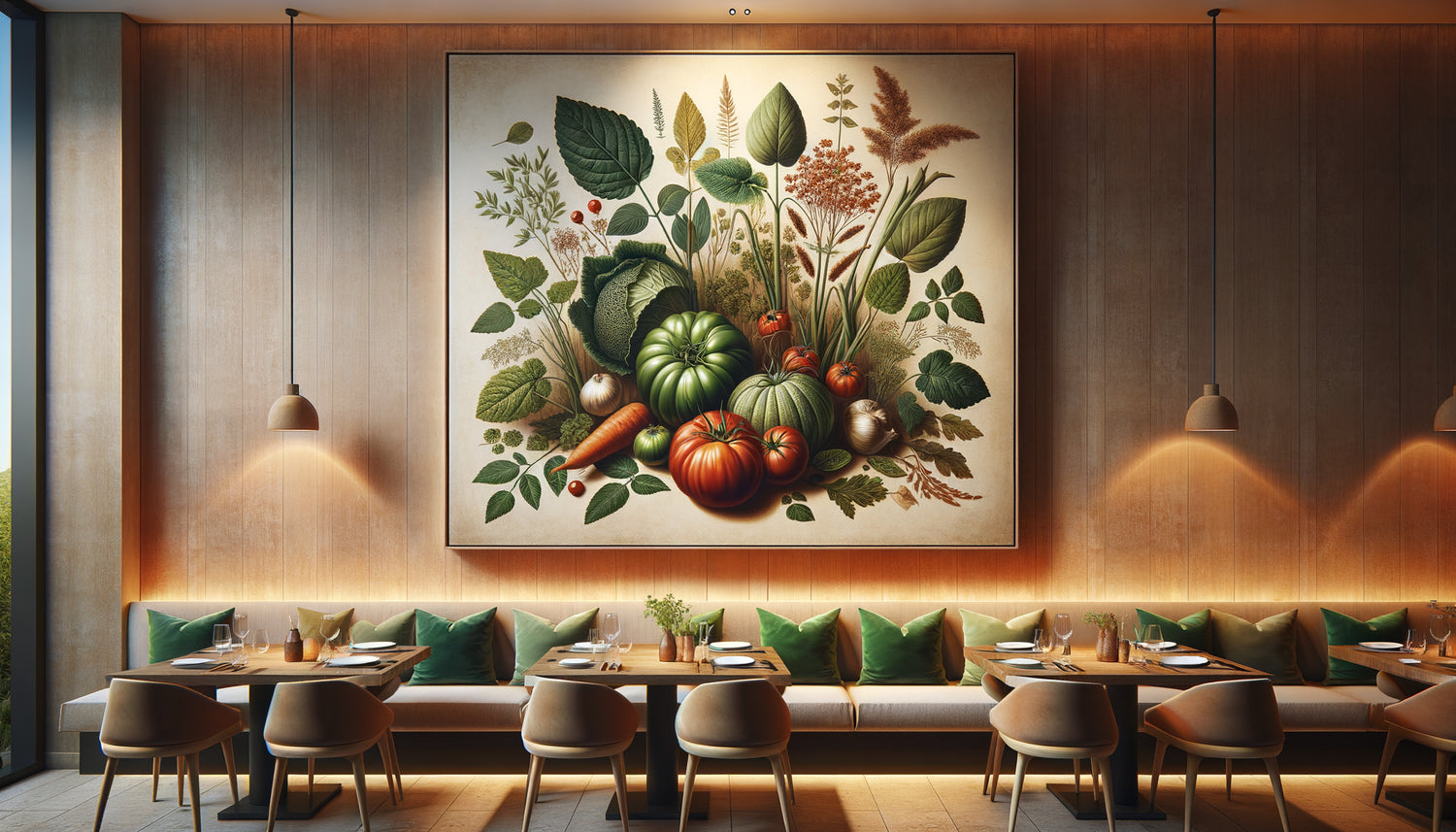
Modern botanical illustrations have this rare ability to combine scientific precision with refined aesthetics. Imagine an ancient tomato drawn with the meticulousness of a 19th-century herbarium, but enhanced with vibrant colors and printed on an XXL format. This type of wall art instantly creates a bridge between nature and gastronomy.
I recently accompanied a vegetarian restaurant that was hesitating between different styles. We opted for a series of three wall murals representing root vegetables: beets, multicolored carrots, black radishes. The result? A gallery wall celebrating the raw beauty of seasonal ingredients. Customers immediately understand that here, we honor the product.
What works particularly well in an organic restaurant: botanical charts of aromatic plants. Basil, thyme, rosemary, coriander... These food wall murals evoke gardens, markets, and the care taken in each preparation. Arranged in a vertical or horizontal series, they structure the space while telling an olfactory story.
Prioritize formats and tones
For botanical art, opt for medium to large formats (minimum 50x70 cm). Details are lost on small formats. As for the palette: prioritize light backgrounds (off-white, beige linen) that allow the motifs to breathe and amplify natural brightness – essential in an organic restaurant.
Market compositions: celebrating local abundance
There's something deeply comforting about contemporary still lifes. Not the dusty versions in museums, no. I’m talking about those food wall art pieces where seasonal fruits and vegetables are piled high, photographed or painted with an almost theatrical light.
A neighborhood organic restaurant that I advised installed a huge painting depicting a basket overflowing with local produce: pumpkins, chestnuts, heirloom apples, walnuts. The effect? Regulars recognize the stalls of the nearby market. This emotional connection transforms your decoration into a territorial narrative.
High-resolution photographic compositions work wonderfully well in modern spaces. A macro shot of an organic strawberry covered in dew, enlarged to 120x80 cm, becomes a sensory artwork. You can almost smell the fragrance, feel the texture. These wall art pieces create a gustatory anticipation – a not insignificant commercial asset.
For organic restaurants focused on fresh juices and smoothies, consider cut citrus paintings: the geometric architecture of a lemon, the explosion of color of a pink grapefruit. These food motifs bring dynamism and freshness, particularly suitable for breakfast or brunch spaces.

Plant minimalism: saying more with less
Counterintuitive but terribly effective: minimalist food wall art. A single vegetable, centered, on a plain background. A carrot. An eggplant. An artichoke. Nothing else. This radical simplicity creates an effect of sanctifying the product.
I saw this approach transform a small organic restaurant stuck in a narrow space. Rather than overloading, we installed three large monochrome paintings: a mushroom, a radish, a fig. Black and white. The result? An unexpected sophistication, almost museum-like, which immediately elevates the perception of the cuisine.
Line drawings – those single continuous line drawings forming a fruit or vegetable – are particularly suitable for contemporary organic restaurants. They evoke simplicity, essentials, the unadulterated. Exactly the values you seek to communicate.
The art of strategic placement
These minimalist wall artworks work beautifully in odd numbers (3, 5, 7) arranged in a row. For maximum impact, install them at eye level when seated – between 120 and 140 cm from the floor. Your guests contemplate them throughout their experience.
Vintage patterns: nostalgia and authenticity
Retro advertising posters for food products possess a timeless charm. These wall artworks with typographies from the 1930s-50s, celebrating artisanal canned goods, exotic fruits or vegetables from the garden, create a warm and reassuring atmosphere.
A recent family bio restaurant bet on this direction with reproductions of old seed labels. These vintage food artworks tell a story of transmission, know-how, peasant patience. They anchor the restaurant in a valorizing historical continuity.
However, be careful: vintage can veer into kitsch. The key? Select wall artworks with desaturated colors and favor geometric or typographic motifs rather than overly figurative illustrations. A subtle balance between nostalgia and modernity.
Old botanical catalogs – these educational charts that were found in schools – are also excellent artworks for bio restaurants. Their educational dimension resonates with your approach of transparency and food awareness.

Organic abstractions: when food becomes texture
Here's an approach that many neglect: abstract artworks inspired by food patterns. No literal representation, but shapes, colors, textures that evoke the vegetable without naming it.
Think of cross-sections of vegetables: the spiral of a Romanesco cabbage, the concentric circles of an onion, the honeycomb structure of a squash. Enlarged and stylized, these compositions become almost hypnotic works. These wall artworks are perfect for design and minimalist bio restaurants.
I recently used a series of artworks reproducing stains of beetroot juice, turmeric, spinach. Abstract? Yes. Powerful? Absolutely. These sublimated food motifs elevate your restaurant to the rank of gallery, while remaining faithful to your culinary identity.
Macrophotographs of seeds – lentils, quinoa, chia, sesame – also offer fascinating graphic compositions. Their repetitive textures create an almost meditative effect, particularly suitable for wellness spaces or bio restaurants focused on conscious nutrition.
Compose your gallery wall: the art of harmony
A single artwork makes an impact. But a cohesive gallery wall transforms your organic restaurant into an immersive universe. The question is no longer 'which painting?' but 'what story do you want to tell on this wall?'
For a balanced gallery, respect the rule of triple guideline: same color palette (maximum three shades), same artistic style (botanical OR minimalist OR vintage, not all three), and variation in sizes (one large + two medium + three small works better than six identical formats).
Food wall artworks gain impact when they dialogue with your menu. If you specialize in organic Mediterranean cuisine, opt for motifs of olives, tomatoes, aromatic herbs. For a Nordic organic restaurant: berries, mushrooms, root vegetables. This semantic consistency powerfully anchors your identity.
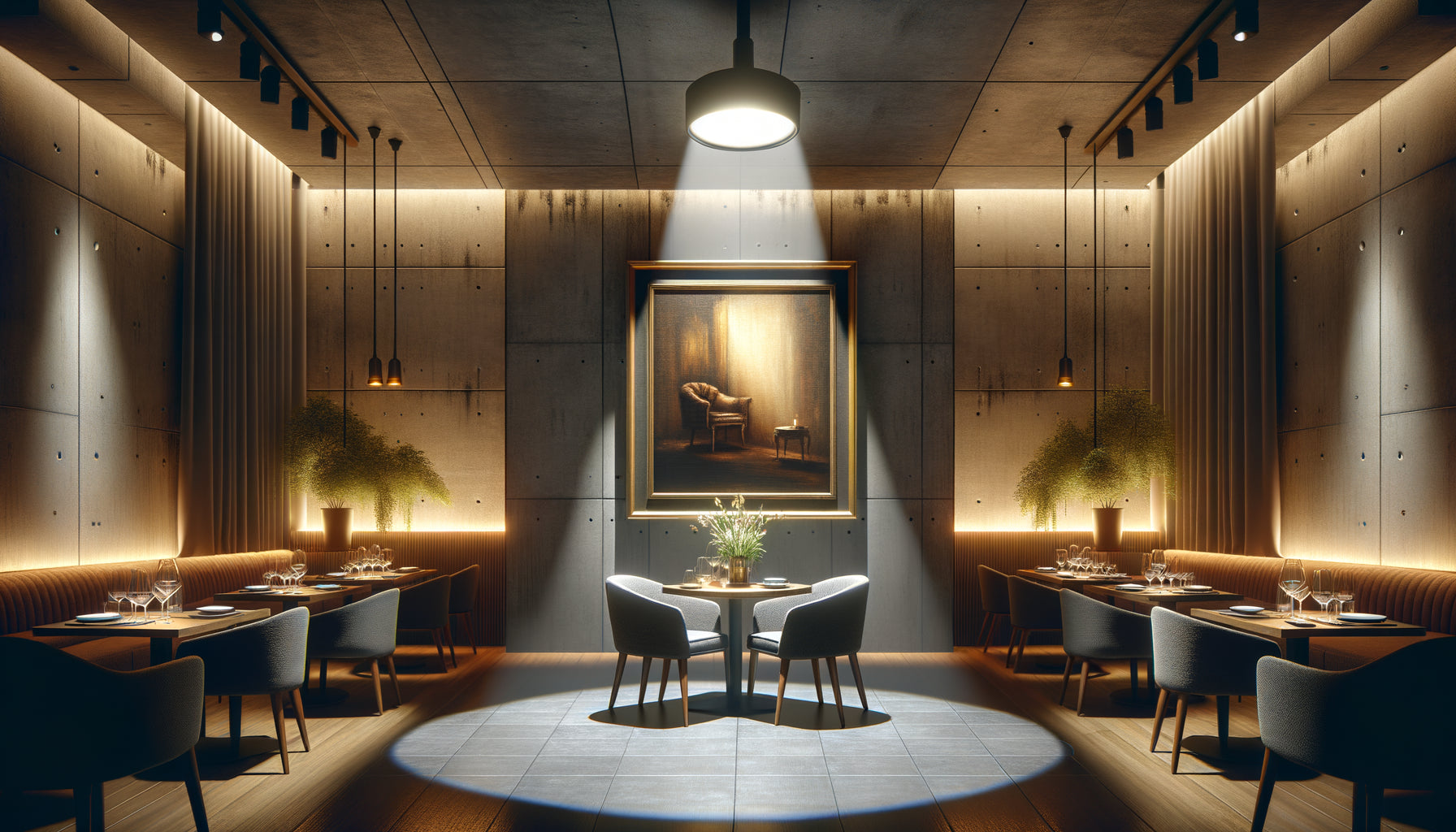
Don't forget the lighting: these artworks deserve to be enhanced. Adjustable spotlights or wall sconces create shadow games that enrich the visual experience, especially in the evening when the atmosphere becomes more intimate.
Transform your walls into a gastronomic manifesto
Discover our exclusive collection of wall art for Restaurant that celebrates the authenticity of life and enhances your organic commitment.
Create a memorable experience, one wall at a time
Your food wall artworks don't just decorate your organic restaurant. They create contemplative pauses between bites, conversation topics among guests, Instagram moments that extend your visibility far beyond your four walls.
Choose works that truly resemble you. Not what 'looks like an organic restaurant', but what expresses your uniqueness. That heirloom tomato you serve in your signature salad? Why not make it the hero of a monumental painting? That local producer you are proud of? Order a custom artwork celebrating his crops.
Start with one wall, the most visible from the entrance. Test, observe reactions. Then gradually complete. Your food artworks will evolve with your restaurant, creating a visual story that grows with you.
Wall art is never an expense, it's an investment in the customer experience. In this world saturated with solicitations, offering a moment of sincere beauty – a carrot sublimated into a work of art – is to create irreplaceable emotional value. And that’s exactly what transforms an ordinary meal into a memorable souvenir.
FAQ: Your questions about food wall artworks
How many food wall art pieces should you install in a 50m² organic restaurant?
For a 50m² space, aim for 3 to 5 artworks maximum. The classic mistake? Overloading. It's better to have two impactful large artworks than ten small ones that create visual noise. Think 'gallery', not 'antique shop'. Distribute them strategically: one large format (100x80 cm) on the main wall visible from the entrance, then medium formats (50x70 cm) in the dining area. Respect the rule of spacing: at least 15-20 cm between each artwork. In an organic restaurant, empty space is part of the aesthetic – it evokes breathing, naturalness, and unclutteredness. If your ceiling is low (less than 2m50), prioritize horizontal formats that visually widen the space rather than vertical ones that crush it.
Do food-themed artworks work in all styles of organic restaurants?
Absolutely, but the approach differs depending on your positioning. A gourmet organic restaurant will prefer minimalist wall art or artistic black and white photographs – think elegance, simplicity. A family-friendly organic bistro will opt for colorful compositions, generous still lifes that evoke conviviality and abundance. A modern vegetarian organic restaurant can dare to use organic abstraction, surprising macro photography. The key? Total consistency between your food artworks, your furniture, and your tableware. If you serve in artisanal ceramics on rustic wooden tables, vintage botanical illustrations will work perfectly. If your aesthetic is contemporary with metal and polished concrete, opt for graphic and minimalist wall art. Style matters less than the overall coherence of the experience.
How to maintain wall art in the humid environment of a restaurant?
Crucial question often overlooked. Wall art in a restaurant is exposed to humidity, temperature variations, and potential splashes. Three professional solutions: opt for prints on aluminum or plexiglass rather than canvas – they are more resistant and can be cleaned with a sponge. If you choose food-related canvases, require a UV varnish protection that protects them from humidity and facilitates maintenance. Finally, strategic positioning: never directly above server traffic areas, at least 2 meters away from open kitchens, and avoid walls exposed to direct sunlight (color fading guaranteed in 6 months). For regular maintenance: monthly dusting with a dry microfiber cloth, quarterly cleaning with a non-abrasive specific product. Maintenance budget? Almost zero if well protected initially. A quality artwork in a well-managed restaurant retains its brilliance for at least 10 years.