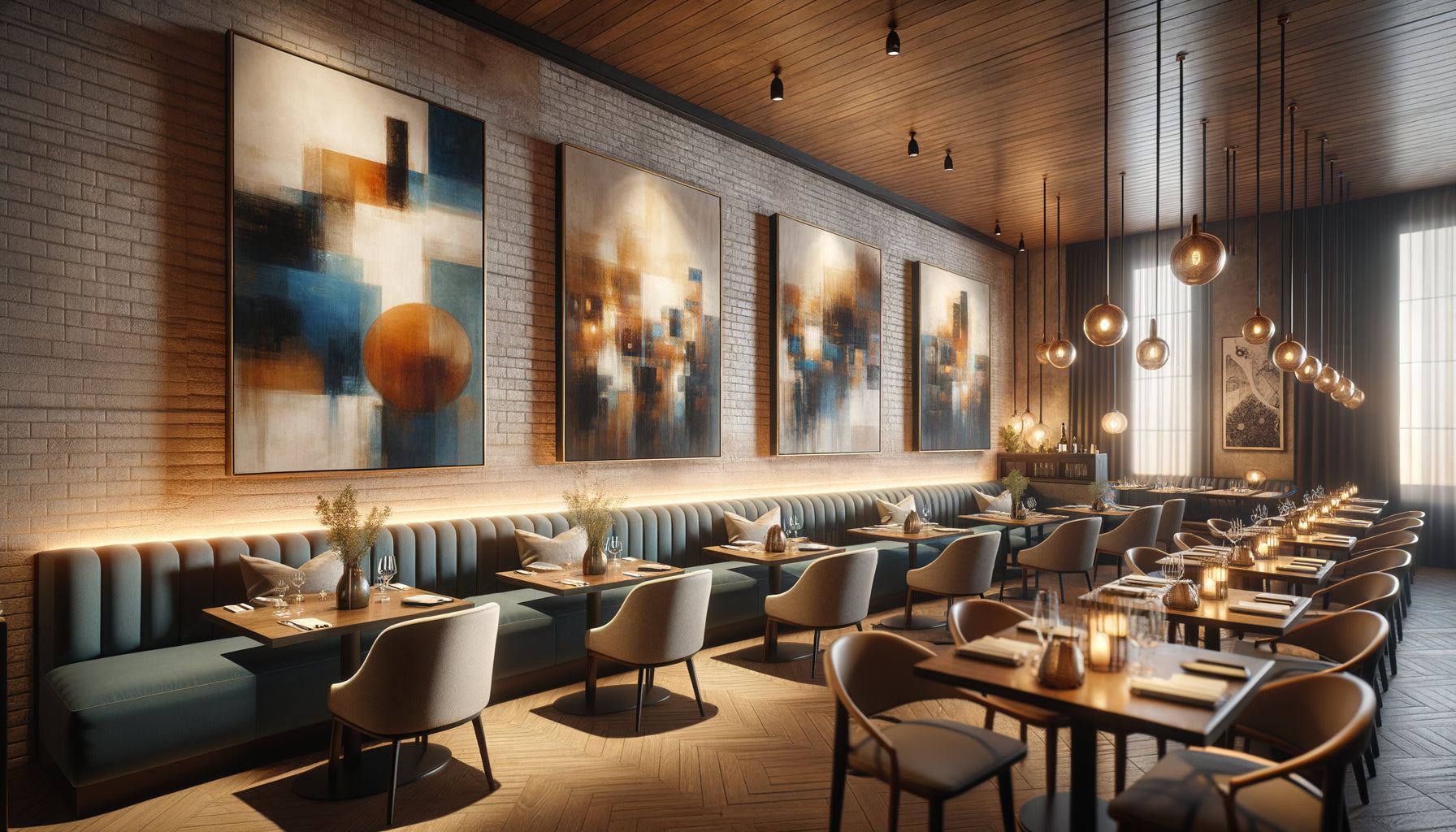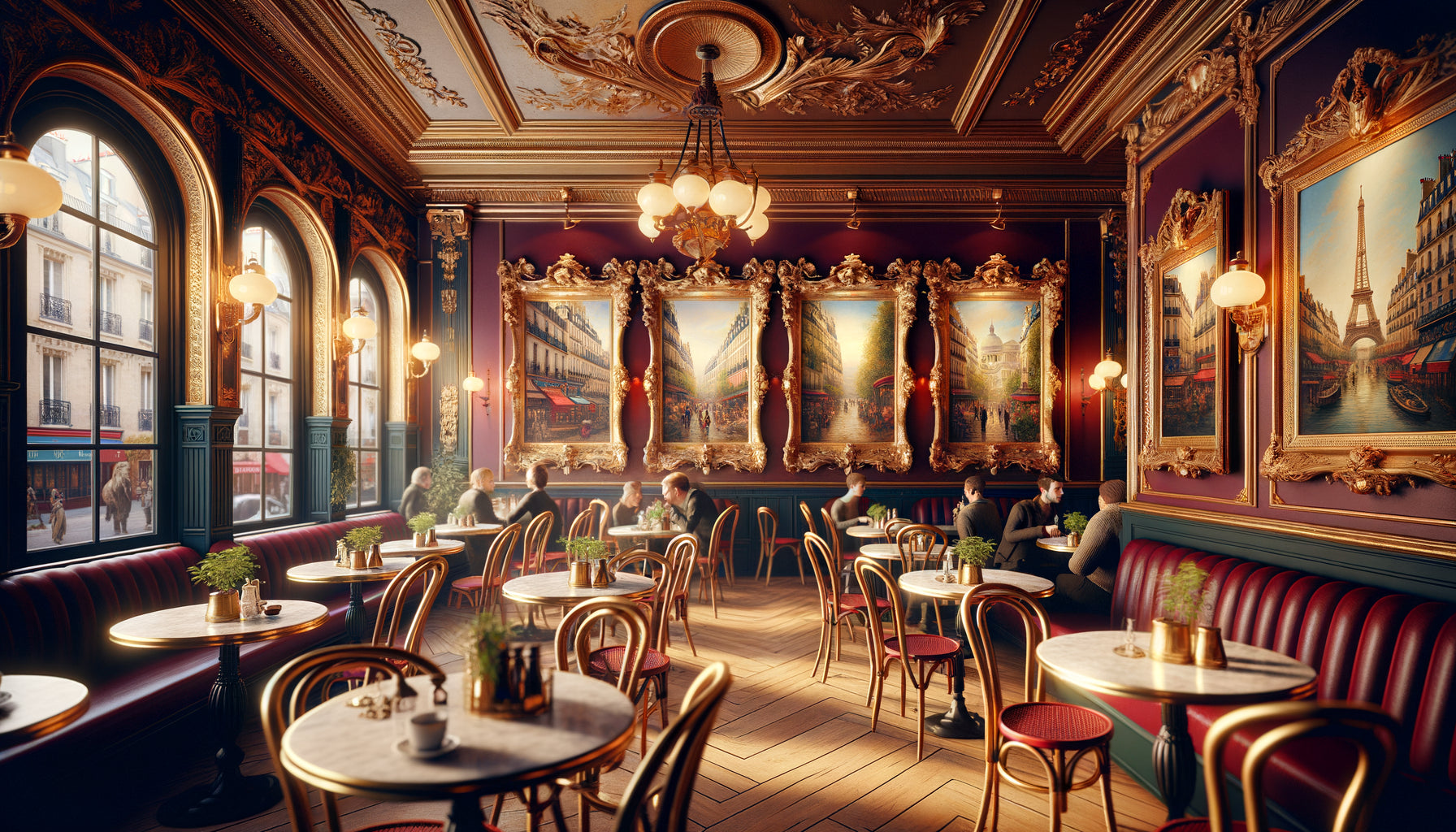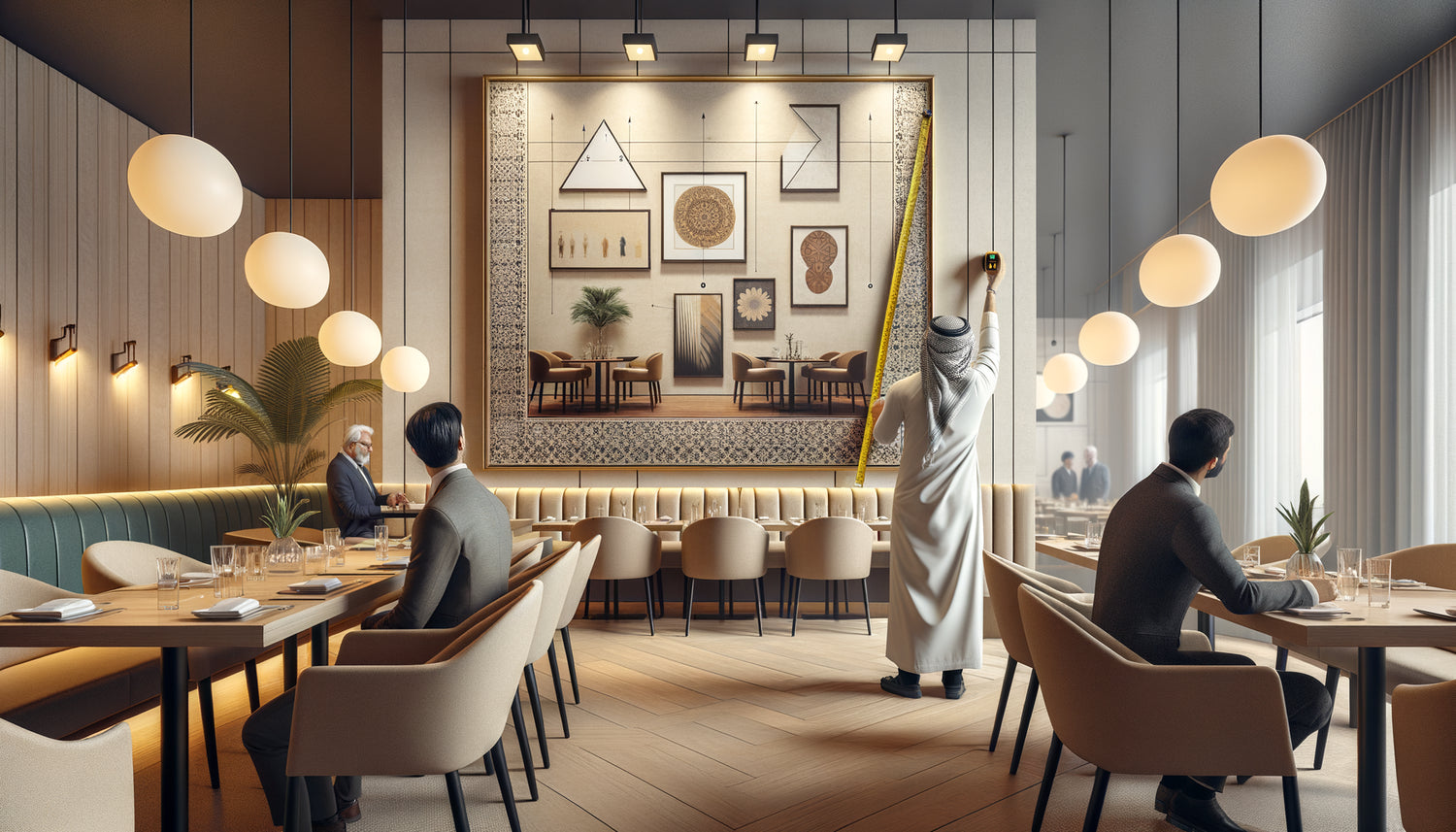
I spent twelve years designing the visual identity of Michelin-starred restaurants and family bistros, and I can tell you that a poorly hung painting sabotages the ambiance of a dining room in seconds. Too high, it floats like a forgotten decorative element. Too low, it creates an unconscious tension that disrupts appetite. The hanging height of paintings in a restaurant is not a question of arbitrary centimeters: it's a visual choreography that dialogues with your seated, standing, and moving guests.
Here’s what the right hanging height brings: a visual harmony that extends the pleasure of tasting, a spatial consistency that naturally guides the eye, and an enhancement of your identity that transforms each wall into an aesthetic signature.
Yet, most restaurateurs hang their works at the standard gallery art height – 1.60 m in the center – without considering that 80% of their customers will view them while seated. The result? Paintings that seem suspended in emptiness, disconnected from the dining experience. This error creates a subtle but persistent imbalance that your guests feel without being able to name it.
Rest assured: with a few proven principles and an understanding of eye lines, you can transform your walls into natural extensions of your culinary offering. I will guide you through the rules that really work in the world of restaurants, far from generic formulas.
The 57-inch rule doesn't apply to your dining room
Museums and galleries place the center of artworks at 145 cm (57 inches) from the floor because their visitors are walking around standing up. In a restaurant, your guests are seated 90% of the time, and their eye line is between 110 and 130 cm from the floor depending on the height of the chairs and banquettes.
I have measured hundreds of configurations: the center of a painting should be located between 120 and 140 cm from the floor to naturally dialogue with the seated gaze. This range is adjusted according to the height of your seating and the size of your artworks.
For large-format paintings (more than 100 cm in height), lower them slightly: their center can drop to 115 cm without problems. Conversely, small formats (30-40 cm) can be mounted at 145 cm, especially if they are grouped into a wall composition.
Adjust the height according to the areas of your restaurant
Each space in your establishment generates different flows and postures. The hanging of wall paintings must adapt to these micro-zones to create a global consistency.
Table area: prioritize seated visual comfort
In table areas, aim for 125-135 cm in the center for main works. This height allows guests to naturally lift their eyes between bites without neck tension. I have found that this position creates a welcome visual breathing space during the meal.
If you use low sofas (seat height of 40 cm), go down to 120 cm. For high counter stools (seat height of 70 cm), increase up to 145 cm. The ideal hanging height always follows the natural line of sight.
Corridors and passageways: think standing
In entrances, hallways leading to restrooms, or waiting areas, your customers are standing or moving. Here, you can increase to 140-150 cm in the center, approaching museum standards. These artworks capture attention during movement and create points of curiosity.
Walls adjacent to the bar: play it versatile
The bar mixes customers sitting on high stools and servers standing. Opt for 135-145 cm, a median height that works for everyone. Wall art in restaurants located behind the bar often becomes a conversation starter: make sure they are visible from the surrounding tables as well.

How to measure precisely before drilling
The theory is clear, but practice requires method. Here's my foolproof protocol for determining the exact hanging height, tested in more than sixty establishments.
Step 1: Measure the total height of your artwork (frame included). Divide by two to find the center point. If your piece is 80 cm high, its center is located 40 cm from the bottom edge.
Step 2: Sit at a table representative of your dining room. Ask someone to hold the artwork against the wall and move it vertically. Note the height at which your gaze naturally meets the center of the work – this is your personalized reference.
Step 3: Measure the distance between the top of your frame and the hanging system (hook or stretched wire). Subtract this distance from the target center height, then add half the height of the artwork. Example: for a center at 130 cm, an 80 cm artwork, and a hook 5 cm from the top → 130 - 40 + 5 = 95 cm from the floor to the wall hook.
Step 4: Use repositionable adhesive tape to simulate the location for 24-48 hours. Observe the artwork during service hours, with natural and artificial lighting. This on-site validation avoids 90% of hanging errors.
The fatal error: neglecting the overall composition
A single painting obeys a logic. A composition of several wall artworks creates another, more complex one. I've seen too many walls where each piece was correctly positioned individually, but the whole created visual chaos.
For a gallery wall (several paintings grouped together), first determine the center of gravity of the ensemble. Imagine a virtual rectangle that encompasses all your artworks: it is the center of THIS rectangle that must be located at 125-135 cm, not the center of each painting.
Always start by hanging the central or largest piece, then build around it while maintaining regular spacing (8-12 cm between frames). Paintings in restaurants benefit from being grouped thematically, color palette, or style to create a consistent visual narrative.
For a horizontal alignment of 3-4 paintings of different sizes, align their LOWER edges rather than their centers. This technique, used in large Parisian restaurants, creates a stable baseline that visually anchors the composition.

When architecture imposes its constraints
The rules adapt to architectural realities. Baseboards, moldings, radiators, electrical outlets: your ideal hanging height must sometimes negotiate with these obstacles.
With wainscoting or baseboards (generally at 90-110 cm), position the bottom of your frame 15-20 cm above the upper molding. This automatically places the center between 120-140 cm depending on the size of the artwork – exactly our target range.
Under high moldings or cornices (at 220-250 cm), lower your paintings slightly to avoid the effect of a “lost work in the void.” A large format can occupy the space between 100 and 200 cm without problem, creating a strong presence that structures the wall.
On narrow walls between windows, center vertically relative to the available space rather than relative to the floor. The eye seeks balance within the immediate architectural framework. If this moves you too far from the ideal height, prioritize a smaller format.
Lighting reveals or sabotages your hanging
I've seen wall artworks perfectly positioned become invisible due to unsuitable lighting. Height and light form an inseparable duo in a restaurant.”
If you are using adjustable spotlights, aim for a 30° angle from a point located 40-50 cm above the center of the artwork. This angle avoids reflections on the glass or varnish while creating a subtle modeling effect. For a painting hung at 130 cm (center), position your spotlight at 170-180 cm in height.
Ambient natural lighting also influences perception. A painting facing a window will appear darker and require additional lighting. Conversely, a work directly under a skylight can be hung slightly higher (up to 145 cm) as the downward light naturally attracts the eye.
Paintings in dark areas (corners, recesses) benefit from being lowered by 5-10 cm compared to your standard: this psychologically compensates for the lack of brightness by bringing the work closer to the eye level.
Transform your walls into extensions of your culinary identity
Discover our exclusive collection of tableaux for Restaurant that naturally dialogue with the gastronomic experience and enhance every glance of your guests.
Test, adjust, observe: the empirical method
No formula replaces on-site observation. Determining the ideal hanging height is as much about sensitivity as it is about measurement. For one week after installation, note your impressions at different times: midday service with natural light, dinner under artificial lighting, morning cleaning with an empty room.
Also ask for feedback from your team. Servers, who are constantly moving around, notice if a painting disrupts traffic flow or captures too much attention to the detriment of the plate. Chefs, accustomed to the visual composition of dishes, often have a keen eye for spatial balance.
Don't hesitate to adjust by 5-10 cm after a few days. A painting in a restaurant is part of a living ecosystem: what works on paper may require a micro-adjustment once confronted with real flows, changing reflections, multiple viewing angles.
Photograph your room from different viewpoints – the entrance, the back of the room, a corner table. These images reveal invisible imbalances to the naked eye and validate (or invalidate) your hanging choices. It is a validation tool that I systematically use before opening.
Imagine your walls as a visual score
You now have the keys to hang your wall paintings at the height that transforms your restaurant into a memorable experience. Imagine your guests naturally looking up between courses, encountering a work that extends the gustatory emotion. Visualize the moment when a customer compliments not "the painting", but "the atmosphere" - proof that your hanging has achieved harmonious invisibility.
Start this week by reevaluating your centerpiece, the artwork everyone sees when they enter. Measure its current height, sit at the most representative table, and honestly ask yourself: "Does my gaze naturally meet the heart of this image?" If the answer hesitates, you now know what to do.
The beauty of restaurant hanging height, is that it's easily corrected: a few centimeters can sometimes be enough to switch from a discreet presence to a visual obviousness. And this obviousness, your guests will feel in their overall comfort, their desire to linger, their wish to return. Because a restaurant where people feel good visually is a restaurant where they eat better.
FAQ
Do I need to hang all my paintings at the exact same height?
No, and it's often a mistake. Perfect uniformity creates an unflattering visual rigidity. Aim for height consistency: keep centers within a range of 10-15 cm (for example between 125 and 140 cm) depending on the size of the artworks and their location. Large formats can be slightly lower, smaller ones a little higher. What matters is that the overall creates a fluid line of sight when you walk through the room. Think of a visual conversation rather than a military alignment. In the restaurants I design, I maintain a global harmony while allowing each zone to breathe according to its function and specific architecture.
How do I adjust the height if I have high banquettes and low chairs in the same room?
Excellent question that concerns many mixed restaurants. The solution is to zone your hanging rather than seek a shaky compromise. Near the high banquettes, raise your paintings to 135-145 cm (guests are sitting higher, their line of sight too). Near standard chairs, stay at 120-130 cm. The important thing is to create visual consistency by zone rather than by entire room. Use architectural elements (beams, partitions, variations in wall color) to naturally delineate these zones. Customers never notice these height variations if they logically correspond to their posture: they just feel that "everything is in its place." Perceived harmony takes precedence over measured uniformity.
Can I hang paintings above the banquettes where customers lean back?
Yes, it is even a prime location, but with one golden rule: <strong>leave at least 20-25 cm between the top of the bench and the bottom of the frame</strong>. This distance prevents heads from touching the artwork, hair from rubbing against the wall, and preserves visual breathing space. For a bench with a backrest that reaches 90 cm, position the bottom of your frame at a minimum of 115 cm. If your painting is 60 cm high, its center will be at 145 cm – perfect for being admired by seated guests facing it. Also pay attention to the type of fixing: prioritize well-anchored systems as these walls experience more vibrations (backs, movements). I have seen disasters with adhesive fixings in these areas with a lot of movement. A well-positioned painting above a bench becomes a strong visual signature that structures the space.