The scent of fresh basil, the melodious sound of Italian spoken between tables, the clinking of porcelain plates... A traditional Italian restaurant engages all senses. Yet, it's often the eye that seals the first impression. Bare or impersonally decorated walls instantly break the magic of La Dolce Vita. A well-chosen wall art transforms a simple dining space into a true sensory journey to the heart of the Italian peninsula.
Here's what an adapted style of artwork brings to your Italian restaurant: it anchors authenticity in every corner of your establishment, creates a warm atmosphere that extends the pleasure of taste, and builds a memorable visual identity that fosters customer loyalty. These wall artworks are not mere decorations; they tell the story that your dishes begin to write.
Too many restaurateurs invest fortunes in their kitchens and menus, only to neglect their walls. The result? A cold, generic atmosphere that could belong to any establishment. Your customers are looking for a complete experience, total immersion in Italian culture. Without visual consistency, even the best nonna's recipes lose some of their evocative power.
The good news? Choosing the right style of wall art for your traditional Italian restaurant doesn't require a degree in art history. It just takes understanding a few essential visual codes and letting your sensitivity to authentic Italy speak. In this article, I will guide you through the pictorial universes that will transform your walls into passports to Rome, Florence or Naples.
Tuscan landscapes: when the Italian countryside comes to the table
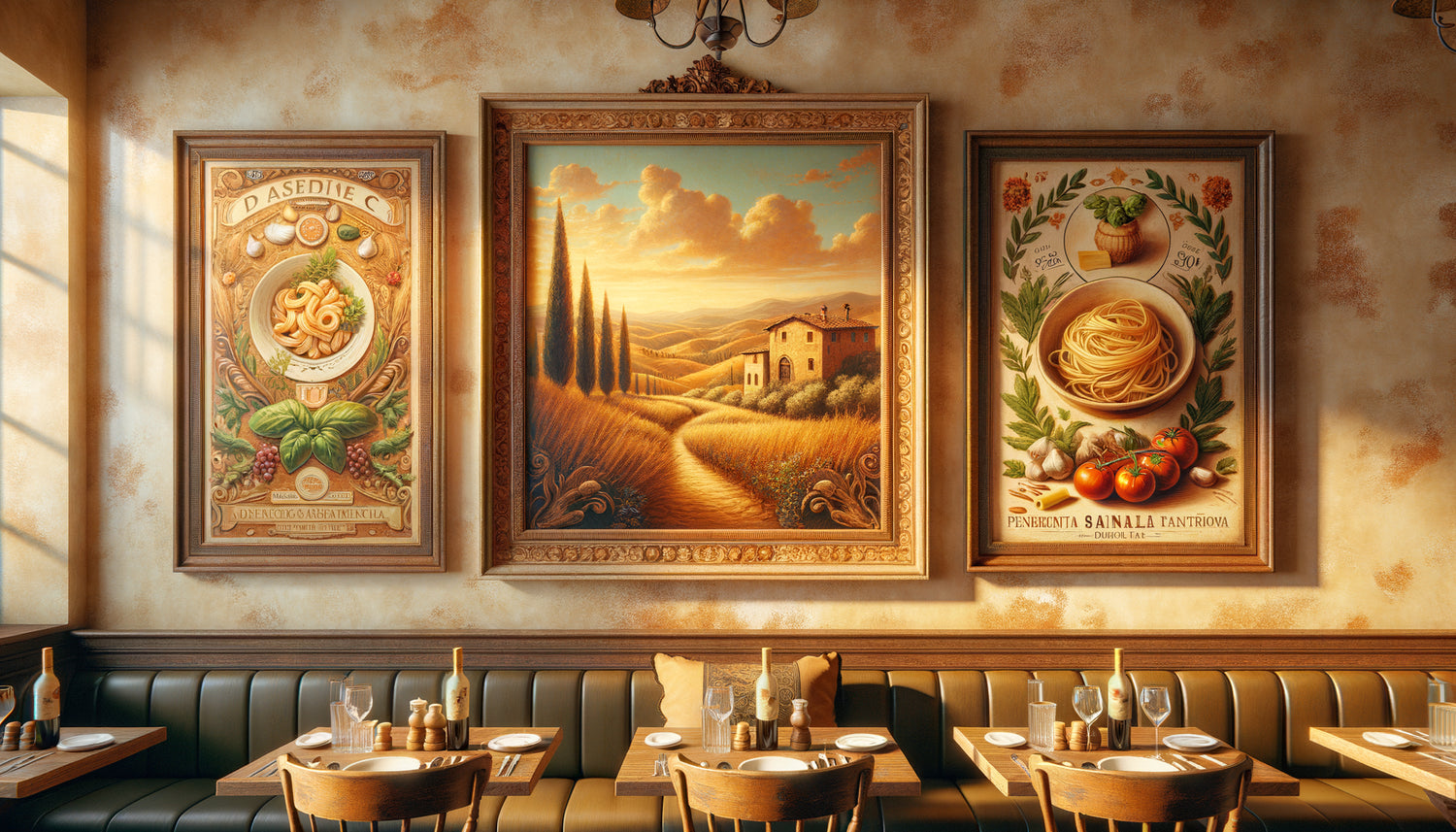
Imagine your guests seated at tables facing tomato pasta, their gaze lost in a painting depicting the golden hills of Tuscany. These works with warm tones – ochres, Siena earths, olive greens – immediately evoke authentic rural Italy. The cypresses lined up like sentinels, the sunflower fields, the stone farmhouses: these visual elements create a reassuring and gourmet atmosphere.
This style of wall art works particularly well in traditional Italian restaurants that showcase local products. If your menu celebrates Tuscan olive oil, Chianti wines or artisanal cured meats, these landscapes naturally reinforce your gastronomic message. They visually tell the origin of your ingredients.
To maximize the effect, opt for generous formats on the main walls. A large Tuscan landscape painting facing the entrance becomes your visual signature, the first chapter of the story you are telling. Favor matte finishes that avoid unpleasant reflections under the restaurant's lighting.
Vintage imagery: retro posters and Italian nostalgia
The 1950s and 1960s produced graphic treasures for Italian culture: Vespa posters, advertisements for Barilla pasta, vintage ads for aperitivo... This retro wall art style injects a dose of joyful nostalgia into your restaurant. The bold typography, stylized illustrations, and vibrant colors of this era create a relaxed and friendly atmosphere.
These vintage wall artworks beautifully suit family trattorias that cultivate a relaxed atmosphere. They evoke popular Italy, the one of lively markets and endless Sunday meals. Your customers instantly feel welcome in an authentic place, far from pretentious establishments.
The trick is in the mural composition. Instead of a single large artwork, create a gallery wall with several vintage posters of varying sizes. Mix themes: an advertisement for Italian coffee, a Dolce Vita poster, a retro scooter visual... This mastered accumulation generates a visual dynamism that stimulates conversations.
Color balance with your space
If your walls are exposed brick or in warm tones, posters with cream and red hues blend naturally. For more contemporary interiors with white walls, dare to use posters with deep blues and vibrant reds that will create energetic focal points.

Gastronomic still lifes: celebrating noble ingredients
Aged cheeses, bunches of grapes bursting with sunshine, glistening San Marzano tomatoes, bottles of olive oil in the grazing light... Italian still life paintings transform ingredients into works of art. This ancient pictorial style, revisited for modern tastes, establishes an elegant bridge between culinary tradition and aesthetic refinement.
In a high-end traditional Italian restaurant, these sophisticated wall artworks immediately elevate the perceived quality. They suggest that each ingredient is chosen with the same care as a collector selects their works. The still life becomes a visual extension of your gastronomic philosophy.
Position these gastronomic wall artworks near your product presentation area or your antipasti bar. This proximity creates a powerful resonance: customers first see the artistic interpretation, then discover the real products. The highlighting effect is spectacular.
Medium sizes (approximately 60x80 cm) work ideally for these compositions. Too small, they lose their impact; too large, they can seem pretentious. Still life demands a human scale, intimate, which invites quiet contemplation.
When Italian street scenes tell the story of daily life
A narrow alleyway in Naples with laundry hanging between balconies, a Roman café at aperitivo time, a Venetian market in the morning mist... Paintings of Italian street scenes capture the very essence of transalpine life. They invite your customers to become virtual strollers in the cities they dream of visiting.
This style of wall art works particularly well in urban Italian restaurants located in town. It creates an interesting mirror effect: your customers leave the bustle of their own city to discover the warm animation of Italian streets. The contrast soothes and transports simultaneously.
Look for artworks with dynamic perspectives that create depth. An alleyway in perspective gives the impression of enlarging the space in your restaurant. Street scenes with characters – even stylized ones – add a narrative dimension that stimulates the imagination.
The power of architectural details
Don't forget wall art of architectural details: a baroque fountain, a Florentine portal, colorful shutters on a fisherman's house... These close-up architectural shots add subtle sophistication without dominating the space. Perfect for circulation areas or alcoves.

Typographic artworks: when Italian words become decoration
Sometimes, simplicity is the most impactful. Typographic wall art featuring iconic Italian words – “Buon Appetito”, “La Dolce Vita”, “Amore” – create elegant reminders of the Italian spirit. These minimalist compositions are suitable for restaurants that want a contemporary atmosphere while honoring tradition.
Italian typographic art has a fascinating historical richness. Fonts inspired by Roman inscriptions, handcrafted lettering from old shop signs, handwritten calligraphy on traditional menus... Each typographic style tells a period of Italian history.
These tableaux for Italian restaurant blend beautifully into mixed wall compositions. Alternate a large Tuscan landscape with two small typographic artworks on either side. This variation of styles maintains visual interest while preserving thematic consistency.
However, be careful not to overdo it. One or two typographic artworks are quite enough. Multiplying the written messages would turn your walls into an advertising billboard and dilute the impact. Restraint is the hallmark of true Italian refinement.
Composing your wall gallery: the art of visual harmony
You have identified the styles that resonate with the soul of your traditional Italian restaurant. Now, the challenge becomes the overall composition. How to create a visual consistency without monotony? How to avoid a sense of decorative clutter?
Start by defining a dominant color palette for all your wall artworks. Even if the subjects vary – landscape here, still life there – a harmony of tones unifies the whole. Ochres, terracotta, olive greens and Mediterranean blues form a typically Italian palette that works in almost every context.
Next, establish a visual rhythm between your different spaces. The welcome area deserves an impactful artwork that immediately announces your identity. The main room can accommodate several artworks of varying sizes. More intimate spaces – alcoves, bar corner – lend themselves to more contemplative or humorous works.
Never forget the golden rule: your wall artworks must dialogue with your furniture, lighting and tableware. A traditional Italian artwork style with warm tones requires soft and warm lighting. Too white or too powerful spotlights would destroy the carefully constructed atmosphere.
Ready to transform your restaurant into an Italian cultural destination?
Discover our exclusive collection of tableaux for Restaurant that capture the authentic soul of Italy and enhance your gastronomic identity.
Your restaurant, your visual storia
Choosing the right style of wall artwork for your traditional Italian restaurant is not so different from composing a balanced menu. You need signature dishes (your main artworks), harmonious sides (your secondary artworks), and a presentation that makes you salivate before even taking the first bite.
Your walls now tell a consistent story, from the entrance to the kitchens. Your customers no longer just come to eat pasta – they are treating themselves to a complete Italian parenthesis. And this transformation begins with a glance, a visual emotion that prepares the palate and mind.
Tomorrow, when you observe your guests photographing not only their dishes but also your walls, you will know that you have succeeded. The perfect wall art for your Italian restaurant is one that makes people want to return, share, and become part of your story. So, which style will you start with to transform your space?
FAQ: Your questions about artwork for Italian restaurants
How many artworks should you plan for a medium-sized Italian restaurant?
For a restaurant with 50 to 80 covers, aim for between 5 and 8 wall art pieces of varying sizes. The common mistake is to underestimate: walls that are too bare create a cold atmosphere that contradicts the convivial Italian spirit. Prioritize a major work (minimum 120x80 cm) in your main space, complemented by medium-sized pieces (60x80 cm) and a few small formats (40x50 cm) for transitional areas. The key is to create visual groupings rather than randomly scattering your artworks. Think art gallery rather than decor store. And remember: in Italian culture, controlled abundance is a form of hospitality.
Can you mix different styles of artwork in a traditional Italian restaurant?
Absolutely, provided that you respect chromatic and thematic consistency. An authentic Italian restaurant is like a family home where several generations have left their mark. You can perfectly combine a classic Tuscan landscape with vintage posters and a contemporary still life, as long as the color palette remains harmonious. The secret lies in the 70-20-10 rule: 70% of a dominant style (for example, landscapes), 20% of a secondary style (vintage posters), and 10% of surprising accents (typography or architectural detail). This proportion creates variety without visual chaos. Imagine your wall decor as an Italian meal: varied appetizers, but all united by the Mediterranean spirit.
Which materials should you prioritize for wall art in a restaurant environment?
In a restaurant, your wall art faces demanding conditions: kitchen humidity, temperature variations, intense lighting, and frequent cleaning. Opt for canvas prints with matte protective varnish or aluminum prints for areas near the kitchen. Absolutely avoid simple glass paper in service areas: reflections ruin the visual experience and glass poses a breakage risk. Stretched canvas paintings offer the best compromise between aesthetics, durability, and safety. For areas most exposed to splashes, dibond (aluminum composite) prints with UV protection are the most durable solution. Think long-term investment: a quality artwork lasts through the years without losing its impact, just like traditional Italian recipes pass down through generations.