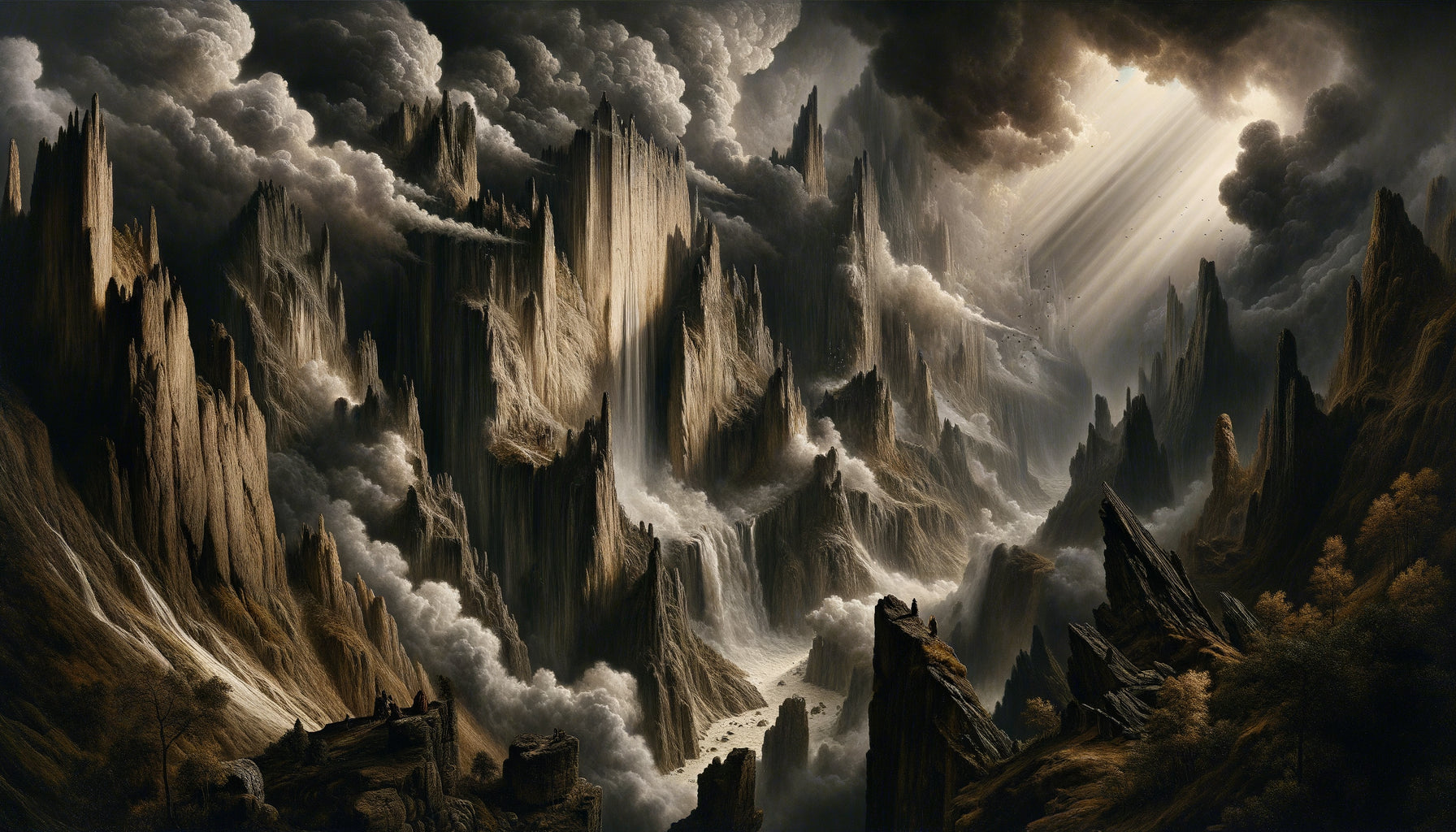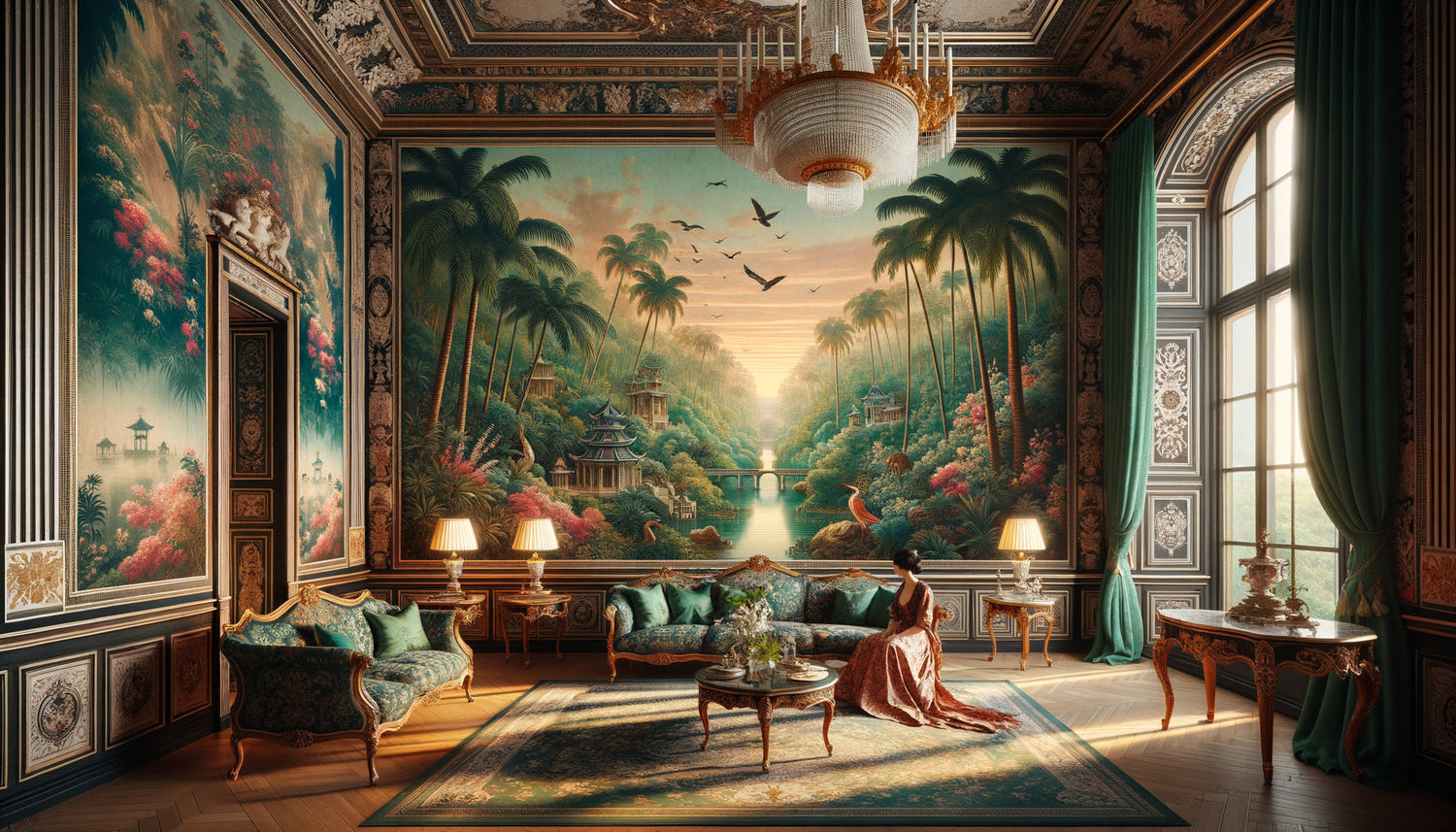
Imagine stepping through the threshold of a Parisian living room in 1830 and instantly finding yourself transported to a lush tropical forest, facing the Niagara Falls, or at the heart of an Italian garden bathed in golden light. No carriage ride, no perilous crossing. Just four walls covered in wallpapers that abolish the borders between bourgeois interiors and the most exotic horizons.
Here's what panoramic wallpapers brought to 19th-century bourgeois decor: a permanent visual escape transforming each room into a theater of illusions, a social status marker as eloquent as a library filled with rare books, and an aesthetic revolution that brought monumental landscapes into domestic intimacy.
You may be fascinated by these testaments from an era when decoration was akin to total art, but you wonder how these panoramas were imposed in interiors, why they cost a fortune, and what makes them so desirable even today. This hesitation is natural: 19th-century panoramic wallpapers embody a nearly lost know-how, a disproportionate decorative ambition.
Yet, understanding their history is grasping the origin of our contemporary fascination for immersive decors and landscapes that transform living spaces. Let me guide you through the cozy salons of 19th-century bourgeoisie, where every glance at a wall became a window open onto the world.
The invention that changed the perception of domestic space
It all begins in French factories at the turn of the 19th century. Jean-Zuber in Rixheim and Joseph Dufour in Mâcon invent a revolutionary process: printing continuous landscapes on several rolls of paper, creating wall panoramas that can cover up to 10 meters in circumference.
Unlike patterned wallpapers that already adorned walls, these panoramic wallpapers offered a unique, non-repeating composition, telling a visual story. Zuber's Views of Switzerland (1804), the Monuments of Paris or the famous Views of Italy literally transformed the living room into a permanent exhibition hall.
The technical feat was considerable: up to 1,500 wood blocks engraved for a single panorama, allowing each color to be applied separately. Some 19th-century wallpapers required more than 80 passes to obtain the subtle gradations of a twilight sky or the depth of a tropical forest.
When landscape became an ostentatious luxury
Owning a wide-format wallpaper in one's home was equivalent to displaying one’s fortune and refinement. A single panorama cost the equivalent of an average skilled worker’s annual salary. The Parisian, Lyon or Bordeaux bourgeoisie invested in these décors as others bought masterpieces.
But beyond the price, it was the choice of landscape that spoke volumes. Opting for the Banks of the Bosphorus signaled an orientalist sensibility, while Arcadia revealed a classical education. The Views of North America, with their majestic waterfalls and virgin forests, seduced romantic minds fascinated by the New World.
In reception rooms, these immersive panoramas served as a starting point for conversations. People commented on the botanical accuracy of the palm trees, debated the topographical accuracy of the monuments depicted. The wide-format wallpaper became a social catalyst, a subject of discussion as prized as the latest political news.
The manufacturers of excellence that shaped taste
The Zuber Manufacture, still active today, produced the most sought-after panoramas. Their Chinese Decor (1832) adorned embassies and private mansions. Each scene was composed with the eye of a landscape painter, creating striking effects of depth.
Joseph Dufour, for his part, excelled in narrative scenes. His Psyché (1816) told the ancient myth on 25 panels, while his Savage of the Pacific Ocean (1804) fueled the exotic fantasies of the bourgeoisie of the 19th century.
The perfect illusion: techniques and artifices of wall landscapes
What made these wide-format wallpapers so captivating was their ability to create a true sense of immersion. The draughtsmen used principles of atmospheric perspective borrowed from great landscape painters: colors gradually lightened towards the horizon, details became blurrier in the distance.
The foregrounds were treated with a luxury of botanical detail almost scientific. Each leaf, each bark was individualized. Then the gaze slid to middle grounds where characters in period costumes added a narrative dimension, before getting lost in vaporous backgrounds where mountains and skies merged.
This ingenious construction transformed a flat wall into a panoramic window open onto a fantasized elsewhere. In an era when few people traveled beyond their region, these immersive landscapes offered a form of permanent visual tourism.
From bourgeois living rooms to palaces: a social conquest
If 19th-century panoramic wallpapers initially seduced the enriched bourgeoisie, they quickly conquered aristocratic circles and even royal courts. The Château de Malmaison, residence of Joséphine Bonaparte, was adorned with several panoramas, including a spectacular tropical decor.
Across the Atlantic, American presidents succumbed to their charm. The White House itself welcomed French panoramas, testifying to the international prestige of these manufactures. Views d'Amérique du Nord by Zuber adorned homes from Boston to Charleston, creating this delicious paradox: Americans contemplating their own continent through the prism of French aesthetics.
In Parisian private mansions, some collectors dedicated entire rooms to these landscape decors. The Chinese living room, the Italian boudoir, the Swiss dining room: each space became a destination, an immobile travel experience.
The revolution of domestic perception
Before the advent of panoramic wallpapers, the wall remained a limit, a border. These decors literally revolutionized decoration by visually abolishing architectural constraints. A small Parisian living room suddenly opened onto Rio Bay, an attic bedroom overlooked the gardens of Versailles.
This psychological transformation of domestic space heralded our contemporary relationship with immersive decoration. It also foreshadowed our current desire to integrate nature into our urban interiors.
The decline and then the renaissance: why these treasures still fascinate us
With industrialization in the second half of the 19th century and the arrival of mechanically printed wallpapers, these artisanal panoramas gradually became obsolete. Too expensive, too long to produce, they were replaced by more accessible decors.
Many of these masterpieces disappeared during renovations, hidden under layers of paint or destroyed. Those that survived became collector's items, protected in museums of Decorative Arts or jealously preserved in heritage homes.
But since the 1980s, we have witnessed a true renaissance of panoramic wallpapers. Historic manufacturers like Zuber are reprinting their 19th-century models using period techniques. Renowned decorators reintegrate them into contemporary projects, creating fascinating dialogues between modern furniture and historical landscapes.
This rediscovery is explained by our current quest for authenticity, artisanal know-how, but also by this need for visual escape in often standardized interiors. The immersive landscape once again becomes a legitimate decorative aspiration.
Want to invite the landscape into your interior?
Discover our exclusive collection of landscape paintings that transform your walls into windows open onto inspiring horizons, in the spirit of the great 19th century panoramas.
The invisible heritage in our contemporary interiors
If you look closely at current decorative trends, you will find everywhere the imprint of these 19th-century panoramic wallpapers. XXL wallpapers depicting tropical forests? A direct legacy. Wall friezes with botanical motifs? An obvious lineage. Architectural trompe-l'oeil? An assumed descent.
Even our passion for large landscape photographic works, for large format canvas prints, for everything that visually expands the space finds its roots in this decorative revolution orchestrated by French manufacturers more than two centuries ago.
Immersive landscapes have definitively established the idea that a wall is not a limit but a potential, a space of mental and emotional projection. Whether you choose a contemporary wallpaper, a large format painting or a mural fresco, you perpetuate without knowing it this tradition initiated by the visionary bourgeoisie of the 19th century.
Today, facing our sometimes stifling urban lives, this historical lesson resonates with particular acuity: we all need horizons, even artificial ones, even illusory ones. The walls of our interiors can become invitations to travel again, visual breaths, windows onto elsewhere that replenish us.
19th-century panoramic wallpapers teach us that living in a place does not mean locking yourself in, but on the contrary opening up this space to the infinity of possibilities. A decorating lesson that, two centuries later, has lost none of its relevance or poetry.
Frequently Asked Questions
Why did 19th-century panoramic wallpapers cost so much?
The astronomical price of panoramic wallpapers was explained by their entirely handcrafted manufacturing process. Each panorama required the engraving of hundreds, or even over a thousand wood blocks, one for each color and shade. The pigments used were often rare and expensive, some imported from the Orient or made according to jealously guarded recipes. Printing itself required millimeter precision so that the panels would fit together perfectly, forming a continuous image without visible misalignment. Finally, only artist-drafters trained in landscape painting techniques created the original compositions. This combination of artistic and technical know-how explains why a single panorama could cost the equivalent of a year's salary for a skilled artisan, reserving these decorations for the wealthy bourgeoisie and aristocracy.
Can we still find authentic 19th century panoramic wallpapers?
Authentic and well-preserved 19th century panoramic wallpapers are extremely rare and sought after by collectors. A few examples survive in private historic homes, museums such as the Musée des Arts Décoratifs in Paris, or at specialized auctions where they fetch considerable prices. Their natural fragility—paper degrades over time with light and humidity—explains this rarity. However, excellent news for enthusiasts: several historical manufacturers like Zuber continue to produce their iconic 19th century models using period techniques, still utilizing woodblock printing. These faithful reissues allow you to acquire a genuine historic panoramic wallpaper, manufactured according to ancestral methods, to integrate this decorative magic into contemporary interiors while preserving the authenticity of craftsmanship.
How to incorporate the spirit of 19th century panoramic wallpapers into a modern decor?
Integrating the spirit of historical panoramas into a contemporary interior creates a fascinating dialogue between eras. Several approaches work wonderfully: you can choose an authentic reprint of a 19th-century panorama and pair it with clean, modern furniture for a striking contrast that enhances both styles. Another option is to select contemporary wallpapers inspired by historical panoramas, with stylized landscapes or large-format botanical compositions that take up the visual codes without the dated style. You can also opt for large landscape paintings that evoke this immersive tradition without covering all the walls, creating a spectacular focal point. The key is to respect the fundamental principle of these decors: transform a wall into a window open onto elsewhere, create visual depth, invite the eye to travel. Whether you choose historical fidelity or contemporary interpretation, you perpetuate this beautiful tradition of visual escape that characterized the refined interiors of the 19th century.