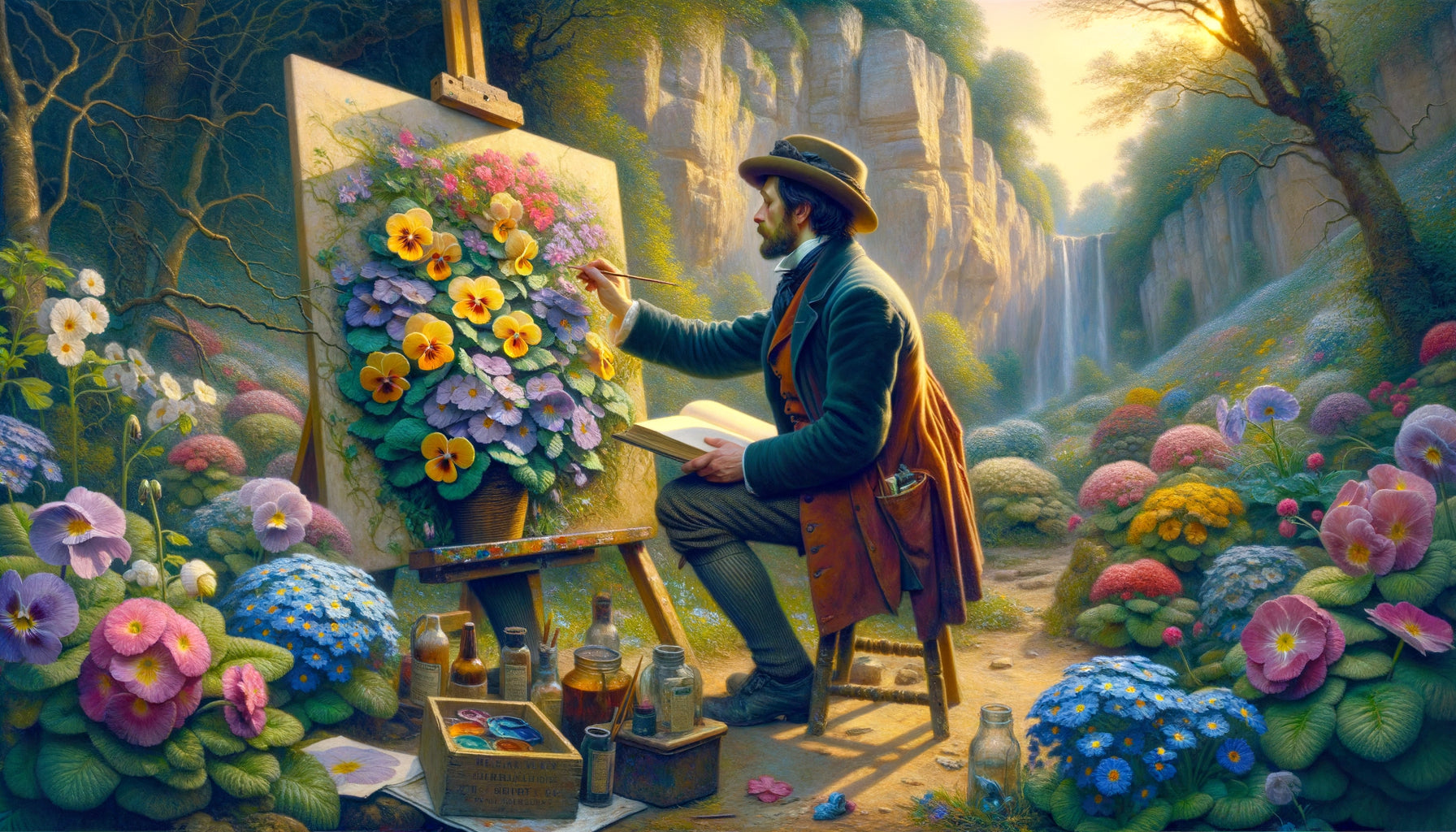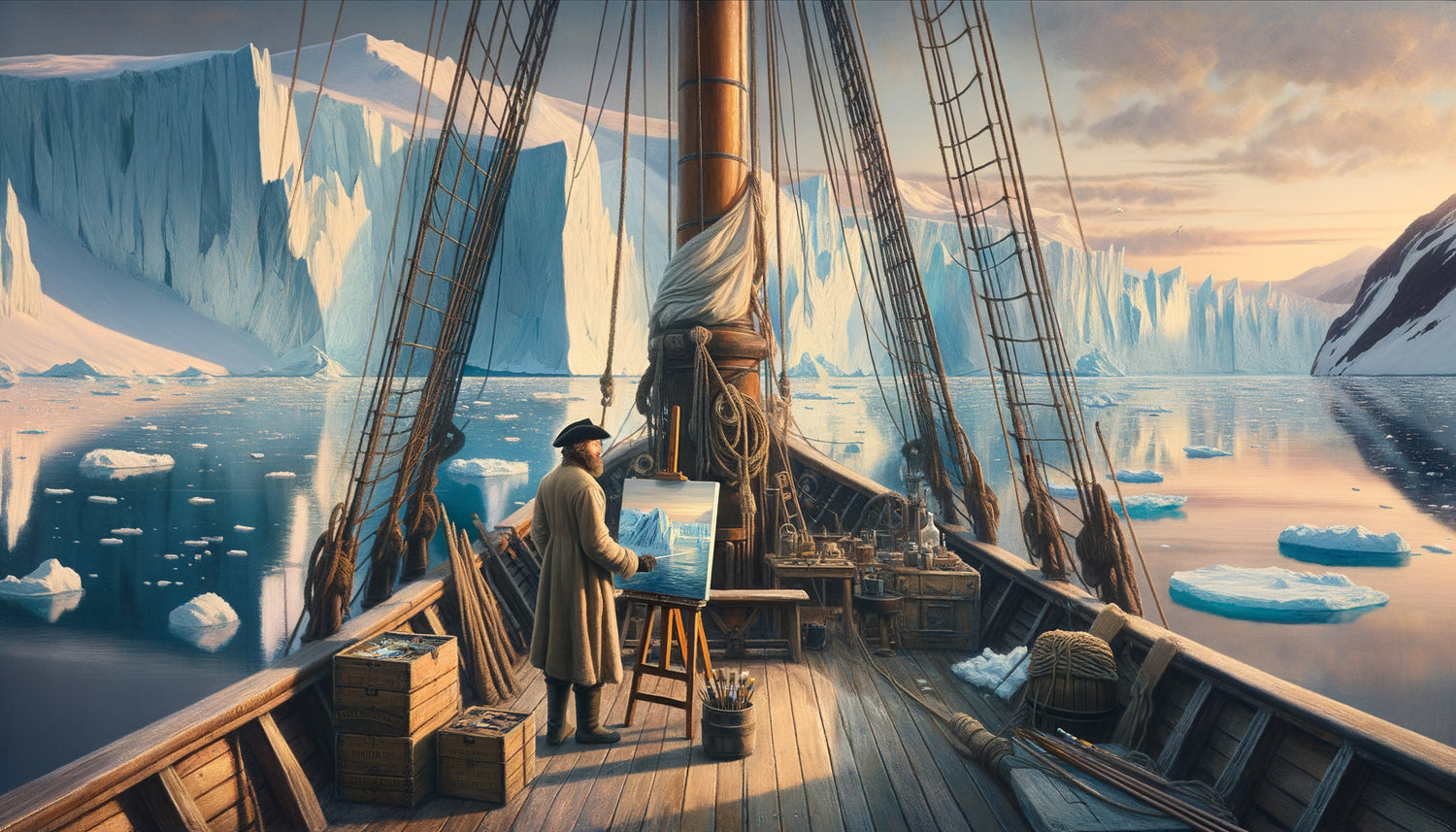
Imagine a ship caught in the ice floes of Greenland in 1869. Aboard, a painter fixes on his canvas the turquoise nuances of a monumental iceberg while a naturalist collects samples of arctic lichens. These two men, who seem to oppose each other, share the same mission: to reveal the Arctic to the world. For unlike popular belief, landscape painting did not only accompany scientific exploration of the Arctic – it was an indispensable tool, a visual memory and sometimes even a financial engine.
Here's what this unexpected alliance between art and science reveals to us: the ability of painting to document what primitive photography could not capture, the role of artists as mediators between scientific discoveries and public opinion, and the influence of Arctic works on our modern understanding of climate change.
Today, when we hang a polar landscape in our interior, we mainly think about its refined aesthetics, its soothing cool tones. We often ignore that behind these paintings lies an extraordinary scientific epic, where art served as a visual notebook for explorers facing the technological limitations of their time.
Yet, understanding this historical relationship between landscape painting and Arctic exploration completely transforms our view of these works. They are no longer simple minimalist decorations, but valuable testimonies of a world in transition, scientific documents as much as artistic ones.
I invite you to go back in time to the first polar expeditions, to follow the frozen brushes of these artist-explorers, and to discover how their paintings continue to influence our relationship with nature and science.
When the brush replaced the camera
In the 19th century, photography was in its infancy. Daguerreotype plates did not withstand extreme temperatures in the Arctic, froze or broke. Exposure times were too long to capture moving phenomena such as auroras or iceberg drift. It was in this context that landscape painting became the reference scientific instrument for documenting Arctic discoveries.
British and American expeditions systematically embarked official painters alongside geologists and botanists. William Bradford, an American painter, participated in seven Arctic expeditions between 1861 and 1869. His detailed paintings of glacial formations served as a reference for glaciologists to study the structure of ice. Each shade of blue, each visible layer in an iceberg provided information about its age and composition.
Arctic landscape painting thus developed its own codes of documentary precision. Artists meticulously noted weather conditions, the exact time of observation, geographical position. These annotations transformed each canvas into a exploitable scientific document for researchers who remained on land.
The explorer-scientist's palette
Painters on expeditions had to adapt their techniques to polar conditions. Oils would freeze, forcing them to work with watercolors or special mixtures. Julius Payer, an Austrian painter and explorer, developed a method of quick ink sketches resistant to the cold, which he then completed in paint once sheltered. This technical constraint gave rise to a particular style: refined compositions, marked contrasts, an economy of means that still characterize the aesthetics of polar landscapes today.
This forced efficiency paradoxically created works of exceptional visual power. Scientists discovered that these paintings, beyond their documentary value, communicated the immensity and hostility of the Arctic better than any written report.
Canvases funding science
The scientific exploration of the Arctic cost a fortune. Expeditions required reinforced ships, specialized equipment, numerous crews for missions lasting several years. Paradoxically, landscape painting became one of the main means of financing these scientific adventures.
The mechanism was ingenious: before departure, organizers of expeditions sold subscriptions granting rights to prints of future paintings. Upon returning, the original works were exhibited in London or New York galleries, attracting considerable crowds. The exhibition of Frederic Edwin Church's Arctic paintings in 1861 generated enough revenue to finance two new expeditions.
These canvases fulfilled an essential scientific mediation function. The Victorian public, fascinated by tales of exploration but unable to understand dry scientific reports, discovered through landscape painting the geological wonders of the Arctic: tabular icebergs, fjords sculpted by glaciers, sea ice formations.
Art as a vector of knowledge
Scientists quickly realized that their discoveries reached a much wider audience when associated with spectacular paintings. Geographical conferences were systematically accompanied by projections of paintings. Learned societies commissioned specific works illustrating particular phenomena: the refraction of light in ice crystals, the stratification of millennial glaciers.
This alliance between landscape painting and scientific exploration created a true visual culture of the Arctic that still influences our collective imagination. The visual codes established by these artist-explorers – the desolate immensity, the deep blues, the grazing light – still structure our perception of polar regions.

The Frozen Archives of Climate Change
Today, environmental historians are rediscovering these paintings with a new perspective. These 19th-century canvases constitute irreplaceable visual archives of the Arctic climate before the industrial era. By comparing historical paintings with contemporary photographs taken in the same locations, glaciologists accurately measure glacier retreat and ice sheet melting.
A 2018 study analyzed 300 Arctic landscape paintings created between 1850 and 1920 to reconstruct the evolution of glacial formations on Spitsbergen. The documentary precision of these works allows us to estimate that the Monaco Glacier, painted by several artist-explorers, has receded 2.7 kilometers in 150 years.
Landscape painting offers a unique advantage over written scientific records: it captures the environment as a whole. A geological report describes a glacier, but a canvas simultaneously shows the glacier, the surrounding vegetation, the extent of the ice floe, and the fauna present. This systemic vision is valuable for understanding past Arctic ecosystems.
A New Discipline: Artistic Paleoclimatology
Researchers are now developing methodologies to scientifically exploit these works. They analyze pigments to precisely date the canvases, geolocate the exact viewpoints thanks to the represented reliefs, and compare the visible plant species in the paintings with current botanical surveys.
This artistic paleoclimatology demonstrates that landscape painting, far from being a simple subjective interpretation, constitutes a scientific document in its own right when carried out with rigor. The notebooks of artist-explorers, found in archives, confirm their constant concern for precision and accuracy.
Contemporary Legacy: When Art Alerts Science
The tradition of artists accompanying scientific expeditions to the Arctic has never been interrupted. Even today, residency programs bring together painters and researchers at polar bases. But the role has reversed: while in the 19th century landscape painting served science, it now uses scientific data to raise awareness about the climate emergency.
Contemporary artists like Zaria Forman create hyperrealistic paintings of disappearing Arctic landscapes, working closely with glaciologists. Their works, fueled by satellite data and climate projections, give tangible form to scientific abstractions. They make visible what graphs and figures struggle to communicate: the fragile beauty of a melting world.
This new generation of Arctic landscape painters also reverses the flow of knowledge. Where their predecessors brought the Arctic to the public, they are now taking the public virtually to the Arctic through digital technologies. Immersive exhibitions, combining monumental paintings and real-time scientific data, create an unprecedented scientific mediation experience.

Integrate this story into your interior
Choosing an Arctic landscape for your living space is to join this long tradition where art dialogues with science. These canvases bring more than just a refined aesthetic: they tell a story of exploration, discovery, and relationship with the unknown.
In an office, a polar landscape evokes scientific rigor and a pioneering spirit. In a living room, it brings visual breathing space, a window to immensity. The cool tones of Arctic landscapes – these deep blues, bright whites, subtle grays – create an atmosphere conducive to concentration and reflection.
The decorative advantage of Arctic landscape painting lies in its stylistic versatility. Historical works, with their classic facture, blend perfectly into traditional interiors. More abstract contemporary interpretations dialogue with minimalist or Scandinavian decor. All share this ability to transform space by suggesting infinity.
Create a narrative wall composition
For enthusiasts of the history of science, a wall composition combining several formats visually tells the saga of Arctic exploration. A large central format representing an ice landscape, surrounded by smaller formats showing details – crystal formation, arctic fauna, auroras – recreates the scientific approach of early explorers: observe the panorama then document the details.
This staging transforms a wall into a modern cabinet of curiosities, where art meets natural science. The effect is particularly successful in transitional spaces such as hallways or entrance halls, where the succession of paintings naturally guides the eye and movement.
Extend the Arctic adventure at home
Discover our exclusive collection of nature paintings that captures the majesty of polar landscapes and transforms your interior into an exploration space.
Conclusion : Ice as a mirror of humanity
The relationship between landscape painting and scientific exploration in the Arctic reveals a profound truth: art and science are not opposing fields, but complementary languages for understanding and transmitting our knowledge of the world.
These canvases born in extreme cold, from the frozen hands of artist-explorers, made it possible to map the unknown, to finance research, to share the fascination of discovery. Today, they help us measure what we are losing and imagine what we must preserve.
Integrating an Arctic landscape into your interior is welcoming this double dimension: the formal beauty of a work of art and the narrative depth of a historical document. It is creating a silent dialogue every day with the history of human exploration.
Start by identifying the space in your home that would benefit from this opening to infinity. Observe natural light – Arctic landscapes transform according to the time of day, revealing different nuances. Then let yourself be guided by your intuition: which canvas calls you towards the North?
FAQ : Your questions about Arctic landscapes
Why are Arctic paintings often in blue and white tones?
This limited palette is not an arbitrary aesthetic choice but a faithful reflection of the Arctic reality. In polar regions, light behaves differently than at temperate latitudes. Snow and ice act as giant reflectors, primarily scattering blue wavelengths of the light spectrum. Early explorer-painters documented this phenomenon with scientific precision. The infinite nuances of blue – from the translucent turquoise of young icebergs to the deep blue of millennial ice – tell the age and structure of the ice. Pure whites indicate fresh snow, while yellowish whites signal the presence of algae or sediments. Today, this refined palette seduces for its decorative qualities – it brings brightness and serenity – but above all, it remains a scientific testimony to unique environmental conditions. In an interior, these cool tones create a sense of space and freshness particularly appreciated in rooms facing south.
Does an Arctic landscape suit all decorating styles?
Absolutely, and that's the richness of Arctic landscape painting: it transcends eras and styles. In a Scandinavian or minimalist interior, it naturally reinforces the clean aesthetic and connection to Nordic nature. In a classic or Haussmannian decor, a 19th-century Arctic canvas brings a touch of history and adventure that dialogues beautifully with period furniture. For a contemporary or industrial interior, modern interpretations of polar landscapes – more abstract, with worked textures – create a sophisticated focal point. The key lies in the choice of artistic treatment rather than the subject itself. An iceberg can be represented hyperrealistically for a spectacular effect, or minimally with a few brushstrokes suggesting essential forms. Observe the dominant colors of your room: if you have a lot of warm wood, an Arctic landscape with cool tones will create a balancing contrast. In an already fresh space, prioritize works including touches of golden light – those famous Arctic sunsets.
How to distinguish a documentary Arctic landscape painting from a purely decorative work?
This question reveals a fascinating evolution in the history of landscape painting. Works created during scientific expeditions of the 19th and early 20th centuries often present characteristic documentary clues: handwritten annotations on the back or margin, indication of the exact date and location, sometimes even preparatory sketches in the margins. Artist-explorers favored topographic precision – you can identify specific geological formations, recognize the precise structure of a glacier. Contemporary decorative works allow for more freedom: idealized compositions, intensified colors for visual impact, elimination of details in favor of the overall atmosphere. Neither approach is superior: they simply respond to different intentions. For your interior, what's important isn't scientific accuracy but the emotional resonance that the work creates. A documentary painting brings a historical and intellectual dimension. A freer interpretation offers a sensory and contemplative experience. Some collectors even mix the two approaches in the same room, creating a dialogue between rigor and poetry that enriches the space.