When I discovered Turner's notebooks at the British Museum, I was struck by the meticulousness of his mountain sketches. Each rock layer was drawn with a quasi-scientific precision. It wasn't until later, while studying the writings of John Ruskin, that I understood: this revolution in geological observation in painting was not accidental. The Victorian art critic had literally changed the way artists looked at and represented stone, transforming landscape painting into a veritable geological study.
Here is what Ruskin’s influence brings to painting: a rigorous observation of the structure of rocks that gives authenticity and depth to landscapes, an understanding of geological formations that enriches the composition, and a spiritual connection with nature through the meticulous study of its mineral details.
For centuries, painters have depicted mountains as uniform masses, theatrical backdrops without real substance. This decorative approach frustrated those seeking truth in art. But Ruskin, armed with his knowledge of geology and his incisive pen, was about to change everything. His revolutionary theory transformed generations of artists into passionate observers of mineral nature, creating a fascinating bridge between art and science that still influences our way of decorating our interiors with landscape artworks today.
The geological gaze: when Ruskin reinvents observation
In his monumental work Modern Painters, published between 1843 and 1860, John Ruskin poses a radical principle: a painter cannot faithfully represent a landscape without understanding its geology. For him, each mountain tells a story of millions of years, and that story must transpire in every brushstroke. This vision transforms geological observation into an artistic imperative.
Ruskin himself roamed the Alps with his geologist's hammer, tirelessly drawing rock stratifications, folds, and fractures. His notebooks are full of annotated sketches where he identifies the types of rocks: schists, limestones, granites. This practice was not merely academic. For Ruskin, understanding how a mountain was formed radically changed the way it was painted.
The influence of this approach on geological observation in painting was immediate. Artists of the Victorian era began to study geology before taking out their brushes. Turner, whom Ruskin vehemently defended, already incorporated these principles into his alpine watercolors, showing cliffs where each sedimentary layer was visible and consistent with the geological reality of the place.
The doctrine of natural truth
At the heart of Ruskin's theory lies what he called natural truth. It wasn't simply about copying what one sees, but understanding the laws that govern natural forms. For rock formations, this meant knowing the principles of sedimentation, erosion, and tectonics. This scientific knowledge, according to Ruskin, allowed for a more authentic and emotionally resonant artistic representation.
When geology becomes visual poetry
What makes Ruskin's influence so fascinating is that he did not advocate for dry, documentary realism. On the contrary, geological understanding should serve a spiritual and poetic vision. He wrote that mountains were the cathedrals of nature, and their strata were like pages from a sacred book.
This approach profoundly marked the Pre-Raphaelite painters and their successors. When John Brett painted his famous Aosta Valley in 1858, after reading Ruskin, he spent weeks studying each rock, each geological formation. The result was not a scientific illustration but a vibrant work where geological accuracy amplified emotion rather than constrained it.
Ruskin thus demonstrated that geological observation and artistic sensitivity were not opposed but complementary. The textures of metamorphic rocks, the broken lines of faults, the curves of geological folds became elements of pictorial composition. Geology offered a rich visual vocabulary that artists could use to create works that were both true and magnificent.

The concrete impact on artistic practice
The influence of Ruskin's theories on geological observation in painting translated into very concrete changes in workshops. Art schools began teaching geology to fine arts students. Manuals combining drawing and mineralogy appeared. Landscape painters went on expeditions with geological guides as much as with their easels.
This revolution affected several technical aspects:
The color of rocks : Ruskin insisted that each type of rock possesses its own palette. The pink granite of the Alpine summits does not have the same tone as the gray limestone of the Norman cliffs. Painters learned to identify and reproduce these specific nuances, creating more authentic landscapes.
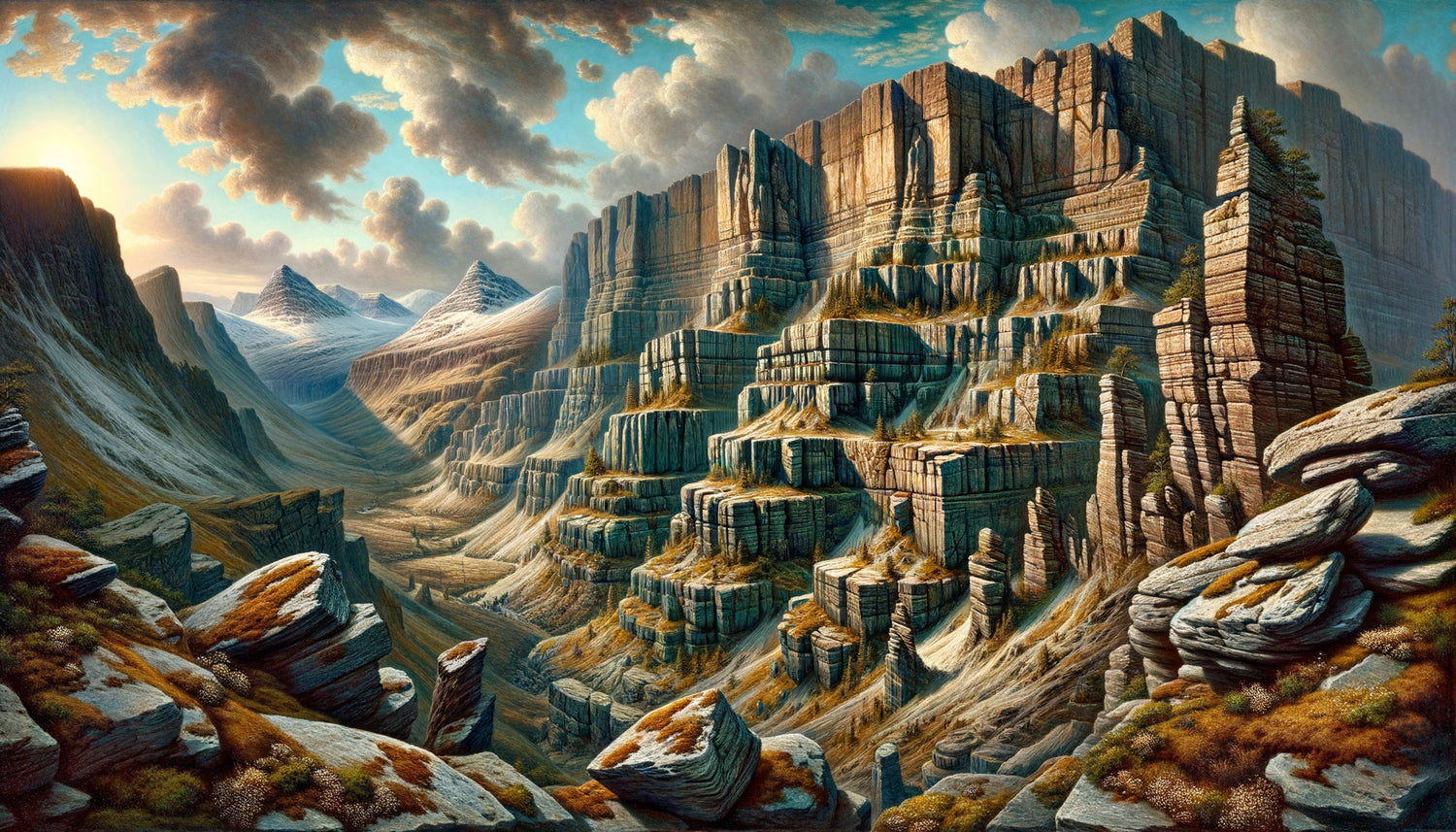
Structure and form: Understanding that sedimentary rocks form horizontal layers while metamorphic rocks can be folded or vertical changed the way mountains were drawn. Artists abandoned generic shapes for geologically consistent structures.
Erosion and texture: Ruskin taught that water, wind, and frost sculpt differently depending on the type of rock. A schist cliff erodes in sheets, a granite in rounded blocks. This knowledge made it possible to render rocky surfaces with new credibility.
From field notebooks to masterpieces
Artists influenced by Ruskin developed a two-stage practice. First, meticulous geological observation in the field, with annotated sketches and descriptive notes. Then, in the studio, the transformation of these observations into artistic compositions. This method ensured that even the most stylized works retained a solid geological basis.
A legacy that transcends centuries
Ruskin's influence on geological observation in painting was not limited to the Victorian era. The Impressionists, although critical of some aspects of Ruskinism, integrated this attention to natural structures. Cézanne, tirelessly painting Mont Sainte-Victoire, analyzed the mountain’s limestone formations with a rigor that would have delighted Ruskin.
In the 20th century, artists like Paul Nash continued this tradition, combining modernism and precise geological observation. In their war landscapes as in their surrealist visions, an understanding of rock structure brought visceral credibility.
Today, this influence endures in contemporary art and even in our decorative approach. When we choose a mountain canvas for our living room, we are unconsciously drawn to these works where geology is respected, where the rocks look real, where the cliffs tell an authentic natural story. This is Ruskin’s invisible legacy in our interiors.

How to recognize Ruskin's influence in a work
Developing an eye for geological observation in painting greatly enriches our appreciation of landscape works. Here’s what to look for:
Stratigraphic consistency: In a painting influenced by Ruskin’s theories, the layers of rock follow a logic. They are not drawn randomly but respect geological principles of sedimentation and deformation.
Erosion details: Observe how the artist rendered the surfaces. Do the rocks show signs of alteration consistent with their nature? Are the cracks, landslides, and erosion patterns credible?
Texture variation: A geologically informed landscape presents a diversity of rock textures. Each formation has its own character, its surface peculiarities, its unique way of capturing light.
Integration into composition: Geological observation is never gratuitous in truly successful works. It serves the composition, guides the eye, creates rhythm. Stratification lines can lead to a focal point, rock formations structure the pictorial space.
Transform your space with geological authenticity
Discover our exclusive collection of nature paintings that capture the mineral truth of landscapes with a precision worthy of Ruskin’s theories.
Integrating this vision into your daily life
Understanding the influence of Ruskin’s theories on geological observation in painting changes our relationship to works of art, but also to our environment. This approach invites us to really look, to understand before judging, to seek truth beneath the surface.
In your interior, prioritize landscape artworks that testify to this attention to geological detail. They bring not only visual beauty but also intellectual depth. Each time your gaze rests on such a work, you rediscover the strata, textures, and millennia-old stories inscribed in stone.
This Ruskinian philosophy of patient and respectful observation reminds us to slow down, to really see rather than simply look. In our era saturated with superficial images, it is a valuable antidote. Ruskin’s legacy teaches us that authentic beauty arises from understanding, that artistic emotion is amplified by scientific truth.
So the next time you admire a painted landscape, take a moment to observe its rocks. Look for the strata, folds, and traces of erosion. You may discover that the painter, consciously or unconsciously, has been touched by the influence of this Victorian visionary who believed that understanding geology makes art more true, more beautiful, more profound.
Frequently asked questions about Ruskin’s influence in painting
Do you need to be a geologist to appreciate a painting influenced by Ruskin?
Absolutely not! That's precisely the beauty of Ruskin's approach: geological observation in painting works on several levels. At first glance, you simply appreciate the beauty and credibility of the landscape. The rocks seem real, the mountains convincing. But if you take the time to observe more closely, you discover this geological consistency that enriches the work. You don't need to know technical terms or distinguish a schist from granite. Your eye, even without training, intuitively perceives that there is logic, a truth in the representation. It is this authenticity that makes these works so visually satisfying and perfect for creating a natural atmosphere in our interiors. Ruskin’s influence acts even on those who have never heard of him.
Does this geological approach make painting less creative?
This is a concern that Ruskin himself anticipated and passionately addressed. No, rigorous geological observation does not hinder creativity, it nourishes it! Think about it: knowing the rules of music doesn't prevent composers from creating moving works, on the contrary. Similarly, understanding how rocks form and erode offers artists an infinitely rich visual vocabulary. Geological textures, stratification patterns, mineral colors become tools of expression. Ruskin’s influence freed painters from generic and conventional representations to allow them to explore the real diversity of nature. The resulting works are both more true and more poetic. This combination of rigor and emotion creates precisely those timeless pieces that transcend eras and embellish our living spaces with an authentic presence.
Can Ruskin’s principles be applied to subjects other than mountains?
Absolutely, and that’s the richness of his vision! While Ruskin is primarily known for his writings on alpine landscapes, his fundamental principle of rigorous and loving observation applies to everything. He himself wrote beautifully about clouds, trees, architecture. The central idea is that understanding the structure and logic of a subject allows it to be represented with more truth and beauty. For a seaside rock, you need to understand marine erosion. For a coastal cliff, knowing the effects of salt and waves on different rocks. Even for a simple pebble in a Zen garden, this Ruskinian approach enriches observation. This philosophy has influenced far beyond landscape painting, touching botanical illustration, architecture, and even our contemporary way of integrating natural elements into our spaces. Ruskin’s influence on geological observation in painting was the beginning of a broader revolution in our relationship with the natural world.