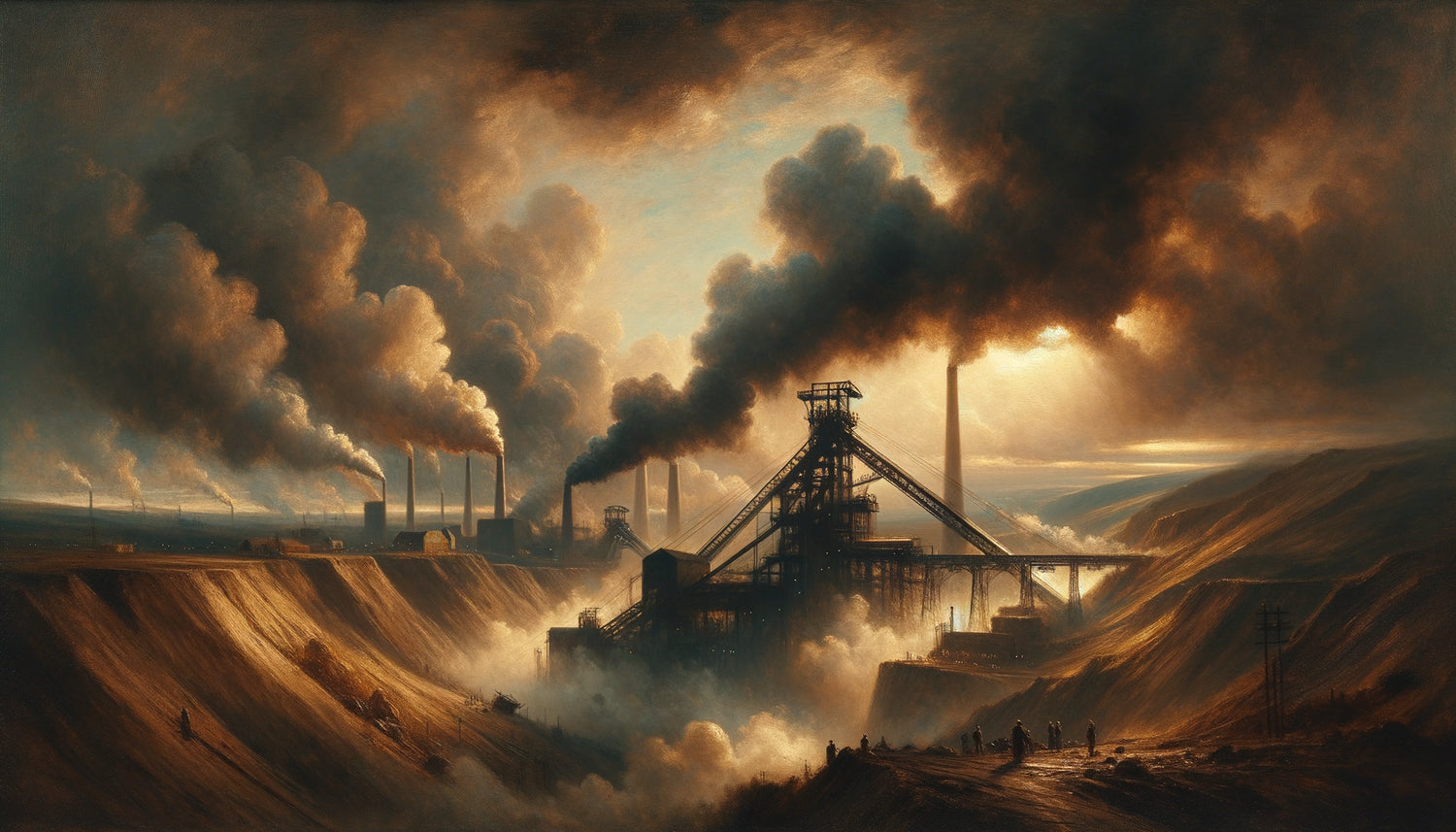
I discovered one day, at a Christie's auction, a small canvas darkened by time. Between the cracks in the varnish, you could make out chimneys spewing their orange smoke into a twilight sky. It wasn't a Turner, but the emotion was there: that magnetic tension between beauty and desolation. English Romantic painters didn't simply document industrialization – they visually translated the great upheaval of their time, transforming mining landscapes into modern cathedrals bathed in dramatic light.
Here's what this artistic approach reveals: a poetic vision of industrial transformation, a valuable historical record of conditions at the time, and a meditation on humanity's place in the face of progress. Three dimensions that make these works much more than simple illustrations.
Many think that Romantic art is limited to medieval ruins and storms at sea. It’s hard to imagine Turner or Constable being interested in the coal mines of Wales or the blast furnaces of Coalbrookdale. Yet, these artists were fascinated by this industrial revolution which literally redrew the face of England.
Rest assured: understanding this approach requires no expertise in art history. It simply takes observing how these painters managed to transform industrial chaos into striking visual compositions, creating a pictorial language that still speaks to our contemporary interiors today.
In this article, I'll take you on a journey to discover how these masters captured the soul of industrialized mining landscapes, what techniques they employed, and why their works resonate with our current sensibilities.
When smoke becomes sublime: The romantic aesthetics of industry
English Romantic painters accomplished a feat: making beautiful scenes that many judged ugly. Faced with emerging mining landscapes, they did not look away. On the contrary, they applied their aesthetic vocabulary – dramatic light, theatrical compositions, dizzying scales – to these new subjects.
Joseph Wright of Derby paved the way as early as 1780 with his famous painting depicting Arkwright's Cotton Mills at night. The flames of the forges become earthly stars, the fumes clouds worthy of a maritime storm. This aesthetic transfiguration is not naive: it translates the ambivalence of an entire generation towards progress.
Turner pushes this logic even further in the 1830s. His representations of industrialization are bathed in almost mystical light. Factory chimneys pierce the mists like Gothic spires. Coal extracted from mines becomes pictorial material, deep black contrasting with incandescent yellows. It is the entire palette of mining landscapes that constitutes itself: earthy ochres, metallic grays, fiery reds.
Light as a documentation tool
What strikes you in these romantic works is the obsession with specific lighting effects characteristic of industry. Painters capture the orange glows of blast furnaces reflecting on canals, the spectacular backlighting created by dense smoke, the artificial auras generated by foundries working at night. This attention to industrial light constitutes an irreplaceable visual record of the atmosphere of these places.
The mining landscape as a social portrait
Beyond aesthetics, romantic painters also document the human dimension of industrialization. Their canvases are teeming with revealing details: tiny miners at the foot of headframes, women sorting coal, children driving draft horses.
Philip James de Loutherbourg, with his series on coal mines and forges in Coalbrookdale in the 1800s, adopts an almost ethnographic approach. Each character is individualized, each work gesture precisely rendered. We see extraction techniques, ore transport systems, the spatial organization of mining sites. These romantic paintings become visual archives of immeasurable value.
John Martin, known for his apocalyptic visions, applies his sense of drama to mining landscapes. His compositions crush human figures under the scale of industrial structures. This choice of scale is not innocent: it conveys a feeling of alienation in the face of these new work environments. Documentation here becomes social commentary.
The technical details that tell the era
By carefully observing these canvases, one learns a great deal about mining technologies. Romantic painters faithfully represent steam engines, wooden and then metal rails, ventilation systems, well structures. This technical precision coexists with poetic license, creating works that are both documentary and imaginative.

Between fascination and critique: the romantic ambiguity
What makes these representations of industrialization so rich is their profound ambivalence. English romantic painters do not naively celebrate progress, but they do not condemn it outright either. They document an ongoing transformation, with all its contradictions.
At Turner’s, this tension is palpable. His famous painting Rain, Steam and Speed (1844) shows a locomotive racing through the mist. Spectacular technological progress, certainly, but immersed in a misty atmosphere that dilutes certainties. This nuanced approach characterizes the romantic documentation of mining landscapes: to show without judging, or rather, to allow admiration and concern to coexist.
The compositions themselves reflect this duality. Often, Romantic painters place natural elements preserved in the foreground – a tree, a stream, rocks – while the background shows industrial progress. This visual structure literally documents the process of territorial transformation: nature receding before mines and factories.
The color palette of the Industrial Revolution
A fascinating aspect of this pictorial documentation concerns the evolution of the painters' palettes themselves. Faced with industrialized mining landscapes, Romantic artists develop new colorful harmonies, creating what could be called an industrial aesthetic.
Constable’s bucolic greens give way to darker and more contrasting ranges. Romantic painters visually document atmospheric pollution by changing their skies: pure blues become grey-yellows, clouds are charged with particles that diffract light differently. Turner, particularly sensitive to atmospheric phenomena, captures these transformations with almost scientific precision.
The lands also change color in these representations. Mining landscapes introduce deep blacks of coal, reds of slag, ochres of overturned earth. This new palette becomes a signature of the industrial era, a visually recognizable code. Today, these tones resonate surprisingly with our contemporary interiors which are looking for precisely these dark and sophisticated harmonies.
Industrial black as a new reference
Black, omnipresent in representations of industrialization, is no longer that of classical shadows. It is a material black, tactile, charged with coal and soot. Romantic painters use it in thick masses, thus documenting the crushing physical presence of this matter which fuels the Industrial Revolution.

The visual legacy: from documentation to decorative inspirationThese romantic paintings of mining landscapes continue to fascinate our contemporaries. In today's interiors, we are precisely looking for this tension between nature and industry, this dramatic atmosphere tinged with nostalgia. Reproductions by Turner or Wright of Derby fit perfectly into industrial, Scandinavian or even minimalist aesthetics.What makes these works decoratively strong is their ability to create narrative depth. A living room adorned with a romantic mining landscape immediately gains character. These images tell a story, evoke a pivotal era, invite contemplation. They bring that cultural and historical dimension that purely contemporary decorations sometimes struggle to offer.
The Romantic painters have bequeathed us a visual vocabulary for thinking about transformation. At a time when we are experiencing our own upheavals – ecological transition, digitalization – their works resonate differently. They show us how art can document change without sacrificing beauty, how it can bear witness without simplifying.
How to integrate this aesthetic into your home
Specifically, the visual universe of Romantic painters documenting industrialization translates beautifully into our contemporary interiors. Here are a few ideas for adopting this aesthetic:
Favor high-quality reproductions on canvas or matte paper, which respect the subtle nuances of these works. The mining landscapes by Turner or Loutherbourg gain from being presented in generous formats, which allow you to immerse yourself in their complex atmospheres.
In terms of decorative palette, dare harmonies inspired by these canvases: anthracite gray, deep blue-black, earthy ochres, with touches of copper or gold evoking the glow of the forge. These colors create sophisticated and enveloping atmospheres.
Also think about materials: raw wood, patinated metal, natural stone echo the elements represented in these Romantic paintings. The combination of raw textures and refined details reproduces this tension between industry and art that characterizes these works.
Transform your interior with the poetry of landscapes
Discover our exclusive collection of wall art nature that captures the same dramatic intensity and emotional depth dear to the Romantic masters.
Towards a new reading of industrial heritage
The English Romantic painters taught us to look differently. Their representations of mining landscapes have transformed our perception of industrial heritage. What could have remained simple technical illustration has become a work of art, a historical testimony charged with emotion.
Today, facing rehabilitated industrial wastelands, lofts arranged in former factories, we are the heirs of this romantic gaze. We know how to see beauty in metal structures, poetry in blackened bricks, history in exposed beams. This sensitivity comes directly from those artists who first knew how to document industrialization without abandoning aesthetic emotion.
Their paintings also remind us that any transformation, however radical it may be, can be looked at, thought about, interpreted by art. In our interiors, hanging a reproduction of these romantic mining landscapes invites this reflection: how to live in a world in transition while preserving the capacity for wonder? It was already the question of English romantics, facing chimneys redrawing their horizon. It is still ours today.
These works are not mere dusty historical documents. They still vibrate, still question, still inspire. Because they captured something essential: that fragile moment when the old world tips into the new, when the landscape is reworked, when humanity redefines its relationship to the earth and the elements. A universal tension that each era plays in its own way.
Frequently Asked Questions
Why were Romantic painters interested in industrial landscapes?
Contrary to popular belief, English Romantic painters did not systematically flee the modern world. Many were fascinated by the spectacular scale of the transformation underway. Industrialization offered visually striking subjects: unprecedented lighting effects from nocturnal forges, dramatic compositions of chimneys in the fog, violent contrasts between nature and industry. These artists also saw in these mining landscapes a form of modern sublime, that mixture of beauty and dread characteristic of Romantic aesthetics. They documented their time with the tools of their sensitivity, creating works that were both testimonies and poetic interpretations.
Are these paintings reliable sources for studying industrial history?
Yes and no. Romantic representations of industrialization contain a wealth of valuable information: architectural details of mining structures, spatial organization of sites, workers' clothing, technologies of the time. Historians regularly use them as complementary visual sources. However, it is important to remember that these artists took liberties to serve their aesthetic vision. They dramatized some elements, minimized others, recomposed scenes. The documentary value is real but must be cross-referenced with other sources. It is precisely this tension between faithful observation and artistic interpretation that makes these works so rich and complex.
How to choose a romantic mining landscape reproduction for your decoration?
Start by identifying what touches you in these works: do you prefer the dramatic atmospheres of Turner, the theatrical nocturnal scenes of Wright of Derby, or the more detailed representations of Loutherbourg? Then, think about the atmosphere of your room. Mining landscapes with dark tones are perfect for intimate spaces like libraries or bedrooms. Scenes with incandescent lights bring a visual warmth ideal for living rooms. Favor quality reproductions that respect the subtle nuances of the original palette – this is essential for these works where gradations of gray, browns and reds create all the atmosphere. Finally, don't hesitate to frame these images in a simple way to let the work breathe and not compete with its internal complexity.
What makes these works decoratively strong is their ability to create narrative depth. A living room adorned with a romantic mining landscape immediately gains character. These images tell a story, evoke a pivotal era, invite contemplation. They bring that cultural and historical dimension that purely contemporary decorations sometimes struggle to offer.
The Romantic painters have bequeathed us a visual vocabulary for thinking about transformation. At a time when we are experiencing our own upheavals – ecological transition, digitalization – their works resonate differently. They show us how art can document change without sacrificing beauty, how it can bear witness without simplifying.
How to integrate this aesthetic into your home
Specifically, the visual universe of Romantic painters documenting industrialization translates beautifully into our contemporary interiors. Here are a few ideas for adopting this aesthetic:
Favor high-quality reproductions on canvas or matte paper, which respect the subtle nuances of these works. The mining landscapes by Turner or Loutherbourg gain from being presented in generous formats, which allow you to immerse yourself in their complex atmospheres.
In terms of decorative palette, dare harmonies inspired by these canvases: anthracite gray, deep blue-black, earthy ochres, with touches of copper or gold evoking the glow of the forge. These colors create sophisticated and enveloping atmospheres.
Also think about materials: raw wood, patinated metal, natural stone echo the elements represented in these Romantic paintings. The combination of raw textures and refined details reproduces this tension between industry and art that characterizes these works.
Transform your interior with the poetry of landscapes
Discover our exclusive collection of wall art nature that captures the same dramatic intensity and emotional depth dear to the Romantic masters.
Towards a new reading of industrial heritage
The English Romantic painters taught us to look differently. Their representations of mining landscapes have transformed our perception of industrial heritage. What could have remained simple technical illustration has become a work of art, a historical testimony charged with emotion.
Today, facing rehabilitated industrial wastelands, lofts arranged in former factories, we are the heirs of this romantic gaze. We know how to see beauty in metal structures, poetry in blackened bricks, history in exposed beams. This sensitivity comes directly from those artists who first knew how to document industrialization without abandoning aesthetic emotion.
Their paintings also remind us that any transformation, however radical it may be, can be looked at, thought about, interpreted by art. In our interiors, hanging a reproduction of these romantic mining landscapes invites this reflection: how to live in a world in transition while preserving the capacity for wonder? It was already the question of English romantics, facing chimneys redrawing their horizon. It is still ours today.
These works are not mere dusty historical documents. They still vibrate, still question, still inspire. Because they captured something essential: that fragile moment when the old world tips into the new, when the landscape is reworked, when humanity redefines its relationship to the earth and the elements. A universal tension that each era plays in its own way.
Frequently Asked Questions
Why were Romantic painters interested in industrial landscapes?
Contrary to popular belief, English Romantic painters did not systematically flee the modern world. Many were fascinated by the spectacular scale of the transformation underway. Industrialization offered visually striking subjects: unprecedented lighting effects from nocturnal forges, dramatic compositions of chimneys in the fog, violent contrasts between nature and industry. These artists also saw in these mining landscapes a form of modern sublime, that mixture of beauty and dread characteristic of Romantic aesthetics. They documented their time with the tools of their sensitivity, creating works that were both testimonies and poetic interpretations.
Are these paintings reliable sources for studying industrial history?
Yes and no. Romantic representations of industrialization contain a wealth of valuable information: architectural details of mining structures, spatial organization of sites, workers' clothing, technologies of the time. Historians regularly use them as complementary visual sources. However, it is important to remember that these artists took liberties to serve their aesthetic vision. They dramatized some elements, minimized others, recomposed scenes. The documentary value is real but must be cross-referenced with other sources. It is precisely this tension between faithful observation and artistic interpretation that makes these works so rich and complex.
How to choose a romantic mining landscape reproduction for your decoration?
Start by identifying what touches you in these works: do you prefer the dramatic atmospheres of Turner, the theatrical nocturnal scenes of Wright of Derby, or the more detailed representations of Loutherbourg? Then, think about the atmosphere of your room. Mining landscapes with dark tones are perfect for intimate spaces like libraries or bedrooms. Scenes with incandescent lights bring a visual warmth ideal for living rooms. Favor quality reproductions that respect the subtle nuances of the original palette – this is essential for these works where gradations of gray, browns and reds create all the atmosphere. Finally, don't hesitate to frame these images in a simple way to let the work breathe and not compete with its internal complexity.