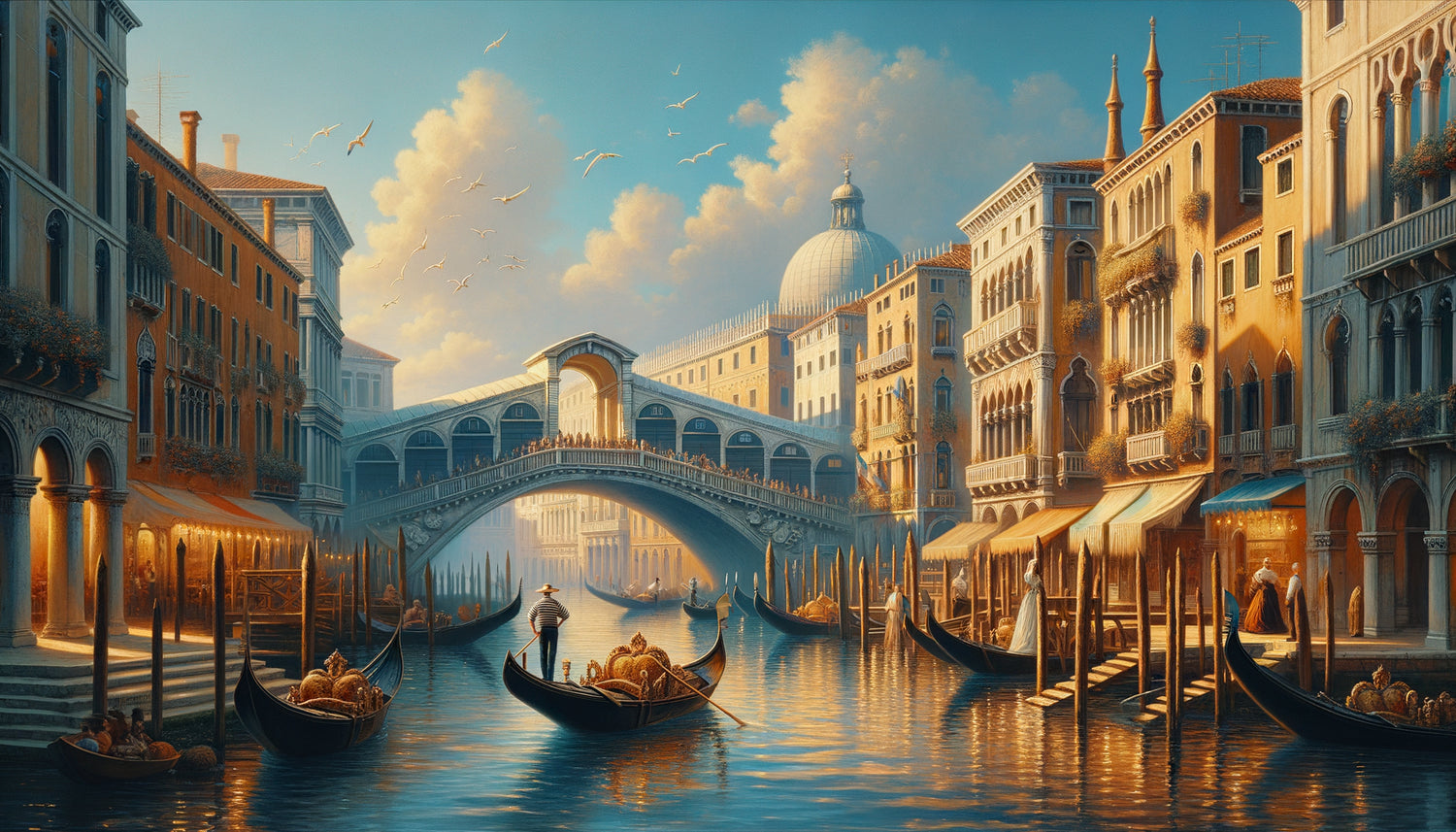
Imagine a dark room in an English manor house, steeped in the perpetual mist of the British countryside. Then, hanging above the fireplace, a rectangle of golden light: Venice under the setting sun, Vesuvius smoking in the distance, Roman ruins bathed in eternal clarity. In the 18th century, these views of Italy were not mere paintings. They were windows onto a bygone world, cultural trophies, tangible proof of belonging to the European elite.
Here's what these paintings brought to British collectors: undeniable cultural legitimacy, a daily reminder of their initiatory Grand Tour, and a way to assert their refinement among their peers. Three reasons that transformed each canvas into something far more valuable than a simple wall ornament.
Today, when we look at these collections in historic British homes, we might believe it was merely a passing fad. How could a foreign landscape trigger such fervor? Why invest fortunes in views of Venice or Rome rather than celebrating the English countryside?
The answer reveals a fascinating history of power, education, and social aspiration. These Italian canvases tell how art becomes a mirror of an era's ambitions, and how simply hanging a painting can transform a house into a declaration of identity.
Let's delve back into that time when owning a view of the Grand Canal was equivalent to exhibiting an invisible but universally recognized university degree.
The Grand Tour: An initiation rite for the British aristocracy
At the heart of the 18th century, every young British aristocrat worth his salt had to undertake his Grand Tour. This continental expedition, generally lasting one to three years, constituted the cornerstone of elite education. Italy represented its absolute pinnacle, the final destination where one came to seek the very soul of Western civilization.
These young men set off accompanied by learned tutors, traversed the Alps in perilous conditions, and then discovered with wonder the treasures of Venice, Florence, Rome, and Naples. Each city offered its lessons: Venetian Palladian architecture, Florentine Renaissance painting, Roman ancient remains, recent discoveries of Pompeii and Herculaneum.
But how to immortalize this intellectual transformation? How to prove, once back in London's fog, that one had truly absorbed the essence of European culture? Italian views became the visual certificates of this initiation journey. Unlike memories that fade, these canvases forever crystallized the moment when the young lord contemplated the Colosseum or sailed on the Venetian lagoon.
British collectors commissioned these works directly from Italian masters, creating a personal connection with their travels. Each view recalled not only a place but a moment of revelation, an erudite conversation, an aesthetic discovery that had shaped their worldview.
Canaletto, Pannini and the vedutisti: painting eternity
The demand from Britain was so strong that it created an entire artistic industry. The vedutisti, these painters specializing in urban views, found their most lucrative and loyal clientele among the British aristocracy.
Canaletto perfectly embodies this phenomenon. This Venetian literally built his fortune on the British appetite for views of his hometown. His compositions of the Grand Canal, Piazza San Marco or the Rialto Bridge possessed a photographic precision, but sublimated by an idealized light. British collectors did not want just a faithful souvenir: they desired a Venice more perfect than reality, an eternal city frozen in its splendor.
The demand became so great that Canaletto moved directly to London for nearly a decade, painting views of the Thames for a clientele who could no longer do without his style. But even then, his Italian views remained more prized than his English landscapes.
Giovanni Paolo Pannini represented another facet of this fascination. His capricci, these imaginary compositions bringing together several Roman monuments in a single fantasized view, allowed collectors to possess the entirety of ancient Rome within a single frame. These impossible assemblages perfectly reflected British ambition: not to reproduce Italy, but to capture its concentrated essence.

Cultural legitimacy through Italian views
Why Italy specifically? Why not France, Spain or the Netherlands? The answer lies in the very construction of 18th century European cultural identity. Italy was not simply a country: it represented the birthplace of two founding civilizations, ancient Rome and the Renaissance.
Owning Italian views meant enrolling oneself in a prestigious intellectual lineage. It was to assert that one understood Cicero and Virgil, that one admired Michelangelo and Raphael, that one mastered the aesthetic codes that separated the cultured from the ignorant. In a British society obsessed with social status markers, these paintings were worth more than any noble titles.
British collectors hung these views in their libraries, reception rooms, private galleries. Each visitor could immediately gauge the owner's degree of refinement. A collection rich in Canaletto and Pannini proclaimed: Here lives someone who belongs to the European cultural elite.
This legitimacy worked all the better because 18th-century Italy was politically fragmented and weakened. The British could appropriate its cultural heritage without threatening their national identity. Italy became a glorious past to admire, unlike France, a political and military rival, whose contemporary art was viewed with suspicion despite its excellence.
When nostalgia becomes interior decoration
There is a deeply emotional dimension to this enthusiasm for Italian views. These paintings did not only serve to impress guests; they offered sentimental refuge from the harshness of British climate and life.
Italy represented light against the English gloom. It embodied Mediterranean softness against Nordic cold, Latin sensuality versus Protestant restraint. British collectors decorated their interiors with these sunny views as people today install lamps for phototherapy: to compensate for a fundamental lack.
The vedute created imaginary windows in the thick walls of English manors. They transformed dark rooms into portals to bright horizons. This almost therapeutic function explains why these paintings often occupied the most visible positions, where the eye naturally fell during long winter evenings.
Nostalgia permeated every contemplation. Collectors relived their youth, that blessed period when they had discovered absolute beauty before returning to assume family and political responsibilities. Italian views functioned as visual Proustian madeleines, triggering a cascade of golden memories.

Italian architecture as British inspiration
The influence of Italian views extended far beyond the walls of private galleries. These paintings profoundly transformed British architecture and landscape design. Aristocrats did not only hang Italy in their homes; they wanted to rebuild it.
The Palladian movement, inspired by the villas of Venetian architect Andrea Palladio, redrew the British countryside. Dozens of residences adopted the classical porticos, harmonious proportions, and symmetrical facades immortalized in the vedute. Collectors who owned views of Venetian villas then commissioned their architects to create British versions of these same buildings.
English landscape gardens incorporated elements directly copied from Italian views: miniature classical temples, Palladian bridges, romantic false ruins. These "follies" transformed properties into three-dimensional versions of Pannini's capricci. One literally walked through the paintings admired inside.
This circularity reveals the power of Italian views: they were not mere passive representations, but active models that reshaped the British built environment. Art influenced life, which in turn generated new paintings celebrating this influence.
The art market and social stratification
The British obsession with Italian views created one of the first truly structured international art markets. The prices of Canaletto reached peaks comparable to the annual salaries of dozens of servants. This economic valuation further reinforced their function as a social marker.
Only the wealthiest could afford originals by the leading vedutisti masters. A complex hierarchy was established: at the top, authentic Canaletto and large-format Pannini; in the middle, works by students or lesser-known painters; at the bottom, engravings and reproductions that allowed the rising middle classes to imitate aristocratic tastes.
This stratification of the market perfectly reflected British society in the 18th century, obsessed with subtle distinctions of rank. Owning an Italian view was not enough: it had to be the right one, by the right artist, in the right format. Connoisseurs debated the comparative merits of different views of the same place, establishing aesthetic hierarchies that simultaneously served as social hierarchies.
Art dealers, notably Joseph Smith in Venice who became British consul, built fortunes by fueling this insatiable appetite. They organized sophisticated networks of acquisition, transport and sales, creating the foundations of the contemporary art market.
Transform your interior into a window on the world
Discover our exclusive collection of nature paintings that capture the essence of timeless landscapes and bring light and inspiration to your daily life.
The invisible legacy of Italian views
Three centuries later, the influence of 18th-century British collectors still resonates. Their massive acquisitions have shaped our current museums: the National Gallery, the Victoria and Albert Museum and countless private collections preserve these Italian treasures brought by generations of aristocrats.
These Italian views also established a pattern that persists: the idea that traveling and bringing back foreign art constitutes a form of education and refinement. Our postcards, our travel photographs, our artistic souvenirs descend directly from this tradition. We still hang images of faraway places to transform our interiors and assert our cultural openness.
More subtly, vedute influenced our very conception of landscape as an artistic genre worthy of interest. Before the 18th century, landscape painting occupied a lower rank in the academic hierarchy. The British enthusiasm for Italian views contributed to its gradual elevation, paving the way for Turner, Constable and the Impressionists.
In your contemporary decorative choices, whenever you prioritize an image of an iconic place, you reactivate the legacy of these British collectors. The difference? You can now travel yourself more easily than they could. But the desire to capture and possess the beauty of elsewhere remains identical, testifying to a fundamental human need to transcend one's immediate environment.
18th-century British collectors were not simply collecting Italian paintings: they were collecting light, legitimacy, nostalgia and prestige. They were buying windows onto an idealized world that compensated for the limitations of their daily reality. This lesson remains strikingly modern: we still decorate our walls with our aspirations as much as with our memories, transforming art into a mirror of who we want to be.
Frequently Asked Questions about 18th-Century Italian Views
What exactly is a veduta?
A veduta (plural: vedute) designates a painting representing an urban view with great topographical accuracy. Unlike imaginary landscapes, vedute aimed to be faithful to architectural reality, even if artists took liberties with lighting or atmosphere to sublimate the place. This pictorial genre particularly developed in Venice and Rome in the 18th century to meet the demand of Grand Tour travelers. Vedute functioned as our tourist photographs today, but required the talent of accomplished artists and represented a considerable investment. They distinguished themselves from capricci, fanciful compositions mixing different monuments in imaginary views.
Why were Venice views particularly prized?
Venice exerted a unique fascination on British collectors for several reasons. Firstly, its extraordinary architecture and aquatic setting created visually spectacular compositions impossible to find elsewhere. Secondly, the city represented an aristocratic republic, a political model that resonated with the British elite. Venice also embodied an intoxicating blend of art, declining power, and libertinism that made it both respectable and slightly scandalous. The play of light on the canals, the palaces reflected in the water, and the lively life of Piazza San Marco offered vedutisti like Canaletto endless subjects. Owning a view of Venice meant capturing this unique atmosphere, this city-theater where all of Europe met during Carnival.
How to identify an authentic Italian view from the 18th century?
Authenticating antique Italian views requires expert knowledge, but a few clues can guide the enthusiast. Look for the artist's signature, usually discreet in a lower corner. Examine the technique: master vedutisti often used the camera obscura to ensure perspective accuracy, creating architectural lines of mathematical rigor. The quality of light is a major indicator: authentic Canaletto paintings possess a characteristic golden luminosity, while Pannini preferred dramatic contrasts. The support also counts: canvas for large formats, copper for valuable small-scale works. Cracks in the varnish, called craquelure, should correspond to the supposed age of the work. When faced with a potentially valuable piece, always consult an expert in old master paintings who can examine the back of the canvas, analyze the pigments, and compare the work to the artist's raisonné.