I still remember the autumn day when I discovered The Lady and the Unicorn tapestries at the Musée de Cluny. As a textile conservator specializing in medieval manufactures, I had analyzed dozens of Flemish pieces, but nothing had prepared me for the visual power of these suspended gardens. These landscapes millefleurs that envelop the lady and her unicorn are neither simple decorations nor pure allegories: they are the secret language of an era when every flower, every animal carried a word.
Here's what the landscapes of The Lady and the Unicorn tapestries reveal: a masterful fusion between decorative aesthetics and symbolic language, a medieval worldview where beauty and meaning intertwine inextricably, and a valuable testimony to the art of transforming space into narrative. In the 15th century, decorating and signifying were not opposed – they formed an organic whole.
Today, faced with these tapestries reproduced in our contemporary interiors, we are often disoriented. Should we see them as simple medieval floral compositions or a botanical codex to decipher? This question is not merely academic: it transforms our gaze and our way of inhabiting these works.
Let me guide you through the threads of wool and silk of these enigmatic landscapes. In fifteen years spent studying Flemish tapestries and their aristocratic patrons, I have learned to read their layers of meaning as one reads a musical score – where every note counts, but it is the overall harmony that creates emotion.
The medieval garden: when ornamentation becomes language
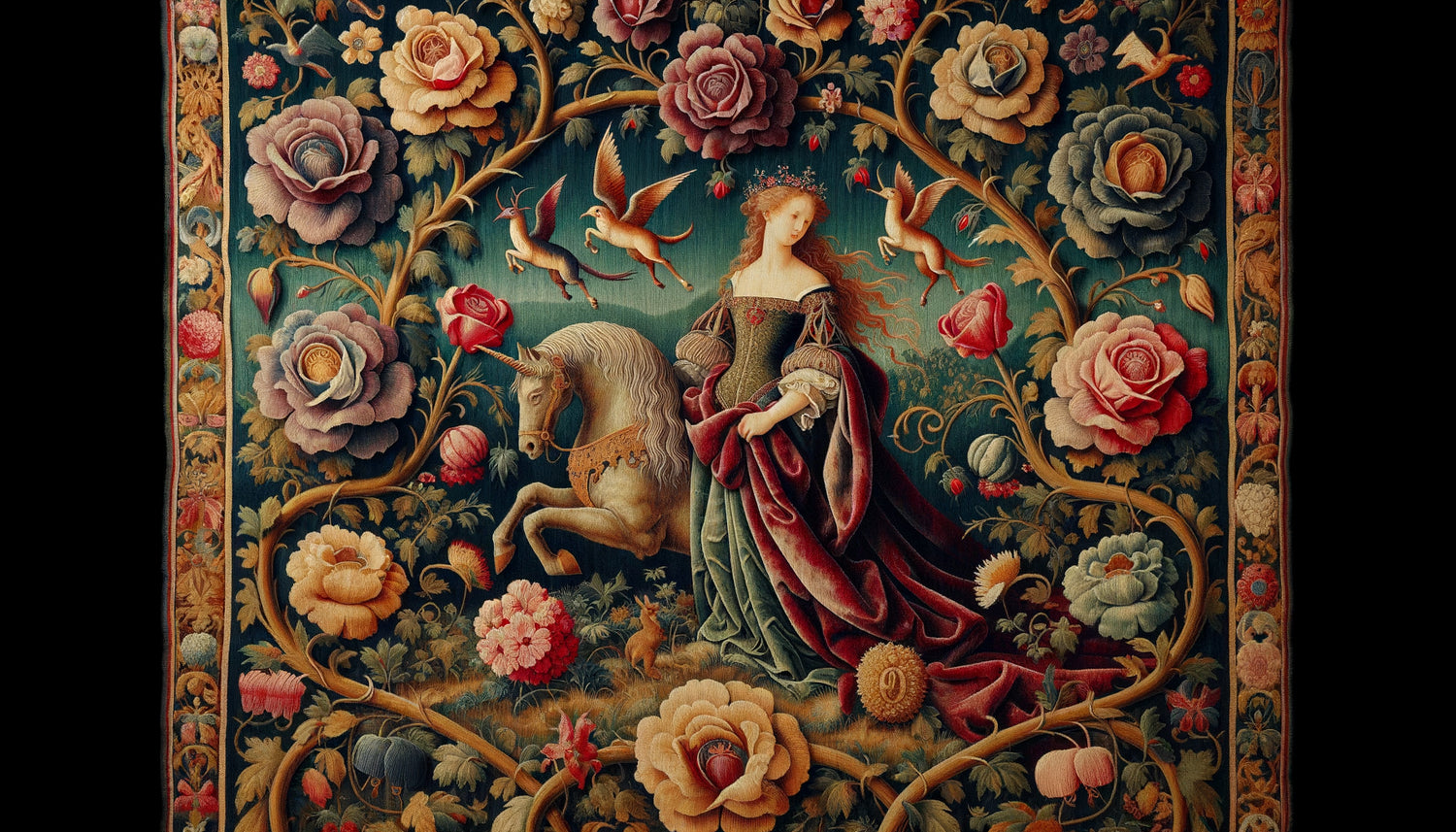
The landscapes millefleurs of The Lady and the Unicorn are not realistic gardens. On a crimson red background, an impossible meadow blooms where spring and autumn plants coexist, Mediterranean and Nordic species. Daisies mingle with carnations, thoughts converse with snapdragons. This profusion of vegetation, far from being fanciful, follows a precise logic.
In the workshop where these tapestries were woven – probably in Brussels around 1500 – preparatory cartoons mobilized a veritable botanical encyclopedia. Each flower possessed its meaning in the language of courtly love: carnations evoked marriage, lilies purity, thoughts faithful memory. The landscape thus becomes a vegetal text celebrating aristocratic virtues and refined love.
But this symbolic dimension does not exclude the decorative function. On the contrary, it sublimates it. These tapestries were intended to warm and embellish the stone walls of castles. Their primary function remained to create a luxurious environment, an illusion of a perpetual garden in state rooms. The patrons – probably the Le Viste family – simultaneously desired decorative ostentation and allegorical depth.
When animals tell a secret cosmology
Carefully observe the creatures populating these landscapes: beyond the heraldic unicorn and lion, you will discover rabbits, foxes, herons, monkeys, leopards. This abundant fauna is not simply a zoological catalog. It composes a moral bestiary where each animal embodies spiritual qualities or dangers.
The rabbit symbolizes fertility and innocence, but also sensuality that must be mastered. The monkey represents the instinct to be domesticated. Birds – nightingales, partridges, ducks – evoke souls aspiring to the divine. In the tapestry of Taste, a parrot takes a seed in the hand of the lady: symbol of eloquence and imitation, it signifies aristocratic education and the transmission of knowledge.
Yet these animals also create a purely visual dynamic. Their rhythmic distribution structures the space of the tapestry, guides the viewer's eye, creates areas of rest and tension. The Flemish weavers perfectly mastered this balance between symbolic narration and decorative composition. Every element of the landscape works in two modes: it means and it embellishes, simultaneously.
The flowering island: a space outside the world
Notice that in each tapestry, the central group stands on an oval blue island emerging from the millefleurs red background. This island constitutes a sacred space, a hortus conclusus – enclosed garden – which isolates the allegorical scene from the rest of the landscape. It is a medieval pictorial convention inherited from illuminations, but it is also a powerful narrative device.
This process creates a visual hierarchy: the landscape becomes both frame and context. It envelops without invading, accompanies without distracting. The flowers in the background remain smaller, treated as repetitive motifs, while those of the island are more varied and detailed. This technical sophistication is evidence of a very conscious decorative intention: to create a visually harmonious environment where the eye can circulate freely.

Color as a symbolic and decorative system
The vermilion red background that unifies the six tapestries is itself a manifesto of aesthetics. In medieval chromatic hierarchy, red embodied divine passion, courtly love, but also earthly wealth – high-quality red pigments were extremely expensive. Choosing this red background for the entire cycle was a decision both symbolic, decorative and ostentatious.
On this crimson sea, the delicate nuances of the flowers create a chromatic polyphony: pure whites, deep blues, golden yellows, soft pinks. The weavers used more than two hundred different shades in this ensemble. This colorful profusion served several purposes: to dazzle the visitor with technical virtuosity, to create a luxurious and contemplative atmosphere, but also to deploy a language of colors where each shade possessed its spiritual resonance.
The blue of the central island, obtained by pastel or indigo dyes, evoked the sky and transcendence. The green of the foliage symbolized hope and renewal. This palette was never arbitrary: it wove a network of correspondences between the visible and invisible world, between aesthetic pleasure and spiritual meditation.
A contemporary reading: beyond the false debate
Opposing symbolic dimension and decorative function in the landscapes of The Lady with the Unicorn is to project onto the Middle Ages a modern separation between form and content that did not exist at the time. For 16th-century aristocrats, beauty and meaning formed an inseparable unity. An object that was only beautiful without depth would have seemed vain; a work loaded with symbols but ugly would have failed to elevate the soul.
These tapestries embody a holistic conception of art where the decorative landscape becomes the vehicle for spiritual meaning. The millefleurs flowers are not disguised symbols in ornaments, nor decorations endowed after the fact with an artificial meaning: they are the visible manifestation of an invisible order, the material translation of a worldview.
In our contemporary interiors, this dual dimension remains relevant. A reproduction of these tapestries works wonderfully as a decorative element – its rich colors, balanced composition, and visual density create a strong presence. But it also offers, for those who want to linger on it, a contemplative depth that transforms the relationship with the work.
Integrate this duality into your decoration
The landscapes of The Lady with the Unicorn teach us a valuable lesson for our current decorative choices: the most durable works are those that work on multiple levels. A painting or tapestry that immediately seduces by its aesthetics, then gradually reveals layers of meaning, permanently enriches our daily environment.
This approach aligns with contemporary trends such as slow design, the search for objects with stories, and the desire for interiors that nourish both the senses and the mind. Millefleur landscapes, with their narrative density and visual harmony, offer a model of smart decoration where each glance reveals new details.
Transform your space into a garden of contemplation
Discover our exclusive collection of nature artworks that capture this masterful alliance between decorative beauty and symbolic depth, for interiors that tell stories.

Create your own landscape of meaning
The real question is not whether the Lady with the Unicorn landscapes are symbolic or decorative. They are both, and it is precisely this fusion that makes their timeless grandeur. In an era saturated with superficial images, these tapestries remind us that a visual environment can simultaneously enchant the eye and nourish reflection.
Imagine yourself tomorrow morning, contemplating your wall adorned with a rich and sophisticated vegetal composition. You will first find immediate pleasure: the harmony of colors, the balance of the composition, the sensation of an eternal garden. Then, over the days, you will discover the details: this bird hidden in the foliage, this flower that evokes a memory, these subtle correspondences between the elements.
This is exactly what the Lady with the Unicorn landscapes have offered for five centuries: a beauty that deepens rather than diminishes. Choose for your interior works of art that possess this double dimension – which beautify your daily life while opening spaces for meaning and contemplation. Your visual environment shapes your experience of the world: make it a garden where symbolism and aesthetics flourish together.
Frequently asked questions about the Lady with the Unicorn landscapes
Can all the plants in the tapestries be identified?
Botanists have recorded approximately forty distinct plant species in the landscapes of tapestries, most of which can be identified with certainty: carnations, daisies, violas, snapdragons, periwinkles, strawberries, dandelions, violets... However, some flowers remain stylized and difficult to identify precisely. This semi-reality is intentional: it is not a scientific herbarium but a poetic composition where recognizable plants coexist with idealized forms. This approach allowed weavers to create a garden of the mind rather than a naturalist inventory, while remaining faithful enough to reality for audiences of the time to recognize and interpret the main species according to their customary and religious symbolism.
How to integrate this aesthetic into a modern decoration?
The aesthetic of millefleurs landscapes adapts wonderfully to contemporary interiors, provided that certain principles are respected. Favor a neutral wall to accommodate a reproduction or a work inspired by these tapestries – off-white, pearl gray, or warm beige will highlight the chromatic richness without creating visual conflict. Avoid overloading the space: one striking piece is enough, surrounded by minimalist furniture with simple lines. The controlled maximalist approach works particularly well: a flourishing landscape framed by modern minimalism. In terms of color palette, pick up some tones present in the work in your textiles and accessories – a deep red cushion, a navy blue throw, touches of sage green. This will create a subtle conversation between tradition and modernity, exactly in the spirit of fusion that characterizes the original tapestries.
Is it necessary to know the symbols to appreciate these works?
Absolutely not, and that is precisely where all their beauty lies. Their first quality is their immediate visual impact: the harmonious color scheme, the balanced composition, the feeling of being transported into a timeless garden work independently of any symbolic knowledge. A person who knows nothing about the medieval language of flowers will be captivated by the visual richness and serenity that emanate from these landscapes. The symbolic dimension constitutes an additional layer of pleasure and understanding, not a prerequisite. It is gradually revealed, enriching the relationship with the work over time. This is also a characteristic of great artistic creations: they operate on several levels simultaneously, immediately touching every viewer while reserving depths to explore for those who wish. First let yourself be seduced by the pure beauty of these landscapes; the symbols will come later, naturally, like friends you get to know.