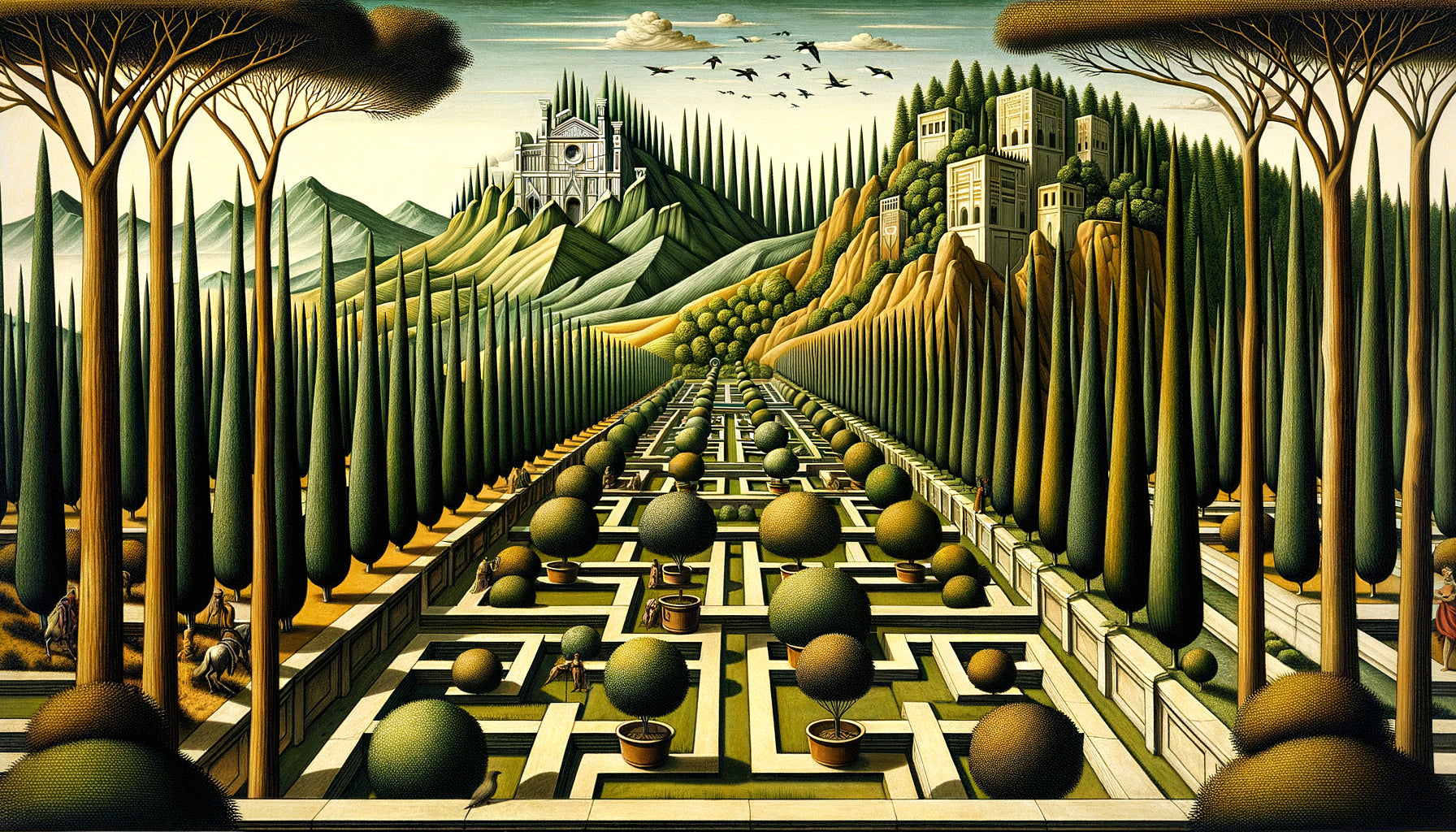
Imagine a young Flemish architect crossing the Alps in the 16th century, breathless before his first Medici villa surrounded by terraced gardens. This precise moment will forever alter his conception of landscape. The travels to Italy of Northern European gardeners triggered an aesthetic revolution whose echoes still resonate in our contemporary gardens. These initiatory journeys transformed artisans into visionaries, copyists into creators.
Here's what these Italian travels brought to Northern European gardeners: a revolutionary understanding of perspective applied to gardens, a mastery of harmony between architecture and vegetation, and the audacity to import Mediterranean concepts into northern climates. You may wonder how these artists managed to transpose Tuscan light under gray skies in the North? How did they finance these perilous journeys lasting several months? And above all, why do these Italian influences remain so present in current landscape design? Rest assured: this transformation was neither instantaneous nor uniform. Each Northern European gardener digested the Italian experience in his own way, creating a unique synthesis between local tradition and Mediterranean innovation. I invite you to follow this route through the Alps that transformed the art of European gardens.
The Grand Tour: when crossing the Alps changed a career
The travels to Italy constituted the culmination of any Northern European artistic training. For gardeners from the Netherlands, Germany or England, crossing the Alps represented much more than a geographical displacement: it was an initiation. The journey generally lasted between six months and two years, punctuated by obligatory stops in Florence, Rome and Venice.
These Northern European artists discovered in Italy a radically different conception of the garden. Where Flemish traditions favored closed and compartmentalized gardens, Italian villas deployed bold perspectives. The gardens of Villa d'Este in Tivoli, with their spectacular water games, or those of Villa Lante in Bagnaia, with their perfect geometry, struck the minds of Northern Europeans accustomed to more modest compositions.
The Northern European gardeners filled entire notebooks with sketches and observations. They measured the proportions of the terraces, analyzed the hydraulic systems, studied the layout of cypress groves. This methodical documentation would allow them, upon their return, to reproduce not a servile copy, but an interpretation adapted to the climatic and cultural constraints of their region of origin.
The revelation of perspective: the art of taming the horizon
The major contribution of Italian influence on Northern European gardeners was the application of linear perspective to gardens. Italian Renaissance architects, nourished by Vitruvius' writings and Brunelleschi's experiments, mastered the art of creating illusions of space. Italian gardens used converging paths, hedges cut in gradient and strategic plantings to create an impression of vertiginous depth.
For a Nordic landscape architect accustomed to the flat spaces of polders or intimate medieval gardens, this discovery was revolutionary. The garden ceased to be a simple collection of vegetable patches and flowerbeds to become a spatial composition conceived as a three-dimensional painting. The eye had to be guided, surprised, amazed by calculated effects down to the millimeter.
The Nordic adaptation of Italian perspective
The genius of Nordic landscape architects was not to simply copy, but to adapt. They understood that the long Italian perspectives, magnified by intense Mediterranean light, had to be rethought under the softer skies of the North. They shortened axes, accentuated color contrasts in vegetation, multiplied intermediate planes to compensate for more diffuse lighting. This creative synthesis considerably enriched the European landscape vocabulary.

The dialogue between stone and vegetation: a lesson in harmony
In Italy, Nordic landscape architects discovered a masterful integration between architecture and garden. The villas of Palladio in Venice or the Boboli gardens in Florence demonstrated how buildings and landscapes could form an inseparable unit. Monumental staircases, sculpted balustrades, architectural fountains: all participated in a global vision where mineral and vegetation dialogued on equal terms.
This lesson deeply marked Northern architects. Upon returning to their countries, they imported the idea of gardens structured by strong architectural elements. Terraces, even modest ones, pergolas, summer pavilions: all elements directly inspired by Italian observations. The Nordic garden moved out of its utilitarian status to access the artistic dimension.
The influence was also evident in the choice of materials. Landscape architects learned to value local stone, to create texture contrasts, to play with reflections in basins. Trips to Italy taught that each material possessed its own voice in the symphony of the garden.
When cypresses meet beeches: botanical adaptation
A major challenge awaited the Nordic landscape architects upon their return: how to transpose the Mediterranean plant palette under much stricter climates? The slender cypresses, potted orange trees, and rose laurels: all this vegetation emblematic of Italian gardens would not survive the northern winters.
The ingenuity of Northern landscapers unfolded within this constraint. They sought botanical equivalents: trimmed yews replaced cypresses, trained lime trees evoked vine pergolas, boxwoods structured flowerbeds like Italian myrtles. This botanical translation created a hybrid landscape language, authentically European.
Greenhouses: Literally Importing Italy
For the most precious Mediterranean species, Nordic landscape architects developed a revolutionary innovation: heated orangeries and greenhouses. These buildings made it possible to cultivate citrus fruits, laurels, and other exotic plants, creating veritable Italian enclaves in the heart of the North. The botanical collections of merchant princes testified to their fascination with the flora discovered during their trips to Italy.

The invisible legacy: how these influences shape our gardens today
Five centuries later, the impact of Nordic landscape architects’ trips to Italy remains perceptible. Whenever we structure a garden with geometric hedges, create a perspective towards a focal point, or integrate a fountain as a central element, we reactivate this legacy. The Italian Renaissance laid the foundations for a universal landscape language.
Contemporary gardens, even the most modern ones, dialogue with these age-old principles. The idea that a garden should offer an spatial experience orchestrated, that vegetation can be sculpted like stone, that visual axes create meaning: all these notions descend directly from the observations made by these Nordic pioneers traversing the Tuscan hills.
In our current arrangements, small or large, we benefit from this synthesis between Nordic rigor and Mediterranean sensuality. The Nordic landscape architects of the Renaissance bequeathed to us much more than techniques: a way of thinking about outdoor space as a harmonious extension of housing, as a theater of daily life.
Get inspired by this encounter between North and South
Discover our exclusive collection of nature paintings that captures the spirit of Italian landscapes which have so inspired the masters of the Renaissance.
Your garden holds these ancient journeys within it
Each garden tells a story of travel and adaptation. Northern landscape architects who crossed the Alps with their sketchbooks were not seeking to erase their identity, but to enrich it. They returned transformed, carrying a broadened vision where northern mists met Tuscan light.
Today, when you plant a geometrically shaped shrub, when you create a bordered path guiding the gaze towards a focal point, when you integrate a water basin into your terrace: you perpetuate this tradition of dialogue between landscape cultures. You become, on your scale, the heir to these artists travelers who dared to cross the mountains to reinvent the art of gardening. What better inspiration for your next landscaping project than this story of intercultural curiosity, boldness and creativity?
FAQ: Your questions about the Italian influence of Northern landscape architects
Why did Northern landscape architects absolutely have to travel to Italy?
Renaissance Italy concentrated excellence in landscape architecture. Italian gardens had rediscovered and reinterpreted the ancient principles of spatial composition, creating a laboratory of innovation unparalleled in Europe. For a northern landscape architect, not making this journey was equivalent to ignoring major advances in their discipline. These trips to Italy were not tourism, but essential professional training. Landscape architects learned there the mastery of perspective, the art of modeling the terrain, the sophisticated use of water, and above all a philosophy of the garden as a total work of art. Upon returning, they benefited from considerably increased professional recognition and gained access to the most prestigious commissions.
How did they adapt Italian concepts to northern climates?
Adaptation represented the true test of a landscape architect's talent. Nordic landscape architects could not simply reproduce Italian models: climate, light, and available vegetation differed radically. Their genius lay in extracting fundamental principles rather than superficial details. They shortened perspectives to compensate for more diffuse light, replaced Mediterranean species with frost-resistant Nordic equivalents, adapted hydraulic systems to heavier rainfall. Italian terraces inspired gently sloping solutions better suited to flat terrains. This constrained creativity wonderfully enriched the European landscape vocabulary, creating distinct regional styles while sharing a common grammar inherited from Italian influence.
Can we still see examples of these gardens influenced by Italy?
Absolutely, and they are more numerous than one might imagine! Many historical gardens in Northern Europe directly testify to this Italian Renaissance influence. The gardens of Frederiksborg Castle in Denmark, Het Loo in the Netherlands, or Herrenhausen in Germany clearly show this synthesis between Nordic rigor and Italian concepts. In England, Tudor and Stuart gardens massively integrated these principles. Even in more recent creations, the codes persist: axes of symmetry, structuring terraces, central fountains, geometric topiary. Visiting these places offers a fascinating experience to understand how the travels of Nordic landscape architects to Italy literally redrew the European cultural landscape. Each walk through these historical gardens is a journey back in time to this pivotal period when North met South.