For a long time, I believed that the richness of a work was measured by the number of pigments on my palette. Until that day in 2018, in an old ochre quarry in the Luberon, where I understood that the earth itself contained all the secrets of chromatic harmony. Observing the geological strata – from light beige to deep brown, through all the oranges and reds – I discovered what the Old Masters already knew: limitation becomes freedom.
Here's what limited earth palettes bring to your artistic practice: instantaneous chromatic coherence that naturally unifies your compositions, an authentic mineral depth that synthetic colors struggle to reproduce, and an ancestral connection with the first pictorial gestures of humanity.
You may have already felt this frustration: multiplying tubes of paint without ever achieving that natural harmony you admire in the great masters. Your colors shout instead of dialoguing, your landscapes lack that mineral authenticity that makes a canvas vibrate. Rest assured: it's not a question of talent, but of chromatic understanding. By adopting a limited earth palette, you join a millennial tradition that produced the frescoes of Lascaux, the portraits of Rembrandt and the landscapes of Corot. Restriction becomes your best creative ally.
The mineral intelligence of natural pigments
Earth pigments have a fascinating peculiarity: they all come from the same mineral family, iron oxides. This geological kinship explains their innate harmony. Unlike modern synthetic colors, designed for maximum intensity, earths murmur rather than shout.
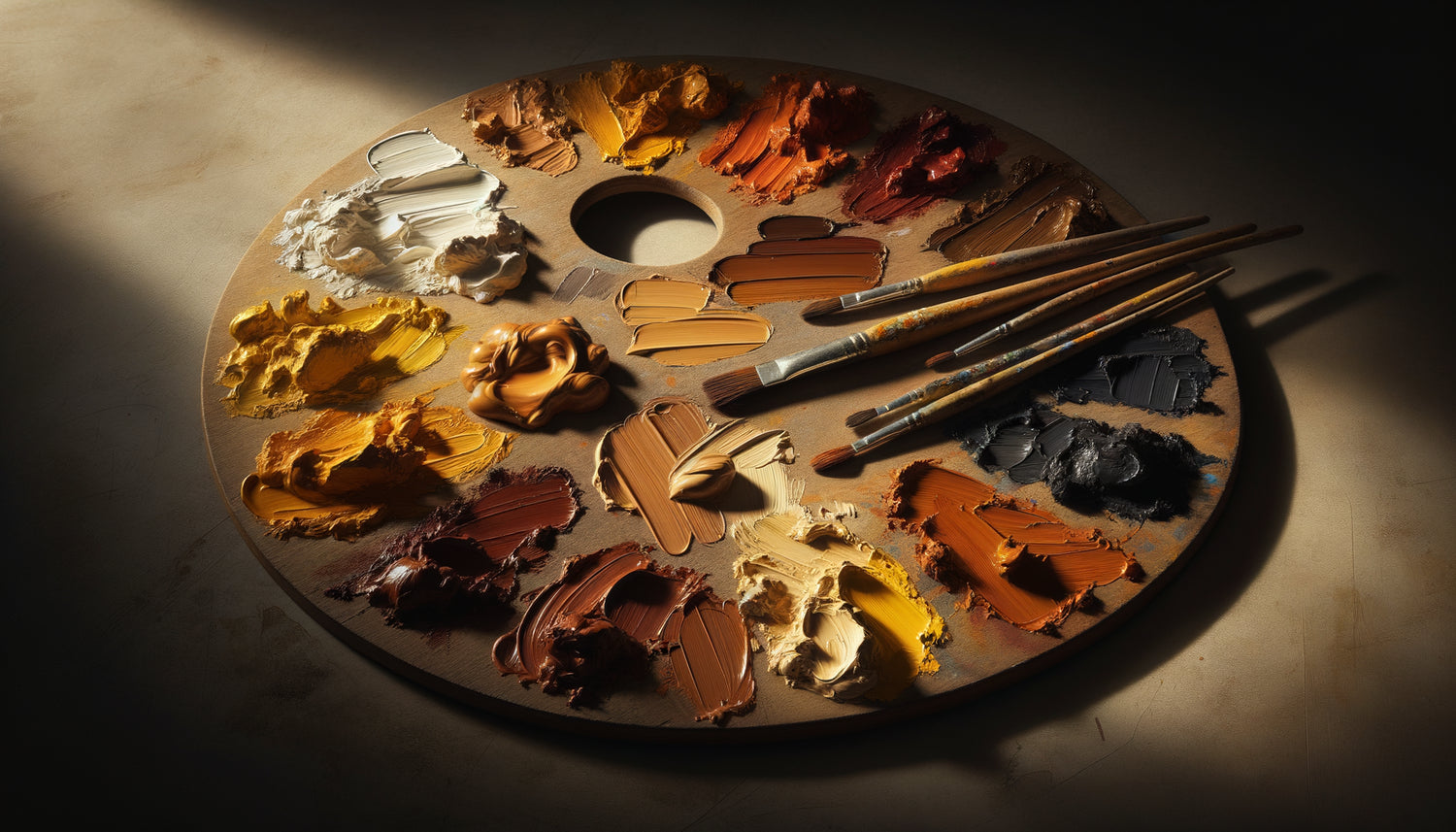
Yellow ochre brings the soft light of autumn mornings. Natural Siennese earth offers those warm oranges of barks and foliage. Burnt Siennese earth introduces the depth of aged woods. Red ochre evokes clays baked by the sun. And shadow earth, natural or burnt, anchors your compositions in that mineral gravity that gives weight to your subjects.
These five pigments are enough to create a complete chromatic universe. Mixed with titanium white, they generate hundreds of subtle nuances. Combined with each other, they produce olive greens, colored grays, velvety browns that all contain this particular quality: the authenticity of raw material.
Granulometry, secret of pictorial vibration
What I discovered by grinding my own pigments is that earths have a particular texture. Their irregular granulometry catches the light differently depending on the angle of observation. A generous layer of yellow ochre reveals micro-tonal variations that bring your surface to life. It's this mineral vibration that the Flemish masters sought after by layering their earth glazes.
Composing Your Minimalist Palette: Essential Combinations
I spent years testing different combinations before identifying three limited earth palettes that respond to distinct pictorial intentions. Each tells a particular chromatic story.
The monochrome shadow palette – natural raw umber, burnt sienna umber, white – is perfect for tonal studies and misty landscapes. It's the palette of gentle melancholy, winter woodlands, and overcast skies. It teaches the value of form before color, structure before detail. 19th-century watercolorists used it for their preparatory studies, creating monochromes of astonishing power.
The classic warm palette – yellow ochre, natural sienna earth, burnt sienne earth, white – celebrates Mediterranean light. It's the universe of Provence facades, wheat fields, sun-kissed skin. This limited earth palette built the aesthetic of Venetian masters. It allows you to paint lights that seem to come from within the canvas, that organic luminescence that digital screens cannot reproduce.
The complete naturalist palette – the five earths mentioned plus white – offers maximum versatility while maintaining chromatic unity. You can paint any natural subject with this palette. Forest greens are born from the mixture of yellow ochre and raw umber. Atmospheric grays emerge from the meeting between burnt sienna earth and natural raw umber, softened with white. Ancient roses appear by adding white to red ochre.
White, This Sixth Essential Element
Never underestimate the role of white in your limited earth palette. It's not just a simple brightener. Titanium white, dense and opaque, transforms your earths into mineral pastels. Zinc white, more transparent, allows for luminous glazes. Some days, I work only with one earth and two whites – this extreme restriction produces a meditative coherence in my compositions.

The Secrets of Mixing for Guaranteed Harmony
Here’s what fifteen years of practice have taught me: with a limited earth palette, chromatic error becomes almost impossible. Why? Because all your mixes share a common base. Each color contains a little of all the others, naturally creating that organic unity which characterizes great works.
To obtain natural greens, mix yellow ochre and raw umber. Add white for the soft greens of spring, burnt sienna earth for the deep greens of summer. These earthy greens possess a quality that emerald green tube will never have: they blend perfectly into your palette, dialogue with your browns, oranges, grays.
Colored grays represent the true treasure of limited earth palettes. By varying the proportions of raw umber and burnt sienna earth, you create grays that tend towards blue, violet, green, pink. These living grays give this atmospheric depth to backgrounds, this subtle vibration to shadows.
A principle was passed down to me by an Italian fresco restorer: never exceed three pigments per mix. Raw umber + burnt sienna earth + white produces hundreds of shades depending on the proportions. Add a fourth pigment and you risk chromatic muddiness. This discipline of minimal mixing guarantees the clarity of your colors.
Painting the living with minerals: paradox and revelation
How can pigments from rocks so well translate flesh, foliage, skin? That was the question that obsessed me at the beginning. The answer came by observing nature itself: all living things are nourished by the minerals of the soil. Plants draw their color from the earth. Our own complexion reflects the elements that make up our bodies. The limited earth palette does not copy nature, it shares its substance.
To paint portraits in earth palettes, I use a technique I call mineral stratification. A base of natural sienna earth establishes the general luminosity of the skin. Touches of yellow ochre bring the illuminated areas. Burnt sienna earth models the volumes. Red ochre warms the cheeks, lips. Finally, raw umber sculpts the shadows, always mixed with other earths to avoid any harshness. The result? Complexions that breathe, that seem to come from within.
Naturalistic landscapes find their perfect expression in these palettes. Imagine painting an autumn forest: your limited earth palette already contains all the oranges, browns, ochres of foliage. Tree trunks, dirt paths, rocks, dead wood – all share this same color family. Your painting instantly acquires that organic coherence which is often lacking in works using too many disparate colors.
Water and sky in earth palette: the technical challenge
The apparent difficulty of limited earth palettes lies in the blues. How do you paint water, the sky, without blue? I solved this riddle by studying American tonalist painters of the 19th century. They painted entire twilight skies without a touch of blue. Their secret: slightly purplish grays obtained by mixing burnt umber, red ochre and lots of white. These pseudo-blues possess an atmospheric quality that true blues cannot match.
For water, I apply the same principle. A mixture of natural umber and white, slightly warmed with a touch of yellow ochre, produces these greenish grays of rivers under foliage. A touch of burnt Sienna imitates the warm reflections of the setting sun on the water. Chromatic restriction forces you to observe reality more closely: water is never simply blue, it reflects its environment, and your earth palette excels at translating these subtle nuances.

The temporal dimension: painting with the patina of time
What fascinates me deeply about limited earth palettes is their relationship to time. These pigments cross the centuries without weakening. The ochres of Lascaux, 17000 years old, retain their luster. Earths are among the most chemically stable pigments. By choosing this palette, you create works that defy aging.
But there's more: these colors naturally evoke patina, noble wear, the beauty of passing time. A canvas painted in an earth palette immediately possesses this timeless quality, as if it had always existed. This is particularly evident in still lifes. Everyday objects – a terracotta vase, bread, dried fruit, wood – painted with these earths acquire a meditative presence, a silent dignity.
I've noticed that my works in earth palettes age differently from those using synthetic colors. They don't go out of style because they were never modern. They belong to a long, geological time that transcends fleeting trends. Some collectors specifically seek this timeless quality for their interiors.
Transcending limitation: when constraint liberates
The paradox of limited earth palettes is that they broaden your vision rather than restrict it. By eliminating the paralyzing choice facing dozens of tubes, you free your attention to the essentials: composition, light, emotion. Your palette becomes a perfectly mastered vocabulary, like a musician who knows their instrument by heart.
I've observed a transformation in my students who adopt these palettes. Their painting gains confidence. They no longer wonder which color to use, they *feel* the necessary blend. Their works acquire that recognizable chromatic signature that defines a true personal style. Limitation becomes identity.
Some days, I work with only two earths and white. This voluntary austerity sharpens my gaze. I discover nuances I would never have seen in abundance. It's a form of pictorial meditation, an intimate dialogue with the mineral matter. The canvas becomes the place of a simple alchemy: transforming earth into light, mineral into emotion.
Let the mineral harmony transform your daily life
Discover our exclusive collection of nature paintings that celebrates this timeless earthy aesthetic, where each work dialogues with the natural tones of your interior.
Integrating the earth spirit into your creative practice
Adopting a limited earth palette does not mean giving up other colors forever. It's rather establishing a solid foundation, a deep understanding of chromatic harmony. Many artists, after exploring these palettes, return to wider ranges – but transformed. They now understand how to create unity, how to make colors dialogue, how limitation generates power.
I recommend dedicating at least three months to working exclusively in an earth palette. Three months to unlearn your reflexes, to discover the hidden richness within apparent simplicity. You will be amazed at how many subjects naturally lend themselves to this approach: autumn and winter landscapes, intimate interior scenes, contemplative portraits, rustic still lifes.
Your gaze on nature will also change. You will begin to see earths everywhere: in the bark, rocks, paths, old buildings, skin at sunset. The world reveals its mineral structure to those who learn the language of earth. It is an education of the gaze that enriches your artistic practice far beyond painting.
Imagine yourself in your studio, facing a blank canvas, with only five pigments and a white. No hesitation, no chromatic doubt. Your hands know these earths by heart. They know that yellow ochre brings joy, that burnt umber anchors the composition, that burnt Sienna warms the shadows. You paint with the confidence of someone who masters their vocabulary. Your work emerges with that natural coherence you've been searching for forever. The colors no longer argue, they converse. Your painting breathes.
The mineral harmony you have created on canvas, you will carry it into your life. Because painting with limited earth palettes teaches a philosophy: that of the essential, the sufficient, the beauty in simplicity. It is a lesson that goes far beyond the workshop.
Tomorrow, choose three tubes of earth and one white. Place them on your palette. Observe them for a moment. These pigments have crossed millennia, they painted prehistoric caves, Renaissance frescoes, Impressionist masterpieces. Now it's your turn to tell your story with this ancestral palette. What will be your first work in mineral harmony?