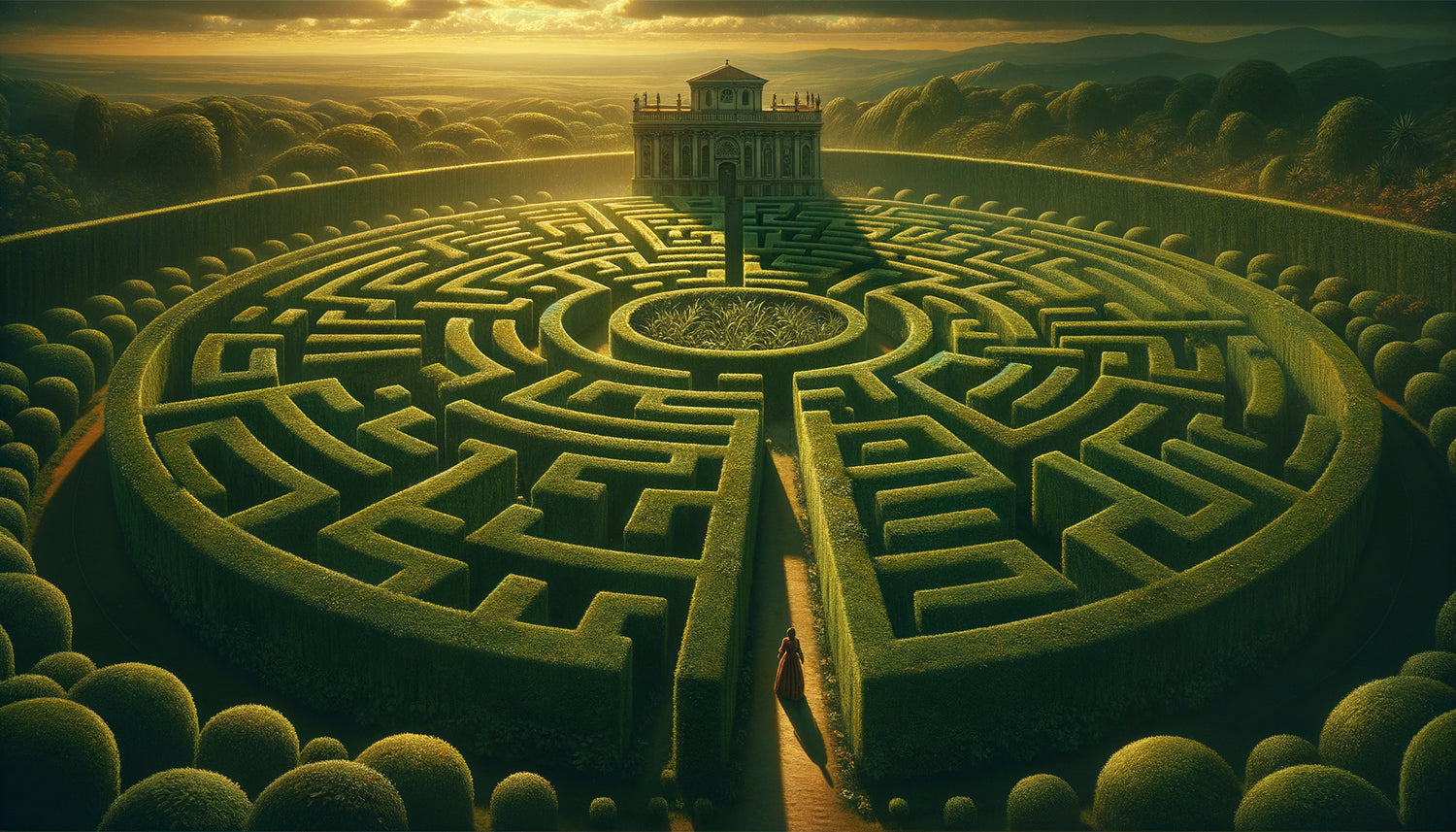
Imagine yourself facing a painting where boxwood hedges rise like green walls, where each path seems to promise an exit before leading you back to the starting point. This feeling of controlled vertigo, this dance between anxiety and wonder: that is precisely what masters of allegorical painting have immortalized through the centuries. The vegetable labyrinth is never simply a decorative motif in these works. It embodies our own human condition: the search for meaning, the necessary wandering, this inner quest that makes us grow with each impasse crossed.
Here's what the vegetable maze in allegorical painting brings: a visual metaphor of existential complexity, an invitation to contemplate our own wanderings, and an inexhaustible source of inspiration for those seeking to introduce depth and mystery into their interior. Too often, we reduce these representations to simple ordered gardens. We miss the symbolic richness, the narrative tension that beats at the heart of each composition. But once you understand the secret language of these painted labyrinths, your view of wall art changes radically. I promise you that after this exploration, you will never look at a garden canvas in the same way again.
When paths close in: the birth of a symbol
In the workshops of the Italian Renaissance, the vegetable labyrinth emerges as a major allegorical motif. Florentine painters intuitively understand that these geometric structures of greenery offer fertile ground for expressing the invisible. Unlike ancient labyrinths carved in stone, the vegetable labyrinth has this organic, living dimension, almost threatening in its ability to grow and evolve. In the frescoes of palaces, it becomes the setting for initiatory tales where the hero must overcome trials to attain knowledge.
Mannerist masters like Bronzino or Pontormo integrate these structures into their complex allegorical compositions. The vegetable labyrinth appears in the background, sometimes barely suggested by a few skillfully arranged hedges. But its influence on the reading of the work is immense: it creates psychological depth, suggests that the character's journey is fraught with obstacles. This metaphorical dimension transforms a simple decorative element into a true narrative protagonist.
Geometry in the service of emotion
What fascinates about the pictorial treatment of the vegetable labyrinth is precisely this paradoxical alliance between order and chaos. The hedges draw perfectly controlled, almost architectural lines. Yet their multiplication creates a feeling of confusion. Painters masterfully play on this duality: the formal rigor of the composition opposes the anguish of being lost that it suggests. In Flemish 17th-century works, we observe how Jan Brueghel the Elder integrates these labyrinthine structures into his Eden gardens, creating tension between paradise and trial.
Being lost as a path: the philosophy of lost paths
The vegetal labyrinth in allegorical painting never represents a simple obstacle. Rather, it embodies the profound idea that getting lost is an integral part of the quest. Baroque artists brilliantly exploit this notion. In their large theatrical compositions, the central character is often depicted at a crossroads in the labyrinth, hesitating between several paths. This hesitation is not weakness: it is wisdom, a necessary moment of reflection before the decisive choice.
Rubens, in his mythological representations, uses the vegetal labyrinth as a dramatic device. Green hedges frame the action, creating natural chambers where scenes of love, betrayal or revelation play out. The viewer becomes a voyeur of an intimacy protected by these plant walls. This mise en abyme is particularly disturbing: we observe characters who themselves are seeking their way, thus creating an immediate identification. The vegetal labyrinth becomes a mirror of our own condition as beings perpetually searching for their path.
The colors of uncertainty
The chromatic palette used to represent the vegetal labyrinth always betrays the painter's allegorical intention. Deep greens, almost black in the shadows, contrast with luminous highlights that suggest a possible exit. This luminous dramaturgy transforms the simple botanical representation into a true mental landscape. Dutch masters excel in this treatment: their vegetal labyrinths seem to breathe, vibrate with an autonomous life that goes beyond mere imitation of nature.

At the heart of the maze: figures of the quest
Who roams these green paths in allegorical painting? Rarely ordinary characters. The vegetal labyrinth welcomes mythological heroes, cursed lovers, meditating philosophers. Theseus still confronts his Minotaur there, but this time in a setting of greenery rather than cold stone. This shift from mineral to vegetation is not insignificant: it humanizes the myth, makes it more accessible, more contemporary for 16th and 17th century viewers who have their own French gardens.
In the gallant scenes of the 18th century, painted by Fragonard or Watteau, the vegetal labyrinth becomes a playground for lovers. Secret bosquets offer refuge for forbidden conversations, clandestine encounters. But even in these seemingly lighthearted scenes, there remains an allegorical dimension: love itself is a labyrinth where one gets delightfully lost. Rococo artists understand that the vegetal labyrinth does not need to be threatening to be meaningful. It can embody the complexity of romantic feeling, its detours, its false trails, its sudden revelations at the turn of an alley.
Compose your own inner labyrinth
How to integrate this symbolic richness into our daily environment? A quality reproduction of a painting depicting an allegorical vegetal labyrinth has this unique power to transform a space. It does not decorate: it opens perspectives, creates contemplative depth. In an office, it recalls that every professional path includes necessary wanderings. In a living room, it invites philosophical conversation, the sharing of existential questions.
The format and framing play a crucial role. Vertical compositions, where the vegetal labyrinth rises like a natural cathedral, are particularly suitable for narrow spaces which they seem to enlarge with their upward perspective. Panoramic formats, which deploy the labyrinth in all its horizontal complexity, create an immersive effect ideal for large walls. Lighting also deserves attention: direct light reveals botanical details, while indirect lighting accentuates the mysterious dimension of these enigmatic vegetal structures.
Color and stylistic associations
The vegetal labyrinth in allegorical painting wonderfully dialogues with contemporary interiors. Its geometric structure blends with the clean lines of modern design, while its organic dimension brings the necessary warmth. In a minimalist interior, it introduces complexity without breaking harmony. In a more classic space, it reinforces cultural and historical anchoring. Natural green tones readily combine with noble materials: dark woods, patinated leathers, natural textiles in linen or hemp.
Let yourself be guided by the beauty of winding paths
Discover our exclusive collection of nature paintings that capture this mysterious essence of the vegetal labyrinth and transform your spaces into invitations to deep contemplation.

When wandering becomes wisdom: the lesson of masters
The greatest painters of allegorical vegetal labyrinths teach us an essential truth: there are no wrong paths, only different ones. In the symbolic works of the 19th century, this philosophy reaches its peak. The English Pre-Raphaelites, particularly Burne-Jones, create vegetable labyrinths where every path seems to lead to a different revelation. The center of the labyrinth is no longer necessarily the ultimate goal: the journey itself becomes essential.
This evolution reflects a profound change in our understanding of the human quest. The vegetal labyrinth ceases to be an ordeal to overcome and becomes a space for exploration, self-discovery. Symbolists integrate fantastic elements: impossible flowers, dreamlike perspectives, mythical creatures hidden in the foliage. This dreamlike dimension transforms the vegetable labyrinth into a mental landscape where we project our desires, our fears, our deepest aspirations.
The labyrinth as meditation
In our era of constant acceleration, the vegetable labyrinth in allegorical painting offers a saving counterpoint. Contemplating these complex structures naturally slows down the gaze. The eye follows the meanders, explores dead ends, seeks passages. This visual gymnastics induces a meditative state comparable to that provided by mandalas or Zen gardens. Placing such a work in a space dedicated to rest or reflection considerably amplifies its soothing potential.
The seasonal variations represented in these paintings add a fascinating temporal dimension. A springtime vegetable labyrinth, bursting with young shoots, evokes renewal and infinite possibilities. The same motif in autumn, with its copper foliage, speaks of maturity and accumulated wisdom. This cyclicality recalls that our own wanderings are part of a long time, that each phase has its beauty and necessity.
Reinventing the labyrinth for our time
How do contemporary artists appropriate this legacy of allegorical vegetable labyrinths? Some photographers create series on historical gardens, capturing these ancestral structures with a new gaze. Other abstract painters decompose the motif into pure lines and colors, preserving the labyrinthine essence while eliminating figurative representation. These reinterpretations prove the inexhaustible vitality of the theme.
The growing interest in the vegetal labyrinth in contemporary art may reflect our collective need for symbols of orientation in a world perceived as increasingly complex. Faced with the multiplication of choices and possible paths, the labyrinth paradoxically offers a reassuring framework: certainly the paths are multiple, but they exist, they are traced, they lead somewhere. This structure within chaos resonates deeply with our current aspirations to find meaning without renouncing freedom of exploration.
Integrating a work representing a vegetal labyrinth into one's interior then becomes an almost militant act: that of slowing down, contemplating, accepting that the winding path has its own beauty. It is choosing depth over superficiality, reflection over reaction, patient quest over immediate gratification. In a bedroom, this presence encourages nocturnal reveries and inspired awakenings. In a workspace, it recalls that creating often involves exploring dead ends before finding the right direction.
The vegetal labyrinth in allegorical painting crosses the centuries without aging because it touches on the universal. We are all, in a way, travelers in a maze that we only partially understand. Accepting this condition rather than fighting it, seeing it as an adventure rather than a curse: here is the subtle but powerful message of these works that continue to fascinate us.
Now imagine your own space transformed by this presence. In the morning, your gaze rests on these intertwined green paths before you start your day. This brief moment of contemplation imperceptibly changes your state of mind. The professional or personal obstacles you encounter no longer seem like failures but necessary detours. In the evening, the same image welcomes you, validating the wanderings of your day, reminding you that any authentic journey has its share of mystery. The allegorical vegetal labyrinth thus becomes a daily companion, a silent guide to an ancient wisdom but eternally current: one that recognizes that getting lost a little is often the best way to truly find yourself.
Frequently Asked Questions
What is the difference between a labyrinth and a maze in allegorical painting?
This distinction is fundamental to fully appreciating these works. The labyrinth traditionally has a single, winding but continuous path leading inexorably to the center and then to the exit. It is a linear initiatory journey despite its twists and turns. The maze, on the other hand, multiplies branches, choices, potential dead ends. In allegorical painting, the vegetable labyrinth often borrows from both concepts: its visible structure suggests the order of the classic labyrinth, but its vegetation density and shaded areas evoke the complexity of the maze. This ambiguity is precisely what makes the motif so symbolically rich: it embodies both destiny and free will, necessity and choice. For your interior, this duality offers an inexhaustible depth of reading, the work being renewed with each contemplation according to your state of mind.
How to choose a vegetable labyrinth painting for a small space?
The size of your space should never deprive you of the richness of an allegorical vegetable labyrinth, on the contrary! In a small interior, prioritize compositions with an aerial or slightly elevated perspective, which create depth without visually weighing down. Works where the vegetable labyrinth is represented in a more stylized way, with breathing spaces between the hedges, work better than very dense compositions. As for the format, a tall vertical painting creates a height impression beneficial in restricted spaces. Also pay attention to the palette: bright greens and light tones enlarge the space, while deep greens create a precious intimacy in a reading corner or an office. The mistake would be to choose a format that is too small for fear of cluttering it up: a medium-sized painting, well placed, becomes a window open onto another world, paradoxically enlarging the room through its perspective depth.
Is the vegetable labyrinth suitable for a contemporary minimalist interior?
Absolutely, and it's even a particularly successful combination! The contrast between the organic complexity of the vegetable labyrinth and the geometric sobriety of a minimalist interior creates a fascinating aesthetic tension. In a clean space with straight lines and solid surfaces, the allegorical work becomes the natural focal point, the element of sophistication that avoids coldness. The key is to choose the frame: opt for a simple, thin frame in neutral tones that do not compete with the artwork. The vegetable labyrinth brings this touch of nature and philosophical depth sought by many minimalists without compromising the clarity of the space. Moreover, the very philosophy of the labyrinth – doing more with less, finding richness in constraint – resonates perfectly with the minimalist spirit. This unique work advantageously replaces a multiplication of small decorative elements, embodying this essential principle: one quality object, full of meaning, is better than ten simply pretty objects.