I spent fifteen years restoring Flemish paintings in the museum's reserves, and each time I put down my brush on a seventeenth-century tulip petal, I feel this extraordinary tension: the dazzling beauty that screams its own end. Vanitas still lifes taught me that talking about death with flowers is not morbid; it is profoundly alive.
Here’s what the vanitas still life reveals to you through its bouquets: beauty as a mirror of our finitude, time visible in every petal that falls, and the symbolic richness that transforms a painting into a philosophical meditation. These works are not mere decorations; they are treatises on human existence disguised as floral compositions.
Many look at these paintings and see only pretty flowers in vases. They miss the essential: this silent dialogue between life and death, this creative tension that makes the vanitas genre one of the most powerful in art history. How can a rose speak to us about our own disappearance? Why did Dutch masters choose flowers rather than other motifs?
I will guide you through the fascinating universe of floral vanities, these works where every element counts, where nothing is innocent. You will discover how to decode these hidden messages and why these paintings still resonate in our contemporary interiors.
The secret language of dying flowers
In my restoration workshop, I have observed hundreds of vanitas still lifes under a binocular microscope. What immediately strikes you is the precision with which painters represent the wilting process. A petal curling in on itself, a leaf spotted with brown, a stem that bends: every detail is intentional.
Flemish and Dutch artists of the Golden Age mastered botany perfectly. They observed their models for weeks, documenting each stage of decomposition. This scientific obsession served a philosophical purpose: to show that beauty is ephemeral, that time devours everything.
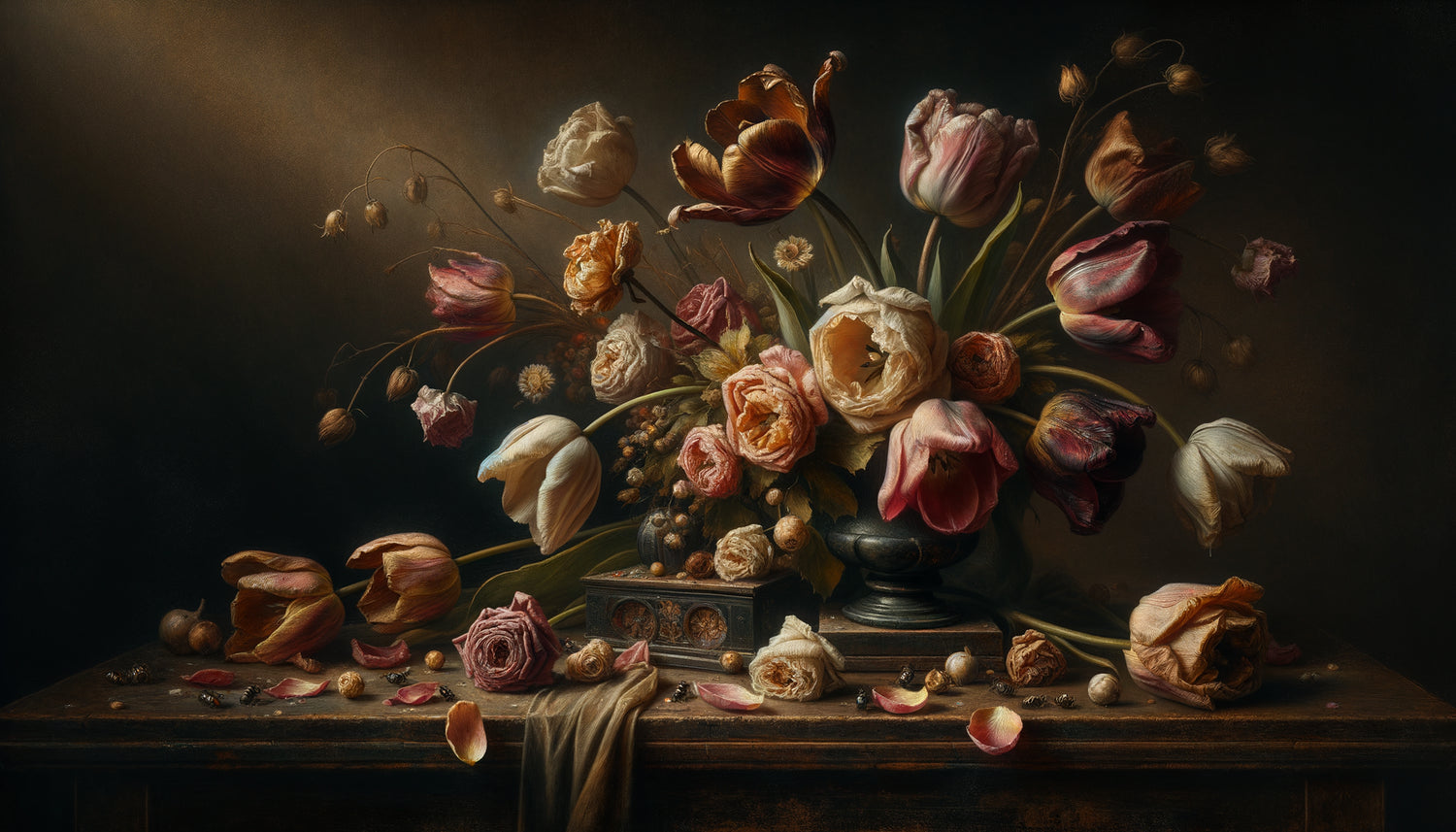
Flowers in vanitas are never depicted at their perfect peak. There is always an indication of decline: a tulip whose petals begin to open excessively, announcing their imminent fall, a rose whose edges turn brown. This calculated imperfection is the heart of the vanitas message.
I restored a painting where a dewdrop on a petal revealed, upon analysis, a micro-crack in the pictorial matter. The painter had used this technical fragility to reinforce his point: even his own painting participated in the cycle of degradation it represented. Brilliant.
When each species tells a different death
The symbolism of flowers in vanitas is never arbitrary. Each species evokes a network of meanings that contemporaries decoded instantly. The tulip, the most prized and expensive flower of the Dutch Republic, embodies the vanity of wealth and the speculative madness of tulip mania.
Roses, in their deep red, simultaneously evoke earthly love and the blood of Christ. Their rapid cycle of flowering and wilting makes them the perfect symbol of the brevity of life. I analyzed compositions where roses scatter at the foot of the vase, their petals forming almost a funeral carpet.
Peonies, with their excessive opulence, speak of pride and temporary wealth. Anemones, whose name comes from the Greek 'anemos' (wind), symbolize fragility in the face of external forces. Even wildflowers, modest daisies or poppies, have their place: they remind us that death touches both the poor and the rich.
The dark companions of the bouquet
Vanitas flowers are never alone. They coexist with skulls, hourglasses, burnt candles, open books. This staging transforms the bouquet into a theater scene where the drama of human existence is played out. The skull dialogues with the rose: both were beautiful, both decompose.
I restored an extraordinary work where a butterfly was perched on a skull placed near faded tulips. Triple symbolism: the metamorphosis of the butterfly (resurrection), its brief life (a few days), and its presence on the skull (the soul taking flight). Vanitas painters were masters of complex visual language.

Technique at the service of memento mori
What fascinates me in my restoration work is the technical virtuosity deployed to represent decay. Masters of the vanitas genre used successive glazes to create this translucency of faded petals, this almost palpable texture of organic matter decomposing.
The contrast is striking: a pictorial execution of absolute perfection to represent imperfection, dissolution, death. This formal contradiction reinforces the philosophical message. Art itself, in its relative durability, opposes its ephemeral subject.
I analyzed floral still lifes where insects perch on the petals: flies, moths, caterpillars. These creatures are painted with astonishing entomological precision. They add an extra dimension: they feed on decomposition, participate in the cycle of transformation of matter.
Light also plays a crucial role. Flemish vanitas paintings are often bathed in dramatic chiaroscuro where flowers emerge from dark backgrounds. This theatrical lighting draws the eye to beauty before the brain decodes the message of mortality. One is seduced before being warned.
The hidden philosophical message within the petals
Behind the aesthetics of floral vanitas paintings lies a doctrine: memento mori (remember that you will die). In 17th-century Protestant Europe, these paintings served as a moral reminder against excess, vanity, and attachment to earthly possessions.
But the philosophical dimension goes further. These compositions question the very nature of artistic representation. What is it to paint already dead flowers? The painting itself becomes a vanitas: it claims to freeze time when everything changes, it captures beauty as it already fades away.
I particularly like vanitas paintings that include mirrors. The reflection in the mirror doubles the illusion, adding a layer of questioning about appearance and reality. Symbolic flowers are reflected, multiplied, and their message spreads: you are looking at an image of an image of death.
An invitation to live fully
Paradoxically, these death-obsessed paintings are celebrations of life. By reminding us of our mortality, vanitas still lifes invite us to savor the present moment, not to waste our time on trivialities. The message is not despairing, it is liberating.
This positive dimension explains why these works adorned the lavish interiors of Dutch merchants. It was not decorative masochism, but a philosophy of life: enjoying prosperity without being attached to it, appreciating beauty knowing that it passes.

How these paintings transform our interiors today
In my practice, I notice a renewed interest in floral vanitas in contemporary decoration. Far from being morbid, these images bring depth, a contemplative dimension that contrasts with the surrounding superficiality.
A vanitas-style still life painting in a modern living room creates a meditative focal point. It slows down the gaze, invites reflection. Faced with the constant acceleration of our lives, these works offer a welcome counterpoint. They reconnect us to essential questions.
The dark and dramatic aesthetic of vanities particularly suits minimalist or industrial interiors. The deep tones, strong contrasts, rigorous composition dialogue with contemporary simplicity. It's a way to introduce historical and philosophical depth without breaking the visual harmony.
I have accompanied collectors who pair antique vanities with contemporary works exploring the same themes. This conversation between eras considerably enriches the aesthetic experience. The dying flowers of 1650 strangely resonate with our current ecological concerns about the fragility of life.
Transform your interior into a space for contemplation
Discover our exclusive collection of nature paintings that bring depth and sophistication to your walls, floral compositions that tell timeless stories.
Decoding a Floral Vanitas in Three Perspectives
When you find yourself facing a vanitas still life, three levels of reading are available to you. The first glance captures the formal beauty: the composition, the colors, the technical virtuosity. It's immediate aesthetic pleasure.
The second look identifies the symbols: which flowers, which objects, what staging? This is iconographic reading, decoding the visual language. You begin to understand the moral and philosophical message.
The third look, the deepest, is personal. What does this confrontation with mortality through beauty provoke in you? How do these four-century-old questions resonate with your own existence? It's here that the vanitas becomes alive, current, necessary.
Imagine your daily life enriched by this depth. Each passage in front of the painting becomes a micro-meditation, a subtle reminder of what really matters. The dying flowers do not depress, they awaken. They remind you not to postpone your projects, to say what must be said, to love intensely.
Start simply: choose a quality reproduction or, better yet, an original work by a contemporary artist working in this vein. Place it in a space where you naturally stop: facing the sofa, in the entrance, near your desk. Let it work on you, slowly, deeply.
Frequently Asked Questions About Floral Vanities
Why did painters of vanitas specifically choose flowers to talk about death?
Flowers offer the perfect metaphor for the human condition: their radiant beauty is inseparable from their brevity. Unlike manufactured objects that degrade slowly, flowers go from splendor to wilting in a few days, making the process of mortality visible. Moreover, cut flowers are already technically dead, separated from their source of life, but maintain an appearance of vitality. This ambiguity between life and death fascinated painters of the 17th century. Finally, the richness of symbolic meaning attached to each floral species made it possible to construct complex and nuanced messages, turning vanitas still lifes into veritable visual philosophical treatises accessible to a literate public.
Is a floral vanitas appropriate for decorating a bedroom or living space?
Absolutely, and I highly recommend it. Contrary to popular belief, vanitas paintings do not create a morbid atmosphere but rather a contemplative and soothing one. Their message about finitude encourages savoring the present moment and focusing on what is essential, which is particularly beneficial in our intimate spaces. In a bedroom, a floral vanitas invites meditation before sleep, a privileged time for personal reflection. In a living room, it brings an intellectual depth that nourishes conversations. The important thing is to choose a work whose aesthetics touch you personally. The dark tones and chiaroscuro of vanitas actually create a sophisticated and timeless atmosphere that transcends decorative trends.
Can one create a living floral composition inspired by vanitas?
It's a wonderful approach that I am seeing more and more enthusiasts adopt. Creating a contemporary vanitas bouquet consists of accepting and even celebrating all stages of a flower’s life. Unlike traditional arrangements where faded elements are immediately removed, a vanitas-inspired composition deliberately integrates flowers at different stages: closed buds, blooming flowers, and petals beginning to fall. Add dried elements, bare branches, decaying fruits. The idea is to show the complete cycle, to create this aesthetic tension between beauty and decline. Photograph your composition over several days to document its transformation. This practice develops a new perspective on beauty, less linked to perfection than to authenticity and temporality. It’s an active meditation on the passage of time.