1912. Moscow. In the smoky workshop of a building on Myasnitskaya Street, a few revolutionary artists brandish brushes like weapons. They don't paint nature - they shatter it, dismantle it, reinvent it. Russian Cubo-Futurism is born, and with it, a radically new way to capture the essence of life. Here’s what this fleeting movement brings to your perception of the world: the explosive beauty of fragmentation, the raw energy of modernity applied to nature, and a poetic vision that transforms every leaf, every branch into an aesthetic manifesto. Perhaps you have long been looking for a style that breaks away from tradition, an approach that reconciles nature and avant-garde without falling into safe decorativeness. You are right to want to go beyond the conventional bucolic landscapes. This little-known period of three intense years has redefined our relationship with vegetation, minerals, and organic matter. Let's discover together how these daring artists broke the codes to create an aesthetic that still resonates in our contemporary interiors.
When Moscow reinvents nature: birth of an explosive movement
Russian Cubo-Futurism emerges in an electric context. Between 1912 and 1915, Moscow is bubbling with activity. Russian artists have discovered the Parisian cubism of Picasso and Braque, the Italian futurism of Marinetti. But they refuse to simply imitate. Kazimir Malevitch, Natalia Gontcharova, Mikhaïl Larionov, Olga Rozanova - these names resonate like a revolution. They fuse the geometric deconstruction of Cubism with the kinetic energy of Futurism, while injecting it with a deeply Slavic soul.
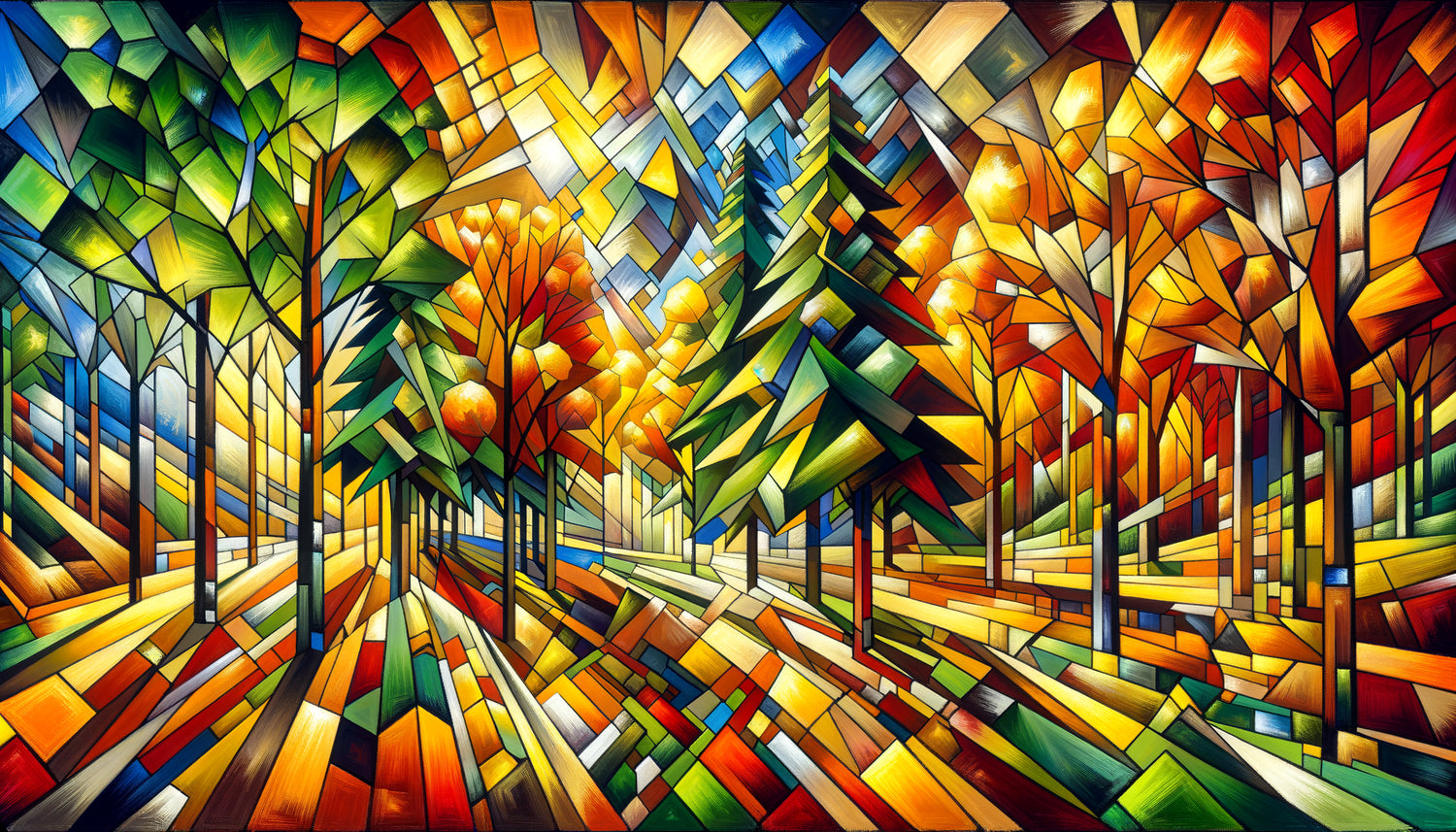
Their manifesto? Nature is not a passive spectacle to contemplate. It is movement, collision, pure energy. A tree is no longer a trunk topped with leaves - it's an explosion of planes, facets, simultaneous temporalities. Observe the works from this period: you will see forests shattered into geometric crystals, flowers multiplied into vibrant kaleidoscopes, landscapes where past, present and future coexist in the same frame. This fragmented nature reflects their conviction: the modern world demands a new visual language.
The technique of fragmentation: decompose to better reveal
How to represent the essence of a forest rather than its simple appearance? Russian Cubo-Futurists develop a radical method. They fragment natural forms into multiple facets, as if each element were observed simultaneously from all angles. A pine tree becomes an assemblage of cones, cylinders and interlocking triangles. A meadow transforms into a mosaic of colored planes that interpenetrate.
This approach isn't free. It captures something that realistic painting cannot: the feeling of nature, its internal dynamism, its vibration. Take Malevich’s
The explosive colors of nature reinvented
Forget soft greens and peaceful blues. Cubism-Futurism imposes a bold palette: acidic yellows, violent reds, deep blacks, dazzling whites. Natalia Gontcharova, in her extraordinary floral and peasant compositions from 1912-1914, juxtaposes tones that vibrate against each other. Her fields of wheat are not golden—they explode in layers of oranges, ochres, and carmines.
This chromatic violence isn't anarchic. It translates the intensity of sensory experience when facing nature. Russian Cubo-Futurists paint what is felt before a sunset, not what is seen. This emotional and visceral approach distinguishes their fragmented nature from the cold analytical cubism of the French.

Between religious icons and avant-garde: the Russian soul of fragmentation
Why does Russian Cubism-Futurism possess this unique power? The answer lies in the Slavic cultural heritage. These artists grow up surrounded by Byzantine icons with inverted perspectives, dazzling gold backgrounds, and symbolic compositions rather than realistic ones. This tradition deeply permeates their approach to nature.
Look at the works of this period through that prism: you will detect a quasi-spiritual dimension. Fragmentation is not destruction—it's revelation of a hidden essence. Just as icons reveal the divine behind human appearance, Cubo-Futurist landscapes reveal the cosmic energy behind vegetal form. Olga Rozanova pushes this logic to the extreme in her compositions from 1913-1914, where stylized natural elements float in ambiguous spaces, between earth and sky, matter and spirit.
The little-known contribution of female artists
The history of Cubo-Futurism would be incomplete without highlighting the major role of women. In pre-revolutionary Russia, Natalia Gontcharova and Olga Rozanova are not bystanders - they are pillars of the movement. Gontcharova develops a particularly rich vision of fragmented nature, nourished by her peasant origins and her interest in Russian folk art.
Her series on the seasons, harvests, gardens, create a unique bridge between radical modernity and ancestral traditions. This synthesis gives Russian Cubo-Futurism an emotional depth absent from contemporary Western movements.
1915: The peak and metamorphosis
In just three years, Russian Cubo-Futurism reaches the heights of invention before transforming. 1915 marks a turning point. Malevich presents his Black Square, shifting towards pure abstract Suprematism. The political context darkens - the First World War and then the Revolution shake everything up.
But observe carefully the works of this late period: the fragmented nature reaches a masterful synthesis. Forms simplify without losing their dynamism. Colors become more contrasting, more architectural. It is in these transitional canvases that the movement perhaps reveals its greatest relevance for our time. They embody a perfect balance between energy and structure, nature and geometry, emotion and intellect.
This brief period 1912-1915 produced a body of work of astonishing modernity. Their influence irrigates all subsequent Russian avant-garde - constructivism, Suprematism, rayonism. Moreover, they offer a way to perceive the natural world that resonates deeply with our contemporary sensibility, fragmented by screens, accelerated by technology, but thirsty for authentic connection to life.

Why this aesthetic speaks to our modern interiors
What can Russian Cubo-Futurism bring to your living space today? Everything. In a world saturated with wise and predictable decoration, this fragmented nature offers a fascinating alternative. It combines the sophistication of geometric abstraction with the organic vitality of vegetation.
Imagine a contemporary living room with clean lines. On the main wall, a composition inspired by this period: fragmented vegetal forms in colorful facets, a vibrant energy contained within a rigorous structure. The effect is immediate - dynamism without chaos, nature without sentimentality, accessible avant-garde. This aesthetic particularly suits minimalist Scandinavian interiors, industrial lofts, and open spaces seeking a strong focal point without falling into decoration.
Cubo-futuristic works also possess this rare quality: they evolve with the gaze. In the morning, you perceive the geometric structure. In the evening, under different lighting, it is the colors that explode. After weeks, new details emerge. This visual depth fully justifies the investment in a quality piece.
Transform your space with the energy of the avant-garde
Discover our exclusive collection of nature paintings that captures this unique vibration between modernity and organic, geometry and vitality.
Living with fragmentation: a daring aesthetic choice
Integrating the spirit of Russian Cubo-Futurism into your daily life is a choice. The choice of assumed complexity rather than bland simplicity. The choice of energy rather than conventional rest. This aesthetic of fragmented nature particularly suits creative personalities, curious minds who reject ready-made solutions.
Concretely, start with a masterpiece. A large format that catches the eye, structures the space, generates conversation. Around it, maintain a sobriety that allows the work to breathe. Scandinavian furniture, raw materials such as concrete or light wood, solid textiles create the perfect contrast. You thus obtain an interior where sophistication and accessibility coexist naturally.
Lighting plays a crucial role. Cubo-futuristic compositions, with their multiple facets and contrasting colors, radically transform according to the light. Favor adjustable lighting - directional spotlights for the evening, generous natural light during the day. You will discover that you actually own several works in one.
Close your eyes for a moment. Imagine your space transformed by this creative energy from Moscow 1912. These shattered natural forms that energize your wall. This bold palette that dialogues with your contemporary furniture. This visual depth that enriches your daily life. Russian Cubo-Futurism and its unique vision of fragmented nature is not just a chapter in art history - it's an invitation to perceive differently, to live more intensely the aesthetics that surround you. These three fleeting years 1912-1915 produced a visual language of enduring modernity. A century later, their proposition remains radical: what if true nature was revealed not in imitation, but in creative fragmentation? Let this question transform your gaze, then your space. Boldness always begins with an aesthetic choice that truly resembles us.
Frequently Asked Questions about Russian Cubo-Futurism
Is Russian Cubo-Futurism suitable for all interiors?
Absolutely, but with discernment. This aesthetic of fragmented nature integrates beautifully into contemporary, minimalist, industrial or Scandinavian interiors where it brings energy and depth. It works less well in very cluttered or classic decor where it would create a visual cacophony. The trick? Let the work breathe. A large cubo-futurist format on a white wall with clean furniture produces a spectacular impact. Think contrast rather than accumulation. If your space favors pure lines and neutral colors, a composition inspired by Malevich or Gontcharova becomes the ideal focal point that energizes the whole without weighing it down. It is precisely this tension between geometric structure and organic vitality that makes Cubo-Futurism so relevant to our modern interiors.
How can you differentiate Russian Cubo-Futurism from French cubism?
Excellent question that reveals the originality of the Russian movement. The cubism of Picasso and Braque (1907-1914) favors an analytical, almost scientific approach: deconstructing the object to understand its structure. Colors remain subdued - browns, grays, ochres. Russian Cubo-Futurism adds three crucial dimensions. First, the kinetic energy of Italian Futurism - movement, speed, dynamism. Then, an explosive palette - violent reds, acidic yellows, stark contrasts inherited from Byzantine icons. Finally, a spiritual and emotional dimension absent from French cubism. When Gontcharova fragments a peasant landscape, she is not seeking to analyze it but to capture its vital essence, its cosmic energy. The result? Works that are more emotionally accessible, more colorful, more vibrant - therefore more suitable for our contemporary living spaces.
Why was this period 1912-1915 so brief?
The Russian Cubo-Futurism shone intensely but briefly for historical and artistic reasons. Artistically, these insatiable creators were evolving rapidly. As early as 1915, Malevich switched to pure abstract Suprematism with his Black Square. Gontcharova and Larionov explored Rayonism. Rozanova moved towards chromatic abstraction. Cubo-Futurism was an explosive synthesis stage, not a final destination. Historically, the First World War (1914) and then the Russian Revolution (1917) upset everything. Artists become politically engaged, emigrate, or redirect their art towards social functions - posters, design, architecture. But don't be fooled: these three years produced a body of work of extraordinary richness and lasting influence on all 20th-century avant-garde. Their brevity itself gives these creations an intensity, a creative urgency that continues to captivate us a century later.