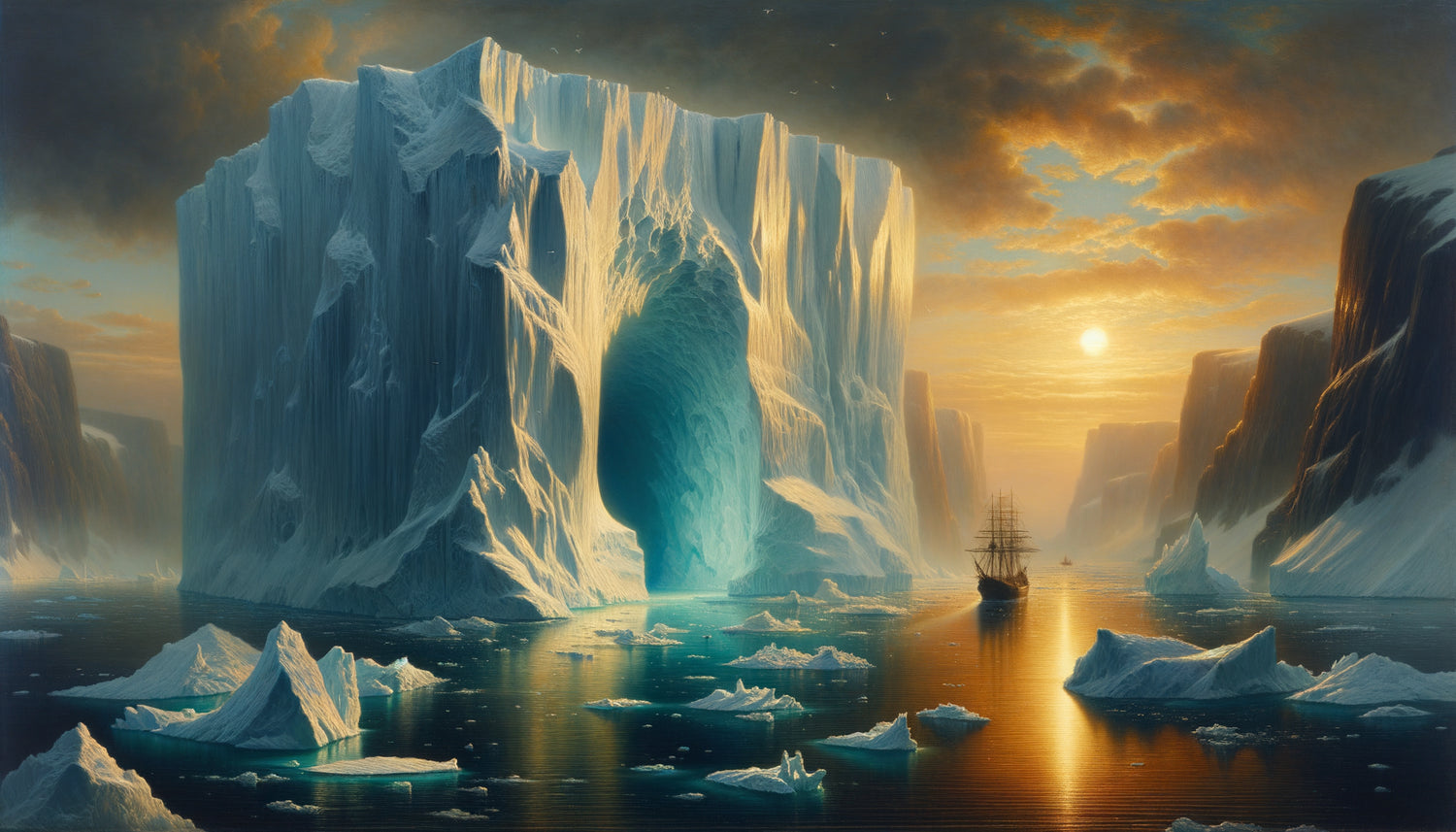
I saw my first iceberg in an art book, one November morning. Not in a National Geographic documentary, but in an auction house, on the catalog of a collection of 19th-century works. This mass of blue ice, frozen in oil by an expedition painter, exuded a power that no photograph had managed to convey to me. Icebergs are not simply artistic subjects: over the centuries, they have become a mirror of our fascination with the unknown, and then our climate anxiety.
Here's what iceberg representations bring to contemporary interiors: a poetic window onto vast, untouched spaces, a silent reminder of the fragility of our planet, and a minimalist aesthetic that transforms any space into a contemplative sanctuary.
Many hesitate to incorporate these glacial works into their decor. Too cold, they say. Too austere to create a warm cocoon. Yet, it is precisely this tension between raw beauty and ecological vulnerability that makes these representations so fascinating today.
Icebergs in painting possess the rare ability to tell several stories simultaneously: that of heroic exploration, that of natural contemplation, and now that of environmental urgency. Allow me to guide you through this artistic evolution spanning three centuries, from pictorial cartography to visual activism.
When explorers became painters of ice
At the turn of the 19th century, icebergs truly entered art history through the grand doors of polar expeditions. Frederic Edwin Church, a giant of the American Romantic movement, undertook in 1859 a voyage off Newfoundland and Labrador. His goal was not scientific but visual: to capture the majesty of these cathedrals of ice that few humans have contemplated.
The resulting painting, The Icebergs (1861), measures nearly three meters wide. Church deploys astonishing technical virtuosity to reproduce the nuances of blue, white and turquoise. Every crevasse, every reflection in the icy water testifies to a meticulous observation. These painted icebergs are not simply landscapes: they become geological portraits, witnesses of an intact nature, almost divine.
At this time, representing an iceberg means documenting the unknown, offering European and American living rooms a window onto territories that only sailors and adventurers dare to face. Exploration painting transforms these giants of ice into objects of collective fascination, symbols of a sublime and dangerous nature.
The iceberg as sublime: between terror and beauty
19th-century artists do not simply paint what they see. They translate a philosophical emotion: the sublime. Edmund Burke, then Kant, theorized this paradoxical feeling that mixes admiration and dread in the face of overwhelming natural forces. The iceberg perfectly embodies this duality.
In the canvases of William Bradford, another great painter of icebergs who accompanied several Arctic expeditions in the 1860s-1870s, we discover compositions where the smallness of the ships contrasts violently with the titanic scale of the glacial masses. These representations remind the viewer of their own fragility in the face of the elements.
The icebergs then become subjects of metaphysical meditation. Their immaculate whiteness evokes purity, but their ability to sink ships recalls the latent violence of nature. This ambiguity is what gives these works all their emotional power, which still adorn museum collections and some interiors seeking depth.
Technique at the service of immensity
To reproduce the unique texture of ice, painters develop specific techniques. Church superimposes up to fifteen layers of translucent glazes to obtain this characteristic inner luminosity of icebergs. Bradford, for his part, works with a palette knife to create reliefs that catch the light differently depending on the viewing angle. These technical innovations make iceberg paintings veritable pictorial feats, collector's items as well as historical testimonies.

From Romanticism to Documentary Photography
With the advent of photography at the beginning of the 20th century, the representation of icebergs became democratized and transformed. The Shackleton, Scott and Amundsen expeditions brought official photographers aboard. Frank Hurley, during the Endurance expedition (1914-1917), captured stunning images of icebergs that became icons of polar exploration.
Photography brings something that painting could not offer: documentary evidence. These icebergs really exist, in these precise shapes, at this precise moment. The photographic medium removes the romantic dimension to install a raw truth. Yet, far from killing artistic interest, this new objectivity reinforces the power of attraction of these giants of ice.
Contemporary photographers such as Camille Seaman continue this tradition, but with an acute ecological awareness. Her series of Arctic and Antarctic icebergs, taken between 2006 and 2012, are as many individual portraits. Each iceberg becomes a unique being, fleeting, whose very existence is threatened.
When the iceberg becomes a climate alert
The shift occurs gradually in the 1980s-1990s, when environmental awareness transforms our perspective on the poles. Icebergs are no longer simply natural wonders to contemplate: they become visual symbols of global warming. Their accelerated melting, their increasingly frequent calving speak of a broken balance.
Contemporary artists like Olafur Eliasson literally use ice as a militant material. In 2014, he transported blocks of iceberg from Greenland to Paris, arranging them in public spaces so passersby could touch, feel, and see this climatic reality melt. The iceberg leaves the confines of representation to become an installation, performance, manifesto.
Documentary photographers are multiplying long-term projects to bear witness to the progressive disappearance of polar ice. James Balog, with his Extreme Ice Survey project, installed dozens of cameras facing glaciers to capture their retreat. The resulting time-lapses, showing decades of accelerated melting, transform icebergs into visual clocks of the Anthropocene.
The aesthetics of the last look
This new awareness creates a paradoxical aesthetic: that of the last look. Photographing an iceberg today means potentially capturing a state that will never return. This temporal urgency gives contemporary images a melancholy that 19th-century works did not possess. The iceberg becomes a visual memory of a world in transformation, a testament to a past that is fading away.

Integrating the iceberg into our living spaces
This artistic and symbolic evolution makes representations of icebergs surprisingly versatile decorative elements. In a contemporary living room, a large photograph of an iceberg brings visual breathing space, a contemplative pause that contrasts with urban agitation. The color palette - these deep blues, these bright whites - particularly suits Scandinavian, minimalist or zen interiors.
But beyond pure aesthetics, hanging a work representing an iceberg is asserting an ecological sensitivity. It's inviting into your daily life a silent but powerful reminder of our collective responsibility. Collectors I meet often seek this double dimension: formal beauty and the underlying message.
Reproductions by Church or Bradford work beautifully in classic or neo-bourgeois spaces, bringing a touch of adventure and history. More graphic, direct contemporary photographs find their place in lofts, creative offices, spaces that embrace an engaged aesthetic.
Transform your interior into a sanctuary of contemplation
Discover our exclusive collection of nature paintings that captures the fragile majesty of our planet and creates spaces where beauty rhymes with awareness.
From fascination to action: the power of images
What fascinates me about this artistic trajectory spanning nearly two centuries is the ability of iceberg images to evolve with our collective consciousness. The same subject - a floating mass of ice - told in 1860 of the heroism of exploration, and in 2024 of the climate emergency. This symbolic plasticity makes the iceberg an artistic motif of exceptional richness.
Contemporary representations have not erased previous ones. They coexist, dialogue, respond to each other. A collector can simultaneously appreciate Church's technical virtuosity and Seaman's documentary commitment. Each era adds its layer of meaning, enriching the overall understanding of what it means to contemplate an iceberg.
Current artists such as Zaria Forman, who draws monumental icebergs in pastel based on her polar travels, perpetuate this tradition while inscribing it within ecological urgency. Her hyperrealistic, almost photographic works celebrate beauty while alerting to disappearance. This creative tension produces images of rare emotional intensity.
The iceberg in art is no longer just a distant landscape. It becomes a mirror of our contradictions: our fascination with the wilderness and our responsibility for its destruction. This ambivalence makes representations of icebergs deeply contemporary works, which question as much as they decorate.
Your own window to the Arctic
Imagine yourself every morning, your gaze caught for a few moments on this blue mass suspended on your wall. Not just a decorative image, but a presence that slows down time, reconnects you to the essentials. Icebergs in art possess this rare power: to transform a domestic space into an open door to infinity.
Start by identifying what you are looking for: the historical adventure of early explorations? The formal serenity of glacial minimalism? Or the ecological commitment of a documentary testimony? Each approach offers a different experience, but all share this ability to elevate everyday life, to introduce a contemplative dimension into our accelerated lives.
The iceberg crosses eras without losing its power. From exploratory painting to climate warnings, it remains what it has always been: a mystery accessible only by sight, a fragment of pure nature that defies our understanding. Hanging this enigma on your walls is choosing to live with this share of the unknown, this necessary breath. And perhaps, also, to remember every day that the most fragile beauty deserves our fiercest protection.
FAQ: Everything you need to know about iceberg representations in art
Why did icebergs become a popular artistic subject in the 19th century?
Icebergs captivated 19th-century artists for several converging reasons. First, the intensification of polar expeditions made these natural phenomena more accessible, even if only through accounts and works brought back by explorers. Second, the Romantic movement valued sublime nature - that emotion mixing terror and admiration for the titanic forces of nature. Icebergs perfectly embodied this aesthetic: immense, dangerous, unpredictable, but of unreal beauty. Finally, technically, painting ice represented a fascinating challenge for artists, pushing them to develop innovative glazing and lighting techniques. For the public of the time, these paintings offered a window into inaccessible territories, nourishing the collective imagination of adventure and discovery. Hanging today a reproduction of these historical works is to enroll in this long tradition of fascination for the edges of the world.
How to harmoniously integrate an iceberg representation into a warm interior?
The fear that images of icebergs will visually cool down a space is legitimate but easily avoidable. The key lies in the balance of materials and colors. Combine your glacial work with natural and warm textiles: a wool blanket on the sofa, linen cushions, a thick rug create a comfortable contrast with the visual coolness of the iceberg. In terms of lighting, prioritize warm light sources (2700-3000K) that warm up the overall atmosphere without altering the blues of the work. The frame also plays a crucial role: a light wood frame, such as oak or ash, creates a natural transition between the coldness of the image and the warmth of your interior. Finally, think about the overall chromatic balance: if your room already has blue or gray elements, the iceberg will integrate naturally. Otherwise, add a few decorative touches in these tones to create visual coherence. The result? A space that breathes, where glacial contemplation harmoniously dialogues with domestic comfort.
Do iceberg representations suit all decorating styles?
The versatility of iceberg representations often surprises. In a Scandinavian or minimalist interior, they obviously find their natural place, reinforcing the clean aesthetic and palette of whites and blues. But they work just as well in seemingly opposite contexts. A historical painting by Church or Bradford brings a touch of adventure and refinement to a classic or Haussmannian interior, dialoguing beautifully with moldings and antique furniture. In an industrial loft, a large-format contemporary photograph of an iceberg creates a poetic counterpoint to the rawness of the materials. Even in a bohemian or eclectic interior, a small iceberg representation can serve as a visual breathing point amidst patterns and colors. The secret lies in choosing the format, frame, and location. Rather than asking yourself if an iceberg suits your style, ask yourself what emotional function you want it to have: bring calm, create a focal point, open a contemplative window? Once this intention is clarified, integration becomes intuitive, whatever your decorative universe.